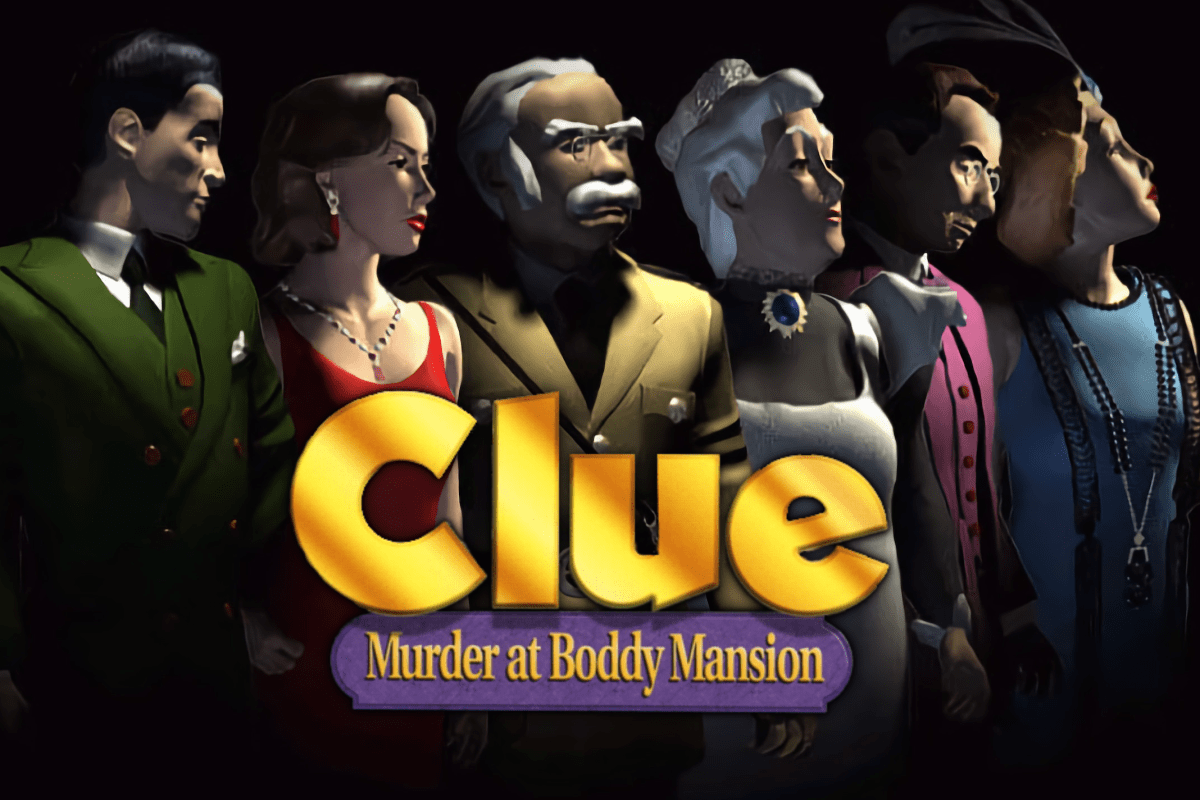
Quite a few games I like to cover on this website are games from my late childhood to early teenage years.
When covering games like Tomb Raider, Assassin’s Creed, or even several James Bond titles, I come to them with nostalgia and child-like fondness, and am sometimes rudely awakened upon replaying when games don’t match the power they once did.
But today, I wanted to go back to another childhood favourite, and possibly one of the first games I ever played, and one I still play to this day. Because this is not just any old game I remember.
I can tie this game to me falling in love with art deco, dark jazz, noir inspiration…and giving me nightmares of being murdered by a psychopathic cook or a disgruntled WW1 veteran.
Let’s dive in to the 1998 adaptation of Clue.
Means, Motive, Opportunity – My Weird Obsession with Clue
Now, just to cover all the bases, I’ll briefly explain Clue (or Cluedo for non-Americans, or me, not realising the difference when installing it as a child and growing up with Clue).
Clue revolves around the murder of a Dr. Black (or Mr. Boddy in the US) at his mansion. In attendance are six other people; Miss Scarlett, Colonel Mustard, Mrs. White, Reverend Green (or Mr. Green, as the Yanks don’t like thinking a member of the Church could murder someone), Mrs. Peacock, and finally Professor Plum.
Player take turns going around the rooms in the mansion and throwing out baseless accusations at anyone they like. Using cards that show who, what, or where were NOT the murderer/weapon/location, the player has to deduce the correct answers.
First made in 1949, Clue has been re-released again and again, with themed variations that, and I’m not making any of these up, include; Harry Potter (three times!), Bridgerton, Alien vs. Predator, RuPauls’s Drag Race, One Piece, and…FC Barcelona.
And like many classic board games it has also been translated to the digital realm, which gets us right back to 1998 and my edition of Clue. It wasn’t the first version, with the earliest apparently from 1984 for the Commodore 64, but it’s the one I grew up with.
And surprisingly, came out of a cereal box.
So, setting the scene of 1998, graphics have come a long way since the invention of 3D. Straining at the computer specs (a whopping 1.33 CPU, 16MB of RAM, and a 1MB graphics card required), we are treated to a stunning and moody opening.
Despite its…blocky features, it’s a great opening cutscene, automatically starting as soon the disc has booted up, not even getting to the main menu yet.
The dark hallway, the lightning outside framing our killer in shadow, the music…my lord the musical stings, it’s all perfectly setting up the mood and tone. This game is going to be dark.
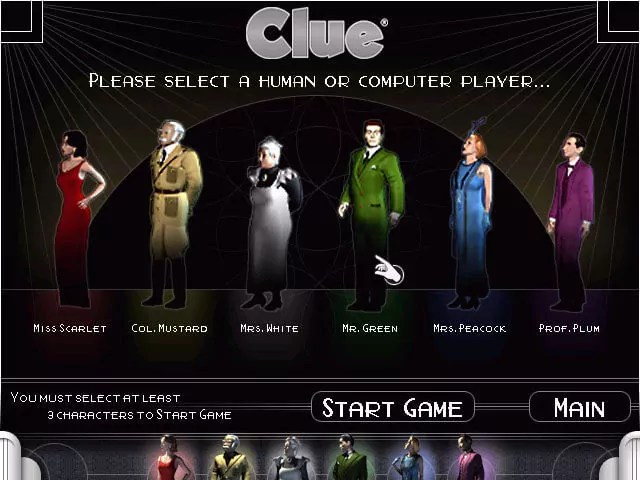
The main menu pops up, and the game treats it as the guests arriving to the mansion. We can see them standing at the door, waiting for their host, as each click is punctuated by lighting and rolling thunder.
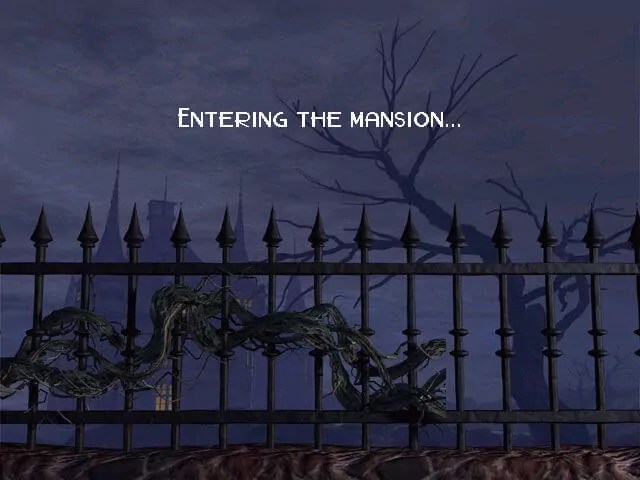
Even when everyone has been chosen and the game starts, the loading bar is visualised as vines growing across the mansion’s front gate. It’s these little details that make it so charming.
***
So from the six characters to choose from, there have to be three “players”, meaning at least two computer characters.
I’ve played against the computer at their different levels of difficulty (Novice, Normal, and Expert), who do actually play differently. Novice can be a cake-walk, whereas Expert play so quickly you’ll sometimes lose track of the accusation. Not to mention, as the rules dictate, characters warp to whatever room their are accused in, meaning the computer will tactically warp you backwards to try and beat you to the final accusation.
On the character select screen, the characters “react” when you scroll your mouse over them, and then when chosen, the screen gives you the full body model, with Art Deco fans and linework framing them. It’s all good stuff.
So once we’ve chosen our players and enter the mansion, another cutscene plays of Mr. Boddy’s ghost dealing the cards and hiding the cards of the killer, weapon, and location in a briefcase in the basement. Again, dark, but a little extra flavour of what we are about to experience.
Then, it’s time to play.
***
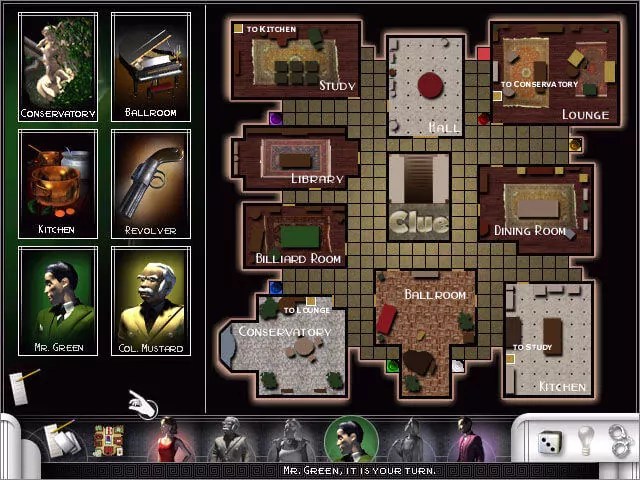
The mansion is fully rendered, with semi-transparent walls to aid movement between each room. These rooms are fully exportable too, so once inside say, the Billiard Room, you can click on the fireplace or the pool table and items will actually interact with the player.
Sometime you might be stuck at a certain angle and not be able to click on the next step forward, but for those that want it, there is a more classic overhead point of view, and can be switched at any point in gameplay.
Once you’ve made it to the first room, then the suggestions start, and here is where the other MAJOR point about this game starts up.
Whenever someone makes a suggestion, (say, Miss Scarlett, in the Dining Room, with the lead pipe), you will see Miss Scarlett with a lead pipe, murdering Mr Boddy, played out from the victim’s point-of-view.
The first time you see this, it’s shocking. The lighting strikes outside, the killer attacks, and Mr. Boddy’s vision cuts to black as the thunder and music sting hit. Every time someone makes an accusation, an animation will play of the suspect and the victim.
***
There are six weapons; Rope, Dagger, Lead Pipe, Candlestick, Wrench (or Spanner) and Revolver, and each one is unique, not just to the weapon, but to the character.
Miss Scarlett kills quickly, smouldering and smirking as she does so. Colonel Mustard hits with military efficiency, aiming the pistol over his arm or throwing the knife with precision.
Mrs White dusts off the candlestick before she attacks, looking on with disdain. Mr Green pulls Mr. Boddy closer as he twists the dagger, staring into his victim’s eyes.
Mrs Peacock is frightened and hesitant, her arms physically shaking when holding the revolver or the dagger, but she pulls through. And Professor Plum indirectly kills Mr. Boddy or has a dash of theatrics about him, such as accidentally firing the revolver or indicating Mr Boddy to wait, heading off screen, before jumping back with the Wrench.
And since we are at the dawn of 3D graphics, each one of these characters, who look fine from afar or in their character selection screen, turn into rubbery skin monsters, with wide staring eyes and misshapen foreheads. I’m sure I wasn’t the only one who got spooked out as a child.
And if you’re in the mood for some Windows 95-esque horror, here’s a supercut of them all stacked one after another down below. My favourites are probably Mr. Green with the dagger (at 1:54) and Mrs. Peacock with the Rope (at 2:51), but special mention should be made to Mrs. White, whose creativity and style points are the most terrifying murders of the whole game.
This game was rated as “E for Everyone” (but eventually edited to E 10+). Even still, those murder scenes have stayed with me for nearly thirty years.
Developer EAI Interactive continued on for a few more years until 2000, releasing other licensed titles like Scooby Doo, a few Disney games, graphics for National Geographic, and oddly enough, animations that were used for court cases to illustrate crime scenes and support witness testimony.
But their adaptation of Clue was hailed by critics upon its release, with solid 3/5s and 7/10s across the board. Computer Gaming World called it “stunning” and the feature-film worthy soundtrack being “sexy [and] mysterious.”
I already highlighted the music, but the full soundtrack is available on YouTube and I still listen to it regularly as a background music while working.
***
Clue has continued on with several other digital adaptations, with the most recent release in 2023, which interestingly uses the moment just before the murder as part of it’s “suggestion” phase.
But this Clue…might be lost to the digital wasteland. You can still buy the disc and jewel case, but it takes a lot of tinkering to get it working on modern hardware. And there are obviously other ways to obtain it.
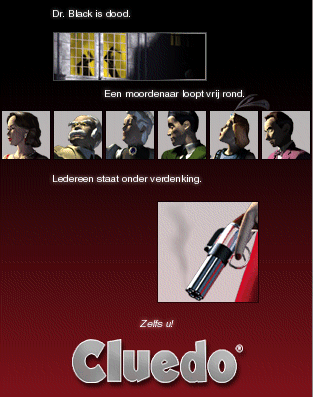
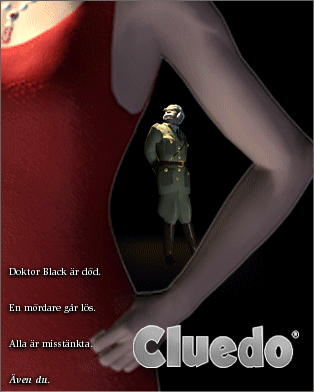
While I was waiting for my new copy to be delivered, I was watching Let’s Plays’ and seeing everyone else freak out over the murder scenes. It felt great to see this game of my childhood be played and experienced by new audiences. I then looked at all other media based on it, including the several posters for the different European markets.
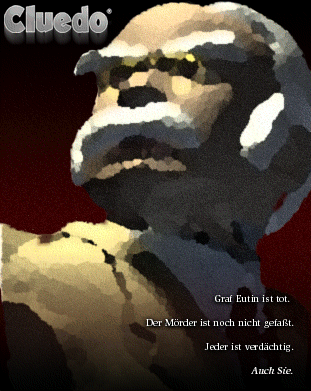
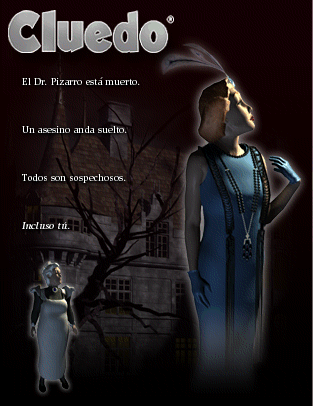
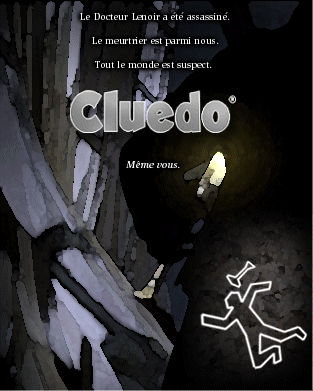
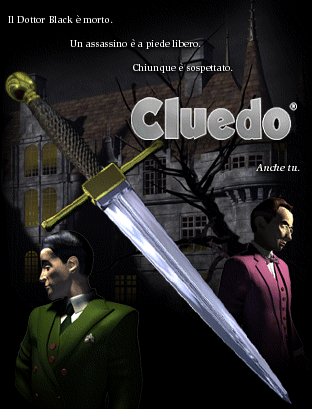
Look at these beauties. Each one uses pretty much the same copy text, but they all have different visuals. Some are focussed on the characters, others on the weapons, each has different poses and scenarios. Some look like film posters, others are closer to book covers, but all are excellent. They completely sell that 40s Noir vibe.
***
Even with all new versions and easier systems to work with, this is my Clue. I’ll always treasure this version, and will continue to play it to this day.
Banner Photo Source: gamesdb.launchbox-app