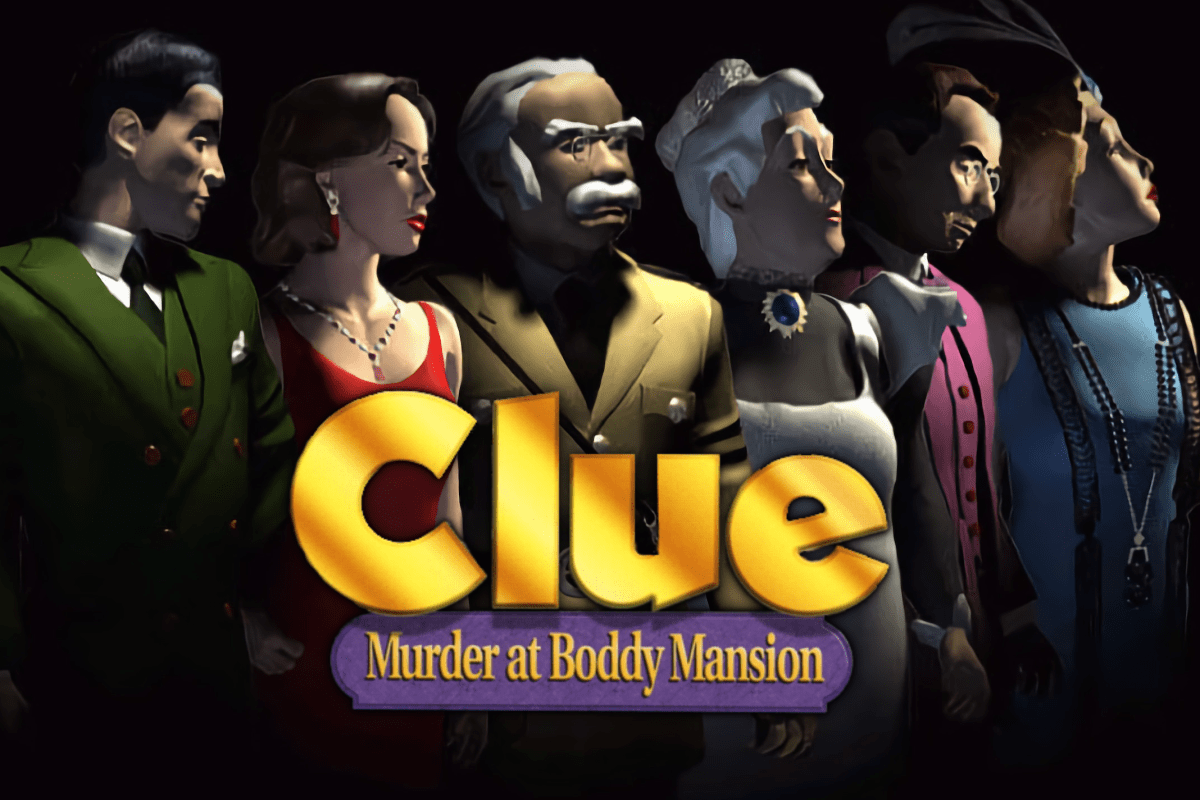
Clue – My First Video Game

Quite a few games I like to cover on this website are games from my late childhood to early teenage years.

When covering games like Tomb Raider, Assassin’s Creed, or even several James Bond titles, I come to them with nostalgia and child-like fondness, and am sometimes rudely awakened upon replaying when games don’t match the power they once did.

But today, I wanted to go back to another childhood favourite, and possibly one of the first games I ever played, and one I still play to this day. Because this is not just any old game I remember. 

I can tie this game to me falling in love with art deco, dark jazz, noir inspiration…and giving me nightmares of being murdered by a psychopathic cook or a disgruntled WW1 veteran.

Let’s dive in to the 1998 adaptation of Clue.

Means, Motive, Opportunity – My Weird Obsession with Clue

Now, just to cover all the bases, I’ll briefly explain Clue (or Cluedo for non-Americans, or me, not realising the difference when installing it as a child and growing up with Clue).

Clue revolves around the murder of a Dr. Black (or Mr. Boddy in the US) at his mansion. In attendance are six other people; Miss Scarlett, Colonel Mustard, Mrs. White, Reverend Green (or Mr. Green, as the Yanks don’t like thinking a member of the Church could murder someone), Mrs. Peacock, and finally Professor Plum.

Player take turns going around the rooms in the mansion and throwing out baseless accusations at anyone they like. Using cards that show who, what, or where were NOT the murderer/weapon/location, the player has to deduce the correct answers.

First made in 1949, Clue has been re-released again and again, with themed variations that, and I’m not making any of these up, include; Harry Potter (three times!), Bridgerton, Alien vs. Predator, RuPauls’s Drag Race, One Piece, and…FC Barcelona.

And like many classic board games it has also been translated to the digital realm, which gets us right back to 1998 and my edition of Clue. It wasn’t the first version, with the earliest apparently from 1984 for the Commodore 64, but it’s the one I grew up with.

And surprisingly, came out of a cereal box.

So, setting the scene of 1998, graphics have come a long way since the invention of 3D. Straining at the computer specs (a whopping 1.33 CPU, 16MB of RAM, and a 1MB graphics card required), we are treated to a stunning and moody opening.

Despite its…blocky features, it’s a great opening cutscene, automatically starting as soon the disc has booted up, not even getting to the main menu yet.

The dark hallway, the lightning outside framing out killer in shadow, the music…my lord the musical stings, it’s all perfectly setting up the mood and tone. This game is going to be dark.

The main menu pops up, and the game treats it as the guests arriving to the mansion. We can see them standing at the door, waiting for their host, as each click is punctuated by lighting and rolling thunder.

Even when everyone has been chosen and the game starts, the loading bar is visualised as vines growing across the mansion’s front gate. It’s these little details that make it so charming.
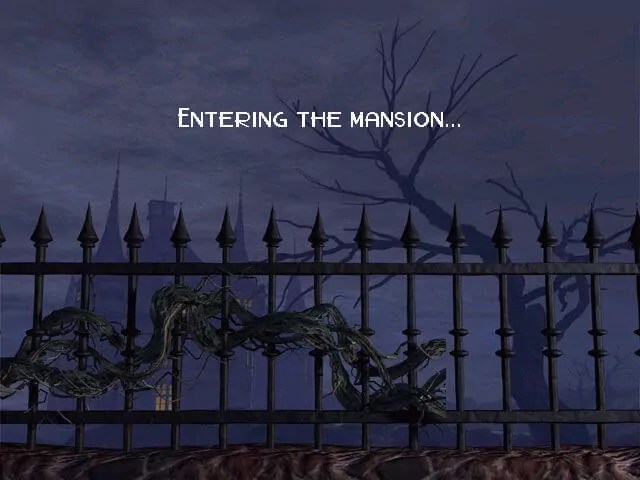
(Source: myabandonware.com)

***

So from the six characters to choose from, their have to be three “players”, meaning at least two computer characters.

I’ve played against the computer at their different levels of difficulty (Novice, Normal, and Expert), who do actually play differently. Novice can be a cake-walk, whereas Expert play so quickly you’ll sometimes lose track of the accusation. Not to mention, as the rules dictate, characters warp to whatever room their are accused in, meaning the computer will tactically warp you backwards to try and beat you to the final accusation.

On the character select screen, the characters “react” when you scroll your mouse over them, and then when chosen, the screen gives you the full body model, with Art Deco fans and linework framing them. It’s all good stuff.

So once we’ve chosen our players and enter the mansion, another cutscene plays of Mr. Boddy’s ghost dealing the cards and hiding the cards of the killer, weapon, and location in a briefcase in the basement. Again, dark, but a little extra flavour of what we are about to experience.

Then, it’s time to play.
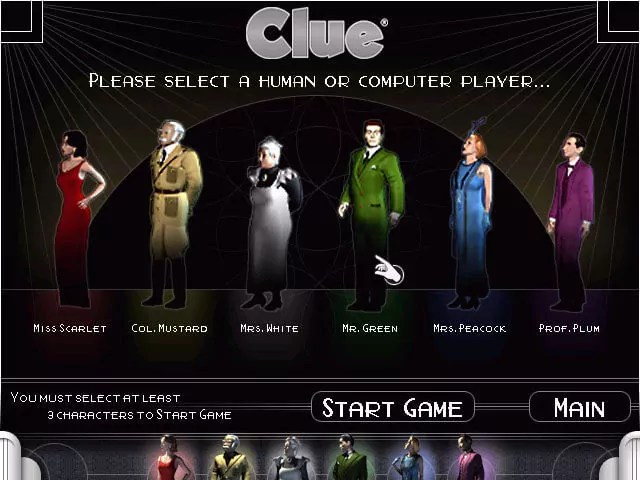
Choose your character… (Source: myabandonware.com)

***

The mansion is fully rendered, with semi-transparent walls to aid movement between each room. These rooms are fully exportable too, so once inside say, the Billiard Room, you can click on the fireplace or the pool table and items will actually interact with the player.

Sometime you might be stuck at a certain angle and not be able to click on the next step forward, but for those that want it, there is a more classic overhead point of view, and can be switched at any point in gameplay.

Once you’ve made it to the first room, then the suggestions start, and here is where the other MAJOR point about this game starts up.

Whenever someone makes a suggestion, (say, Miss Scarlett, in the Dining Room, with the lead pipe), you will see Miss Scarlett with a lead pipe, murdering Mr Boddy, played out from the victim’s point-of-view.

The first time you see this, it’s shocking. The lighting strikes outside, the killer attacks, and Mr. Boddy’s vision cuts to black as the thunder and music sting hit. Every time someone makes an accusation, an animation will play of the suspect and the victim.
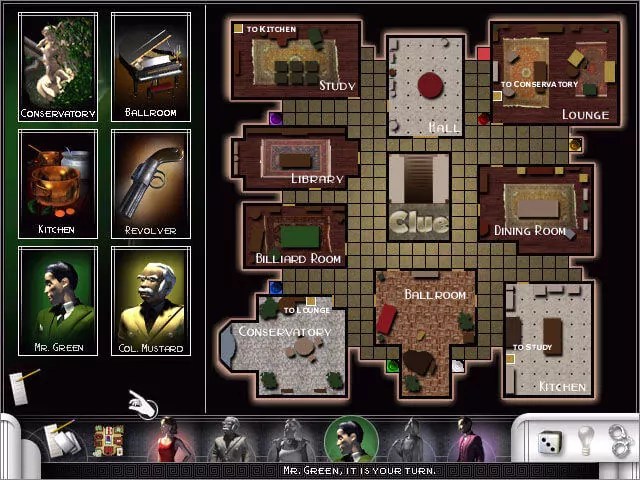
The suggestion cards are excellently designed, and heighten the game’s presentation. (Source: myabandonware.com)

***

There are six weapons; Rope, Dagger, Lead Pipe, Candlestick, Wrench (or Spanner) and Revolver, and each one is unique, not just to the weapon, but to the character.

Miss Scarlett kills quickly, smouldering and smirking as she does so. Colonel Mustard hits with military efficiency, aiming the pistol over his arm or throwing the knife with precision.

Mrs White dusts off the candlestick before she attacks, looking on with disdain. Mr Green pulls Mr. Boddy closer as he plunges and twists the dagger in, staring into his eyes.

Mrs Peacock is frightened and hesitant, her arms physically shaking when holding the revolver or the dagger, but she pulls through. And Professor Plum indirectly kills Mr. Boddy or has a dash of theatrics about him, such as accidentally firing the revolver or indicating Mr Boddy to wait, heading off screen, before jumping back with the Wrench.

And since we are at the dawn of 3D graphics, each one of these characters, who look fine from afar or in their character selection screen, turn into rubbery skin monsters, with wide staring eyes and misshapen foreheads. I’m sure I wasn’t the only one who got spooked out as a child.

And if you’re in the mood for some Windows 95-esque horror, here’s a supercut of them all stacked one after another down below. My favourites are probably Mr. Green with the dagger (at 1:54) and Mrs. Peacock with the Rope (at 2:51), but special mention should be made to Mrs. White, whose creativity and style points are the most terrifying murders of the whole game.

This game was rated as “E for Everyone” (but eventually edited to E 10+). Even still, those murder scenes have stayed with me for nearly thirty years.

Developer EAI Interactive continued on for a few more years until 2000, releasing other licensed titles like Scooby Doo, a few Disney games, graphics for National Geographic, and oddly enough, animations that were used for court cases to illustrate crime scenes and support witness testimony.

But their adaptation of Clue was hailed by critics upon its release, with solid 3/5s and 7/10s across the board. Computer Gaming World called it “stunning” and the feature-film worthy soundtrack being “sexy [and] mysterious.”

I already highlighted the music, but the full soundtrack is available on YouTube and I still listen to it regularly as a background music while working.

***

Clue has continued on with several other digital adaptations, with the most recent release in 2023, which interestingly uses the moment just before the murder as part of it’s “suggestion” phase.

But this Clue…might be lost to the digital wasteland. You can still buy the disc and jewel case, but it takes a lot of tinkering to get it working on modern hardware. And there are obviously other ways to obtain it.

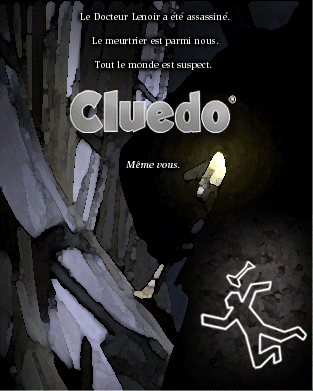
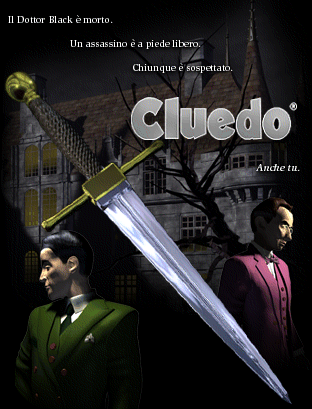
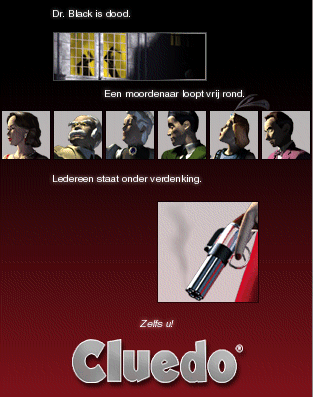
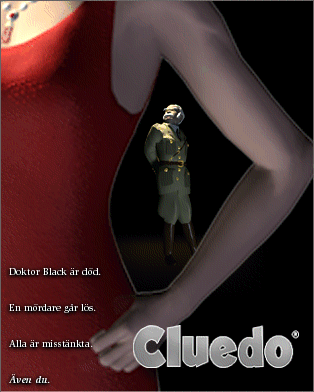
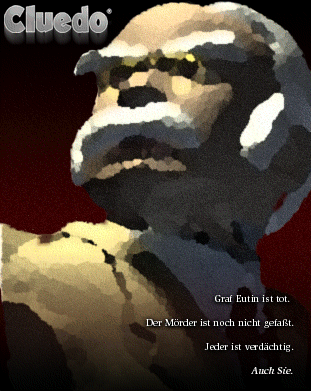
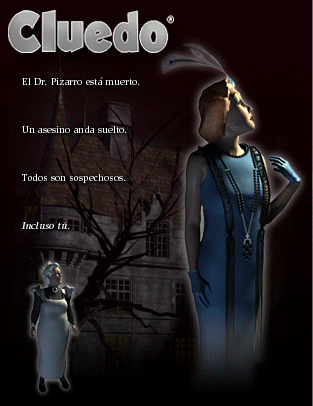
While I was waiting for my new copy to be delivered, I was watching Let’s Plays’ and seeing everyone else freak out over the murder scenes. It felt great to see this game of my childhood be played and experienced by new audiences. I then looked at all other media based on it, including the several posters for the different European markets.

Look at these beauties. Each one uses pretty much the same copy text, but they all have different visuals. Some are more focus on the characters, or the weapons, different poses and scenarios. Some look like film posters, others are closer to book covers, but all are excellent. They completely sell that 40s Noir vibe.
***

Even with all new versions and easier systems to work with, this is my Clue. I’ll always treasure this version, and will continue to play it to this day.


Banner Photo Source: gamesdb.launchbox-app

The Best Star Wars Game?

One of the first games I ever played was Star Wars Episode I: Racer. As a defender and fan of the Star Wars prequel trilogy, having a racing game based on the high-octane drag racing sequence was a formative gaming experience, and one of the main reasons I play games today.

While the original game was on the Nintendo 64, the game recently got an re-release for the PlayStation 4, Xbox One, and Nintendo Switch. The update was a simple polish and shine, updating the graphics and the frame rate so the game would run smoothly (sometimes the N64 would play like a powerpoint) and that was it.

It was kind of refreshing to see a game of a very particular time be brought to a modern console. The early 3D graphics where every shape needs a right angle, the stripped-down story, and sometimes odd animations, it has a retro charm that goes a long way to papering over its failings. Being a Star Wars game it would have been so easy for the Game Overlords that run the SW brand to force micro-transactions or some daft online ranking to the game, but it’s thankfully been kept as pure to its original form.

So, as a defining game of my childhood, I decided to pick it up and blasted through it over a lazy weekend. Despite the rather short lifespan of the game, I loved every moment, so I wanted to list a few reasons why it is one of my favourite games of all time.

Start your Engines! Why I Love Star Wars Episode I: Racer

1. The Universe

While we’ve only seen pod racing once in the entire cinematic Star Wars canon (in one of the best sequences of the entire saga) the game builds upon the work the film did with new tracks and worlds that are not even seen in the other movies.

I think a lot of SW films are kind of boring when it comes to their landscapes, mainly just reusing the same sand/snow/forest landscapes, but in Racer we have a whole host of planets and racetracks.

While the game has the sands of Tatooine and the snowy mountains of Ando Prime, it also has the methane lakes and geysers of Malastare, the smoky quarries of Mon Gazza, and the modern architecture and rocky cliffs of Aquilaris. Those are just the tame ones.

The game also features some standout tracks such as the abandoned gas stations of Ord Ibanna, suspended in low orbit, just like Cloud City from The Empire Strikes Back. Another is Oovo IV, which is a space prison situated on an asteroid belt, complete with cells and airlocks. My favourite tracks are on Baroonda, a planet of tropical jungles, swamps, and beaches, complete with Moai-inspired statues as well as the odd volcano.

While the locations are a high point, the are pushed even further by their individual quirks that helps bring them to life. Ando Prime is inhabited by monk-like aliens, with statues and flags reminiscent of temples in Nepal and Tibet. The race course on the asteroid Oovo IV has several sections without gravity and rogue asteroids. The spice mines of Mon Gazza feature everything from massive diggers to transports that litter the courses. The machines slowly move backwards and forwards so that they are not in the same place as each tracks progresses.

Each planet has its own look and feel, which leads onto…

2. The Tracks

While the game only has eight planets, it manages to keep each one rather fresh, even while refusing certain sections of a map. When attempting a new course it’s a fun mixture of certainty and fear, knowing how to tackle some corners and sections, while at the same time having to pick up on the fly how to navigate other sections of the map.

While the earlier tracks are definitely the easier and less interesting with wide open spaces and flat plains, there are always a few little extras to spice up runs, be they secret areas obscured by vines or waterfalls as well as branching paths that take you to completely different areas of the track than your competitors, or just really big jumps that let you glide effortlessly above the other racers.

Later tracks becoming increasingly difficult with sequential hairpin bends (with nothing to stop you flying of the side of the rocky cliff face that you’re racing on) or erupting volcanos that change the layout of the course.

Even in some of the earlier tracks there are hazards. Pod racers are good on solid terrain, but when going across the ice lakes of Ando Prime, the swamps of Baroonda, or the methane rivers of Malastare, pods can start to drift, sending them careening off course, usually to an explosive end.

The Boonta Classic, the track that is featured in The Phantom Menace and the last track of the game, also features sharpshooting Tusken Raiders and moisture pockets, both are severe dangers to weave through. These little features are great, as it throws a curveball into racing so even if you’re ahead of the pack, one wrong move could have them catching up to you.

3. The Podracers

Podracing to me is so cool. Taking the high speed of Formula 1/drag racing, place them on dangerous terrain, and just boost everything to as much as it could be. The idea of a small pod that by the sheer speed and force of the massive engines makes it float is such a novel and interesting concept, and Racer replicates that dangerous sense of speed perfectly.

While we only saw a fraction of the racers in the film, the game goes all out, adding all the racers that were included in the deleted scenes, each with different strengths and weaknesses. And while some racing games’ vehicles would be simple re-skins or little tweaks, here every pod racer is unique. You have the monster truck equivalents of Sebulba and Mars Guo, to the dainty butterflies like Anakin Skywalker and ‘Bullseye’ Navoir. My favourite is Neva Kee, who is unique in the fact that his pod has no cables (that purple energy bar that connects the engines), and is essentially just a tiny cockpit glued to two giant rockets.

As you complete each race you usually unlock a new pod racer which can be useful considering the different tracks layouts as you aren’t stuck with one machine. If you’re on a course that has a lot of tight corners, you can choose a racer that is more suited to turning. On a course with long straights, you can pick someone with a fast boost and high acceleration. Size and weight also plays a factor in choosing a podracer. Smaller pods are generally faster, but can’t take as much damage as the larger, slower, pods.

The pods do everything they do in the film, which is something unique in the racing genre. While they have the standard boost, the pods can also flip sideways to fit through narrow gaps and have air brakes that allow you to float over jumps and gaps. It’s thrilling on tracks like Ando Prime where you can boost off the top of a mountain peak and then just gently float across ice gorges and alien monasteries of that planet.

Each pod can be customised, either through buying from Watto’s Shop or by exploring for parts in the junkyard. While these custom options are more for building stats than changing the look of your pod, it’s still great fun to max out your speed and boost stats, leaving you on the edge between ‘in control’ and ‘totally lost it’.

The sounds design helps sell the illusion of the pods with every single engine having a beautiful hum and rev. Even the small things like shutting down an engine to repair it or put out a fire, to the whistling air as you fly across a gap, to the hiss of the air brakes, each one is solid, sounding exactly like what would you think these gigantic machines would sound like, and mixing perfectly with the ‘vroom’ of the pods around you.

And it doesn’t hurt to having the excellent John Williams score layered over the top. Nothing beats hearing the boost of a pod over the pulsing strings of ‘Duel Of The Fates’ our soaring through the air to the blaring trumpets of ‘Battle of Naboo’, and making you want to shout, “NOW THIS IS PODRACING!”

Conclusion

Despite being over twenty years old, I had a so much fun with Episode I: Racer. And while there was a sequel by the same studio for the PlayStation 2 called Racer Revenge, it was met with mixed reviews.

Episode I: Racer is still fondly remembered by many, featuring highly on several ‘Best Star Wars’ game lists, and was happily received with its re-release. It took a sequence that was only about fifteen minutes of the first film, and delivered all the promise that it offered.

I was partly raised on racers, with things like Gran Turismo, Forza, and Mario Kart being pretty much constants throughout my gaming life. And while each of those is fun in their own right…there is just something better about Racer.

I could be biased, but there is just something about the sense of speed, trying to control two full force engines, flying through impressive vistas and winding corridors that no other game has replicated.

The only other game that really worked in the same way is Split/Second: Velocity, a beautifully daft arcade racer, also published by Disney. Split/Second is filled to the brim with powerful looking and sounding cars, interesting and unique locations, and explosive gameplay. It too, like Racer, has been left behind by Disney, a one-and-done game that deserved a sequel.

Despite Disney breathing life back into the Star Wars property, the games have been few and far between, with only two controversial Battlefront games, one action adventure (Jedi: Fallen Order) and one flight sim (Squadrons) being released. With the new trilogy finished, now would be the time for games to fill the space between new films and television shows being created.

If we were to ever get more Star Wars games, I hope that one is based on pod racing. With today machines, Disney could push it further and farther than before. New tracks from planets across the saga, new racers, more customisable options, a strong story, and even the option to build your own pod racer from scratch.

There is so much that could be created and improved…and with a name like Star Wars, it’s all but guaranteed to make money.

Banner Photo Source: nintendo-insider.com