It was with a mix of trepidation and eagerness that I picked up Battlefield V. I had enjoyed the excellent War Stories in the previous game, Battlefield 1, and wished to see what creators DICE had followed up with. Yet I remained cautious. The previous War Stories had been a high point of my gaming experience of recent times and I didn’t want to raise my hopes too high in case they were dashed.
The sequence started beautifully, reusing the iconic shot from BF1 of the two opposing troops levelling their weapons at each other as the sun breaks through to the battlefield. That was one of the defining moments of BF1; it is abrupt from the carnage that we have been a part of and distinct in its imagery.
I had previously written about how even though I liked the War Stories of BF1 and the opening, it could have toyed with player expectations a little more with its use of death. BFV’s opening reuses this defeatist attitude and makes it work. We aren’t told that are characters are destined to die yet most of them do. But unlike BF1 we do not see their names upon death, an aspect that is sorely missing. While I am happy that DICE isn’t directly lifting from BF1 for the semi-sequel, the inclusion of character names added a sense of humanity that can usually get lost in the larger stories of a world war.
A shot from the opening of BF1. It is an excellent and artistically significant image that helped set DICE’s new tone for the series. Source: fraghero.com.
BFV also switches characters through its opening, circling around the locations that appear in the later War Stories. On the surface this is good. The major problem with the shorter stories in BF1 was the lack of narrative cohesion. With each story lasting around an hour, the overall arc falls flat with predictable peaks and troughs, leaving the game without a strong climax and resolution. The opening of BFV helps aid the previous lack of narrative structure by having the opening focus on the locations, but not always on the playable characters.
The paratroopers dropping into Norway, the German tank crew driving forward in the desert, the Senegalese troops providing covering sniper fire, and the German planes flying overhead, they give us a taster of what is to come and also help set up the story. For example, the paratroopers in Norway get slaughtered in the first few minutes of gameplay, with the playable character in the Norway section being the resistance member they were meant to rendezvous with.
The opening is also a beautiful example of editing within gaming. Each scene leads into one another and connected with excellent scene transitions. The tank in the Norway section rolls out into Libya, the plane flying overhead in the Kasserine Pass moves into dogfights over Germany, before said plane crashes into the Netherlands right in front of our new character. It is a nice flow of scenes and heightens that feeling of a world consumed by war.
However, while the changing characters help create that crux for the larger narrative, it means it loses something of its previous identity. BF1’s opening was set entirely on a singular battlefield. The fight was contained to one narrative with sweeping long shots taking us across the lines to the next solider after one had died. It told a solid story on its own and helped set that “anything goes” precedent of that game.
Swapping between five different fronts and fighting styles in the BFV opening feels disjointed and uneven and it is partly because of the change of scenery. The stakes change on a dime and the enemy we were previously charging is now half a valley away. It loses that excellent pace and momentum that the opening of BF1 had. This isn’t helped by the gameplay. In BF1 you could fight for as long as you wanted, but eventually you were going to be brought down by the enemy soldiers. In BFV the onus is on you to continue the story. This was especially evident in the Senegalese sniping and the German dogfight sections.
As I was getting to grips with the controls, my sniper aim lacked finesse, with shots widely missing the enemy targets. Only when all the targets are down will the prologue continue. In the German dogfight section I managed to shoot down several Allied bombers, but was unable to see the tiny red marker that indicated the ONE plane I was meant to shoot to continue the sequence.
With gameplay swapping every few minutes, BFV assaults us with a flurry of imagery. It is just sad that none of it feels connected. Source: VGR.com.
The whole pacing is off. Each section starts the same; the player slowly moves forward before being presented with a few enemies and then ends with explosions. At least BF1 kept the explosions as a constant, throwing the players into disarray and keeping them on edge. It feels like there is a distinct lull in BFV’s opening and feels antithesis to the tone that it seems to be aiming for.
This comes to a head at the final playable section. After shooting some soldiers on a turret, you turn said turret around and direct the fire back. Your squad is bombed and you are paralysed, trying to hold off the oncoming enemies with only your pistol. It feels so odd to go from the excellent Remarquism of BF1 to this Hollywood-ised, last-man-standing depiction of battle.
I understand why it was done. This is the final scene, the gameplay needs to end at the same time as the narration for the pacing, but it doesn’t have that brutal edge that worked wonders in BF1. This final scene could have worked if we had control of our movement, if we were allowed to charge, retreat, anything other that having to sit still, playing out a sequence ripped straight out of Call Of Duty 4.
It is also a context problem. BF1 worked because it wasn’t about the grand ideas, rather focusing on the little person caught in the whirlwind of history. It was a pointless war with both sides fighting for pretty much the same reason and therefore could focus on the personal stories.
While there are flourishes of these individual stories in BFV’s campaign, the grand ideas can’t help but push through. Every fight (bar the Tiger tank story) is about pushing back the forces of darkness from enveloping the world. Every fight is about how to weaken and dismantle the Nazi war machine. It can’t help but BE that.
That’s not to say that grander stories are bad. Grand ideas work well in several games; Civilization, various CoDs, the first Assassin’s Creed, but the smaller stories are what gave BF1 a bit of bite and it is sad that BFV is without it. It means the characters in BFV don’t get a chance to shine since we don’t focus on them.
Characters like Zara Ghufran and Frederick Bishop in BF1 get small moments in between all the fighting, giving us hints of their personality and time outside the war. This makes them richer, making them more than the “stoic badass” or “stealthy assassin” archetypes. And I haven’t got that from a single lead in BFV yet.
Either way, I’m still enjoying BFV. I’m blazing through the campaign and will hopefully look fondly on my time spent with it. And while the opening fixes a lot of the issues I had with BF1’s, it can’t help but produce a few of its own.
Edit: Now that I have finished the campaign my feelings on BFV have changed. I started to really like the story and have written a follow up. You can read it here.
I recently finished Mafia III after a good few months playing it. It was one of the first games I got when I upgraded to the newest console generation and I was pretty much playing it non-stop, leaving other newer games by the wayside just to come back to this one again and again.
And after finishing the game I’m certain this will be among my favourite games I will play on this system.
Not since Remember Me has a whole game caught with me rather than just one or two good parts of it. So I thought a little breakdown about the points that hooked me into staying in New Bordeaux for much longer than I would ever imagine…
“We are a cruel and wicked people”– Why I love Mafia III
The Story and Characters.
The story is the high point of the game. Telling the story of bi-racial orphan and Vietnam veteran Lincoln Clay, the narrative is told in a documentary flashback format. Characters tell their story in interview format, evoking recent films like Precinct Seven Five.
This feeds into the linear game structure, as we are being told a story (much like the previous Mafia games) which helps keep the pace up which can sometimes suffer in a game where you can go anywhere, anytime.
Despite having this linear structure the multiple endings all fit the character depending on the player’s reading of Lincoln.
I was surprised we didn’t start in Vietnam, similar to Mafia II starting in WW2 Italy, but that added to the characters, leaving us open to interpret Lincoln actions in Vietnam from his and comrade Donavan’s stories.
The story is beautifully realised with several standout characters. We have the three main bosses, Burke, Cassandra, and Vito, each with their own unique quirks. Vito is especially interesting, it’s fun to see a once playable character from the other side (again), where his simple layers in Mafia II (due to being a playable character) become a lot greyer with age and antagonism.
The second-in-commands too are well defined and have some interesting layers to them, making them more than cardboard cut outs that sometimes arrive with games as big as this. Emmanuel, the once refugee-saver reduced to dope peddling, Alma, the businesswoman not afraid to use female charms for her own gain, and Nicki, a woman struggling with her sexuality in a time and place that does not care for it, they all add something to the game, all through optional dialogue (which I am a big fan of ever since I first encountered it in PoP 2008).
But highest praise must go to Alex Hernandez for his portrayal of Lincoln Clay. Convincingly switching from cocky and confident to anger, sadness, light-hearted and eventually bloodthirsty when the time comes, he is truly an asset to the game.
(From L to R) Father James, Sal Marcano, “Cassandra”, Lincoln Clay, Vito Scaletta, Thomas Burke and John Donavan, some of the most layered characters I’ve played alongside. (Source: mafiagame.fandom.com)
The Missions
One of the main criticisms of Mafia IIIis its mission structure. Very much like the first Assassin’s Creed, the game centers itself around taking down members of the Marcano crime family one district at a time.
Once you talk to a contact in the district you have several tasks dealt out to you, but these always follow the same path; kill some people, interrogate a member of the crime family or destroy their shipments. Once done then you can take over the rackets in that area before going after the main controller of the area.
This is just going to be one of those cases where I find enjoyment that others don’t. I think it might be because I really enjoyed the driving and combat (more on the latter next) so I had fun being given new scenarios lasting a few minutes to make my way through.
Hangar 13 said their approach to the missions, at least side missions, was “Lincoln doesn’t go fishing”. Essentially, this means the mission must make sense for the character to do (why does psychopathic murderer Michael De Santa do yoga in GTAV ?). This feeds back into the story, again, keeping the pace and flow up rather than bogging the game down.
The Marcano capo missions are fun due to their added story and setting with each one being a completely unique situation; a shootout on a sinking steamboat, sneaking into a swanky whites-only party, breaking up a KKK-inspired cross burning, the list goes on and on (all involving excellent and period-fitting musical accompaniment such as the Rolling Stones, Del Shannon, and Janis Joplin).
With missions in mob-enforced saunas, partially built casinos, supremacist rallies, burlesque houses and drug dens, Mafia III can at least boast of having some memorable places for action sequences. (Source: geforce.com)
While most devolve into shootouts the combat is so fun I never got bored. Speaking of which…
The Combat
I can’t actually remember how long it’s been to have a combat system this satisfying, but it was probably at least back on the PS2 (I’m going to have a wild guess and say 007: Everything Or Nothing).
It’s your standard shooting, melee, and stealth tri-factor, but each one is done so well.
The gunplay feels responsive and sounds meaty, with a vast array of weapons to choose from.
At the start I was on-the-fly, picking up weapons due to limited ammo. Then I specialized in a sawn-off shotgun and sniper for both range advantages, before coming round to silenced pistol and assault weapons for an action/stealth combination. This is a perfect distillation of Hangar 13’s motto, “Every player’s story is unique”, and can be seen in the multiple approaches to combat as well as hidden pathways through the missions.
The animations in combat as well are a nice detail. With lovely smooth transitions from running (where Lincoln holds the gun one handed), to aiming, to the short sidestep after stopping, the little points make the game feel rich and loved by the creators.
While the melee can become stale after the fiftieth whistle-come-stab, it does have moments of intense fun especially with the running takedowns. Only in a handful of games have I audibly “oohhhed” at the brutality I’ve dished out on NPCs (Sleeping Dogs is probably the main one), and Mafia III’s American Football-style takedowns are poetry in motion.
You can choose between lethal and non-lethal attack as well. Even if the change is hidden in the pause menu rather than switching in gameplay it’s nice that you at least have the option. Especially since most games just give you “kill” as a catch-all for their combat.
The feeling of combat is one of the better from an open world game, and has several variables and the opportunity to customise. (Source: geforce.com)
The Open World and Travel
The world of New Bordeaux is a lovely city to drive around in. The cars seem more arcade-y than the previous Mafia games (there is an option of a Simulation mode for purists in the option menu). Lincoln’s signature vehicle is a classic, wheel spinning, fire spitting, drifting muscle car, and sliding across three lanes of traffic or 180 hand brake turns are easy to pull off and create that sense of spectacle and wonder we want from games.
As usual in Mafia games the setting is an approximation of a real city (this one being New Orleans), but has enough of its own style to stand out rather than feel like a copy/paste of Google Maps. The South has been the setting before in games, with indie hits like Virginia being in, well…Virginia, Telltale’s The Walking Dead Season 1 in Georgia, GTA: Vice City in Vice City (a version of Miami) and Left 4 Dead 2 in a swathe of southern states.
I would say only the latter two come close to creating a sense of place as good as New Bordeaux with Vice City also having Haitian and Cuban influences (but better at creating a sense of time rather than place) and L4D2 having a wide range of locales like Mafia III (but most feeling more like shells rather than a fleshed-out world). Mafia III is the first one that actually feels like a living place with countless indoor locations, pedestrians, and drivers.
Talking of the variety of locations, Mafia III has a selection to rival most other open world games. With settings such as the bayou, junkyards, quarries, downtown areas, and its own version to the French Quarter, the city has a tremendous scope of backgrounds for Lincoln to dish out punishment on the Italian mob.
And despite having these completely distinct sections the map, New Bordeaux doesn’t feel disjointed when moving from neighbourhood to neighbourhood, which has happened within other open world titles focusing on rising criminal empires.
With customisable cars and easy inputs to pull of a variety of stunt-worthy moves, the driving is a wholly enjoyable experience. (Source: microsoft.com)
Conclusion
The interesting part about my time with Mafia III is I was completely sick of open world games when I started. I was sick of the endless stream of side missions, the “revealing” of the world through climbing towers, the largely meandering story that can sometimes come with having a sandbox as big as it can be.
I had been wanting a more refined experience and Mafia III delivered. That’s what sets it apart from its contemporaries; GTA has the bustling modern metropolis filled to the brim, AC has the historical fiction, Fallout has the nuclear dys/utopia, and The Witcher/Skyrimhave the magical fantasy. The Mafia series works because it has a focused central story that fires straight as an arrow carving out its niche in the market.
And that niche made me adore Mafia III. Add in a cracking sense of time and history, as well as vivid locations and brutal, satisfying combat sections, Mafia III is a gem in my game library.
When players of the future will look back on games that could be part of the ludo-canon there will be a whole host of different styles and genres, from indie games to AAA releases.
Some games, such as Grand Theft Auto III, won’t be the best in their series, but will indicate the start of something bigger. Some, like Bioshock, show a more thoughtful, provocative, and literate attempt at the art form. And some, like Minecraft, are, well…revolutionary.
The list will go on and on as more games and platforms are released, but today I want to focus on one game. This game, much like GTAIII before it, was the start of not just a best-selling franchise, but managed to blend genres, brought a completely revolutionary idea of multiplayer to our screens, and kick-started a whole slew of imitators. Today, I’ll be talking about Assassin’s Creed, all the way back from 2007.
At the time of writing the series has been going for eleven years with nine games so far. Its most recent release, Origins, came out in late 2017, ten years after the first game. So, with over a decade of gaming to look back over let’s dive in.
This isn’t going to be a simple re-review of the game, but more a sort of breakdown and rethinking of the game. Enjoy!
Nothing is True, Everything is Permitted – A Look Back at Assassin’s Creed (2007)
Origins (no, not that Origins)
At the tale end of 2003, Ubisoft Montreal had just released Prince Of Persia: The Sands Of Time. Sands Of Time was the reboot of the series and would go on to spawn two sequels, Warrior Within in 2004, and Two Thrones in 2005. It was from this creative team that Assassin’s Creed would be born.
In a surprisingly detailed feature in Edge Magazine(Note: This is a second-hand account of the work, as all links to the original revert back to GamesRadar’s homepage), Creative Director Patrice Désilets talked about how the idea grew from the PoP series, where the player would be an assassin bodyguard protecting the child version of the Prince. Long after the game was released, this test footage of the game was leaked. (Source: Felipe Orion).
You can see the building blocks of the series; the crowd mechanics, the ominous white hoods, and hidden blades. There is a lot of stuff in that trailer that would take several games to be brought back into the series, with the main ones being co-op and bows and arrows being used.
You can easily see how PoP was the precursor. The free-running mechanics are obviously the key influence, but in a much larger way. The fun of a PoP game, even the more open ended-style like the 2008 reboot, the free running is in more of a linear sequence. The game world is an assault course; you see the path and you have to hit the buttons at the correct time to move through the land. It’s not experimental or improvisational; the path forward is set. Assassin’s Creed is more open with a world full of opportunities and pathways. In the feature Désilets remarks the freerunning was meant to be similar to the use of vehicles in GTA, “The pleasure of driving a car in Liberty City should be the same as a main character in Assassin’s Creed.” (para. 19).
The Arabian aesthetic would be another key factor. While PoP would feature expansive areas, the game is limited mostly to palaces and corridors to feature the prince’s wall-hopping acrobatics. Assassin’s Creed builds on that by opening up the world, not just into outdoor areas, but three different cities and a huge countryside to explore.
So with the building blocks of the game set let’s look into how Assassin’s Creed actually works.
“The World is a Stage” – The City and Lands of Assassin’s Creed
Assassin’s Creed is set in the Holy Land and the bulk of gameplay is divided between three cities in the region; Damascus, Jerusalem, and Acre. Despite all being in relative proximity to each other they all have different design and artwork.
Damascus is bright and tan, with minarets and spires stretching high into the sky. Jerusalem is has muted shades of brown, with mosques sitting beside churches and synagogues. And Acre, well, Acre is a warzone; cold, dark, and grey, with most houses reduced to smouldering ash and rubble.
This slideshow requires JavaScript.
The three cities are distinct and each tell a different facet of the Crusades. For example, the Teutonic Crusaders were the invaders of Acre, so while they want to be seen as the saviours of the city’s Christian inhabitants, the scars of war show them to also be invaders and destroyers. The cities are split between three districts; poor, middle and rich. While this helps design variety, it’s also meant to be a visual signifier for player interaction and gameplay (which we will talk about later in this retrospective).
The only part of the world that seems a bit pointless is the Kingdom. It boils down to a really big set of crossroads with a single path leading to each city and to the Assassin’s mountain top castle, Masyaf. There is nothing to do here, apart from collect flags (for no benefit besides 100% completion) and annoy roaming Saracens and Templars (although according to Désilets, this was an effort for an “improv” sense of gameplay, where each player’s story is different (para. 24-26)).
Masyaf is, again, different to any of the other cities. Having the game unceremoniously start there in a weird dream sequence and also end there with the fight against the shape-shifting Al Mualim has a nice cyclical nature to it. Again, like the Kingdom, there isn’t really a need to explore aside from flag collecting, so they majority of the gameplay will be spent in the targets hometowns.
I mentioned that visual significance of the districts allowing for greater player clarity in traversing the city, so let’s explore that idea. The problem of the city comes down to the inclusion of the mini map.
“In the Kingdom of the Blind, The Man with Eagle Vision is King” – Visual Signifiers and the Mini Map (and also the side missions)
One of the biggest faults many people find with Assassin’s Creed is its repetitive nature. Receive a target, go to the city, talk to the Assassin Bureau, do three tasks such as eavesdrop, pickpocket, or beat up a public speaker, return to the Bureau and then assassinate your target. Rinse and repeat nine times, game over. But that is a shallow experience of the game, and I would expect 98% of that comes from the mini-map.
Back in May 2017 on Twitter I got into a conversation with Stanislav Costiuc, a developer at Ubisoft, who wrote a fantastic essay on how Assassin’s Creed was designed for HUD-less gameplay and no mini-map. Costiuc explains that the levels and districts were designed in such a way to aid player exploration but also player interaction with the world.
Going back and playing Assassin’s Creed without the HUD makes playing the game a much different experience. You have to be in tune with your surroundings and recognise patterns. Costiuc shows this with a running commentary of how he played through one of the assassinations without the HUD.
Without the map telling him where to go, Costiuc had to find markers in the world that would help him find the Bureau and his targets. Each Bureau leader tells the player where to start their investigations; the north markets, the west gardens, the south gates, each one filling in the world. All these dialogues are meant to help the player rather than just fill for time. That’s why the different sections of the maps and specific locations are needed in AC1 because they were originally used for player education, without the mini-map as a crutch.
This is one thing I wish had been carried over to the rest of the games. With the more detailed world and the inclusion of a database helping identify actual buildings, this type of landmark guidance would have worked wonders. For example, after getting back one holiday from Florence I booted up AC2 and was able to find my hotel just by going to the buildings I recognised.
This makes me think the original game was meant to be much slower paced, almost similar to IO-Interactive’s Hitman, with the player finding pieces of information that could help or hinder them with their assassination attempt.
For those assassination attempts the player needs to get close to the target and then attack them with a weapon. So, let’s talk about traversal and combat.
“He’s Going to Hurt Himself” – Freerunning, Movement, and Killing Targets
I previously talked about the freerunning aspect in comparison with Prince Of Persia, but Assassin’s Creed has a more dynamic movement system than its ancestor. Each of the face buttons is a part of the body; A/X is legs, B/Circle is empty hand, X/Square is weapon hand, and Y/Triangle is for the head. All of these are then modified with the use of RT/R2 into high-profile moves. In the Edge feature Désilets mentioned how it was based on puppets (para. 21), and the system is simple enough that you don’t have to spend several hours getting to grips with the control layout.
Again, AC1 is slower than its sequels; there is no jump climb ability and you can’t sprint across beams, but the central mechanics are solid. Swimming is also absent (there is a debate over whether it’s historical accuracy since we are covered in armour, or a technical feat since swimming mechanics were still in their infancy, only appearing a few years prior in Rockstar’s GTA: San Andreas), but this is offset by only having a few water sections in the game. This does come to the fore during the assassination of Sibrand in Acre, where the stealthiest way to his ship is via jumping precariously around the harbour.
Still from Jerusalem of Altair in “flight”. Source: AC Wikia
Freerunning is especially well defined for such an early game. Apart from PoP I can’t think of many games before the first Assassin’s Creed that had a smooth freerunning mechanic. It also feels like there is small amount of auto-guiding in terms of chasing targets. Many times in AC sequels I would find myself chasing a target and instead of following them through an archway, Ezio or Connor would instead get stuck to the doorframe or run up a wall. I’ve never had that problem during my playthroughs with Altair.
The combat of AC1 is my favourite of the entire series. I’ve written previously about the feeling of the combat, how the sword has weight behind it, but there is so much more than that. It feels like a multi-tiered system with different moves for skill levels and play-styles. For those just wanting to kill enemies with brute strength there is the charge up sword. For those with patience there is the counter mechanic. And for those with good timing there is the combo kill and the break defence, which are rewarding for being the quickest kills.
None of the skill-based attacks have the same depth as in later games and merely reduced to a single button presses (AC2 was concered more on movement, but because the Hidden Blades were perfect counters and the sword/short blade took two or three counters and are slower in general, there is no reason to use them).
The revamped combat in the sequels was due to the supposed stalling enemies, crowding around you and staring you down for several seconds before attacking. But that is simply not true in AC1. Sure, if all you are using are counters then yes there is a lot of dead air when it comes to battles. But using the break defence and combo kills, or the Short Blade and Throwing Knives, and again, recognising the visual signifiers of scared/taunting soldiers (which leaves them open to a quick hidden blade or throwing knife kill) the combat is far from static.
You get these moves through the game so you are meant to up your strategy. The problem is that the counter is way too powerful leading to players defaulting to that, making the battles seems stilted. These was “rectified” in later games by having enemies that could stop counters (here is a video by Extra Credits talking about this problem, calling them FOO strategies), but made combat even more stilted by having to perform these actions several times to defeat one enemy.
The weapons feed into the aspect of upping strategy alongside the moveset. The sword is good for defence and strong attacks but is slow. The short blade/knives are faster, and the hidden blade (which we will get onto next) is a one-hit kill. They allow for a sense of personalisation when it comes to combat.
The Hidden Blade is the best weapon in the game. The blade only kills in low profile situations (or as a counter), otherwise the target can block your attack and force you into open combat. Knowing this feeds back into the world and those visual signifiers, trying to find a way to get close to your target without raising the alarm.
For example, the assassination of Majd Addin in Jerusalem has the target on a platform surrounded by guards. There is no way to break through the guards and get a clean kill with the hidden blade. You have to look at your surroundings; should you take the ladder to the side of you to climb up and around to the platform, or should you hide among the scholars to try and pass through the crowds? The limits of the blade make you work for the best kills, but then the sequels turned them into insta-kill spree-delivering devices.
The only problems with combat in Assassin’s Creed are in hindsight of the sequels. Things like Air Assassinations and Haystack Drags that debuted in AC2 are sorely missing. And while the throwing knives are a good ranged weapon, certain guards seem invincible to them which breaks immersion. AC1 also has the odd habit of making you a wanted man just for locking onto a guard.
Now that I’ve talked about most of the design and gameplay aspects that I wanted to mention, let’s move onto the story and narrative.
“Sit Down and I Will Tell you a Tale Like None You Have Ever Heard!” – The Dual Narrative
I remember when I first played Assassin’s Creed I thought, “This is so cool, I get to run around fighting medieval knights, run across rooftops like a high-wire trapeze artist, and there is even some conspiracies and intrigue. I love this!” Then the game would wrench me out the experience, taking me away from the badass Altair and replacing him with bland bartender Desmond Miles.
The “very special boy” Desmond Miles, who seems to be a descendant of EVERY single Assassin ever. Source: giantbomb.com.
I think the overarching, modern day narrative was the part that lost a lot of players. Because we don’t spend enough time with dear old Desmond we have no reason to care about him or his trials. Even when the games tried to jazz up his role such as learning the skills of the Assassin’s in Brotherhood, learning about his past in Revelations, or making him the most super special person in the world in III, Desmond still felt like an afterthought. Even next to Connor “What-Would-You-Have-Me-Do” Kenway (honestly the worst protagonist I’ve ever played as), Desmond was a poorly defined character. Another problem with the wider narrative is that it never got a satisfying ending. Every game would end with Desmond and his posse running from the Templars to another safe haven, meaning we would have to buy the next instalment to get a follow up.
I’m not sure how I feel about Desmond’s departure after III and Abstergo basically turning into Ubisoft and selling genetic memories as games, but it seems a rather silly hold over. The modern aspect is only in there for the game to have overt gamey-aspects not break narrative cohesion by saying “we’re in the Animus”. It should just be ditched; I think gamers would understand that their game has to have some anachronisms. The fact that both Subject 16 and Desmond both started hallucinating outside of Animus shows that humans can experience genetic memories without a wacky machine. Why not focus on that; a character that has learnt to go into a zen-like trance to relive their memories?
The reveals of the wider story, especially the surprise ending where the Apple Of Eden presents us with several Precursor Temple sites, would have worked a lot better without the pre-knowledge of technology and conspiracy. That reveal of a story much wider than the one being presented to you would have been a gut-punch of a reveal, possibly similar to the world of Columbia and “swimming in different oceans but landing on the same shores”. It still sets up the possibility of other Assassins around the globe and without Desmond’s genes limiting the range of Assassins for sequels to mostly European white guys.
One thing I do like about the Holy Land story of Assassin’s Creed is that it takes some risks. It brings ideas about religion, secularism, hypocrisy, and violence to the table, and explores them with each target during the confessions sequences. It’s interesting and I can’t think of another game bar the AC sequels that tries to shine a torch on some of the not-too-pleasant aspects of mankind. While the splash screen at the front of the game, with the now infamous “various different religions and cultures” was meant to be a failsafe against typecasting most of the Arab characters as cutthroat murderers, I think the Templars are portrayed much worse. They are already the invaders, destroying Acre pre-game, and just from my own play sessions, they are always seem more aggressive.
Legacy (no, not that Legacy)
The first Assassin’s Creed is seen as an important stepping-stone in the way open-world games are developed nowadays. While more people find AC2 to be the high point of the series (including me until this final play session, where I think AC1 just pips it), AC1 is remarkable in how if you updated the graphics it could still stand somewhat with its contemporaries.
Let’s count them off;
Open world, check.
Collectables that are pretty meaningless, check.
Map that opens up when you scale towers, even Ubisoft made a joke about how much of a trope it had become in their games.
This idea of AC1 as being more of a proof-of-concept is so ingrained that it has become shorthand for other similarly repetitive games. Mafia 3 was unfavourably compared to AC1 by it being a mostly empty map with the same few side missions.
Looking at Assassin’s Creed nowadays, you can see how it influenced the later games. Characters like Ezio, Edward, and the Frye twins were obviously created in response to Altair and his other sour brothers, Connor and Arno. The setting influenced later games locations, with Revelations obviously taking inspiration from AC1 with its Eastern location and design after having two games of classical European architecture in the form of AC2 and Brotherhood.
In my experience though I feel the later games fall prey to trying to compensate for the somewhat spartan presentation of AC1. This came to the forefront when I recently played AC: Unity. When I first brought the map up I said to myself, “What is this?!” The map was full of stuff, juststuff, that had very little bearing on the main narrative; chests, cockades, underground systems, side quests, murder mysteries, cryptic puzzles, hours upon hours of nebulous content. For the longest time I didn’t synchronise viewpoints and turned all the collectables off, because I knew the game was screwing with my completionist tendencies.
This is a picture from a forum post called “Is Assassin’s Creed Unity Just A Bit Too Much?” Seems that a lot of people have been thinking the same idea. Source: gamespot.com
Altair is also a major factor in AC2. Thinking back to 2009 before we knew that he would come back in Revelations, Altair does share brief moments with us again. First and most notably, Altair returns in the Codex pages. As we read his notes we see an older and more cynical Altair, testing out the Apple of Eden, creating new mechanics for the Assassins such as the Poison Blade, and writing about the upcoming Mongol threat. Then we see him in a flashback getting busy with Maria Thorpe, with the player staying with Maria and entering her womb once Altair has deposited his seed. While the descendant aspect of the series had been explained at this point in the series this was the first time it was “shown” to an extent.
And just talking numbers, Assassin’s Creed was a hit. In Ubisoft’s own words it, “greatly outstripped” their expectations. It became the fastest-selling new IP at the time, projected to sell five million copies for 2007-2008. This was enough to send what was originally a spinoff of Ubisoft’s popular wall-crawler into a multi-million dollar franchising spanning books, comics, and even films.
Conclusion
After going back to the first Assassin’s Creed my views on it have changed quite a bit. I played AC1 and AC2 back-to-back, with only a few hours between finishing AC1 and starting AC2. And now having played all the way up until AC: Unity, what I used to see as a nice blueprint feels much more like a refined experience.
The brilliant open-ended assassinations are obviously a high point especially as soon as AC2, the assassinations were distilled and streamlined (mainly for narrative sense). For reference even now in Unity I play the “levantine” approach to combat; sneak until within a few metres, high-profile assassination, then flee into the crowds. It’s a classic set of moves that AC1 instilled into me, highlighted with its “Chase Cam”.
The repetitive grinding of missions is the takeaway most people get from the gameplay with the assassinations only being a sliver of the content on offer. That obviously wasn’t the intention, with the side quests meaning to be information on how to approach your target, but the mini-map turns them into chores.
The combat suffers from the same aspect of having good intentions, but it not being found when first playing. The combat arena where you learn new moves doesn’t do a great job at telling you how to fight and so we revert to what we know; hold RT/R2, pressing X/Square when hit.
The open world, especially the Kingdom, feels like needless padding and is only really there for the first feeling of odyssey-like wonder at riding off into unknown lands. The cities though are a fantastic if not realistic portrayal, having rooftops close enough that endless running is a delight. This is where the freerunning in III didn’t work, with cities that might be historically accurate but aren’t fun to parkour around due to the wide gaps between buildings.
Looking at it eleven years later, it’s obvious that Assassin’s Creed grabbed people because it was fresh and exciting. We had seen open-worlds before and we had seen historical action combat before. But together they were a match made in heaven, a license to go to whatever historical setting Ubisoft wanted and print money to set up new IPs with.
That same sense of freshness is why I think we all got on board for the modern day aspect. While Desmond’s story did get little payoff in the grand scheme of things, that new blend for gaming was novel. While we had seen the same beats in media such as The Matrix or Ghost In The Shell, in gaming it hadn’t really been explored before apart from maybe David Cage’s debut, Omnikron: The Nomad Soul.
With the new game AC: Origins, the series seemed to be travelling back to its roots. With a revamped modern day aspect that is moving away from the memories-as-games plot thread as well as bringing back a more branching style to combat, Origins was seen as a return to form to what many thought to be a dying and withered franchise.
Many have been quick to dismiss the new Assassin’s Creeds as not true AC experiences. I understand their criticisms, but don’t necessarily agree with them. Assassin’s Creed 1 shows us that you can pretty much take a whole new spin on a well known trope and make it its own thing, and that’s pretty much the defining theme of the series;
I really like the Civilization series. I first came to the series with Civilization II on the original Playstation and sucked at it. Please understand I was probably around four or five years old at the time and pretty much completely blown away with what I had to do. I think I spent the majority of the game looking at the box cover which I still think is a elegant bit of art.
Through the years I would play different Civs, but only really got into the series with Civilization Revolution for the Xbox 360. While Civ Rev (as it is more commonly known as) is seen as a runt of the litter by fans due to its more simplistic design and streamlining due to being on consoles it still holds a dear place in my heart.
I mean, look at this cover art. It is lovely. Source: emu paradise.me.
It is one of those special games that managed to connect with non-gamers I know, with its mix of history, politics, and geography (all helpfully illustrated with the Civilopedia). I loved the game so much I even went out and got an old copy Sid Meier’s Pirates!, created by the main lead designer of the Civ series, Sid Meier.
Today I wanted to write about something I find fascinating about Civ Rev that I don’t see much of, that is adaptive music and sound effects.
Introduction – Music in the Games Industry
Music has become a large part of the culture behind video games. What started out as what Melanie Fritsch described as, “…a ‘bip’ disrupt[ing] the silence…” (pg. 12, 2013) has transformed into an integral part of the system.
This can be seen with the rise of famous composers being brought it to do video games soundtracks, with notable examples being Hans Zimmer (Call Of Duty: Modern Warfare 2, 2009), Joe Hisashi (Ni No Kuni: Wrath Of The White Witch, 2013), and Tyler Bates (Rise Of The Argonauts, 2008).
There are even stars that are well known for their work on games. One of the high-profile creators is Jesper Kyd. Kyd is known for his work on the Hitman series as well as creating one of the most famous pieces of the seventh generation, Ezio’s Family, for Assassin’s Creed II (which has become THE defining piece for the entire series).
The music is so high profile now that games are picking up awards (Christopher Tin for Civ IV won the Grammy for Best Instrumental Arrangement with Vocalist(s)) and there are live performances for the music, for example, I went to the Tomb Raider Suite back in December 2016. In a similar vein Video Games Live is a major-selling show that plays famous video game music to sold-out venues.
But anyway, let’s move to focusing on Civ Rev.
The Silence in Between – Music and Sound in Civilization Revolution
A game of Civilization Revolution takes place over 6000 years. It starts in 4000BC with the game finally stopping at 2100AD if the player or AI haven’t reached a win situation.
The game is split up into four distinct eras, Ancient, Medieval, Industrial, and Modern. These rely on how advanced your civilization gets, with more technologies you discover your civ keeps moving forward.
The techs reflect this, with Bronze/Iron Working and Alphabet in the Ancient Era, Engineering and Banking in the Medieval, Gunpowder and the Railroad in the Industrial, and Electronics and Space Flight in the Modern.
As the game moves through time the music adapts and changes. It’s something that is so small but so engrossing. It would have been easy to have a singular “fight” sound, a continual loop that plays with every encounter, but for Civ Rev it changes based on your era.
Michael Liebe notes this as, “…linear music…” as it;
“…runs incessantly without any direct influence on the player’s action… [but] may change with different levels or milestones in the game.” (pg.47, 2013).
However, it also is part of what Liebe calls;
“…reactive music…[a] type of game-music [that is] is triggered by specific micro-actions… [such as] beginning a fight…” (pg. 47, 2013) because the battle music changes according to the era.
In the Ancient era, the player’s aggressive interactions with other civs or barbarians will produce woodwind and drums, perfectly evoking primitive instruments (4:23, 6:11, 12:24).
Moving to the Medieval era, there is a light accompaniment of brass into the mix, sometimes having an almost ecclesiastical quality (32:45, 33:23, 38:10).
The Industrial era brings with it strings, and heavier, lower-registered brass, hinting at the more expansionist, mechanized warfare as well as a more romanticized view of warfare that came with the age (1:04:24, 1:09:55, 1:10:28, 1:12:52, 1:15:57).
When a player reaches the Modern era, the sound completely changes with hints of synthesizers, metallic percussion, and even some electric guitar thrown into the mix (35:23, 35:39, 42:46).
The sound effects also follow this mode of changing although these can also be based on the unit (be it the ship, warrior, caravan etc.). While each has a “movement” sound effect, with marching boots, revving engines, or oars in water depending on the unit, it was the idle sounds that drew my attention.
Just hovering your cursor over a galley or galleon produces creaking wood and flapping sails. Hover over a warrior and your hear swinging swords, or pawing hooves on a horseman unit.
This even translates to the world. As you move over the ocean, crashing waves greet you. If you have built a city near the sea you hear crowing seagulls and shoreline swash. Build a strong market place and you hear barters conversing in shouts, or if you select a high profile mining and factory town, the sounds of hammers on metal and machines can be heard.
It’s not a subtle change, but it is somehow smooth. As we move through the eras not just the music changes but the visuals too, with our “advisors” (who look strikingly similar to Condoleezza Rice, Martha Stewart and Albert Einstein) taking on different dresses and outfits depending on the era. Roads adapt too, moving from dirt tracks, to cobbled streets, and finish as tarmac highways.
I previously mentioned Sid Meier’s Pirates! as being another game I picked up due to loving Civ Rev. Despite the remake of Pirates! being thirteen years old at this point its music is very much the same; always playing, but then reactive as to the situation, the location, and your reputation.
As you pass by ports of the different nations they each have their own theme. Even passing by the ports of pirate havens, Jesuit missions, and natives have their own musical accompaniments. Upon entering into the towns, the music seamlessly switches into different tones for the merchant, governor, tavern, and shipwright. But it’s the way the music adapts that got me again.
One of the gameplay themes of Pirates! is making money for certain nationalities. You can do this in many ways; become a pirate and plunder gold, trade professionally with merchants, or even send in some pirates or natives to raid towns.
This creates wealth disparity between ports with some being filthy rich (with the nation’s flag above being crisp and clean) while others are desolate (with the same flag being dirty and torn). The music reflects this with rich towns having beautiful renditions of the nations tune while poorer towns have maybe a single instrument with some notes being off-key. For example, here is the standard British theme and here is the poorer version.
Conclusion
All the parts I’ve talked about are small parts of the games. Most of these are not even needed as far as a minimum viable product; they are there as nice additions to the final published work. But that makes me love them even more.
They are so small but they create a much better product by having it adapt to the changing landscape and react to the player’s decisions.
It’s almost comfortable; a change that doesn’t jar you out of the experience but lets you settle into it. And with even the shortest Civ games taking place over a good few hours it helps aid that sense of progression.
Edit: This comes to an apotheosis with Civ VI, with the themes for the countries adapting and adding instruments as time continues. Similar to Civ Rev the themes are traditional songs from each civilisation, but these variations are excellent additions and aid that sense of passing time. My favourites are the Americans, Indian, and Greek.
[Back to original text].
We’ve all played games where the same two or three sound effects are used for battle sequences or playing over menus and load screens. Some of these soundtracks are great and I love them just as much.
But that reactive quality that I previously mentioned gives Civ Rev an extra quality that I never thought about let alone be able to vocalize a need for it.
It’s such a small touch and elevates Civ Rev in my mind to a much higher place for having it in.
Bibliography
Fritsch, M. (2013). History Of Video Game Music. In Moormman, P. (Ed.) Music and Game: Perspectives on a Popular Alliance. (p.11-40). Springer Fachmedien: Wiesbaden, Germany.
Liebe, M. (2013). Interactivity and Music in Video Games. In Moormman, P. (Ed.) Music and Game: Perspectives on a Popular Alliance. (p. 41-62). Springer Fachmedien: Wiesbaden, Germany.
Once upon a time, there was a girl. She was a film studies graduate and looking for her big break in the world of post-education. She followed her friends to a mystical and mysterious island, documenting their travels.
When we as an audience first met the girl, it was only for a few seconds, where we saw her dragged off by a scary-looking man with a knife. She was hidden away until the release of the full story.
When the story was released, we saw the girl in a different light. Sure, she was still a little bit of a damsel in distress, but she turned out to be a lot more than that.
We saw her playful but sensitive banter with our protagonist. We saw the half-smiles. We saw the girl and the protagonist bond over the course of the narrative. And of course, some of us saw a little more, underneath all of the subtle movements and words. Something that kept us going. Something that pushed us forward.
But that girl is now forgotten, passed aside with a hand-wave explanation in the sequel, and only slightly more of a payoff in the side-stories.
At this moment, we are just like our protagonist. We think we know about sacrifices, but what we have here is a loss, a choice that is made for us. Despite the cries to bring her back, we must sadly think that the girl will never come grace our screens again.
***
I’ve been mulling over the loss of Sam Nishimura for the past few weeks. With the months leading up to the release of the new game, Shadow Of The Tomb Raider, we’ve been seeing a lot of people ask the developers, “where is Sam?”
And I sadly have to admit, I’ve grown apart.
Please understand.
I love Sam; in the same way I love Lara as a character. But sometime that is not enough. And we need perspective. Lara is our protagonist, not Sam (although I would totally buy Tomb Raider Snap, a spin off in the style of Pokémon Snap, where Sam tries to photograph Lara beside certain objects like a T-Rex, a relic and holding her dual pistols).
To love her knows when to let her go. Not forgotten, not a footnote, but a defining part or our heroine’s legacy. And with her departure, Lara can eventually start to heal and move on.
I, along with many others in the Sam Nishimura movement were unsatisfied with the way Sam was maligned during the interim between 2013 and RotTR. But I can see why they decided to focus on Jonah rather than Sam.
With Lara flying from desolate desert to hazardous hiking expedition, she needed someone to keep up, and Sam isn’t that. Jonah, Reyes, Roth, they would all be able to keep pace with our lead. Sam could not, not without changing a large sense of her character from 2013. Sure, Alister and Zip (Lara’s mates from the LAU trilogy) wouldn’t keep pace either, but a different Lara calls for different rules.
So I begin to look to the horizon. Shadow Of The Tomb Raider is nearing completion, so unless Eidos Montreal throw us a curve ball, these would have to be in a sequel.
So, what do I want from Lara’s belle?
Easy one start with, keep her ambiguous enough. I know, I know, we all want her to make out with a girl by the end of the game, and with Kassandra in AC: Odyssey and Ellie from The Last Of Us II at this year’s E3 being major talking points, TR could have been riding ahead of the curve with it’s non-straight lead.
Maybe it’s me, but I’m more of a fan of all that sweet hand-holding and the longing stares rather than character full on snogging each other. Yorda and Ico’s closeness in Ico has much more depth to it than if the characters just made out.
The problem with trying to add a character in is the questions that it poses. With Lara jetting off around the world, she needs a character that wants to wait for her and understands what her job is and where it takes her. For her to be a recurring character (which is needed if the interaction is going to have any bearing on the story), she needs to compliment our heroine, essentially becoming the “other half” or at least offering vital help.
And the major problem is, is that Sam was those things. Which is why it hurts more to cut her out and start anew. Because it was there. It was within reaching distance and possibility, but it wasn’t used.
So how to construct it?
The new Tomb Raiders take much from Uncharted, so here is another thing it can take from them. In Uncharted 2, Nathan Drake had a diary filled with sketches, notes, and importantly, phone numbers and names of girls all around the globe (this was actually inspired by a tweet by @pfangirl, who has written extensively about Lara Croft being a gay character).
Lara has a notebook, filled with her Dad’s notes, but soon they will be full of her own. She’s taken notes all the way since AoD and Anniversary. Her notebook can be filled with numbers and drawings. Jonah, Reyes, Conrad’s daughter (wouldn’t that be a scene to watch? Lara talking to her surrogate father’s ACTUAL daughter), these are all people from the first reboot game that Lara helped and in turn they helped Lara become the Tomb Raider.
From Rise, there is Sofia (because you could cut that sexual tension with a knife) and Nadia (who also had a full-on crush on our protagonist), two women who mirrored our protagonist; characters that she could relate to and find solace from their shared experiences.
And aside from character from the games, there could be a myriad of one-time flings; girls from Kathmandu to Kansas. Have her wake up next to a girl a la Girl With The Dragon Tattoo beside some watering hole in the backwoods of whatever country she’s in. There are so many ways you could play with this idea.
However, with the loss of Sam, I’m kind of annoyed that instead of a monogamous, strong relationship between two characters will be swapped out for the “promiscuous lesbian/bisexual” trope (I personally read her as ace, since I see Lara as seeing sex more as a biological need than an emotional one). But with Lara’s lifestyle, she can’t ask for a special someone to wait for her while she spends other ten months shooting chickens with fire arrows or petting another twenty llamas.
Conclusion
I had never thought about Lara as being part of a couple before 2013. And with Lara and Sam’s time together, seeing that vulnerable side, I was touched, because it was sweet and adorable, in that way first blossoms of affections are (and relationships of any kind are rarely seen in AAA games). But then I become irritated, because that vulnerability gives us a character like Sam, but then discards her. Would it have just been better to never have that part of Lara? The heart doesn’t miss what it doesn’t know.
I also see the limitations. I recently replayed 2013, in my series of “Play-Games-While-Listening-To-Podcasts-And-Achievement-Hunt” and despite talking to Sam several times; she doesn’t have much of a character. There is a base there, but not a fully developed character. She needed shades, she needed dimensions. To give her those aspects would have taken time, which would have disrupted the pace of RotTR, unless it was incorporated as an integral feature. Which as a side-story, it wouldn’t be.
Again, please understand.
I love the character. But I have to stop. I need to say goodbye. Because while Sam has been a character in my heart for half a decade, Lara has over four times that. And between the girl I have grown up with, against the girl I met when I was an adult, the former will win out every time.
Let me conclude with the poet Rumi’s #1849 from Kolliyaat-e Shams-e Tabrizi, which I feel fits the moment…
“The moment you find a companion in joy,
Is the moment you find your life’s own fate,
Beware that you don’t waste that moment in vain,
You will find very few such moments again.”
Sayonara Nishimura-san.
Thank you for being there, for both the fans (so many who were brought in by you) and for being there for our dear Lara.
Banner Photo Source: Video Games Source, July 23 2013, Tomb Raider – Coastal Forest: Samantha Nishimura, Mathius Introduction Cutscene HD Gameplay PC. [YouTube video].
I recently upgraded my console to the newest gen (PS4) after a good near decade of time with my Xbox 360. I bought a few games for the new console; Assassin’s Creed Unity (so I could pretend I was in an Alexandre Dumas novel), Mafia 3 (so I could drive around New Orleans), and finally Battlefield 1.
I’d never played a Battlefield game before apart from a few matches on a friend’s console of Bad Company 2. I always thought of Battlefield as a multiplayer-focused title so my interest was immediately turned off (local co-op is more my thing). Add to the fact that it was a continuation of a gritty, modern war aspect; nothing about the series got me hooked enough to play.
But with the announcement of Battlefield 1 being set in the First World War my interest was piqued. So I picked up the game and its probably the best thing I’ve played so far on my new system.
I was in love with time period (although annoyingly the game was focused on the latter part of the war to add as many machine guns as possible) and happy that the developers looked beyond the trenches of Western Europe. I was especially excited to see Gallipoli and Arabia make an appearance with a female Bedouin playable character in the latter section.
From a narrative perspective the change from sprawling epics to individual vignettes of War Stories is a stroke of genius, allowing the developers to move from battle to battle without having to tie it into each other. While the smaller stories mean you lose larger narrative structure making the ending feel flat, the end coda is a nice wrap up.
I just wish they had added more in connection with the DLCs, with battles on the Russian Front, or even better some from the Central Powers point of view (Germany, Austria-Hungary, Ottomans, and Bulgaria). This isn’t the Second World War with a clear bad guy on one side (so we are not playing as Nazis). If we want to talk about crappy stuff on the Allies side in WWI, Gallipoli and Arabia have you covered. Even the game acknowledges this with the final coda in the Arabian section (13:17).
But today I wanted to write about the opening of the game and how even though I like the start of Battlefield 1, the game bungles its hand and for me loses some impact. I am of course talking about, “You Are Not Expected To Survive.”
Battlefield 1 and Death as Inevitability
Many people hold up Battlefield 1’s opening as one of the most engaging bits of interactive media of the generation. As the game starts you are dropped into the boots of a member of the Harlem Hellfighters.
After a few lines telling us how many people fought and how world changing the “War To End All Wars” another line flashes up;
“What follows is frontline combat. You are not expected to survive.”
It’s an effective opening and conveys the game’s darker theme than other shooters as well as portraying the brutality and futility of some battles. BF1 carries this tone throughout the rest of the game with No Man’s Land during “Fall From Grace” being littered with soldiers (and rats), or the final push on “Cape Helles” showing the amount of deaths it took to take the hill.
However, I feel that telling the player that death is inevitable makes the prologue lose its shocking quality. Most players were probably the same as me, trying to fight for as long as they could, but eventually falling to a hail of bullets before quickly moving onto the next character.
The expectation of death (for me anyway) made me feel a little defeatist. What was the point of playing if I was just going to die anyway?
So, What Would be Better?
I did some research into WWI deaths for this article, but nobody can really give a definitive answer to deaths in WWI due to the huge amounts of missing and unnamed soldiers.
History On The Net ranks it collectively as 2/3 soliders died. The official statistics are 6 million for the Entente Powers, and 4 million for the Central Powers.
But let’s take 2/3 as our number just for conveniences sake.
“What follows is frontline combat. Two out of every three soldiers in WWI died.”
Now, what that does is give a glimmer of hope to a player. As players we are conditioned to not dying in-game. That third, that 1/3, we think it will be us. So when we die and your character’s name flashes on screen it would hit much harder. This is a concept known as defamiliarization (breaking away from traditional forms to allow us to view things differently, such as being killed again and again in what should be a fun shooting game), and interestingly here is an academic dissection of the scene by Stuart Marshall Baker which discusses the idea in relation to the prologue. If we even wanted to go further the game could pit us in a battle where entire squads were wiped out such as The Somme or Passchendaele.
“What follows is frontline combat. Entire squads were wiped out in a single day.”
That still delivers a grim mood, but isn’t an absolute. You could still make it through and be one of the lucky ones.
I believe that giving us that inch of hope only to snatch it away would make for an effective and memorable opening. Obviously some of the gameplay would need to be changed. It would lose some effectiveness if players were allowed to pause and restart immediately after dying thinking that they could win the fight. Something similar happened with the “corrupted” section of Batman: Arkham Asylum when you meet Scarecrow (00:05-00:14). Anecdotal evidence aside, I know friends who went to go get their discs fixed because they thought it was a bug.
At the moment this seems like a bit of a pipedream, more theory without a real-world example. So let me show you a similar game (from the EA stable) that conveys a similar theme and makes it work.
Lets talk Medal Of Honor (2010).
Comparison: Medal Of Honor and the Looming Horror of Death
I really liked the two Medal of Honor reboots, Warfighter and all. Part of it was the “Based On True Events” aspect; I found that to be an interesting and unique selling point.
Medal Of Honor in 2010 was set all during the first few days of the Invasion of Afghanistan in 2001, with the player switching between a behind-enemy-lines secret operative and a Ranger who was part of the larger invasion force.
In our first mission as the latter character, “Belly of The Beast”, our transport helicopter drops us into a firefight and we must make our way to another drop zone and set up a perimeter for a medical transport. We move through the hills and encounter enemies and old relics of the Russian invasion.
Another reason why I love this game is also highlighted in this mission; you are not always the pointman. Your character carries a massive machine gun, better for suppressive fire than leading the charge. It was a little change from the one-man-army approach of Call Of Duty and I really liked it. But I digress…
We get to end of the level where the drop zone is to be located; a large, flat plain. You are ambushed from the hills and you cower with your comrades in the only cover there is, a small hut in the middle of the plain. Your radio messenger tries to call in support as you try and keep enemies at bay.
This is the end of the level. If you haven’t been stocking up on ammo (by requesting ammo from your teammates, which destroys some of the tension) then you will be running dangerously low just like the rest of your team. As you pick up stray rifles from dead enemies and are forced to use your pistol you realise that there are too many enemies and that reinforcements won’t get there in time.
Your commander tells the radioman to call off reinforcements and you start to contemplate the end, fighting until every last bullet is gone.
Around ten seconds later rockets fly across the sky as a pair of Apache helicopters come to help you out by scaring away the enemies. You end up surviving by the skin of your teeth and go on to fight another day.
This scene works because instead of subverting our ideas of death at the start like Battlefield 1, it waits until the end to make that shock and reflection closer together.
We were not thinking that we were going to die (inside the story rather than dying as a “game over”) and having that few moments to allow that idea to sink in was a chilling and horrifying feeling, something that Battlefield 1’s opening line extinguished by making us aware of the inevitability of the situation.
Conclusion
Protagonist deaths have started to become a wider theme in gaming nowadays although many of them won’t have it during gameplay. One of the memorable ones is Call Of Duty, with Modern Warfare 2’s Roach being killed at the end of a level. But Roach’s death is during a cutscene with control taken away from the player, lessening the impact. The same happens with playable character Pvt. Allen during the infamous “No Russian” level, where he dies at the end during a cutscene.
Red Dead Redemption had a similar scene with player character John Marston being shot down during a last stand during the finale. However, there isn’t much lead into the scene, with the death/shooting being moved to a cutscene rather than during gameplay.
The closest scene that I can think of is Halo: Reach’s ending. Again, you know that death is unavoidable, all the ships have taken off without you and you are left to fight an endless wave of Covenant troops. But just before you die you take off your helmet and it fades to cutscene again just like all the other games I’ve mentioned.
Battlefield 1 is an improvement over these scenes by having death come at you during gameplay. But by telling us that it is coming I feel that it loses some of that punch it could have had.
I still love Battlefield 1 and I still think its probably my favourite game on my new system, but that opening, while still impactful may have reached greater heights by toying with us a little more.
I love Star Wars Battlefront I and II. I should qualify that; by SWBI and SWBII I mean the original games, created by Pandemic Studios in 2004 and 2005 respectively.
They were my introduction to large-scale warfare games and the fact it was also Star Wars themed was a bonus (and so many prequel levels!). What made it even better was the splitscreen capabilities, allowing for endless co-op and counter-op matches with friends and siblings. I loved the series so much that I rebought both games for the original Xbox, as they were backwards compatible with the 360.
I didn’t play the original Battlefront when I was younger, skipping straight to Battlefront II. I had wanted to see the difference between the two games (as well as the “new” maps) so picked up a copy. As soon as I booted up the game, it instantly came back to me; that rush at the start of a map, trying to score a tactical position, aggressively pushing for the vacant capture points or maybe taking to the skies to knock out support vehicles. No other game I’ve played feels just like it.
Each level and each match has its own stories, the little differences that you talk with friends about. And after having so much fun going back to SWBI, I thought I would share three recent stories of my time playing. These stories are all from a co-op perspective with my friend, Alex, being the other player.
I hope you enjoy reading this little experiment in content. I’ve been wanting to stretch my creative writing muscles since graduating from university and this seemed like an excellent opportunity to do so. The three stories are below, just click on either name or the accompanying picture to read the story.
Alex and I spawn in late, with only one X-Wing left for the taking.
“Mine!” we both shout as we race towards the cockpit. I reach the ship a millisecond before Alex and engage the engine, taking to the skies as he fires angry blaster shots towards the craft.
“Even all the Y-Wings are taken!” he moans over the commlink.
“You could always take the center command post,” I suggest. I look towards my wrist-mounted computer and tap the screen, bringing up the map, just to see the previously white icon turn green. “Ah, scratch that, we’ve already taken it.”
“I’m hopping in an Ion Cannon,” Alex says, “Maybe I’ll shoot you out of the sky!”
I’m about the reply when I hear the unmistakable SKREEE! of a TIE Fighter’s engines. I swing around the X-Wing and realise that the sky is full of Imperial ships. I pass a Rebel platform and look on, pained, as a X-Wing tries to take to the skies but is immediately blown apart by a TIE bombing run.
I pull the joystick as far back as possible and put the thrusters on full, flying high into the atmosphere. As I reach the edge of the combat area, I dampen the engines and pull the ship around. I can now see the entire map below me, locking on to the closest TIE Fighter and fire three shots, hitting the craft right in the cockpit, blowing the ship apart.
I continue to descend at a snail’s pace, firing shots and missiles at any TIE craft that comes close. As I enter the high orbit of the platforms, I see a fellow X-Wing get blown apart by an enemy Ion Cannon, which promptly sets its sights on me. I try to swing around, but the cannon hits me square in the body, cutting my fighter’s health in half.
I can’t wait for the cannon to cool down; I’ve got to destroy it before it has a chance for another shot. I push the thrusters forward, flying straight at the cannon before reversing them completely and firing a missile. It was a tactic of “pressing”, getting as close to an enemy as I could get, so that there is a 99.9% chance of a hit. The missile streaks forward and hits the cannon at the base, completely destroying the machine.
I turn the X-Wing around and fly high again, but my computer starts to beep.
“Missile Lock, Missile Lock”.
A missile strikes me in the back, cutting my health down even further. I engage the thrusters to get away from my attacker, but they’ve seen I have low health and come in for the easy kill. I’m trying to do a quick repair and regenerate my ship’s health, but the TIE Fighter who hit me keeps firing blaster shots, and each third one hits my craft, diminishing any work I do.
“Alex, can I get some help?” I ask.
“What can I do? I’m just sitting here waiting for a craft to spawn in. I’d take a Cloud Car if I had to.” Alex replies.
‘You can have my X-Wing, if I don’t crash it.”
“Fine, where are you coming from?”
“South-west, coming straight for you.”
Alex turns the cannon and see me, full thrusters, flying straight at him.
“Watch your descent, you’re coming in too fast!”
“That’s the point, when I cut the engines, shoot.”
I fly closer and closer to the cannon, counting down the distance.
Hundred metres.
Fifty metres.
Twenty Metres.
Ten.
Five.
Two.
I cut the engine fully, dropping the X-Wing vertically, lining up the pursuing TIE Fighter with Alex’s cannon.
“Fire!” I shout.
From my cockpit view I see the TIE Fighter pilot finally realise what is going on. The pilot tries to veer to the side, out of the range of the cannon. But Alex’s shot rings straight and true, hitting the craft in the front of the cockpit, splitting the craft in two.
I clamber out of the cockpit and head up to the platform.
“Nice shot,” I say, “The X-Wing is yours.” We both look at the craft, balanced awkwardly off the edge of the landing platform.
“You could of landed it a bit better,” Alex says, climbing in, “but I’ll take it.” He boots up the machine, putting the engines on their lowest setting and slowly turning it so that it drops off the platform and engages flight.
“Hey, this X-Wing is nearly dead!” he shouts.
I laugh.
“I said I’d bring an X-Wing Alex, not a brand new one!”
“We need to get the center command post,” I say to Alex. “The CIS charge at the start of the battle. If we wait, the AATs and Droidekas will claim the position and cut us down in droves. I say we ride in on Kaadus and get the drop on them. They are fastest mounts we have.”
Alex nods.
“Good plan. Lets go with it.”
A flash of blinding white light washes over my eyes and the next moment I’m on the green rolling hills of the Naboo countryside. I start to run towards the Kaadus, seizing one and hoisting myself into the saddle. I turn back to see Alex running away from the battle.
“Where are you going?!!” I call out to him.
“Get moving. I’ll be there in a second.”
I turn around and whip my Kaadu. I’ve lost precious seconds figuring out why Alex is deviating from the plan. I can see the AATs already moving towards the center command post. The light Kaadu is twice as fast as the slow-moving AAT and within a few seconds I’m at the center, but the rolling Droidekas have already beaten me to the post. I leap off the Kaadu, landing behind one of the fallen structures, as a hail of gunfire flies towards me,
“Alex, where the hell are you?!!” I shout into my comm link.
“Right here,” he replies, as a Jedi Starfighter streaks overhead, laying down pinpoint fire onto the Droidekas, obliterating them in seconds. I watch him engage his thrusters for a second, flying high into the air, before spinning round and firing homing rockets into the incoming AAT, disabling it.
I whoop in celebration, watching in awe as he lays down more covering fire, destroying all incoming enemies before I can even draw a bead on them. Suddenly, an enemy rocket flies across the sky, hitting the starfighter in the back; the weakest point.
With my heart in my mouth I watch as high above, Alex ejects. He’s planned for this moment; instead of the Engineer class that can repair the fighter while piloting it, Alex has chosen a Jet Trooper. As he throws himself out of the cockpit, he engages his shoulder-mounted jet boosters, gently gliding himself down and landing with a gentle thud a few feet from me.
“Quite an entrance!” I say, as we crash forearms together in celebration. A Gungan rushes in on his own Kaadu, dismounting to help take the center command post, giving Alex a Kaadu to commandeer.
I clamber aboard my own mount that has been patiently awaiting my return and I call a general round up of all available troops to follow us. Alex and I whip our Kaadus and race off across the green pastures, as a stream of Clone troopers and mighty Gungans follow in our wake.
Ten seconds later we disembark at the final CIS command post, on an outcrop overlooking the entire battlefield. But we’ve misjudged the timing. The Kaadus have deposited us far ahead of the pack, and we are heavily outnumbered.
“Spin!” we both shout at each other, a tactic born out several hours spent playing co-op Timesplitters 2 Siberian zombie horde mode. We face opposite sides and start to spin counterclockwise, firing at the closest enemies to us.
We spin three or four times, taking down nearly every enemy with lock on to. I draw a bead on an incoming Engineer droid and fire off the last few rounds from my blaster rifle. The shots flying wide of their intended target. Damn! I had forgotten that continual fire makes the blaster rifle overheat and lose accuracy, and I’m about to pay for my mistake.
“Roll!” I shout to Alex as I switch to my sidearm and drop to prone. Alex doesn’t think about the command, rolling to the side and continuing to shoot down enemies facing him. The droid fires a cluster over my head, right where Alex had just been standing. I fire one shot into the droid’s chest plate before twitching a centimeter up and fire another shot. I miss by a hair and now am in range to be obliterated.
A blue bolt of energy flies over my prone form and hits the droid squarely between the photoreceptors, bursting the metal hunk into flames. I push myself up onto my knees and Alex grabs my arm, hoisting me onto my feet.
“That’s twice I’ve saved your skin today!” he says with a devilish smile, as the rest of the Clone/Gungan battalion finally reaches the peak of the hill. We secure the hill in a record time and the twenty-second victory counter starts to tick down.
“Same again?” Alex asks.
“Always,” I reply.
With two seconds to go until the round ends, we throw grenades ahead of us, before rolling towards them. The explosion goes off at zero, giving us our victory poses; a squashed character model, twisted like a pretzel, a millimeter from being vaporized by fire.
The ice beneath me is cold and hard, not at all like the training simulations. I’m prone, trying to make my body as flat as possible, cradling my sniper rifle, looking out over the frozen harbour of Rhen Var.
As I perform last minute checks, my radio comm crackles into life. I shift my weight onto one side and hit the transmit button.
“Hey Alex, you nearly set?”
“Yep, just linking up with a few other fighters and we’ll be entering the caves. Whereabouts are you?”
“On the ice lake, ready to catch a few skinnies accompanying the AT-AT. Once I’m done I’ll make a dash and meet you on the other side.”
“Okay, good luck. Out.”
I switch off the comm link before pressing my shoulder against the butt stock of my rifle and looking through the optics. There is no movement in front of me. I hear a rumble from the heavens as heavy fog starts to develop and roll towards me. It always happens in the early morning, it gives the Empire an edge. Not to worry though.
I zoom in a bit further and immediately a silhouette pops out, darker than the surrounding vapor. I nudge the rifle a little higher to compensate for drop off before squeezing the trigger. It takes around a second for the light beam to travel across the whole ice lake and hit the grunt squarely in the temple, taking him down.
I start to swivel my rifle from side to side, picking out darkened outlines here and there, each one being brought down by at most two shots. I want to try and get as many at this range, before I am in any mortal danger. I move away from the optics to reload and out of the corner of my eye I start to see the first waves of soldiers break out of the mist and into the daylight.
Their all white uniforms make them easily identifiable against the grey background they emerge from. I pick off a few of the forward troops, before scanning for the big hitters; jet pack troopers and rocketeers.
I set my scope on a lovely Dark Trooper, but a giant metal boot obscures my line of sight. I back out of aiming to see what it is.
The AT-AT? Already? How did it sneak up this far without me realising? I’m a sitting duck if I stay here. I jump to my feet, grabbing my rifle and slinging it over my shoulder, before dashing across the harbor towards the walker. The AT-AT has a powerful set of cannons on its front side, but can’t aim straight down. If I get close enough, it won’t be able to focus its weapons on me, making it useless in terms of combat.
As I pelt across the ice and snow, I draw my pistol. Even though I’ve thinned the ranks, the majority of the Empire’s forces are charging across the bay. I serpentine towards the legs of AT-AT, rolling behind one to dodge incoming fire. I peek out and fire off a few non-committal shots, keeping any nearby soldier at arms length. I need to keep moving; staying under the AT-AT isn’t the safest option, even less with Snowtroopers surrounding me.
I roll away from the AT-AT’s back legs and sprint away. The Snowtroopers fire a few shots my way, but I am soon out of range, and they turn back towards the main battle. I make my way up a small snowy mound, switching back to my long-range rifle and do a quick scan of the horizon. There are only a few stragglers entering the party late. I quickly dispatch them, leaving the coast clear.
I throw my sniper onto my back and draw my pistol again, before setting off towards the Imperial command post. As I get close, I see the faint red glow of the capture point, reflected on the cold-grey stone walls of a bombed-out ruin that the Empire have commandeered as their forward base.
I switch from a slight jog to walking; taking pot shots at any late-coming Snowtroopers that gets close. My radio beeps again.
“Alex, how is it going?”
“We’re a bit stuck mate. They’ve got a turret on the entrance to the ice caverns; any time we try and push it cuts us in half. You got a sight on them?”
I stop, equip my rifle and look through the sight. The enemy is easy to spot; they are sat in a revolving turret atop the ruin, firing round after round at the small opening that leads to the caverns.
“Yep, I see ’em, top deck.”
I kneel for support, before tapping the trigger, hitting the Snowtrooper’s exposed head and silencing the turret fire.
“They are down, go!”
I rush forward, catching up with Alex as he exits the caves. We stop just before the stairs leading up to the ruin.
“Any news on the rest of the battle?” I ask. Alex gives me a grimace.
“That AT-AT is destroying all of our carriers. We need to get back pronto.”
I tap the screen on my wrist-bound computer, bringing up the map. I see the AT-AT; it is almost at the entrance to the marina, destroying every speeder that manages to spawn in.
I sigh in exasperation.
“Bloody amateurs,” Alex says. “Let’s capture this post and get back!”
I turn the map off, and check my weapons.
“Well, you’ve got the rapid-fire blaster Alex, after you!”
“The Rebel Hare” Photo Source: battlefront.wikia.com
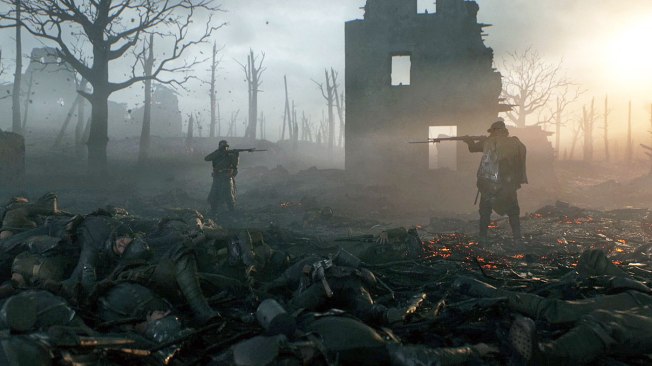


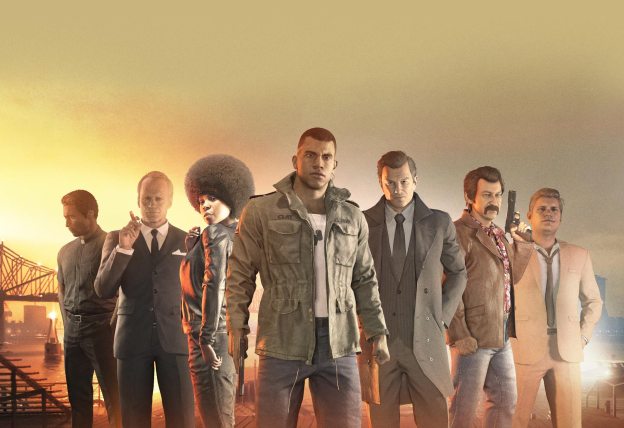

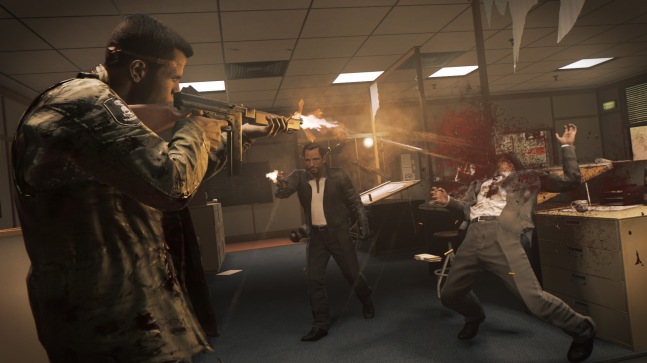
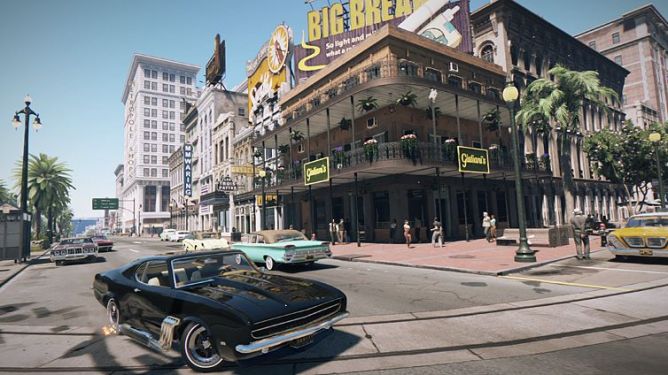

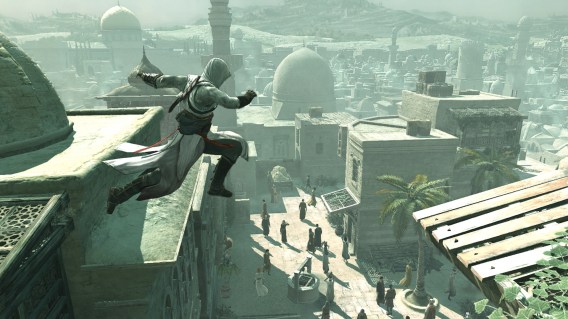


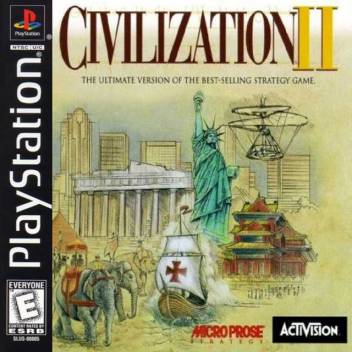
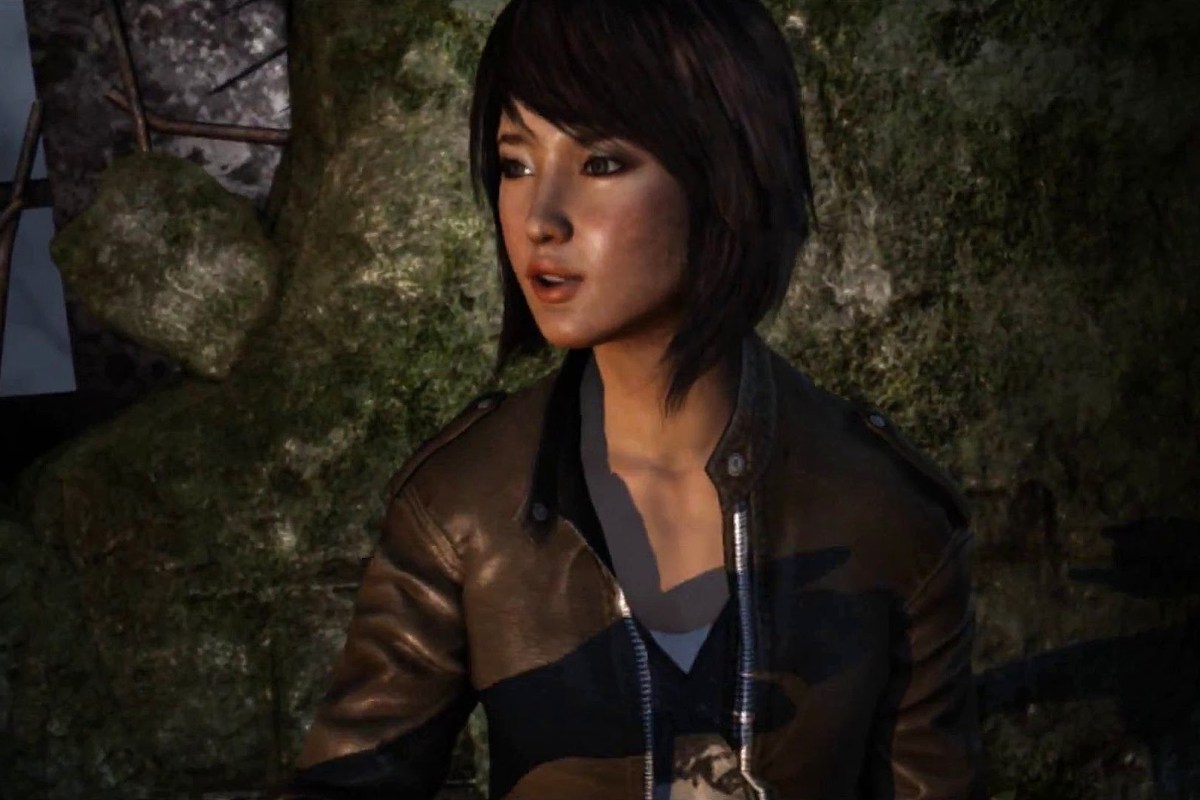
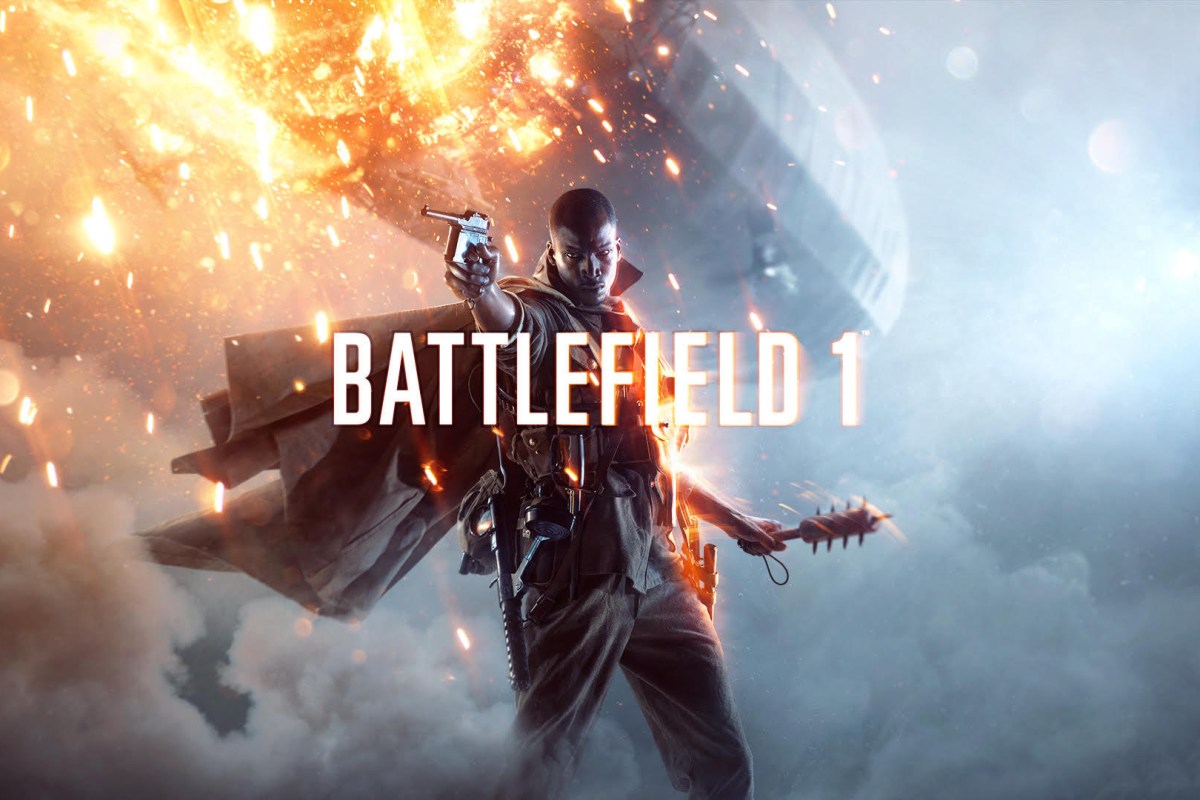


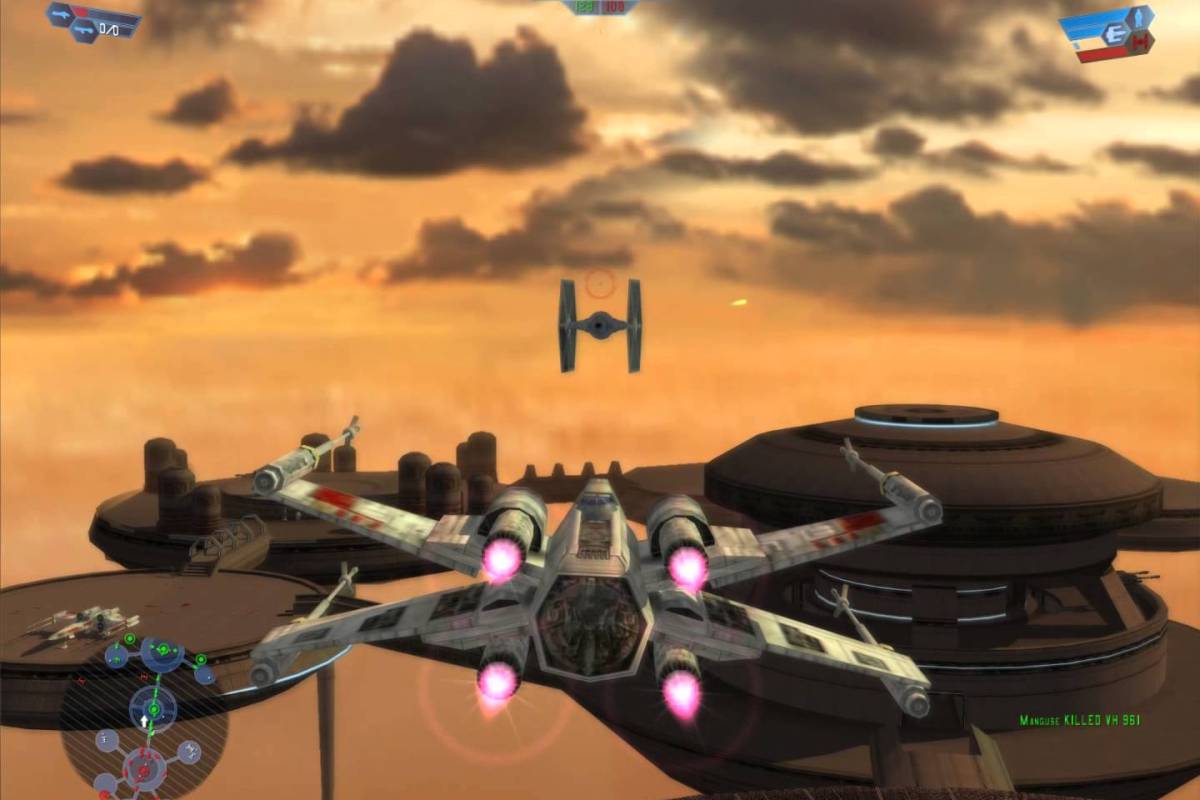


 TOM CLEMENT | GAME PRODUCER | NARRATIVE DESIGNER