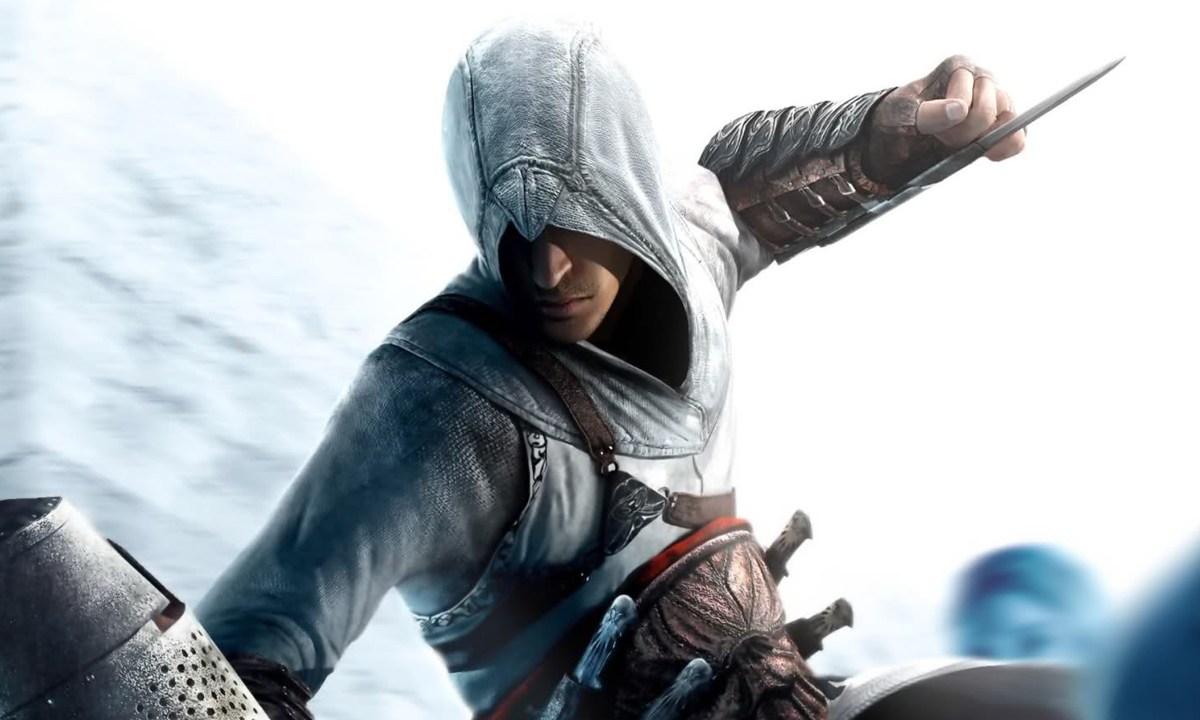
A flick of the wrist, a flash of metal…and someone falls to the ground dead. Is there any gaming weapon more iconic than the Hidden Blade?
A symbol and mark of justice, freedom, and commitment, passing through many hands over centuries, and yet still widely recognisable the default weapon of the Assassin Order, the Hidden Blade has cemented itself with its unique look and historic use.
It’s well known as the Assassins’ trademark and holds fascinating insight into both its users and its victims, and so I thought it was worthy to be analysed.
A Blade in the Crowd – What Makes the Hidden Blade an Iconic Weapon
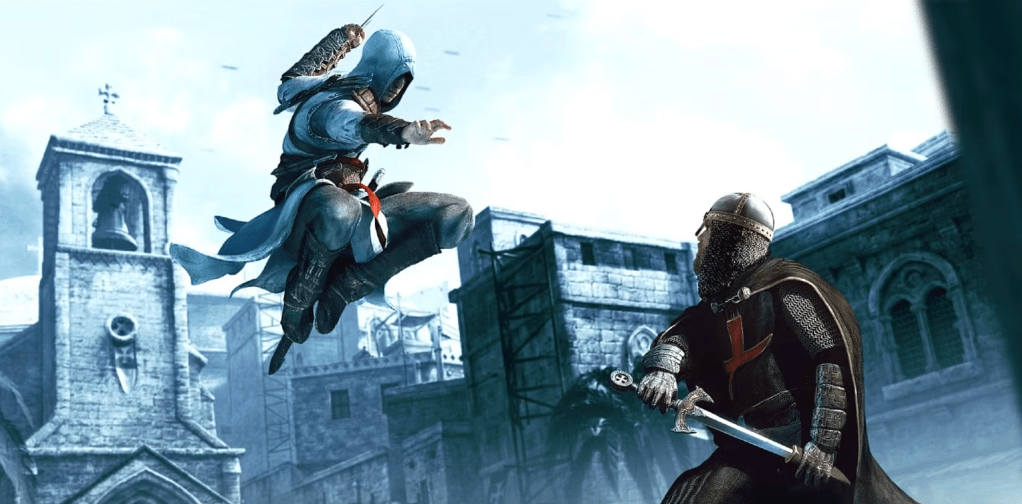
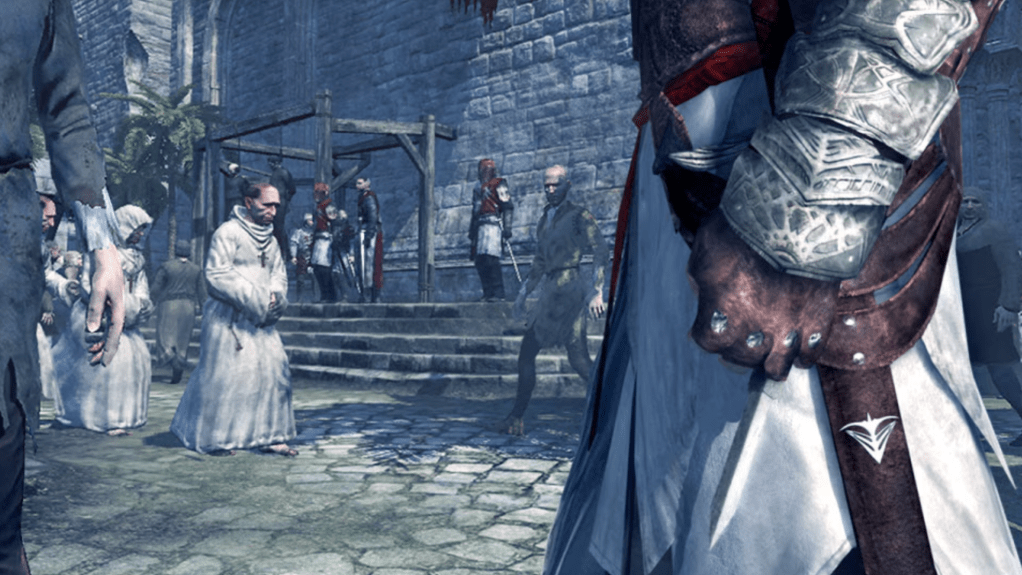
A public hanging has just been committed in the town square of Acre. The crowd roar in anger as the Templar soldiers jeer at them from the gallows, pointing to the swinging corpses behind them.
As the Assassin, Altaïr Ibn La’Ahad, moves through the crowd below, the knights spot him and try to attack. Altaïr shoots one solider with a crossbow and trips another, using the prone soldier as a ramp to leap into the air.
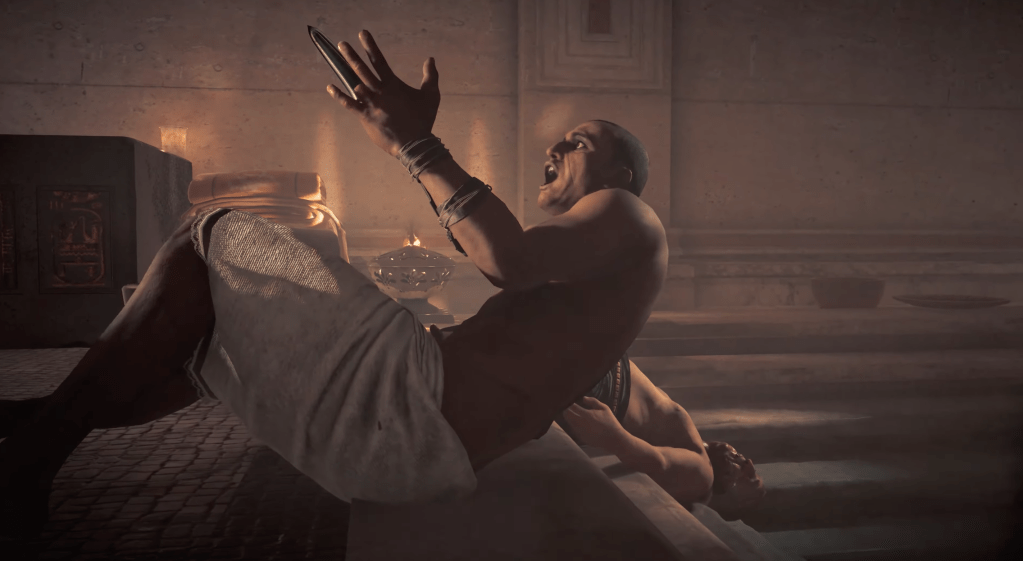
Altaïr flexes his hand, raised aloft, then brings it down squarely onto his target. Altaïr lands with a satisfying thunk! and the knight in front of him now lies dead.
Even from this short intro, it tells us so much about both the Assassins and their weapon. The hidden blade is not for all-out combat, it’s to be used as a surprise.
Like a eagle with its talons, the hidden blade strikes only when the time is right, and most importantly, it hits with conviction.
When Altaïr hits, the target immediately slumps. The knight doesn’t get to contest the assassination, he doesn’t even have a chance to draw his sword, he’s dead.
Altaïr in the opening cinematic. (Source: screenrant.com)
***
Psychologically, it should strike terror into a target; if you see this blade then you are going to die and you can’t stop it.
Then add on top the placement of Altaïr’s strike.
While we see later in the game that Altaïr can kill a target by stabbing them in the gut, in this intro Altaïr hits the target in the neck, between chainmail and the helmet.
This is not a drawn-out sword fight where you might glance off a shield or breastplate. The Hidden Blade finds the soft squishy part of the human body, somewhere no sword or dagger could find in a fight.
Again, it’s psychological warfare; no matter how armoured you are, you will die and nothing you can do will stop it.
And for the most part, the blade works exactly like that in the first game.
The blade can only be used in low profile situations (or as a counter), but if you achieve the hit, the target will fall.
It’s then interesting that the Hidden Blade immediately changed across the sequels, having it’s own arc of development in the confines of game mechanics, impacting the story as well.
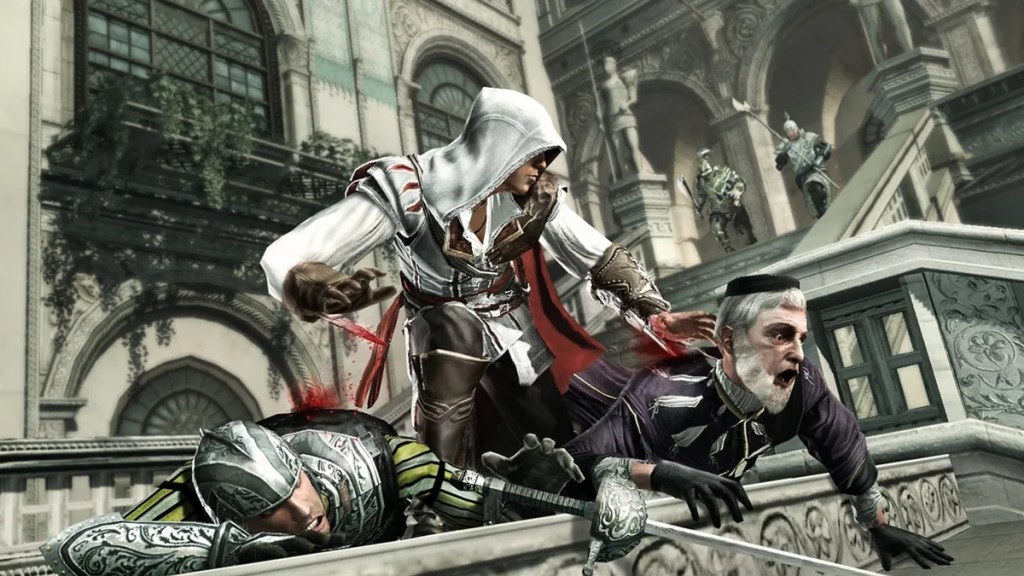
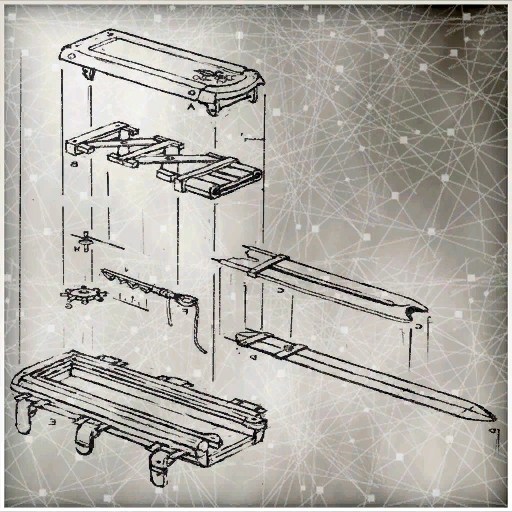
In Assassin’s Creed II, Ezio’s Hidden Blades (note the plural, another notable step) were made of a special alloy that Altaïr discussed in his Codex (No.13), ostensibly to “deflect incoming blows” but allowed them to be used in standard combat.
ACII‘s Dual Blades allowed for simultaneous takedowns on targets (Source: gamesradar.com)
***
What’s more, the new Hidden Blades were a fast attack and would get an immediate counter kill, unlike the sword or dagger, effectively dooming those weapons into irrelevance.
This continued in the sequels Brotherhood, Revelations, Assassin’s Creed III and Black Flag, before they changed with the new console generation in Assassin’s Creed: Unity.
In Unity, the Hidden Blade could not be equipped, but was a one-hit kill on unaware enemies. This change in mechanics carried the original spirit of the Hidden Blade, if not all of its unique attributes from the first game.
The same mechanic continued in Assassin’s Creed: Syndicate before it changed again with Assassin’s Creed: Origins.
In Origins, the Blade can only be used as a stealth kill weapon, but…RPG ELEMENTS!
The Hidden Blade needs to be a one-hit kill. It is the reward for getting close to your target without them being alerted. So it makes no damn sense that the Hidden Blade, whose sole use is killing someone undetected, needs to be bloody UPGRADED to make it worth using.
Well done Origins, you managed to screw up the one defining aspect of Assassin’s Creed!
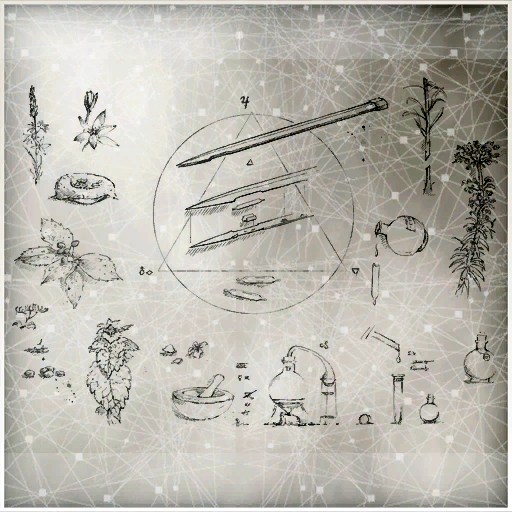
The Hidden Blade schematics from Altaïr’s Codex (Source: assassinscreed.fandom.com)
***
While I’m on the topic of Origins rewriting Assassin Lore…the ring finger.
Ever since the original AC, the ring finger of the Assassins’ has been an important part of the lore. To show an Assassin was worthy to wield the Hidden Blade, they had to sacrifice their ring finger.
You can actually see this on Altaïr’s model in the original AC, which is pretty cool that Ubisoft added it, when in reality not many players would look that closely at the character model’s hands.
As noted in Altaïr’s Codex, the Assassins stopped removing the ring finger, as it was an easy identifiable mark and the new blades Altaïr developed didn’t require its removal.
In ACII, when Ezio is finally inducted into the Assassin Order, they brand his ring finger, a small token of their traditions.
In Origins, Bayek incorrectly uses the Blade and gets his ring finger sliced off during an assassination.
In theory, I don’t hate the idea and I’m not against subverting a trope or a previous incarnation (hello I love the reboot Tomb Raider trilogy which goes out of its way to subvert every preconceived idea of Lara Croft and Tomb Raider).
I would probably like it more if the blade needed the ring finger to be taken off and Bayek just didn’t know.
But the fact that another iconic point of the Assassin Order came about because someone used the tool wrong and his failure to use the Blade correctly becomes a defining mark of the Assassins’…it stings.
It’s a cool shot, but it destroys the established lore. (Source: YouTube, Drake Platinum)
***
If you want to talk about subversion that does work, the series has two very good examples.
The first is Templars using the Blade, mostly notably Haytham Kenway and Shay Cormac, both former Assassins that switched sides. Despite turning their back on the Creed, they still wield the blade, almost as a sign of pride.
They know the power of the Hidden Blade, the psychological warfare that I mentioned earlier. Now they are turning that back onto the Assassins, and over the course of their games, Assassin’s Creed III and Rogue, they decimate the Colonial Brotherhood.
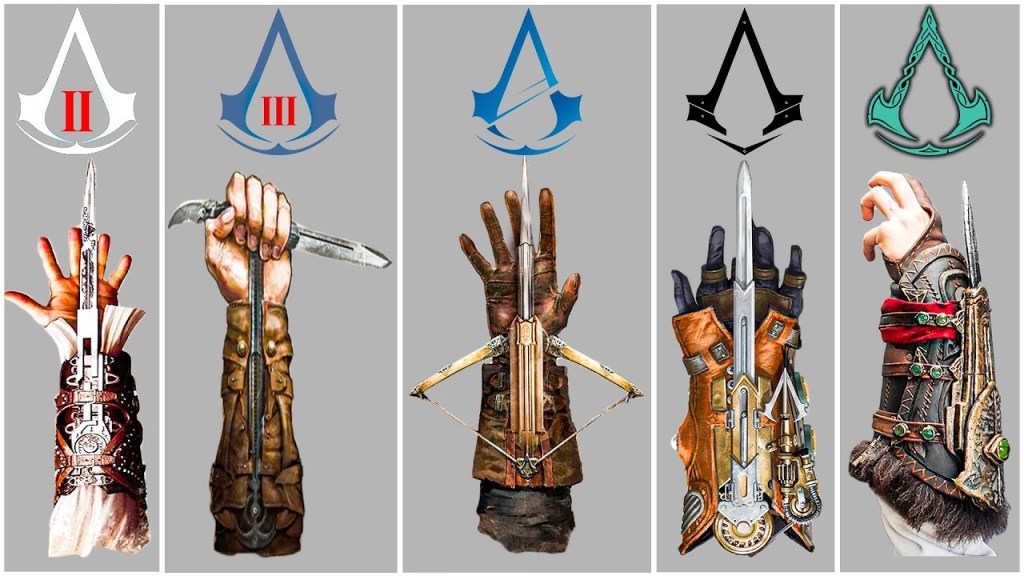
The second subversion is removing the “Hidden” from the Hidden Blade. In Assassin’s Creed: Odyssey and Valhalla, the Hidden Blade is worn on the outside of the hand, negating the loss of a ring finger.
In Valhalla, Eivor is gifted an incredibly bejewelled Hidden Blade and when told by Assassin Basim that it is usually under the arm, she replies, “I have no wish to hide this.”
It’s a cool switch up, and is in-keeping with the franchise, as ever since Assassin’s Creed II, the Hidden Blade has been modified again and again. As Altaïr says in his codex when referring to how the Assassins operate, “…our tactics, too, must change.”
First came the Poison Blade and then the Hidden Gun (in its best form when it was slow to aim and fire, instead of the machine-gun-level insta-murder weapon of Brotherhood), both detailed in Altaïr’s Codex from ACII.
Assassin’s Creed: Revelations brought forward the Ottoman Hookblade (which if you didn’t know has two parts; the Hook and the Blade). While it could be used in combat to trip guards, its true use was in traversal, allowing for further jumps and accessing the many ziplines that dotted the rooftops of Constantinople.
Assassin’s Creed III introduced the Pivot Blade, where the blade would spin in the hand into an Ice Pick grip, allowing the Assassin Connor to effectively dual-wield it with his tomahawk.
And then two more ranged variations appeared; first the Phantom Blade in Unity being a silent but deadly mini-crossbow, which eventually evolved into the Darts of Assassin’s Creed: Syndicate.
Syndicate also introduced the Rope Launcher, a referential upgrade on the Hookblade, acting as a zipline and traversal tool that was essential for the wider rooftop layout of Victorian London.
Hidden blades throughout the series, from Ezio to Eivor. (Source: YouTube, AKG29)
***
With each development, a new form of assassination was made, but was something lost with all the new ways to kill a target? Does a Hidden Blade make sense to use when one could easily use a Hidden Gun?
However, I may be falling to my own biases. As someone who loved the first Assassin’s Creed, I grew up with the “Levantine” method; sneak close to the target, perform a high-profile public assassination, and then escape amongst the crowds, the exact style that Altaïr perfectly displayed in the intro video.
And whenever I play a new Assassin’s Creed game, I fall back on my gameplay groundings, performing that same style of assassination in Unity, Syndicate, Origins and Valhalla, and so I wish the Blade would remain as it is.
But even Valhalla explicitly called out this rigidity of thought. When Eivor is gifted the Hidden Blade, the Assassin Trainee Hytham is not impressed, saying it is “unorthodox” to give a blade to a non-Assassin, claiming it is a “sacred tool”.
Basim responds, “Do not make a fetish out of cold metal Hytham.”
But then Altaïr in his Codex says, “The Hidden Blade has been a constant companion of ours over the years. Some would even say it defines us…”
The Blade in the Crowd, searching for its next victim. (Source: ubisoft.com)
***
As Assassin’s Creed has continued, the iconic qualities have changed. The white robes and hood were discarded, first with different colours and then without hoods at all.
The stealth and the parkour were reduced, instead all-out combat was favoured for a while.
The Assassins and Templars were renamed to the Hidden Ones and the Order of Ancients, so that their stories could continue in different forms.
Even the parallel modern-day parts of the narrative have been tinkered and toyed with, before being utterly discarded in some games.
But the defining thing that ties them together is the Hidden Blade.
It is entirely iconic, a final flourish to the many lives it has taken, and is well and truly a character in its own right.
***
P.S. I don’t actually hate Origins, I actually think it’s one of the best of the series, easily better than Brotherhood or Black Flag. Yeah, I said it!
When players of the future will look back on games that could be part of the ludo-canon there will be a whole host of different styles and genres, from indie games to AAA releases.
Some games, such as Grand Theft Auto III, won’t be the best in their series, but will indicate the start of something bigger. Some, like Bioshock, show a more thoughtful, provocative, and literate attempt at the art form. And some, like Minecraft, are, well…revolutionary.
The list will go on and on as more games and platforms are released, but today I want to focus on one game. This game, much like GTAIII before it, was the start of not just a best-selling franchise, but managed to blend genres, brought a completely revolutionary idea of multiplayer to our screens, and kick-started a whole slew of imitators. Today, I’ll be talking about Assassin’s Creed, all the way back from 2007.
At the time of writing the series has been going for eleven years with nine games so far. Its most recent release, Origins, came out in late 2017, ten years after the first game. So, with over a decade of gaming to look back over let’s dive in.
This isn’t going to be a simple re-review of the game, but more a sort of breakdown and rethinking of the game. Enjoy!
Nothing is True, Everything is Permitted – A Look Back at Assassin’s Creed (2007)
Origins (no, not that Origins)
At the tale end of 2003, Ubisoft Montreal had just released Prince Of Persia: The Sands Of Time. Sands Of Time was the reboot of the series and would go on to spawn two sequels, Warrior Within in 2004, and Two Thrones in 2005. It was from this creative team that Assassin’s Creed would be born.
In a surprisingly detailed feature in Edge Magazine(Note: This is a second-hand account of the work, as all links to the original revert back to GamesRadar’s homepage), Creative Director Patrice Désilets talked about how the idea grew from the PoP series, where the player would be an assassin bodyguard protecting the child version of the Prince. Long after the game was released, this test footage of the game was leaked. (Source: Felipe Orion).
You can see the building blocks of the series; the crowd mechanics, the ominous white hoods, and hidden blades. There is a lot of stuff in that trailer that would take several games to be brought back into the series, with the main ones being co-op and bows and arrows being used.
You can easily see how PoP was the precursor. The free-running mechanics are obviously the key influence, but in a much larger way. The fun of a PoP game, even the more open ended-style like the 2008 reboot, the free running is in more of a linear sequence. The game world is an assault course; you see the path and you have to hit the buttons at the correct time to move through the land. It’s not experimental or improvisational; the path forward is set. Assassin’s Creed is more open with a world full of opportunities and pathways. In the feature Désilets remarks the freerunning was meant to be similar to the use of vehicles in GTA, “The pleasure of driving a car in Liberty City should be the same as a main character in Assassin’s Creed.” (para. 19).
The Arabian aesthetic would be another key factor. While PoP would feature expansive areas, the game is limited mostly to palaces and corridors to feature the prince’s wall-hopping acrobatics. Assassin’s Creed builds on that by opening up the world, not just into outdoor areas, but three different cities and a huge countryside to explore.
So with the building blocks of the game set let’s look into how Assassin’s Creed actually works.
“The World is a Stage” – The City and Lands of Assassin’s Creed
Assassin’s Creed is set in the Holy Land and the bulk of gameplay is divided between three cities in the region; Damascus, Jerusalem, and Acre. Despite all being in relative proximity to each other they all have different design and artwork.
Damascus is bright and tan, with minarets and spires stretching high into the sky. Jerusalem is has muted shades of brown, with mosques sitting beside churches and synagogues. And Acre, well, Acre is a warzone; cold, dark, and grey, with most houses reduced to smouldering ash and rubble.
This slideshow requires JavaScript.
The three cities are distinct and each tell a different facet of the Crusades. For example, the Teutonic Crusaders were the invaders of Acre, so while they want to be seen as the saviours of the city’s Christian inhabitants, the scars of war show them to also be invaders and destroyers. The cities are split between three districts; poor, middle and rich. While this helps design variety, it’s also meant to be a visual signifier for player interaction and gameplay (which we will talk about later in this retrospective).
The only part of the world that seems a bit pointless is the Kingdom. It boils down to a really big set of crossroads with a single path leading to each city and to the Assassin’s mountain top castle, Masyaf. There is nothing to do here, apart from collect flags (for no benefit besides 100% completion) and annoy roaming Saracens and Templars (although according to Désilets, this was an effort for an “improv” sense of gameplay, where each player’s story is different (para. 24-26)).
Masyaf is, again, different to any of the other cities. Having the game unceremoniously start there in a weird dream sequence and also end there with the fight against the shape-shifting Al Mualim has a nice cyclical nature to it. Again, like the Kingdom, there isn’t really a need to explore aside from flag collecting, so they majority of the gameplay will be spent in the targets hometowns.
I mentioned that visual significance of the districts allowing for greater player clarity in traversing the city, so let’s explore that idea. The problem of the city comes down to the inclusion of the mini map.
“In the Kingdom of the Blind, The Man with Eagle Vision is King” – Visual Signifiers and the Mini Map (and also the side missions)
One of the biggest faults many people find with Assassin’s Creed is its repetitive nature. Receive a target, go to the city, talk to the Assassin Bureau, do three tasks such as eavesdrop, pickpocket, or beat up a public speaker, return to the Bureau and then assassinate your target. Rinse and repeat nine times, game over. But that is a shallow experience of the game, and I would expect 98% of that comes from the mini-map.
Back in May 2017 on Twitter I got into a conversation with Stanislav Costiuc, a developer at Ubisoft, who wrote a fantastic essay on how Assassin’s Creed was designed for HUD-less gameplay and no mini-map. Costiuc explains that the levels and districts were designed in such a way to aid player exploration but also player interaction with the world.
Going back and playing Assassin’s Creed without the HUD makes playing the game a much different experience. You have to be in tune with your surroundings and recognise patterns. Costiuc shows this with a running commentary of how he played through one of the assassinations without the HUD.
Without the map telling him where to go, Costiuc had to find markers in the world that would help him find the Bureau and his targets. Each Bureau leader tells the player where to start their investigations; the north markets, the west gardens, the south gates, each one filling in the world. All these dialogues are meant to help the player rather than just fill for time. That’s why the different sections of the maps and specific locations are needed in AC1 because they were originally used for player education, without the mini-map as a crutch.
This is one thing I wish had been carried over to the rest of the games. With the more detailed world and the inclusion of a database helping identify actual buildings, this type of landmark guidance would have worked wonders. For example, after getting back one holiday from Florence I booted up AC2 and was able to find my hotel just by going to the buildings I recognised.
This makes me think the original game was meant to be much slower paced, almost similar to IO-Interactive’s Hitman, with the player finding pieces of information that could help or hinder them with their assassination attempt.
For those assassination attempts the player needs to get close to the target and then attack them with a weapon. So, let’s talk about traversal and combat.
“He’s Going to Hurt Himself” – Freerunning, Movement, and Killing Targets
I previously talked about the freerunning aspect in comparison with Prince Of Persia, but Assassin’s Creed has a more dynamic movement system than its ancestor. Each of the face buttons is a part of the body; A/X is legs, B/Circle is empty hand, X/Square is weapon hand, and Y/Triangle is for the head. All of these are then modified with the use of RT/R2 into high-profile moves. In the Edge feature Désilets mentioned how it was based on puppets (para. 21), and the system is simple enough that you don’t have to spend several hours getting to grips with the control layout.
Again, AC1 is slower than its sequels; there is no jump climb ability and you can’t sprint across beams, but the central mechanics are solid. Swimming is also absent (there is a debate over whether it’s historical accuracy since we are covered in armour, or a technical feat since swimming mechanics were still in their infancy, only appearing a few years prior in Rockstar’s GTA: San Andreas), but this is offset by only having a few water sections in the game. This does come to the fore during the assassination of Sibrand in Acre, where the stealthiest way to his ship is via jumping precariously around the harbour.
Still from Jerusalem of Altair in “flight”. Source: AC Wikia
Freerunning is especially well defined for such an early game. Apart from PoP I can’t think of many games before the first Assassin’s Creed that had a smooth freerunning mechanic. It also feels like there is small amount of auto-guiding in terms of chasing targets. Many times in AC sequels I would find myself chasing a target and instead of following them through an archway, Ezio or Connor would instead get stuck to the doorframe or run up a wall. I’ve never had that problem during my playthroughs with Altair.
The combat of AC1 is my favourite of the entire series. I’ve written previously about the feeling of the combat, how the sword has weight behind it, but there is so much more than that. It feels like a multi-tiered system with different moves for skill levels and play-styles. For those just wanting to kill enemies with brute strength there is the charge up sword. For those with patience there is the counter mechanic. And for those with good timing there is the combo kill and the break defence, which are rewarding for being the quickest kills.
None of the skill-based attacks have the same depth as in later games and merely reduced to a single button presses (AC2 was concered more on movement, but because the Hidden Blades were perfect counters and the sword/short blade took two or three counters and are slower in general, there is no reason to use them).
The revamped combat in the sequels was due to the supposed stalling enemies, crowding around you and staring you down for several seconds before attacking. But that is simply not true in AC1. Sure, if all you are using are counters then yes there is a lot of dead air when it comes to battles. But using the break defence and combo kills, or the Short Blade and Throwing Knives, and again, recognising the visual signifiers of scared/taunting soldiers (which leaves them open to a quick hidden blade or throwing knife kill) the combat is far from static.
You get these moves through the game so you are meant to up your strategy. The problem is that the counter is way too powerful leading to players defaulting to that, making the battles seems stilted. These was “rectified” in later games by having enemies that could stop counters (here is a video by Extra Credits talking about this problem, calling them FOO strategies), but made combat even more stilted by having to perform these actions several times to defeat one enemy.
The weapons feed into the aspect of upping strategy alongside the moveset. The sword is good for defence and strong attacks but is slow. The short blade/knives are faster, and the hidden blade (which we will get onto next) is a one-hit kill. They allow for a sense of personalisation when it comes to combat.
The Hidden Blade is the best weapon in the game. The blade only kills in low profile situations (or as a counter), otherwise the target can block your attack and force you into open combat. Knowing this feeds back into the world and those visual signifiers, trying to find a way to get close to your target without raising the alarm.
For example, the assassination of Majd Addin in Jerusalem has the target on a platform surrounded by guards. There is no way to break through the guards and get a clean kill with the hidden blade. You have to look at your surroundings; should you take the ladder to the side of you to climb up and around to the platform, or should you hide among the scholars to try and pass through the crowds? The limits of the blade make you work for the best kills, but then the sequels turned them into insta-kill spree-delivering devices.
The only problems with combat in Assassin’s Creed are in hindsight of the sequels. Things like Air Assassinations and Haystack Drags that debuted in AC2 are sorely missing. And while the throwing knives are a good ranged weapon, certain guards seem invincible to them which breaks immersion. AC1 also has the odd habit of making you a wanted man just for locking onto a guard.
Now that I’ve talked about most of the design and gameplay aspects that I wanted to mention, let’s move onto the story and narrative.
“Sit Down and I Will Tell you a Tale Like None You Have Ever Heard!” – The Dual Narrative
I remember when I first played Assassin’s Creed I thought, “This is so cool, I get to run around fighting medieval knights, run across rooftops like a high-wire trapeze artist, and there is even some conspiracies and intrigue. I love this!” Then the game would wrench me out the experience, taking me away from the badass Altair and replacing him with bland bartender Desmond Miles.
The “very special boy” Desmond Miles, who seems to be a descendant of EVERY single Assassin ever. Source: giantbomb.com.
I think the overarching, modern day narrative was the part that lost a lot of players. Because we don’t spend enough time with dear old Desmond we have no reason to care about him or his trials. Even when the games tried to jazz up his role such as learning the skills of the Assassin’s in Brotherhood, learning about his past in Revelations, or making him the most super special person in the world in III, Desmond still felt like an afterthought. Even next to Connor “What-Would-You-Have-Me-Do” Kenway (honestly the worst protagonist I’ve ever played as), Desmond was a poorly defined character. Another problem with the wider narrative is that it never got a satisfying ending. Every game would end with Desmond and his posse running from the Templars to another safe haven, meaning we would have to buy the next instalment to get a follow up.
I’m not sure how I feel about Desmond’s departure after III and Abstergo basically turning into Ubisoft and selling genetic memories as games, but it seems a rather silly hold over. The modern aspect is only in there for the game to have overt gamey-aspects not break narrative cohesion by saying “we’re in the Animus”. It should just be ditched; I think gamers would understand that their game has to have some anachronisms. The fact that both Subject 16 and Desmond both started hallucinating outside of Animus shows that humans can experience genetic memories without a wacky machine. Why not focus on that; a character that has learnt to go into a zen-like trance to relive their memories?
The reveals of the wider story, especially the surprise ending where the Apple Of Eden presents us with several Precursor Temple sites, would have worked a lot better without the pre-knowledge of technology and conspiracy. That reveal of a story much wider than the one being presented to you would have been a gut-punch of a reveal, possibly similar to the world of Columbia and “swimming in different oceans but landing on the same shores”. It still sets up the possibility of other Assassins around the globe and without Desmond’s genes limiting the range of Assassins for sequels to mostly European white guys.
One thing I do like about the Holy Land story of Assassin’s Creed is that it takes some risks. It brings ideas about religion, secularism, hypocrisy, and violence to the table, and explores them with each target during the confessions sequences. It’s interesting and I can’t think of another game bar the AC sequels that tries to shine a torch on some of the not-too-pleasant aspects of mankind. While the splash screen at the front of the game, with the now infamous “various different religions and cultures” was meant to be a failsafe against typecasting most of the Arab characters as cutthroat murderers, I think the Templars are portrayed much worse. They are already the invaders, destroying Acre pre-game, and just from my own play sessions, they are always seem more aggressive.
Legacy (no, not that Legacy)
The first Assassin’s Creed is seen as an important stepping-stone in the way open-world games are developed nowadays. While more people find AC2 to be the high point of the series (including me until this final play session, where I think AC1 just pips it), AC1 is remarkable in how if you updated the graphics it could still stand somewhat with its contemporaries.
Let’s count them off;
Open world, check.
Collectables that are pretty meaningless, check.
Map that opens up when you scale towers, even Ubisoft made a joke about how much of a trope it had become in their games.
This idea of AC1 as being more of a proof-of-concept is so ingrained that it has become shorthand for other similarly repetitive games. Mafia 3 was unfavourably compared to AC1 by it being a mostly empty map with the same few side missions.
Looking at Assassin’s Creed nowadays, you can see how it influenced the later games. Characters like Ezio, Edward, and the Frye twins were obviously created in response to Altair and his other sour brothers, Connor and Arno. The setting influenced later games locations, with Revelations obviously taking inspiration from AC1 with its Eastern location and design after having two games of classical European architecture in the form of AC2 and Brotherhood.
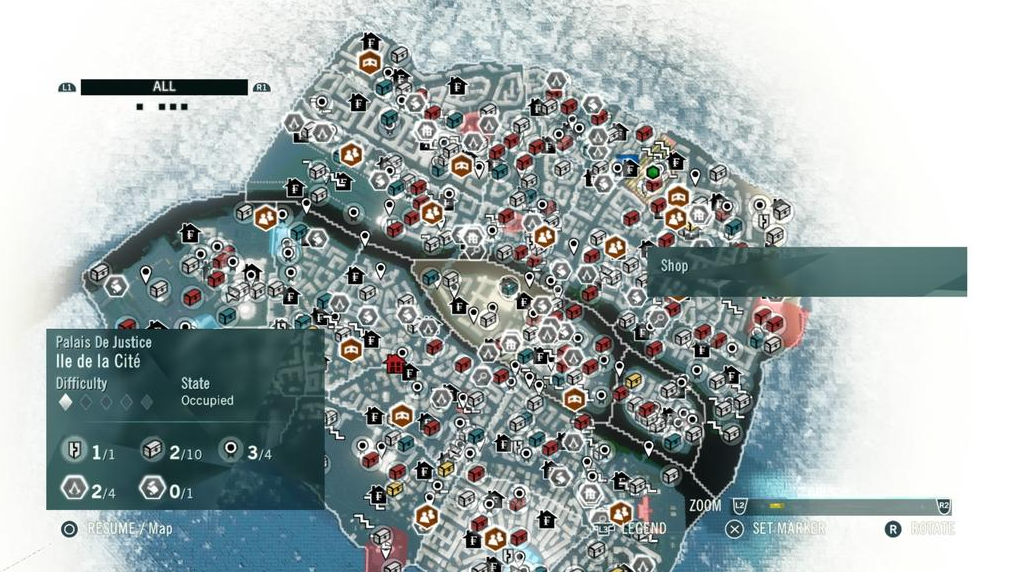
In my experience though I feel the later games fall prey to trying to compensate for the somewhat spartan presentation of AC1. This came to the forefront when I recently played AC: Unity. When I first brought the map up I said to myself, “What is this?!” The map was full of stuff, juststuff, that had very little bearing on the main narrative; chests, cockades, underground systems, side quests, murder mysteries, cryptic puzzles, hours upon hours of nebulous content. For the longest time I didn’t synchronise viewpoints and turned all the collectables off, because I knew the game was screwing with my completionist tendencies.
This is a picture from a forum post called “Is Assassin’s Creed Unity Just A Bit Too Much?” Seems that a lot of people have been thinking the same idea. Source: gamespot.com
Altair is also a major factor in AC2. Thinking back to 2009 before we knew that he would come back in Revelations, Altair does share brief moments with us again. First and most notably, Altair returns in the Codex pages. As we read his notes we see an older and more cynical Altair, testing out the Apple of Eden, creating new mechanics for the Assassins such as the Poison Blade, and writing about the upcoming Mongol threat. Then we see him in a flashback getting busy with Maria Thorpe, with the player staying with Maria and entering her womb once Altair has deposited his seed. While the descendant aspect of the series had been explained at this point in the series this was the first time it was “shown” to an extent.
And just talking numbers, Assassin’s Creed was a hit. In Ubisoft’s own words it, “greatly outstripped” their expectations. It became the fastest-selling new IP at the time, projected to sell five million copies for 2007-2008. This was enough to send what was originally a spinoff of Ubisoft’s popular wall-crawler into a multi-million dollar franchising spanning books, comics, and even films.
Conclusion
After going back to the first Assassin’s Creed my views on it have changed quite a bit. I played AC1 and AC2 back-to-back, with only a few hours between finishing AC1 and starting AC2. And now having played all the way up until AC: Unity, what I used to see as a nice blueprint feels much more like a refined experience.
The brilliant open-ended assassinations are obviously a high point especially as soon as AC2, the assassinations were distilled and streamlined (mainly for narrative sense). For reference even now in Unity I play the “levantine” approach to combat; sneak until within a few metres, high-profile assassination, then flee into the crowds. It’s a classic set of moves that AC1 instilled into me, highlighted with its “Chase Cam”.
The repetitive grinding of missions is the takeaway most people get from the gameplay with the assassinations only being a sliver of the content on offer. That obviously wasn’t the intention, with the side quests meaning to be information on how to approach your target, but the mini-map turns them into chores.
The combat suffers from the same aspect of having good intentions, but it not being found when first playing. The combat arena where you learn new moves doesn’t do a great job at telling you how to fight and so we revert to what we know; hold RT/R2, pressing X/Square when hit.
The open world, especially the Kingdom, feels like needless padding and is only really there for the first feeling of odyssey-like wonder at riding off into unknown lands. The cities though are a fantastic if not realistic portrayal, having rooftops close enough that endless running is a delight. This is where the freerunning in III didn’t work, with cities that might be historically accurate but aren’t fun to parkour around due to the wide gaps between buildings.
Looking at it eleven years later, it’s obvious that Assassin’s Creed grabbed people because it was fresh and exciting. We had seen open-worlds before and we had seen historical action combat before. But together they were a match made in heaven, a license to go to whatever historical setting Ubisoft wanted and print money to set up new IPs with.
That same sense of freshness is why I think we all got on board for the modern day aspect. While Desmond’s story did get little payoff in the grand scheme of things, that new blend for gaming was novel. While we had seen the same beats in media such as The Matrix or Ghost In The Shell, in gaming it hadn’t really been explored before apart from maybe David Cage’s debut, Omnikron: The Nomad Soul.
With the new game AC: Origins, the series seemed to be travelling back to its roots. With a revamped modern day aspect that is moving away from the memories-as-games plot thread as well as bringing back a more branching style to combat, Origins was seen as a return to form to what many thought to be a dying and withered franchise.
Many have been quick to dismiss the new Assassin’s Creeds as not true AC experiences. I understand their criticisms, but don’t necessarily agree with them. Assassin’s Creed 1 shows us that you can pretty much take a whole new spin on a well known trope and make it its own thing, and that’s pretty much the defining theme of the series;