During the late 2000s and most of the 2010s I was the owner of an Xbox 360. I think my main reasoning behind choosing that system was that all my friends had one, so if I wanted to play with them, that would be the console.
Before I had chosen a 360 I was scouring through games that looked interesting to me and I remember one catching my eye. I remember going into game stores and continually picking up one box and reading and re-reading the back cover.
That game was Uncharted 2: Among Thieves. I knew nothing about the series at that part of my life, but I was already hooked. I mean, it looked like a modern Indiana Jones game. Anyone who knows me knows I love Tomb Raider, so another treasure-hunting simulator would be right up my street.
But alas, when I finally picked up an Xbox I realised that Uncharted was a PlayStation exclusive title, therefore I couldn’t play it (and I was not the position to buy a separate console). So Uncharted moved to the back of my mind until I picked up a PlayStation 4 in mid-2018.
With Uncharted being one of Sony’s premiere exclusives, the first three games were given a quick polish and sent out as a boxset to customers. I quickly bought the collection and settled down for some classic shooting/platforming fun. I mean, these games were beloved, how could they be anything more than excellent?
Well…
What Spending 100+ Hours with Nathan Drake Looks Like
I felt very confused while playing Uncharted 1. Here was this game, lauded as inspirational and influential in its design and gameplay…yet all I could think was single sight plains, flat geometry, and tedious whack-a-mole gameplay.
I died many times just to try and speed up the process; it felt like my life was ebbing away from me as I continued to play. The only time when it livened up for me was when the Nazi Mutants appeared, changing gameplay into a more run-and-gun affair. This was on normal/moderate difficulty setting (because ‘normal’, as the word suggests, would be the standard way to play the game), yet it was like pulling teeth.
The game certainly livened up by the end, but couldn’t save the rest of the experience for me. (Source: engadget.com).
I rationalised my thoughts by thinking, ‘Maybe this was standard for 2007.” However, 2007 also gave us Assassin’s Creed (genre-defining), Bioshock (narrative behemoth), CoD4 and Halo 3 (game-changers). Even Tomb Raider Anniversary, much maligned by its own fanbase, felt fluid and fast, the complete opposite of UC1.
So maybe this was just a blueprint game, one that would get better with subsequent titles.
I put those bad feelings aside as I booted up Uncharted 2: Among Thieves. This one was going to be good. It is generally accepted as the best game in the series.
There have been times where I have played games I haven’t enjoyed. There have been games I’ve actively disliked. But never have I played a game that has made me waver in my love of the medium.
Most of my complaints for UC1 were back, but tenfold. Long flat corridors or arenas, plinking away from behind cover with ineffective weapons, I could feel that draining sensation again.
The gunplay was serviceable, but it was nothing compared to the climbing. In most platforming sections, Uncharted 2 switches to a cinematic camera. I’m all for the cinematic approach to games, especially when it heightens the gameplay.
I hated Uncharted 2 from the very first sequence because of that bloody camera. Climbing up the train cars is a moment most gamers found thrilling, but because of the camera switches I couldn’t even figure out where to go.
The angles would throw off my depth perception, making me push forward and die when I should have been pushing sideways. Dying over and over again two minutes in because the game is giving you insufficient information will drive anyone to anger.
Even now I still can’t do this sequence in one go…I feel my blood pressure rising already. (Source: playstation.com).
Even the introduction of Chloe Frazer hardly tempered my loathing. Just like UC1, the game picked up during the final stretch at the monastery, mainly due to the excellent level design and geometry, and the inclusion of the Nazi Mutants again.
As I booted up Uncharted 3: Drake’s Deception, I was worried. Was this third entry going to be more of the same? What was wrong with me? Was I playing the game wrong?
I knew I liked third-person shooters; I’ve spent unknown hours with several 007 games, I love all of Remedy Entertainment’s work, Spec Ops: The Line is my favourite game of all time. Even at the same time of playing UC2 I played The Order: 1886, Ready at Dawn’s Victorian-steampunk shooter PS4 launch title. I loved that game and still hope to see a sequel some day.
So, I started Uncharted 3…and a new feeling came over me. I was having fun. Good-hearted, honest fun. I thought there had to be a catch, but none came. It was a blast.
The fights and shootouts in London, the rooftop chases in Colombia and Yemen, the attack on the citadel in Syria, the shipyard/sunken cruiser (with a beautiful cinematic camera, this time not obscuring the way to go), the cargo plane…repeat, THE CARGO PLANE, the horse ride into the desert, then finishing off once more with an ancient city crumbling to dust, I loved it from start to finish.
Uncharted 3 still has some of the best set-pieces in all of gaming. (Source: YouTube.com, GameSpot).
Upon finishing UC3 I had a lull in my games at the time, so I went back to the first two games and cranked up the difficulty to Crushing. I had nothing to lose if I didn’t enjoy it, but I adored every second.
I don’t know what came over me, but it was like experiencing the game for the first time again, but this time being the game that everyone told me it was. Even in Uncharted 2, it seemed all the levels I had hated had switched positions, making the final push towards the monastery even better.
Uncharted 4 follows in UC3’s stellar footsteps. I’ve always liked when Nathan has had someone to bounce off like Charlie or Chloe, and Sam is a great addition to the narrative. Throw in some excellent set pieces and locations and delving into the married life of Elena and Nathan (something seldom seen in games), I think this one might be my favourite one.
Conclusion
So what changed? Well, obviously the graphics and design became better and more intricate as subsequent games were made, but what about that turnaround for UC1 and UC2?
As I said previously, I’ve played my fair share of third-person shooters, but I wasn’t exactly raised on them in same way I was raised on racing games or Tomb Raider. Looking back at my favourite TPSes, most come from the PS2 or 360 generations. I haven’t played a straight, linear shooter since Spec Ops, because they aren’t really made as much any more.
Sure, there are shooting games galore, but not many single player shooter games. Even Amy Hennig said they are “…a harder and harder proposition.” (Takahashi, D. 2019). The closest I could think of besides The Order: 1886 was Ghost Recon: Wildlands, which is another open-world extravaganza from Ubisoft.
If you haven’t had the chance yet, please play The Order: 1886. It looks and sounds stunning. (Source: huffingtonpost.co.uk).
That might be the reason. It is enthralling to see a gameplay or mechanic that hasn’t been felt in over a decade, to see a simple beginning-middle-end structure with some shooty bits in the middle. I know, what a concept!
But that sounds offensive, ‘I only liked your game because I had nothing else to play,’ that is definitely not the case. I must come clean and say the problem was probably me.
I just needed time. I came to Uncharted with my own ideas on what it would be and my own biases.
I was sure I was to like Nathan Drake, being a composite of swashbuckler and dork. Yet I never found him enthralling until UC3, when it was revealed he married but separated from deuteragonist and love interest Elena.
My appreciation grew even more in UC4 when we get to see married life for the pair. In a similar vein, when Sam Drake entered the story, I was overjoyed. This is what I meant earlier about loving Chloe Frazer despite hating UC2, I loved Nate when he had a partner. While Sully was around for the first two games, he never stuck around like Sam or Elena did. For Nate to be at his best (for me at least), he needed people to bounce off.
Yet when I returned to UC1 and 2, I was pleasantly surprised that I didn’t hate it as much as I did, and I think it was due to previously seeing Nate’s story through to the end. To know where it was going, to seeing him settle down and have a family, it gave me an odd sort of comfort when heading back into the earlier games.
Marriage and commitment are rarely seen in games, and it was charming to play and experience and made me want to see Nate and Elena’s story again, to ‘chart’ their course through life.
When I first played Uncharted I wasn’t on its wavelength, and I found it increasingly hard to get a handle on.
It may have taken a few games to get me to understand, but I get it now.
Historical and biographical media is currently riding high in a big way.
Chernobyl, HBO’s newest mini-series, retelling the worst nuclear disaster in history, is the highest rated television show of all time on IMDb. Gentleman Jack, another HBO/BBC series following the true story of the first modern lesbian, Anne Lister, has just been greenlit for a second series.
I’ve been on a bit of non-fiction binge of my own, re-reading The Unwomanly Face Of War by Svetlana Alexievich. The book is an oral history of the women who fought in the Soviet Army in World War II.
It is a great polyphonic work filled with both mundane stories of waiting for hours in a ditch for a battle that never arrived, to the tense such as running into No Man’s Land to drag away the wounded whilst dodging gunfire.
While reading The Unwomanly Face Of War I got thinking about the recent Battlefield games 1 and V that both featured female warriors in Arabia and Norway respectively. While there was some…‘spirited’ discussion on the historical accuracy of the stories in Battlefield, it got me thinking about the stories highlighted by Alexievich, and how similar they were to the BF narratives. I started to think about stories in games and tried to think if there were any with biographical qualities.
‘Nordlys’ was my favourite of BFV‘s stories. I would love to see stories similar to it and to those featured in Alexievich’s record. (Source: pcgamesn.com).
The games industry has always had genres, but these are still mostly on how we experience the game; it is an adventure game, a point-and-click, a first-person shooter. But from there we can have genres of story; a war story, an adaptation of religious text, a comedy, sci-fi, the list goes on.
Even in the small grouping of “open-world crime story” we have satire (GTA), historical (Mafia III), drama (Yakuza), and techno-thriller (Watch_Dogs). There are so many genres to explore.
So would it be possible to make a biographical game, or do we have some already? I went for a look.
Life Without Theory – Biographical Accounts in Video Games
The first thing that comes to my head when I think of biographical features in games is the one I started with at the beginning of this post, war stories.
With Medal of Honor in 1998, the game was touted for its account of true events and scenarios that soldiers would have faced during WWII. The continued throughout the early 00s as WWII shooters became the norm for almost the entire FPS genre.
Even when Medal of Honor followed the market leader Call Of Duty into the modern day in 2010 and 2012, there was another attempt at bringing an authenticity to proceedings. Some levels in the 2012 release, Warfighter, were subtitled “Inspired By True Events”. This was in stark contrast to Call of Duty, which would often leave details vague on locations, time, and people.
One instance of ‘historical retelling’ in game that I remember from my childhood is Tony Hawk’s Pro Skater 4. Of the fourteen pro skaters in the game, several of their ‘Pro Challenge’ missions were based off their previous exhibitions. While some changes were made, these missions were meant to be recreations of famous skating moments such as Tony Hawk’s Indy 900 gap, Bob Burnquist’s loop-da-loop or Jamie Thomas’ one-day photo shoot.
Another might be The Beatles Rockband. With the song progression being in release order and with stages set in the Cavern Club, on the Ed Sullivan Show and on the Apple Corps roof, it felt like a memorial and musical biography, like a video game adaptation of Ron Howard’s documentary Eight Days A Week.
The Beatles Rock Band takes you through The Beatles entire career in 45 songs, charting their rise and change. (Source: polygon.com).
Another game that comes to mind when I think ‘biographical narratives’ is Assassin’s Creed. Ever since AC2 first included a database filled with locations, customs, and characters, detailed historical biographies (narrated excellently by Danny Wallace) have become a staple of the series. When I first played AC2 I spent an untold amount of time scrolling through the database, reading every last scrap of text. One entry that has stuck with me over the past ten years is Annetta.
Annetta is one of the first characters outside of the Auditore family that the player meets. She is one of the Auditore family’s servants and helps Ezio get his mother and sister out of Florence after the family are branded as traitors. Her database entry is only six lines long, ending quite sadly,
“Ultimately, little is known about Annetta’s life. She passed on without making a mark on history.”
I still think back on that entry even to this day, mainly for its almost achingly beautiful melancholic tone, but now I think how interesting it would have been to follow a servant girl during the tumultuous time of Renaissance Italy.
However, most of the games mentioned above are historical retellings. They are facts and dates, historical figures and public affairs.
Even in the historical offshoot of “heritage” media, which focuses on historical periods, but with fictional characters, I can name several games; the previously mentioned Assassin’s Creed, the Mafia series, Kingdom Come, Pillars Of The Earth (which is also a novel adaptation). Where are the personal tales that aren’t straight historical documentations?
A Different Perspective – The Personal Angle
There have been two games that I’ve been leaving off mentioning until now, as they are almost perfect examples of the autobiographical form, both from the indie market.
The main one is That Dragon, Cancer, a 2016 release created by Ryan and Amy Green, Josh Larson, and the studio Numinous Games. The game is based around the Green family and their son Joel, who was diagnosed with terminal cancer at twelve months old. The game follows the five years of Joel’s life and how the family coped with his illness. It is a raw personal story, with Ryan Green stating in an interview with The Telegraph,
“ can do something no other medium can, you can create this world and ask the player to live in it and love what you have created.” (Robertson, A. 2013).
The game was praised widely for its story and heartbreaking exploration that could only be achieved in a game, whereas others believed that its lack of gameplay disqualified it from being a game.
The other game that came to mind when thinking of biographical games was Depression Quest by Zoe Quinn, Patrick Lindsey and Isaac Schankler. While Quinn and Depression Quest are more likely known from the ‘GamerGate’ hashtag, the game was created as a form of self-expression. Quoted in The New Yorker,
“Quinn…has suffered from depression since she was a teen-ager…game-making provided Quinn with a community and introduced her to Lindsey, who also suffers from depression. Lindsey suggested that the pair attempt to communicate their experience through a computer game.” (Parkin, S, 2014).
Notice the ‘(non) fiction’ subtitle on the game screen. (Source: sites.psu.edu).
While not a direct autobiographical tale, the game was informed by the duo’s experiences and the game was praised for its depiction of depression with gaming. However, some claimed it was too simplistic a representation, which Quinn admits to in the interview with The New Yorker. Just like That Dragon, Cancer, the game was also criticised for its lack of entertaining quality or gameplay, being mainly a text adventure.
Conclusion
In research for this piece I found an article by Kawika Guillermo on Mediumthat also discussed the autobiographical nature of some games. Alongside That Dragon, Cancer, Guillermo gave a host of other examples such as Cibele and How Do You Do It by Nina Freeman.
Guillermo talks about the ‘death of the author’, a term coined by Roland Barthes, which posits there can be no singular reading of a work because we all have our own prejudices and views. Guillermo quotes game designer Robert Yang who said, “No-one makes personal games,” mentioning that due to the international market, what he terms ‘identity stories’ would lose meaning to non-Americans.
However, people do write their own tales into their work, be it in literature, film, or even games. Recently there was a thread on Twitter by Osama Dorias where developers described when they had put personal stories into games. I gave my personal experiences that informed my work on Story Beats. While these games may not have been fully autobiographical, there is a sense that this could be a new, mostly unmapped avenue for the industry to explore in the future.
We also have to think about what biographical stories that can be explored. The top selling biographies have included former presidents, businessmen, and musicians and have ranged in topics from road trips, traumatic childhoods and the final days of living with cancer. We would have to think on how to represent those in gameplay form. With a resurgent of point-and-click style games as well as the gameplay stylings of David Cage, there is more outside of the general action/adventure mould for games.
However, in the FPS/action genre there was Six Days in Fallujah, which was an attempt to document the Second Battle of Fallujah of the 2003 Iraq War. The game, by Atomic Games, was made alongside veterans of the battle and was made to highlight, in the words of Creative Director Juan Benito,
“…the importance of the stories of the marines that we worked with and were inspired by…to make people understand what those individuals faced…What we had set on was the first war documentary that was a video game…” (Paprocki, M, 2018).
At the time of development, the FPS market was filled with generic power fantasies. SDIF might have been a new look at the conflict. (Source: lattices.com).
The game was said to feature interviews with veterans between missions, bringing the story to life (GVMERS, 2017, 5:05). The game was cancelled after backlash from several anti-war groups and parents of soldiers that died during the conflict. A similar viewpoint came from Captain Dale Dye back in 1998 when he was asked to consult on the first Medal of Honor. When first told about the game, he was said to have called it, “…an exploitative, tone-deaf, irresponsible thing.” (Edge Staff, 2015).
To quote Linda Hutchinson, “Whether it be in the form of a videogame or a musical, an adaptation is likely to be greeted as minor and subsidiary…” (2006, p.xii).
These are things that would have to be addressed in making a biographical game. What would be removed, what would be added? Can we only make stories about events far in the past? Are no living people to be represented in games? Or would most of these games be too inherently political, grappling with the social and cultural context of the time?
Maybe biographical games are to stay in the independent or experimental market. But then there are stories that are almost stand-ins for AAA games already. For example, Paris by Julian Green is a semi-biographical book where the narrator takes a stroll through the French capital and describes the locations he visits. Could that not be similar to a Ubisoft game, describing the city as we travel it? But again, that is just a history lesson.
Where is the story of the man or woman in the street, of the personal tales that enthral audiences across the world? Where is Annetta’s story? Those are possibly harder to capture, but can offer a story rarely seen in games and bring a new facet to the medium.
I recently finished reading the first James Bond book, Casino Royale. Despite being a 007 fan for as long as I can remember, I had never actually gotten round to reading the classic stories by Ian Fleming.
While I was obviously introduced to the series with the films (every week I would head to Blockbuster and get a new one to watch), I think I truly became a fan when I was introduced to the games.
Picture the scene; it is 2003. I am seven years old. Our household console, the original PlayStation, ups and dies. We upgrade to the PlayStation 2 which is few years into its lifespan. We get three games with the PS2; FIFA, a Dave Mirra game, and James Bond 007: Nightfire.
The latter is the first FPS (first-person shooter) I play, and I become both a lifelong fan of the genre and the character.
There are no nostalgia goggles when I say Nightfire is one of the best games of the sixth generation. I have bought that game several times for different consoles, playing it well into my adult life. And I think that it all comes down to the excellent opening of the game, ‘The Exchange’.
This level features so many variations and little things to help a new player immerse themselves into the world of 007, so I thought I would take a look back and analyse how it creates and inducts the player into the gameplay.
“Now, pay attention 007!”– How ‘The Exchange’ Teaches Players Mechanics Through the Level Design
‘The Exchange’ is the second level of 007 Nightfire. The first level, ‘Paris Prelude’, is strictly an on-rails/driving affair with ‘The Exchange’ being the game’s first proper FPS mission.
If a player has not played the game before, ‘Paris Prelude’ starts. Aiming is computer-controlled; the player just has to shoot using the R1 button (the button is helpfully flashed on-screen when it is needed).
‘Paris Prelude’ acts as a tutorial to Nightfire, teaching driving mechanics as well. (Source: superadventuresingaming.blogspot.com).
Even if the player has not got to grips with all the controls (by reading the game manual) then they know at least one button and what it does.
‘The Exchange’ begins with 007 on a mission to infiltrate an enemy castle in Austria. Bond starts a few hundred metres away from the front door on top of a guardhouse. This starting placement is important.
This guardhouse allows the player that has never played a game before to get used to the movement controls. This is a safe space. There are no enemies patrolling, nothing shooting at you, it is nice and calm. The game even allows you to fire your weapon once just to try the controls out. If you fire a second shot then a guard will investigate the sound (a good way to discipline the player for forgetting what the button does).
Bond’s placement on top of the guardhouse also helps player navigation. The end of the opening cutscene and the player starting position draw the eyes forward to the large castle, pointing the way forward. The player can venture backwards on the road, but will find the path blocked by a locked door, forcing them to have to move towards the castle.
The opening section of ‘The Exchange’. Notice how we are guided towards the castle. (Source: infinitemirai.wordpress.com).
This is such a small thing, but it helps aid movement. Imagine if the player started inside the guardhouse. It would be a more claustrophobic start instead of the freedom of the open environment. It would be counter-intuitive to player guidance by not showing us the way forward.
Once the player has got the hang of the controls there are three main ways to get into the castle; one aggressive, two stealthy. We will go with aggressive first.
Aggressive
The player makes their way down the stairs of the guardhouse and sees a bad guy stationed just outside the door. This is the first enemy of the game. This set-up allows us to be ushered into combat without being overwhelmed. The guard is facing away, allowing the player to play at their pace.
This is where knowledge of shooting comes back. Guns and bullets are player interaction at its purest. The guard must be dealt with to proceed, but since he is unaware of the player, the player can take their time to line up a shot. If the player has tinkered around on the roof, they may have found Bond can punch or use a stunning gadget. If the player accidentally wanders out of the guardhouse, Bond will make the guard surrender, a safety net for those still struggling with the controls.
And to top it all off, this guard is a singular entity. Unless the player completely messes up and doesn’t deal with him, he cannot alert other guards.
The first enemy of the game, allowing the player to get to grips with the game before entering combat. (Source: oocities.org).
Subduing this guard will net us a new weapon, a sniper. The other enemies at the beginning of this level are visible in the distance (white outfits against a black/grey backgrounds), and so the sniper can be used to pick enemies off. Again, the player knows the shoot button and will use it to interact with the world.
The guards further up the road are stationery and will not notice the player until they get close. This allows the player to find an unobstructed viewpoint (the middle of the road) to survey the bad guys. The sniper is also silenced, allowing for players to take down bad guys without alerting others.
As the player moves up and dispatches the bad guys, they may acquire another new gun, a machine gun. This brings Nightfire’s weapon matrix into play. Now we have three distinct weapons. They each have their own strengths and weaknesses in regards to damage and range. After the player takes the machine gun, there are two more enemies in this starting area that it can be used against, allowing the player to familiarise themselves with the new weapon.
From there, the player heads to the main door and once they have found the action button, they continue to the next section.
Stealth 1: The Wine Truck
If the player waits on the roof, they can use the wine truck method. When the truck passes through the guardhouse, it will stall for a period of time. This allows the player to hop into the back from the roof and get inside the castle without killing any guards.
It is such a classic Bond moment, one that isn’t signposted and just requires the player to mess around to find. (Source: superadventuresingaming.blogspot.com).
This is one of those moments that reward the player’s imagination. If the player thinks they can do it, then they quite possibly can in Nightfire. It is such a long way from the funneled systems of many big budget games of this generation where a mission will fail if you step an inch outside of the creator’s vision.
Stealth 2: The Castle Wall
Continuing the jumping aspect, if the player jumps from the roof to the rocky cliff face (the same way if they were to head backwards) they will find a footpath that leads to a ravine.
The ravine is another stealthy way into the castle and gets the player closer to the next objective. (Source: cheatcodesgalore.com).
If they continue, a pop-up in the corner of the screen indicates there is a grappling station nearby. If the player looks around with their grapple equipped they can see a white target reticle. Focussing in on the reticle with the grapple turns it green (the universal colour of ‘go’). Once the player has used the grapple they have to make their way around the outside of the castle, sneaking past other guards.
You have to monitor enemy movement to sneak past the windows. If you don’t, several bad guys will spawn in. (Source: cheatcodesgalore.com).
This path introduces the (optional) contextual movement aspect where the player can traverse a wall or zipline by shimmying along. These are some serious stealth strategies though and failure will lead to heavily armed goons coming to take you down. This is for a player that has mastered the controls and locates the opportunity.
However…
There is another contextual movement section before the one previously mentioned.
After the player has got through the first wave of bad guys but before the main door, there is a little path leading off to the left.
Notice the pathway to the left, highlighted by the wooden handrail. (Source: xTimelessGaming, YouTube).
Heading down there allows the player to scale around the wall. During the cutscene Bond moves through some crunchy snow (5:28). The guards at the door (if they are alive) will come and investigate, but soon head back to their post. This introduces sound into a larger gameplay loop.
If the player has gunned their way to this section, they already know about sound and its role in alerting guards. This gameplay section highlights that quick movements can give you away and that slow movements (such as when the player is crouching) can make you silent and less easy to detect.
Each one of these variations on infiltrating the castle starts you in a different place during the next section. If you came in with the wine truck you start near the wine cellars. If you walked through the main door you are a few corridors away. And if you took the ‘Stealth 2’ route you start in a guard tower.
The different play styles net different rewards and new locations, making each style feel unique. (Source: infinitemirai.wordpress.com).
Even better, all these other places are available to visit. If you came in via the castle wall you can find the truck and where it ends up. It’s almost like reverse engineering, seeing where certain gameplay decisions spawn you.
Conclusion
I am going to finish this piece here because I don’t want this article to run long, but I will give a few bullet points as to what the next gameplay sections deliver.
A non-violent social stealth element where the player must work their way through the environment (useful in later levels like ‘Night Shift’).
Bond uses his micro-camera in two cutscenes. Its appearance shows it can be used for surveillance and to complete objectives (like in ‘Chain Reaction’).
We are barred from following the bad guys, so we go another way to rendezvous with another agent. On the way back, the barred section is open. As it is now unlocked, we can follow it. This is a perfect way to guide players in a non-linear fashion.
The player is familiarised through non-violent gameplay sections before the level opens up. This allows for the game to guide the player without needing waypoints. (Source: infinitemirai.wordpress.com).
After some shooting we get another weapon (an unsilenced machine pistol, another element added to the weapon matrix).
We head back outside and encounter a contextual zipline. Like the guardhouse there are no enemies shooting at us, so we can find the button that makes the zipline work without the worry that we will die.
Alternatively, the player can stay inside and get to the next objective quicker.
Alternatively, if we did go outside we would be awarded with another weapon (a machine gun with a silencer) and a stun grenade. These weapons make quick work of the guards at the objective, as they use cover and have machine pistols.
When the player completes the objective by retrieving a suitcase, they also pick up a rocket launcher. It is impossible to pick up the suitcase without also getting the launcher.
Once the player has got to the cable car station (which they would have visited if they went outside, but is also in a straight line if they stayed inside), a helicopter shows up. What do we have that can take down a helicopter? The rocket launcher.
Bond in combat against the helicopter. (Source: superadventuresingaming.blogspot.com).
The cable car has several windows. These can be shot out with regular ammo, allowing an almost perfect 360 degrees view.
The rocket is automatically on guided rockets, so when a player first shoots one they control its destination. While this may seem confusing on the first shot, the player’s previous movement controls come back into play and they can deliver several follow up shots on the helicopter.
The rocket launcher has full ammo capacity so even if the player misses a few shots, they will have enough to finish the mission.
Each following level takes one of the aspects from the ‘The Exchange’ and expands it, whether that is close quarters combat (‘Double Cross’), stealth (‘Night Shift’) sniping (‘Chain Reaction’) or all-out action (‘Phoenix Fire’).
While there might be some stealth in ‘Phoenix Fire’ or action at the end of ‘Night Shift’, these are only very small elements. This allows the levels to have their own distinct tones and themes. But that is why ‘The Exchange’ is a perfect opening. It allows for that difference in playstyle but also player freedom, educating them on how to play the game.
Newer 007 games like Blood Stone and Goldeneye Reloaded also have this balance of stealth and action in their opening levels, but none of them give the freedom of Nightfire, instead they railroad you through a directed experience.
That is not to say that strict linear games are bad. On the contrary, I love Blood Stone. But I think that freedom gives ‘The Exchange’ and Nightfire an excellent sense of character and gameplay. And that is why it is so fondly remembered.
And it doesn’t hurt that they absolutely killed it with the multiplayer. ‘Skyrail’ anyone?
I recently completed Assassin’s Creed: Syndicate and loved the entire experience. While I have enjoyed certain aspects of each Assassin’s Creed since the exquisite original, none of them have really captivated me as a whole.
While I enjoyed the majority of the predecessor, Unity, Syndicate really felt like a step up. The setting of Victorian London was a great location, and the constant liberation missions through the boroughs were on the right side of grinding for me. But the major selling point that got me interested in the game were the dual playable characters, twins Jacob and Evie Frye.
I was excited at playing as Evie due to her being the first playable female Assassin in the main series and loved her no-nonsense attitude and bubbling chemistry with fellow Assassin Henry Green. I at first neglected Jacob for his more charming sister, but became intrigued at reading online that he was confirmed as bisexual. Jeffrey Yohalem, lead writer for the game, confirmed Jacob’s identity on The Assassin’s Denpodcast, and the official Assassin’s Creed Tumblr posted,
“Jacob Frye is bisexual. This is canon. The end.”
AC as a series has always tried tackling serious topics in the games. Religion and hypocrisy managed to fuel four games, but the series has also turned an eye towards colonialism, slavery, and the idea of ends justifying the means.
Even Syndicate manages to debate imperialism, with Evie trying to convince Queen Victoria to retreat from India after the end credits. Syndicate also includes the series’ first openly trans character, so if the game wanted to focus on one of its lead’s sexuality, I was all for it.
Jacob’s sexuality is brought to the fore in Sequence 8, where a vaguely flirtatious relationship is developed with bad guy Maxwell Roth, culminating in Roth kissing Jacob as the former dies. It was a small moment, and Jacob’s reaction can be read in numerous ways.
Despite being an avid gamer, I can only name a few game characters that are bisexual. Compared to the gay and lesbian characters (both open and can be read as) that I could rattle off with ease, it was a struggle. So,in a bid to both better myself and hopefully learn something new, I decided to go for a look.
“Of course, people do go both ways”– (Scarecrow, The Wizard of Oz) – Researching Bisexual Characters in Games
There is one place that bisexuality does come to the front in gaming spheres; role-playing games. The houses of Bethesda and Bioware have an amazing hold on one subsection of games because they cater to gamers who want to explore a different identity or play as someone similar to themselves.
As Keza McDonald says in the documentary How Video Games Changed the World,
“In Mass Effect your character is basically bisexual by default. You can flirt with whoever you want and pursue a relationship with whoever you want…” (1:02:26)
Games like Mass Effect, Dragon Age, Elder Scrolls and Fallout start off players in the middle and then allow them to move in any direction they want.
While there are characters like Steve Cortez in Mass Effect that will only romance you if you are the same gender, most characters can be romanced by both genders. There was even some fan backlash when character Kaidan Alenko, who had been a heterosexual character, became a romantic possibility for a male main character in Mass Effect 3.
However, my issue with RPGs like the ones listed above stems from that openness to player choice. While Mass Effect has been thoroughly mocked for its “input-gifts-output-sex” approach to sex and sexuality, it is entirely player driven, and not part of the default character of Shepard.
Games that use the Marvel properties give a massive boost to LGBT representation. Characters like Mystique, Prodigy, Deadpool and Lightspeed are either bi or pan, and have appeared in everything from Ultimate Alliance to Lego Marvel, games catering to all ages and players. Yet these characters are from another medium, they aren’t solely bi/pan within their games. And that is even if the topic of their sexuality comes up during the experience.
In a similar vein, games of other properties have confirmed bisexual characters like Ramona Flowers in Scott Pilgrim Vs. The World and Korra in The Legend Of Korra. But again, does it count toward representation if their sexuality doesn’t come into the game? According to the LGBTQ Video Game Archive, the character of Asami from The Legend Of Korra (and girlfriend of the eponymous bisexual heroine) is omitted from the game, taking away a large amount of bi visibility from the franchise.
And what of people from history that would have identified as bi or pan? In AC: Unity, Marquis De Sade is one of main character Arno’s contacts, and embraces his relationships with both genders. While it is only really found in side-missions rather than the main game, it is nice that it is included.
***
Before doing some research into the topic, I could only name two other bisexual characters besides Jacob Frye. Those two were Juri Han from the Street Fighter series and Trevor Phillips from Grand Theft Auto V.
I like Juri, she’s a fun character and her crazy fighting style in StreetFighter IV drew me to her. All of her dialogue in the games points to her attraction to other characters or being sexually aggressive. When she squares off against Chun-Li in the latter’s Rival Fight, Juri ponders whether Chun-Li has “a schoolgirl crush” on her. However, none of Juri’s flirting is confirmed within game, so it could just be Juri’s way of mentally screwing with her opponents.
With Trevor, the game is explicitly up front about his sexual preferences, with his LifeInvader profile stating that, “any hole’s a goal”. When asked by his friend Franklin if he is gay, Trevor responds,
“No. Yeah. Whatever. Labels, bro…”
He seems indifferent to who his partners are, just going along for the ride and propositioning several members of the cast. That makes a debate on whether Trevor is bisexual or pansexual, but he can be easily identified as ‘not straight’.
With Jacob, it is more layered when it comes to his sexuality. I’ll link here to an excellent article on New Normative by Susana Valdes, which goes into more detail than I ever could. Valdes breaks down all the subtext and personality traits of Jacob, highlighting how his sexuality is foreshadowed throughout the game.
Conclusion
There is one genre that I have neglected to talk about in this post; dating sims. A notable one in recent years was Dream Daddy, a dating simulator game where all the characters that can be romanced are fathers, with the player character being gay or bi, cis or transgender.
And sure, dating sims are a great way to have that diversity, it is inherent to the product. But Jacob’s story is one that I wish we could see more of. Something different to the ‘bisexual-as-sadist/psychopath’ trope that has been perpetuated for years in media (highlighted by Trevor and Juri), or not just as someone to bed like in Mass Effect.
There has been a massive boost to diversity with games like Overwatch and Apex Legends, where characters preferences and sexualities are highlighted, but are never more than a bark or backstory, one that we may never see.
I’ve only really scratched the surface in this short post, and there are much smarter and more qualified people to really dig into the stuff I’ve mentioned. But there is a reason I wanted to write about this topic. While I wholeheartedly approve and promote for more representation and inclusivity, I want to add to it. It was an important first step to show LGBT characters, now I would like to see mainstream games tackle issues around it.
Some of the best books (Giovanni’sRoom), television shows (TheSopranos Seasons 5-6), and films (Call Me By Your Name) have been about coming out, homophobia (internal and external), and civil rights, why not games? The only game I can think of that has broached these subjects is Persona 4. In that game, punk biker dude Kanji Tatsumi struggles between his outward masculinity and his sexual identity, which he feels are incompatible with each other. His internal battle is something rarely seen in games and it helps develop a compelling character in the process.
It doesn’t have to be for a whole game, but have it as a continual thing in the background, waiting for its chance to come into the limelight, rather than being thrown out for a level or two. I want to move the focus to the main character, where their relationships are part of the main story. Player and avatar don’t always have to be in sync, and I feel that’s where the best stories are found, where the player lives in another’s shoes.
Let us step into those stories, experience a character’s world, and who knows, we may find ourselves identifying with them more than we could have ever known. That can only be a good thing.
He is one of the most beloved characters of the seventh generation and possibly the face of an entire franchise. Even now, almost a decade on from his role in the spotlight, you can find a myriad of blog posts and forum messages detailing why Vito Scaletta is one of the greatest characters to ever grace a computer screen.
Vito Scaletta is a central character in the Mafia series. An Italian-American immigrant brought into the fold of the Cosa Nostra, we play as Vito in Mafia II through the 1940s and 50s as he rises through the ranks of organised crime. Despite only being a playable character in the second game, he has featured in the series from the start.
While not named in the original Mafia, a mission near the end of Mafia II retroactively inserts Vito into the story, being the hitman that kills previous main character Tommy Angelo. After playing through his story in Mafia II, he is brought back in Mafia III as an underboss.
Vito (left) as he appears in the original Mafia, completing the hit on main character Tommy Angelo. (Source: stemacommunity.com).
It is cool having this unique connecting thread through the series, rather than a more standard sequel with a returning cast. Other series such as Assassin’s Creed and Timesplitters have had similar through-lines, but not as clear as Mafia’s (AC’s are usually just cameo appearances such as Charles Dorian in AC: Rogue, and TS had the Jones family featuring in the years 1853, 1965, and 2243).
So what made Vito such a compelling character? Well, I thought about doing a little character study. Let’s jump in.
Made Man – A Look Back at Vito Scalleta
The first thing we have to address in looking back at a character, any character, is how the story or text is framed. Context is important, how the creator presents it can affect how it is received. The entire Mafia series is presented by flashback format; Tommy tells his story to Det. Norman, Vito looks over his family album, and Lincoln’s story is told through interviews of other characters in a documentary format.
Characters retelling a story can lead to embellishment, skipping over points that may seem inconsequential to them, but would aid a greater understanding of their life. This is nothing new; games ranging from Battlefield to Silent Hill, Dragon Age to Monkey Island have used unreliable narrators for action set-pieces, antagonist reveals, or even just for a laugh.
It seems that the team at 2k Czech were aware of this aspect. Games Radar mentioned that the original Mafia,
“…centered on the most significant events in [Tommy Angelo’s] life while largely ignoring his day-to-day life as a mobster.” (Reparaz, M. 2008)
In response, writer/director of both games, Daniel Vavra said,
“The player is going to experience more of everything…those action sequences will always be in context to the story and the mafia theme…[but aren’t] mutually exclusive to the ‘nitty-gritty life of a mobster’”. (Reparaz, M. 2008).
We also have to keep in mind the aspect of the nature of the avatar. Depending on who is playing Vito, he could be a bloodthirsty psychopath or a pacifist, a road rageaholic or someone who never passes 30mph. It is both one of the great foibles and assets when trying to dissect a videogame, as there is never a “concrete” personality to a character when in gameplay.
Personally, I will be working off the idea of the only characters that the player is under obligation to kill die during the narrative, as it is a good medium.
So with those addendums given, let us start on the game proper.
Vito’s first appearance in Mafia III. Soon after, he joins with Lincoln Clay to take down the Cosa Nostra. (Source: pinterest.com)
The first aspect ties in with the nature of the avatar, but from a designer point of view rather than a player. Jack Scalici, Director of Creative Production on Mafia II listed Vito’s character traits,
Scalici: “…he’s a nice guy. He has strong morals. He doesn’t kill people because he wants to, he kills because he has to.” (FAIR/PLAY, 2017).
I’ll add a few more; he is quiet, unassuming, and rational. He is the complete opposite of “shoot-first-ask-questions-later” Joe, that’s why they make a great pair. But all of these terms to describe Vito are rather nebulous. There is nothing standout about him, he is tabula rasa, a blank slate.
The technique of tabula rasa is used a lot in games, as it helps develop quick player identification. If there is no set personality, we can project whatever we want onto a character. Some of the most iconic and beloved characters are like this; Gordon Freeman, Link, Crash Bandicoot, Doom Guy, none of them have any notable character traits besides vague concepts like “brave’ or “wacky”, but they are often found at the top of ‘Favourite Game Character Lists’.
Tabula rasa can also lead to great narrative twists. Characters like James Sunderland in Silent Hill 2, Nilin in Remember Me, and Walker in Spec Ops, these characters are kept vague in the beginning, before their personality is revealed later into the narrative, leading to shame, shock, or abhorrence at their true colours.
Vito doesn’t have these quirks. He is kept elusive and quiet, possibly for player connection, but that unfortunately bleeds over into the game. It makes Vito look like someone who only takes orders and has no initiative. He’s constantly the fall guy, from start to finish, always kowtowing to his higher-ups. When Luca Gurino asks whether Vito is willing to “take the next step” by,
Luca: “…taking somebody out, just ‘cause someone points his finger at him and tells you to do it.”
Vito replies,
Vito: “I was in the war, Mr. Gurino. All I did was kill people I was told to kill…”
Luca laughs and responds,
Luca: “We need guys like you. Guys who can follow orders without asking questions.”
Throughout the two games that he prominently features in, Vito has this veneration for authority. When Cassandra and Vito square off, Vito falls back on his seniors,
Cassandra: “You can blame Marcano all you want, but it was your men who ambushed us.”
Vito: “My men were following orders. We got rules.”
When Lincoln breaks up the argument, Cassandra follows up,
Cassandra: “…do you know how many of my men this connard killed ‘cause Marcano ‘told him to’?”
It could be that Vito appeals to authority due to his absent father. Throughout Mafia II, Vito doesn’t look too kindly on his father’s memory. When Joe mentions him near the beginning, Vito quickly shoots in and calls him a “deadbeat”. And when Mama Scalletta says she wished Vito’s father could have seen him return from the war, Vito sarcastically replies, “Yeah, sure.”
This could be a reason why Vito jumps in with the mafia, to have a surrogate family. He obviously looks up to Leo Galante as a father figure (although Leo does not see Vito as a son). This could be why Vito goes along with things that are a detriment to him because he’s wanted a security of family.
Vito Scaletta and Leo Galante at the end of Mafia II. Vito looks up to Leo, but the older man sees Vito as disposable by Mafia III. (Source: ‘LoudMouthZander’, YouTube.com)
There are only two times that Vito pushes back against other’s actions, both times weakly. When Vito returns from the war, Joe get him out of the service. Vito objects, saying that he will go to prison if caught. After Joe placates him, Vito never brings up the subject again, even after going to prison partly because he went AWOL.
The second is when he and Joe team up with Henry Tomasino after killing Alberto Clemente. Henry proposes the three go into the drugs business. Vito objects, saying,
Vito: “Drugs are bad. They kill people.”
On top of this, when swearing allegiance to the Cosa Nostra, Frank Vinci, one of the other bosses in the city, says,
Vinci: “Whatever you do gentlemen, stay away from the dope! No dope! That’s our policy.”
Yet, Vito goes along, swayed by the money Henry promises. He is greedy. When his house is burnt down by the Irish mob, Joe tries to console him with the fact that,
Joe: “…all that stuff that got burnt up, it’s just things Vito.”
However, Vito does not see it like that. He replies angrily,
Vito: “Just things? Hey, those were my things Joe. Why do you think I do the shit we do anyways? It’s to buy things, ya know, suits, cars, broads, houses.”
This thin motivation of material possessions is brought up again in Mafia III,
Lincoln: “Nobody forced you to get greedy. You could’ve sat back, been content, watched the money roll in. But no, that wasn’t enough.”
Once Vito is ‘made’, we get montages featuring him buying cars, a big house, and smart suits. Money seems to be Vito’s main motivating factor. (Source: tiltingatpixels.com).
So, other than a substitute family, it is a drive for the American Dream that pushes Vito forward. When thinking back on his arrival in Empire Bay, Vito remarks,
Vito: “Never in my life had I seen anything as fantastic as Empire Bay. It was beautiful…on the other hand, I’d never seen anything filthier or more disgusting than our new shithole of an apartment.”
He is always trying to better himself, motivated by an almost loathing of his parents for raising him in poverty. Maybe this is why Vito is notoriously work shy, throwing in the manual labour job at the port he gets at the beginning of the game, as it reminds him of his father. This aversion to the lower class is seen in dialogue with Joe near the beginning of the game.
Joe: “The working man is a sucker, that’s for damn sure.”
Vito: “You said it.”
And when talking to Joe after they exact revenge on the Irish mob for torching Vito’s house (therefore losing all of his accumulated wealth), Vito explains,
Vito: “I promised myself I’d never be poor again, end up a fucking wharf rat like my old man.”
Senior producer Denby Grace shed some light on Vito’s motivations during pre-release promotion of the game,
Grace: “He [Vito] just wants to get a bit of money, a bit of respect and a bit of power. Vito doesn’t aspire to be the Don.” (FAIR/PLAY, 2017).
Unlike Tommy who joined up for safety in the original Mafia, or Lincoln who was raised by the Black Mob in Mafia III, Vito just starts off as a delinquent and never wavers, even after a stint in prison.
The only acknowledgement that Vito wanted to be a gangster is an internal monologue during the scene where he becomes a made man.
Vito: “You might wonder why I’d take this risk again after spending almost seven years in the can. You see, where I grew up, the only guys who mattered were the ones who had the balls to take what they wanted…
…and after years of doing everybody else’s dirty work, I was willing to risk anything to finally be somebody.”
There is obviously a feeling that he always wanted to follow this path. In Mafia III, Vito’s death mission is literally called “I Deserved Better”. When he is beaten, Vito says,
Vito: “I gave up everything for this life. Everything! And look where I ended up!”
But Vito is wrong. He did not ‘give up’ everything. He lost everything. He lost his family, with his sister Frankie breaking ties with him. He lost his freedom when he went to jail. He lost his friend Joe and lost his way within the Cosa Nostra when he killed Carlo Falcone. As Tommy says in the epilogue of the original Mafia,
“…the guy who wants too much risks losing absolutely everything. Of course, the guy who wants too little from life might not get anything at all.”
Vito is at first sceptical of Lincoln’s help, fearing that he would be betrayed once again just like he was back in Empire Bay. (Source: pinterest.com)
Vito’s ‘death’ in Mafia III also sheds light on his character. If Lincoln kills the other two bosses, Cassandra and Burke, he is restrained and gentle in their final moments together. He sits with Burke while he drifts away, and returns Cassandra’s pendant with a picture of her dead daughter to her.
Vito is the only one that is holding a gun in his final cutscene, dropping it to the ground after realising it is empty. However, he pulls a switchblade out and rushes Lincoln, forcing the latter to shoot him dead. This can be seen as a continuation of his traits in Mafia II. As Vito says in his confrontation with Lincoln,
Vito: “There’s always been someone waitin’ to fuck me.”
The switchblade makes sense; he’s been around for too long and will take any chance he gets to bring some semblance of balance to his world. He’s turned grey with age and anger, only having dominion over a scrap of land given to him more out of loyalty than being an earner.
And once he is dead, his underboss Alma sadly refers to him as “a good little solider.” That is seemingly all he was, even after all this time.
Yet if he takes over when Lincoln leaves, Vito seemingly drags New Bordeaux out of dirt. Unlike Burke or Cassandra, Vito revitalises the city and lives into old age. He builds casinos, arenas, convention centres, turning the city into “the Las Vegas of the South” according to Jonathan Macguire. He finally ‘wins’. It is all material, nothing but bricks and mortar, but as mentioned previously, that is all Vito wants for.
Conclusion
As I said in the introduction, it is rare to find a character like Vito that develops with subsequent games. Even the other famous Italian gaming icon, (no, the OTHER one), Ezio Auditore, doesn’t change much over the thirty-five years we spend playing as him, only really changing in the first act of AC2 when his father and brothers are murdered. And that’s the main difference; Ezio starts with tragedy, Vito ends with it.
I think it is this beautifully melancholic arc, which is why Vito is so loved. Tommy in the original Mafia doesn’t get as much time to grow, and Lincoln is seemingly indifferent by the end of Mafia III. We see Vito through both the major moments and his everyday life, and it endears us to him.
Even now nearly a decade on, Vito and Joe’s story is fondly remembered by fans of the series. (Source: greghorrorshow.wordpress.com)
His nature as a protagonist also makes us look favorably on him. As an avatar, we have a slight bias towards him. I think a character, especially one in a story-driven game like this, digs into a psyche deeper than a general protagonist in an open-world crime sim.
Following on from that, the setting also helps aid our connection to Vito. For all the open-world games we have nowadays, there are very little that have a period setting. And while the original Mafia is a fun game, it is brutally unforgiving. There is an idolisation of the gangster trope, seen in Hollywood since the 30s. This was the intended goal by 2k Czech, as Cinematic Director Tomás Hrebícek said in an interview,
“We want to present the whole game in a Hollywood film like style…” (FAIR/PLAY, 2017).
Sat next to your best friend, both dressed in snazzy suits, wielding a classic Tommy gun, driving a sleek convertible, listening to classic rock-n-roll blaring out of the radio, it is hard not to see the draw. And being the guy we get to experience that with would make him stick in your mind.
And speaking of friends, what of Joe? Even when he kills innocent bystanders and causes havoc for Vito to clear up, it is never questioned, because of that bond. Joe is Vito’s friend, therefore by extension is ‘ours’. The company we keep can be just as enticing as the lead.
In the end I think I like Vito more in Mafia III. There is a history there that is interesting to ruminate on and more to play off. But the simple layers of Mafia II worked their magic, seeing this once promising young lad reach for the dream of something better, but lose everything in the process.
He may not have much to say, but he has a damn good story to tell. And a good story will be remembered and treasured.
***
If you’ve enjoyed this post, then please have a look at my newest article, where I attempt to disprove the myth that Joe Barbaro is alive!
It is weird to think that L.A. Noire came out eight years ago, back in the good old days of 2011. And being in development of some kind for nearly six years, we are fast coming up on fifteen years of L.A. Noire being a “thing”.
And in the past few years the game got somewhat of a new lease on life, being released for the PlayStation 4, Xbox One and Nintendo Switch in November 2017, with enhancements to accommodate for new features such as the touch screen on the Switch and VR abilities for the PlayStation.
With these new enhancements came the “complete” story, compiling all of the cases that had previously been DLC (short for downloadable content) into the experience. For me however, these “new” cases being placed into the story has made the game feel a little disjointed.
L.A. Noire VR allowed to players to step into the (gum)shoes of Cole Phelps in specific cases made for the system. (Source: dualshockers.com)
Let’s have a look at the cases, because while I love nearly all of them, the fact that they are DLC makes me view them differently. And part of it is to do with pacing.
This isn’t me railing against the fact that these are cases that should have been in the original retail experience. The game is already 20+ hours long, five cases of varying length is hardly going to up the playtime.
I can also understand why DLC cases work for something like L.A. Noire. L.A. Noire is designed almost like a TV serial, with each new case being a new episode. It will have scenarios that link between cases such as the Black Dahlia in Homicide and morphine in Vice, but each case is mainly self-contained. And yet these new cases seem to alter the balance of the pacing of the game.
From Snails to Speeding Bullets – A Quick Look at Pacing
Pacing is something that never gets much attention when it comes to games. Similar to editing in film, it is a phenomenon that you don’t know is there until it is not there. For example, pacing is only really brought up when it is a detriment to the game, with many walking simulators or opening hours in open-world games being criticised for their slower pace.
Open-world games are probably the hardest to do; how can you have a character-driven story if the player can decide to head off and not focus on the narrative (see Bethesda’s games). Pacing can also affect a sense of time, feeling like scenes are shunted together. I felt this in AC: Unity, where a moody European white boy became an Assassin and then due to the breakneck presentation felt like he attained the rank of Grand Master within a week.
Talking of assassins, AC: Syndicate’s pacing is better than many of the previous games by virtue of one screen; the shot of Big Ben ticking by. Any time the game wanted to move forward in time the screen cut to sped-up footage of Big Ben cycling through the hours. That at least gives us a sense of progression rather than the Frye Twins seemingly dissolving the criminal underbelly of London over a weekend.
This one aspect of presentation helped Syndicate’s narrative feel more expansive than previous entries. (Source: steamcommunity.com)
I’ll hold up Spec Ops: The Line as a game with excellent pace and flow. While the twist doesn’t fully work as it shows new material, the pacing goes a long way to help play up the insanity that fuels the twist. Each new chapter from the very start to the very end, starts slow before methodically upping the action, drawing you into the experience and mimicking Walker’s slow descent into brutality and madness. You have your peaks and troughs, intense action with stealth.
That’s why CoD4: Modern Warfare works well too. The game starts slow with the SAS in Russia before becoming an all out action game with the Americans in the Middle East. Once the nuke has gone off, the SAS take over the main action, but the game starts with a distinct “medium” in between stealth and OTT action in the level “Safehouse”.
This works wonders because after the two stealth levels of “All Ghillied Up” and “One Shot, One Kill”, we have the level “Heat”, which uses the same map as “Safehouse”, but has the action on full. CoD4 gives us the stealth to get to grips with the level before ramping up the action. This is seen in the micro in levels such as “Crew Expendable” and “Sins Of The Father”, as well as the macro in how the acts are structured and levels follow on from each other.
CoD4 starts with stealth to ease players into the controls, before slowly ratcheting up the action. (Source: nerdreactor.com)
Call Of Duty: World at War has some interesting pacing issues. Since the campaign of WaW can be played co-op, certain levels had to be left out. This means that the excellent stealth level “Vendetta” is cut. The following level, “Their Land, Their Blood” works because of the juxtaposition and slower pace of the preceding level, going from being on the back foot to charging at the enemy.
Going straight from “Hard Landing” to “Their Land, Their Blood” feels exhausting. It could be argued that the change of character may add to this jarring tone, however we hardly get any character introduction in “Vendetta” or even at the start of the game, so it feels more to do with the unrelenting gameplay.
This is the same reason I had real trouble with the original Black Ops. My favourite level of the game is “U.S.D.D.”, a level without any shooting and is one big cutscene. I love it because it allows a break after the all-out action of “Operation 40” and “Vorkuta”. And while there are stealth sections in Black Ops, they aren’t mandatory or last an entire level (such as WMD and Rebirth). This can get instill a sense of weariness when explosions end each level.
Now you see how pacing can make a good game turn into a great game. So, back to L.A. Noire.
Back on the Beat – L.A. Noire and Pacing
As previously mentioned, while nearly each case in L.A. Noire is its own story, some cases add together to form a larger picture. These mostly happen on the Vice desk. There is a running B story throughout the whole of L.A. Noire about gangster Mickey Cohen staging a heist of army surplus morphine, which the majority of the Vice desk is spent dealing with.
These cases then lead into the Arson desk that has its own mini arc. Another B story is about property land developers in a building scam, pretending to build homes for returning GIs before burning them and then collecting the insurance. But the man they have sent to burn down the houses (a mentally scarred flamethrower from WW2) has started targeting any and all houses rather than the ones they told him to.
The Arson desk follows this plotline all the way to the conclusion, with every case about the arson attacks and the development fund.
The DLC cases slide into each desk and end the steady pace that the game has because of these running B stories.
The DLC is at least thrilling, with several action sequences and memorable investigations. (Source: geforce.com).
Traffic seems to get away pretty unscathed. Each case of Traffic features new suspects and scenarios and has no overarching narrative like the other desks. The new case, A Slip Of The Tongue, slots easily into Traffic, following the same one-off pattern as the previous crimes.
In Vice, things start to get a little tricky. In the original edition, there are only three cases (the same as Traffic), compared to six of Homicide and five of Arson.
The new cases add more variety meaning the Vice desk isn’t all about morphine. One of the new cases, The Naked City, also sets up that Det. Bekowsky, the partner on the Traffic Desk, eventually moved up to Homicide and was partnered with Rusty Galloway, the partner from the Homicide desk.
It is strange how this case was cut, especially as it introduces Bekowksy as part of Homicide before he appears in the final Vice case, Manifest Destiny.
Another reason why it is strange that these cases were cut is that they actually foreshadow Cole’s later infidelity. During driving sequences, Roy mentions Cole’s regular visits to the Blue Room and Bekowsky asking what Cole looks for in a woman. But these lines should have been in the original experience to make that character turn actually feel plausible instead of bizarre.
Arson is the “worst” offender when it comes to pacing. I like the Nicholson Electroplating case and I think it is the best of the DLCs, but when looking at the game as a whole it feels out of place.
First, some background.
Elsa Lichtmann, jazz singer and mistress of lead character Cole Phelps, receives the life insurance payment of her friend, Lou Buchwalter.
Lou was working as carpenter on one of the doomed housing projects, but the timbre he was working on gave way and he fell to his death. The house fires that Cole has been investigating are on the land that the property developers want to build on.
After putting two and two together (the house fires are perpetrated by the developers so they can build shoddy houses), Cole gets threatened by his higher-ups and told to close his investigation.
To keep pressure on the situation outside of the police force, Cole enlists comrade-now-turned insurance investigator Jack Kelso to inspect Elsa’s friend’s death, thus exposing the racket. Jack’s cases play one after the other in the original experience (including the final level), but the DLC case Nicholson Electroplating slots in right before the final level.
Nicholson Electroplating starts with a bang…and puts a stop to the Kelso-centric cases. (Source: dsogaming.com).
This completely upends the narrative, with a case that has no bearing on the story while said story is hurtling towards its conclusion.
But that is why they work perfectly as DLC.
Instead of just ANOTHER case in a long line of cases, the DLC is a reminder of that appealing central core of the game. Seeing these old friends again, Bekowsky, Rusty, Roy, and Biggs, and getting to do the old “crack the case” thing one last time (which could get tiring after having several in a row), it feels comfortable, safe even.
So while these new additions can feel out of place, seemingly halting the steady pace of the game, the episodic nature of L.A. Noire allows them to work as individual cases, unmoored to the extravagant length of the base game.
Remasters and definitive editions are becoming a bigger draw in the industry than ever before. Games like Dark Souls and Resident Evil 2 have been remade and changed aspects like bonfire warping and enemy introductions. So that is why we must remember and catalogue the original way that games were played and delivered.
The way L.A. Noire was originally published must be remembered for posterity, a testament to excellent story pacing within the art form, as well as the power in how a narrative can be structured.
I have been on a backlog binge recently. Games that I missed the first time around, I’ve been rooting out copies and giving them a try. A lot of these games are outside of my usual genres, but have something that brought it to my attention.
IL2-Sturmovik: Birds Of Preyis a WW2 flight simulation that subtly evokes themes common in Russian literature and film. Enslaved: Odyssey To The Westis a western adaptation of an 16th century Chinese text with motion-capture courtesy of Andy Serkis and was written by Alex Garland (of Ex Machina fame). And Shadows Of The Damnedis a puerile and phallus-infused grindhouse romp through hell from legendary creators Suda 51, Shinji Mikami and Akira Yamaoka.
Following the running theme of games with confusingly long titles, recently I’ve been playing El Shaddai: Ascension of the Metatron. The reason I became interested in playing El Shaddai is that it is an adaptation of the Book of Enoch, an ancient Jewish text not part of biblical canon and that it was infused with anime visuals. It sounds like an fun prospect.
From the very first level, El Shaddai is a visually-arresting game. (Source: thesixthaxis.com).
El Shaddai is an odd duck.
You play Enoch, a human and scribe of Heaven, sent down to Earth to capture the souls of fallen angels. If he fails then the archangels have permission to send a great flood and wipe away the world.
Aiding Enoch is the archangel Lucifel who follows along and calls God on his mobile phone to report Enoch’s progress. Oh, and he wears skinny black jeans and snaps his fingers with the frequency of a Broadway actor on opening night (he only snaps with his left hand, which is a neat touch given his name). He also rides a motorbike and constantly breaks the fourth wall.
An example of the latter is where he at one point rewinds time, but ends up going so far back that you get booted to the main menu and have to hit the start button again. Another is when he tells the PLAYER, “You can clear this in seven hours, if you are good enough,” (34:00) which is literally just under the standard play-length of the game
Enoch must make his way through the different realms to take on the fallen angels one at a time. Each realm has a different art style; the first is a cave rave with chanting hordes and psychedelic light shows. Another is filled with soft colours and fluffy clouds. Another seems to be influenced by Tron and another is a 70s glam rock concert complete with back-up dancers.
It gets even weirder when you finish some levels by being eaten whole by a Nephilim; human/angel crossbreeds that roam the land eating each other and destroying the landscape. I would call it Gilliam-esque but even Monty Python wouldn’t think up anything this brazenly ludicrous.
From Sariel’s realm in El Shaddai, featuring an art style similar to Studio Ghibli. (Source: mcmbuzz.com).
It is full of themes to deconstruct; the presence of religion, the nature of silent protagonists, or directionless combat. But let’s get away from those heavy topics and onto something a bit more artistic.
Today I want to talk about one of the aspects that made El Shaddai stand out from the other games I’m playing; the use of the camera.
Double Exposure – The Use of Camera Techniques in El Shaddai
El Shaddai doesn’t give the player any control over the camera. This usually proves a detriment to player engagement, leading to annoyance at only having a certain degree of gameplay to view. But the limitations give El Shaddai a unique look, one that couldn’t be found in traditional camera controls.
The entrance to the Fallen Angels’ Tower, always in the player’s view, no matter which way they move. (Source: lifeculturegeekstuff.wordpress.com)
El Shaddai is a mix of genres, mainly hack’n’slash and a third person platformer. Enoch runs through the realms, navigating pathways and pitfalls, as well as taking on hordes of demons, martyrs and, erm…heavily armoured giant pigs.
Like I said, odd duck.
Most hack’n’slashers like Devil May Cry and Bayonetta have a camera that hangs back; with so many enemies on screen you need to keep track of all of them. If the camera is too close to the action then it can cause problems, with the player getting tagged by enemies they were unaware of.
El Shaddai during its hack’n’slash sections draws the camera back until the characters are incredibly small in the frame. While being in-keeping with the genre, it also lends thematic resonance. Enoch is a human, not a omni-competent world-shattering entity like the archangels are shown to be (that is when they aren’t being portrayed as talking swans, which is a good 97% of the game. Yeah, have you gathered how weird this game is yet?) The enemies and the landscape dwarf Enoch, as he fights against a world that seems too big to comprehend.
The Fallen Angels’ Tower stretches onwards and upwards, changing art styles and gameplay on a consistent basis. (Source: newgamenetwork.com).
The hack’n’slash elements are structured in El Shaddai. As Enoch runs along he will come across a circular arena and the enemies will enter into combat. Nearly every encounter works like this, which is understandable. The arena gives the player a safe space to fight without having the fear of falling off the map.
In the boss battles with some the fallen angels such as Sariel, Azazel, and Armaros, they shape-shift into other forms (Sariel becomes a giant bat, Azazel becomes a Locust-like insect and Armaros transforms into some weird bug/whale/dinosaur/Sith lord hybrid, that is as simple as I can describe it).
When these forms appear, the camera shifts downwards, artificially making their scale appear larger. During boss fights, the fallen angel is the only enemy, allowing the fixed camera to not be intrusive. As soon as regular enemies appear, the camera moves higher to accommodate the player.
“So long as I can protect this world, I don’t need to be human.” As Sariel takes to the skies, the camera moves closer to the ground, making Enoch seem smaller. (Source: trueachievements.com).
Once these combat sections are done, the game turns back into a platformer and changes its camera subtly. It moves more into a birds-eye view to aid jumping, especially since 3D platforming doesn’t have the precision of its 2D cousin. It is a light touch and is a smooth transition, accommodating for the dual gameplay but without large changes in gameplay or design.
A lot of the time during gameplay the player is running on a singular path, making their way through the expansive locations. The gameplay is predominately 3D, but sometimes the camera becomes stationery, morphing gameplay from 3D to 2D and back again. It creates these beautiful sequences that feel epic in their scope despite how limited they are.
Certain sections of gameplay will only be 2D, but these are usually for narrative reasons. The first section has us admiring a stained-glass window of the archangels. As the silhouette of Enoch climbs upwards, we are treated to beautiful renditions of Michael, Uriel, Raphael and Gabriel (who in this interpretation uses female pronouns, an interesting change from biblical tradition). This sequence is used to set up these characters and to inform the player that they are by your side during the adventure.
The depiction of the angel Gabriel in the Fallen Angels’ Tower. “This atmosphere of wisdom truly befits her.” (Source: neogaf.com).
The second time the game uses this technique is after Enoch wakes from his Indecision after he journeyed into Purgatory. Once his soul is purified, Enoch awakens and goes to find Nanna, a little girl who helped guide him through a few of the realms. During his time out, she has grown up and has led a revolt against the fallen angels.
As Enoch runs along the 2D plain, the background shows a silhouette of Nanna fighting the fallen angel Ezekiel, the latter besting the former. The sequence is to illustrate how long Enoch’s journey has been and his desperation to help Nanna against the Fallen Angels.
During these cases, El Shaddai almost feels like an endless runner, focussing more on jumping pitfalls than actually changing direction or speed. It also brings you into the run at a pace, which I love. In certain games they’ll be a “run away from the bad guys/object” segment. Games like Uncharted, Tomb Raider, Crash Bandicoot, even L.A. Noire has a sequence like this.
El Shaddai has these running sequences, but the first few seconds of gameplay already have Enoch running away. It helps guide the player back into the action without losing a sense of flow.
Enoch making his way into Ezekiel’s realm. As he reaches the bottom of the stairs the camera moves upward to facilitate gameplay. (Source: paste magazine.com).
Despite the camera moving all around the environment, El Shaddai always highlights which way you have to go to progress the story through. The camera guides your vision, unobtrusively showing us the way without a mere hint of an objective marker. There are only a few times El Shaddai breaks this rule, but all in service of gameplay.
The first time I realised it was just before Enoch heads into Ezekiel’s realm, the second of the Fallen Angels (9:04). Enoch is heading down a corridor before it is revealed that it is opening up. There is no floor beyond the corridor, only empty space.
A faint outline can be seen outside, but nothing concrete. In essence you are taking a leap of faith. When you do take the leap, the screen blooms and a staircase is revealed where the faint outline was. Much like the walkway at the end of Indiana Jones 3, the path is only fully visible once the player makes that leap and is both stylistically and thematically fitting. The game does this a few times during important moments, where the art will slightly obscure the path to allow those moments of revelation to the player.
Conclusion
Many games try and create a world, but only a few capture an excellent sense of location and space in their camera movements. It is something that Japanese games work well with. Metal Gear Solid, Silent Hill, Resident Evil, Shadow Of The Colossus, 3D Mario games, they are very precise on shot placement and movement in gameplay.
That is not to say Western developers don’t also use these techniques. Gone Home’s use of first-person camera and lighting definitely created a sense of foreboding during gameplay. The original Alone In The Dark is credited with inspiring Silent Hill‘s and Resident Evil‘s camera techniques. Quantic Dream does everything in their power to create cinematic shots in their games. And Ready At Dawn mimicked lens focus and aspect ratios for their launch title The Order: 1886.
Another example may be Uncharted 3 during its chases sequences.
Looking at this sequence in Yemen, the camera moves with the action; zooming, focussing, and wiping to aid player progression.
When main character Nathan Drake and bad guy Talbot are inside, the camera zooms closer in, when they are running on the rooftops the camera heads into more of a birds-eye view to help jumping. My favourite moments are in changes of direction.
Similar to how film editors “wipe” the screen during long takes, Uncharted 3 will make these small adjustments to aid players, such as Nathan banging into walls or being hit by a door (4:23, 5:30, and 6:56).
Control is taken away for a second, the camera shifts where it needs to be (the new direction the player is moving) and then control is given back. It is a smooth transition yet it is distinct; players know that when the camera resets to a certain distance, they are back in control.
Cinematography is alive and well in games and when thought is given to how it is used, a slight camera change can make an intense action set piece more thrilling and enjoyable than it would with a bog-standard third-person view.
An example might be the Skate series. The major skating series, Tony Hawk’s Pro Skater, uses a standard camera to aid traversal and give the player a sense of spatial awareness when moving. Skate on the other hand brings the camera lower, almost touching the ground. This is to mimic home-made skating videos, and somehow makes Skate feel richer, even if the camera can sometimes obscure geography.
With games being able to perform angles and shots that are almost impossible in film, it is always interesting to see where the format will go.
A sense of character is one of the things that I look for when playing a game. I play games mainly for the story and a large part of that is the character. If we can’t get emotionally attached to the protagonist, it can create a disconnect between them and us. I have stopped playing games because I can’t see or connect to the main character’s motivation.
Games are an interesting medium to view characters due to player input. Can a character be labeled a badass secret agent if he has trouble navigating tables? In this feature I wanted to zone in on an aspect that can highlight character traits, that being the animation.
Small animations can help fill a character backstory or tell us something about their personality, usually without an ounce of dialogue. To modify an old saying, “A picture paints a thousands words. And an animation at 60FPS conveys a book.”
The inspiration behind this post was the animation of Doom Guy from 2016’s Doom. His animations are intentional. The way he nonchalantly pushes computer screens with vital intelligence on them aside or smashes scientifically important power sources in direct violation of orders shows so much of his personality, all without ever seeing his reactions (here is a video by critic Jim Sterling highlighting these points).
An example of an accidental animation could be how Ned Luke, the actor who plays Michael De Santa in Grand Theft Auto V, moves during gameplay. Luke is deaf in his right ear and in cutscenes he will move to his right if someone is talking to him. This can be seen as a happy accident as it fills in Michael’s backstory. Being partially deaf could be an indication of him being close to guns for a portion of his life (for example, the entire opening of GTAV). Michael was also meant to be slower than the other playable characters Trevor and Franklin, so Luke put on weight for his motion-capture.
So here are five animations that give us a peek at a character’s personality. These aren’t in any ranking, but just five from my some of my favorite games.
Cortez’s gun spin in Timesplitters: Future Perfect
When a character picked up a gun in the first two Timesplitters games it would simply pop up on screen. That changed in the third entry, where each weapon had an equipping animation.
The animation I want to highlight is in the third game, at the very start of the second level. Main character Sgt. Cortez is sent back in time to 1924 and teams up with WW1 veteran Captain Ash to retake a Scottish island from some vaguely foreign types. After landing on the shores of the island, Ash gives Cortez a Luger and the duo head off.
When control is given back to the player, Cortez equips the gun and spins it like a Wild West gunslinger.
We’ve seen in the previous mission that Cortez is kind of a super soldier; crashing his spaceship in the middle of a battle zone, holding off Splitter charges singlehandedly, and sniping enemies from impossible distances. But throughout the story he shows a goofier side; fan-boying over his future self, dancing with the R110 war robot, and constantly saying his catchphrase, “Time to Split!” which everyone but him thinks is incredibly uncool.
The gun spin is a distillation of these two traits. It shows his “cool factor” off by being able to pull off the move, but also shows his incredible dorky side that he would do it, instead of just lock and load the gun like very other pistol in the game.
(Start at 2:11)
Haytham Moving Through the Audience in Assassin’s Creed 3
We start AC3 playing as Templar Agent Haytham Kenway on a mission in the Theatre Royal in London. He has to assassinate a British Assassin and steal the First Civilization Medallion that said target keeps around his neck.
It is a great opening to the game and gets us invested in the character. Haytham sits down in the auditorium with Templar Master Reginald Birch as they talk about the performance that night. During his dialogue with Birch, as well as with the Assassin Miko, Haytham displays a veneer of civility, a quintessential Britishness.
After receiving his mission to kill Miko, Haytham starts to make his way past the audience in the auditorium row. As he goes, Haytham whispers out apologies, “A thousand pardons…my apologies…”
One audience member decides to stand up to allow Haytham to pass by. WHAM! Haytham roughly pushes the man back down into his seat and continues moving through the audience. It is such a small animation, but the ferocity and power behind the gesture shows there is much more behind the warm front that Haytham puts on when speaking.
(Start at 2:00)
The Scarecrow’s Running Animation in Lego Batman: The Videogame
The great thing about the Lego games in their infancy is they had to communicate plot points entirely through gestures. While I’m not bashing the later games in the series, it was hilarious to see them riff on Indiana Jones and Star Wars in the vein of Charlie Chaplin or Laurel and Hardy (especially in Episodes IV-VI, with scenes like this 3:54-4:25).
When creating the first Lego Batman game, the folks over at Travellers Tales created their own plots. These stories made allusions to the films, television shows, and comics, but were mainly their own thing. While they have the building blocks (aha!) of the characters, they need to transpose them to the Lego world. So let’s look at Scarecrow.
The major factor in Scarecrow’s run is his arms. When Batman runs, his arms pump up and down to indicate his strength and stamina. When Poison Ivy runs, her arms sway, demonstrating a delicate side. When Scarecrow runs, he holds his arms out in front of him, as if he were a frightening monster chasing someone.
His shoulders bunch up as he runs and there is a definite swing to his movements. The former is indicative of his desire to reach forward and catch whoever he may be chasing, the latter shows that he having fun and delighted that he is chasing some poor, frightened citizen.
Scarecrow doesn’t have a single line of dialogue in the entire game, yet he manages to portray a multi-faceted personality through his over-acted run.
(Start at 3:34)
Larson Conway in Tomb Raider: Anniversary
Switching up the structure here, as this is an enemy rather than a playable character. Yet the animations portray a very layered individual.
We can tell from the start of TR: Anniversary that heroine Lara Croft and anti-hero Larson Conway know each other. The two are on first name terms and have some flirtatious banter (1:34). This banter is important because it feeds into Larson’s later fight animations.
When the two square up against each other, Larson declares he “…prefers a more hands-on approach.” He leaps at Lara and she fends him off using her fists. As Lara continues to best him, Larson becomes more irate until he finally pulls out his gun. The fight takes place during a quick time event and Larson only draws his gun on the final button press.
During another quick time event involving all of the scheming bad guys, Larson doesn’t shoot at Lara, instead trying to strike her with his gun (18:27).
Designer Toby Gard revealed in the developer commentary that Larson has a soft spot for Lara (56:13). You can see this in the animation. He never tries to kill her, instead going for non-lethal attacks and only pulling out a gun when she does the same to him. When she flees during the aforementioned quick time event, he intentionally pushes away other bad guys and aims his shot wayward (18:42).
They are small tweaks but create a character that isn’t a straight-up bad guy, which gives his death at Lara’s hands later in the game a sense of pathos.
Captain Walker’s Changing Animations in Spec Ops: The Line
I love Spec Ops: The Line partly because it is a great deconstruction of the art form as well as being a fun “tactical” shooter.
I’ve talked about how the visual design of Walker changes through the course of the narrative with his design becoming less and less human with each important moment within the story. But this decline is also featured in the audio clips and the animations.
At the start Walker and his team are professional; knocking people unconscious with either the butt of their rifle or with a swift punch/karate chop. But as Walker’s mind slowly descends into insanity, his animations become more violent.
His rifle strikes become longer and more sadistic. He jumps on fallen enemies and gouges at their eyes with his fingernails. He starts breaking necks with ferocity but also indifference, doing so without a second’s hesitation. And when he has finally snapped, Walker drops all pretence of professionalism and starts executing unarmed soldiers with a gunshot to the head.
The cool thing is that most of these are hidden due to player choice. While the player will have to take on close range enemies it is entirely possible that a player could shoot them and not have to engage in hand-to-hand combat. The developers could have just had one or two repeated animations, but decided to have a variety with the possibility that a player would never see their hard work.
Despite the optional aspect, there is one “mandatory” execution in the twelfth chapter (5:28). This helps show the descent into primitive violence without taking control away from the player. In the sequence, Walker ziplines between buildings and lands on a soldier. While it is possible to shoot him, the “execute” button flashes up. If the player chooses execute then Walker goes crazy, smashing the soldier’s head in with his rifle, much to the shock of his sidekicks Adams and Lugo.
And just like the character design and voice barks, the change in animation is seamless. This slow but steady change makes the game that much richer and expresses Walker’s character excellently.
(Start at 3:13)
Conclusion
There are a series of smaller animations that are also great examples of character backstory. Silent Hill 2 is a great example of a variety of animations. The main character James Sunderland has the habit of looking down when people are talking to him, indicative of a feeling of shame or embarrassment. He also has the habit of touching his head when remembering, as pointed out by the YouTube channel The Gaming Muse; I’ll let them explain the reason behind the animation.
Silent Hill 2’s creature animations are also fascinating. Art Director Masahiro Ito said his, “…basic idea for creating the monsters…was to give them a human aspect…then I proceeded to undermine this human aspect.” (16:24). He based the movements on, “…drunk people or the tentative walk of a young child.” (17:19). This is reflective of the idea of the “Unheimlich”, a Freudian concept of something being both familiar and unknown, and is used constantly in horror games and films to create a sense of unease.
The recent Splinter Cell games also have some small animations that lent to the character. In the fifth entry, Conviction, secret agent Sam Fisher has gone rogue, trying to find his daughter’s killer. His hand-to-hand animations are incredibly violent, using pianos, urinals, and even flag poles to interrogate enemies. Much like Walker in Spec Ops, this shows how far the former spy has fallen, but also shows how far he would go to find out what happened to his family.
Another small set of animations that caught my eye were the idle animations of Marvel: Ultimate Alliance. Part of the appeal of MUA is creating your own four-person squad of heroes from Marvel Comics. When you choose one from the Heroes Gallery, the hero has a ‘move’. Iron Man powers up his suit, Captain America salutes, Human Torch fixes his hair, Luke Cage cracks his knuckles, Spiderman does the “Spider-Man Crouch”, Deadpool spins his guns like Cortez, it goes on and on. Each tiny move tells us all we need to know to get a general idea on the character without learning their backstory.
Talking about how animations feed into characters is a simple idea and I’m definitely not the first to talk about it. I just find it fascinating that entire characters can be found in the smallest movements. That we can find meaning in a wave of a hand, the twinge of a smile, or the placement of a foot.
Games are an outlet for our sometimes drab and dreary lives. The stories and locations that video games transport us to can give us a taste of a life different from ours.
Being able to travel across the entirety of the USA in a muscle car, keeping the gas pedal to the tarmac, while an army of pursuing police cars grows in your rear-view mirror is something that I can’t claim to have done in real life. But for nearly twenty years I’ve been doing it in several games. One stands out however, for being exactly twenty years old in 2019. That game is Driver.
And as it has been two decades since the original entry was released, I thought a deconstruction was due. Does Driver still hold up?
Reflections in the Car Mirror – A Look Back at Driver
Part I: First Gear – Pre-Production
During the late 90s, driving games had been on a string of hits. Every style was catered for; Gran Turismo was simulation, Need For Speed brought underground drag racing, and SF: Rush brought arcade physics and gameplay to home consoles.
During the latter half of the decade, two British teams were working on games with a heavy emphasis on driving, both with a distinctly criminal tone to them. One was DMA Design, who released crime simulator Grand Theft Auto in 1997. With the ability to drive and steal motor vehicles and partake in joyriding and hit-and-runs, the game was blasted by moral guardians and even debated in the House of Lords to be refused classification.
The other game, by Newcastle-based Reflections Interactive also had shades of reckless driving, but had a more cinematic angle to its freewheeling antics rather than the psychotic gameplay of GTA. Reflections were a well-known studio with several successes under their belt including Shadow Of The Beast and Destruction Derby. The latter game and its sequel were pioneers of 3D driving and in Reflections own words were, “Hailed as a significant step forward…” (1999, para. 5), with both games selling over a million copies each.
With the release of Grand Theft Auto, Reflections saw an opportunity. One of the drawbacks of the GTA series in its infancy was the top-down camera, limiting the action to the 2D plain. The team at Reflections had a thought; could the open-world of GTA be married to the 3D design and driving mechanics of Destruction Derby?
Reflections co-founder Martin Edmondson was a fan of car chase films, stating in an interview with gamesindustry.biz that,
“…one of the first movies I remember going to see at the cinema…was Walter Hill’s The Driver. And then any other car chase film that came along, I was first in line to go and see it.” (2011, Meer).
Edmondson was passionate about the idea and designed Driver to be a reflection (aha!) of his personal love of car chase movies. In the same interview, Edmondson highlighted that was the feeling that the team was aiming for,
“There are plenty of driving games and racing games, but something that really nails or attempts to nail the car chase environment, there really isn’t anything out there. I’m talking about the movie car chase style, not a videogame car chase.” (2011, Meer).
So the team got to work on developing a new title. The game would evoke the feel of the classic car chase films of the 60s and 70s while marrying it to the 3D work of their previous titles and the open-world aspect that was taking the industry by storm.
According to then Project Manager Gareth Edmondson (brother of Martin) it was a tough production cycle as,
“…we were reinventing gameplay technology in many new ways. It was the first game to; tackle the free-roaming city environment; re-create an entirely new vehicle-destruction system, and develop an entirely new in-game AI system.” (Edmondson, 2006, para. 3).
But all that hard worked paid off. Two and half years after the release of Grant Theft Auto, Driver released to the public on PC and PSOne.
Reflections took many inspirations from car chase films of the 70s, with The Driver (1976) sharing many aspects of presentation. (Source: forum.blu-ray.com).
Part II: Five Wheels and an Engine – Controls and Gameplay
It is interesting that if you updated Driver’s graphics it could stand toe-to-toe with any open-world game with driving segments.
While the controls have some kinks (Triangle as handbrake is always a little hard to perform as it is further away than X, the accelerate button) it is a solid basis and is intuitive enough that after a few missions you have mastered it. This was Reflections intention, with the original website for Driver stating, “[Our] titles can be picked up and played instantly by a novice yet provide a tough enough challenge for experienced players.” (1999, para. 12).
X is accelerate, Square is brake/reverse, Triangle is handbrake, L2/R2 are camera controls, and the directional arrows or analog stick are for control, all pretty standard stuff. But Driver has a few unique tricks under its bonnet.
Circle is burnout, which spins your wheels to build up speed. R1 is a horn, seemingly to get cars in front of you to move lanes, although on my playthrough I didn’t see a notable difference of cars getting out of the way. But the one new button that I haven’t seen anywhere else is L1, which locks your wheels to whatever side you press the directional arrows or stick. This button is integral to many of the evasive and film-worthy moves that you can pull off such as drifting and the beautiful 180 Reverse. It is also needed as most of the cars in the game have a habit to understeer, so having a button that can flick the back wheels out helps in certain cornering situations.
And that is pretty much it.
The player car has two bars at the top of the screen, one for “Damage” and the other for “Felony”. Damage is straightforward. Every time your prang your car the bar fills up until the car is busted and you fail whatever mission you were playing.
Felony applies to any laws broken in front of a police vehicle. Burnouts, running red lights, crashing into other vehicles, being a public menace, and going over the speed limit (the latter is only available in the PC version) in view of a police officer will start to fill up your Felony bar. Luckily you can’t kill any pedestrians when driving as each one seems to be related to The Flash and can zip out of the way a second before you flatten them. It is a nice addition after the wanton rampages of Grand Theft Auto.
With more infractions the Felony bar continues to fill and more police pile in, chasing you and setting up roadblocks. They hunt you down with the ruthlessness of a tiger but the intelligence of a goldfish. With some chases having upwards of ten police cars, their AI is neutered, making them come at you like the Keystone cops (hey, film reference!). Police cars will fly right by you, ping themselves off geometry, or Austin Powers themselves against lampposts and garbage bins.
The main obstacle you’ll come across in the game is the police. Or rival mobsters. Or the FBI. Or just anyone in a car that is gunning for you. Most rival cars are faster than yours, meaning that they can easily catch you and appear constantly in your back mirror. Luckily a lot of them are weaker than your car, meaning they will get damaged quicker and can be dispatched with relative ease. This is obviously done with the intention to keep the tension high while also being able to shake off your pursuers. The game does also have a selectable difficulty level, allowing players to decide their level of challenge.
Flying around corners in Miami, the first city that Tanner visits in Driver. Notice the wheel lock to aid cornering. (Source: Sega-16.com).
Part III: Manual or Automatic? – Game Modes
Speaking of drifting and the 180 Reverse, before you start the narrative you have to pass “The Interview”. Vaguely reminiscent of a scene from 1976’s The Driver, the player must show off their driving skills to some prospective clients in a parking garage.
This mission is infamous for being incredibly difficult; with a sixty-second time limit and only allowing four “penalties” (crashing your car into objects), many players never actually saw the rest of the game because of this “tutorial”. There is a video on the main menu that tells the player the inputs to perform the moves, but isn’t exactly intuitive.
The narrative (known as Undercover) is the meat of the game. It features several types of driving missions; pursuit, evade, rampage, every single idea you could have about driving a car around a city, Driver probably has it. That does cause a problem in that a lot of the missions have the same objectives, just starting at different ends of the map. This repetitive nature does serve a purpose though, as will be highlighted in Part IV.
Alongside the narrative are a collection of mini games. There are time trials, checkpoint hits, pursuit, getaway, and survival (a variant horde mode where the police will never stop pursuing you). While many are similar to scenarios that the player will perform in Undercover, these are bite-size gameplay modes that provide their own unique fun.
There is also the Take A Ride mode. This is essentially a free roam option, with the player dropped into the map with no restrictions. I bet a lot of memories of this game are based in this mode, featuring high-octane chases and crazy collisions without a time limit to ruin a player’s fun. The player can visit any of the locations in free roam, but must unlock them in the narrative first, with the same being true for the mini games as well. The first two cities are open from the start though, allowing for reckless fun even if you can’t beat The Interview.
Alongside the game modes was a mechanic that elevated the cinematic design that Martin Edmondson wanted from Driver. At any time during the game the player can hit pause and enter the Director Mode. Said mode plays the entirety of the gameplay up to that moment and gives the player control over a slew of camera angles and techniques, letting players create exciting short movies of their car chases. It is quietly revolutionary and predates things like Machinima and sharing/streaming options that have become a major force within the industry.
Director Mode allowed you to place cameras anywhere on the map to capture the action. (Source: playstation.com).
Part IV: Does Anyone Have a Map? – The Cities and Roads
Driver takes place across four cities from all corners of the United States. The cities are Miami, San Francisco, Los Angeles, and New York, as well as a small track in the desert (possibly outside Las Vegas?). There is also a secret city, Newcastle (where Reflections are based) that can be unlocked using cheats and also viewed on the credits. Each city has a day/night variation (except L.A.) and have several weather effects such as rain and snow.
The cities are all distinct from one another, with geography that helps set up the possibility of great movie-esque chases. Miami has wide-open roads for four lane drifts, San Francisco has steep hills to catch some air while speeding, L.A. has long straights that are perfect for police pursuits, and New York has tight-knit neighbourhoods that require excellent use of slaloming. Each city has its own car with unique traits, be it having greater speed or greater traction. While it could be annoying to not be able to choose your favourite car, limiting us to a single vehicle allows you to get to grips with its individual quirks.
Each city is rather small compared to today’s MAHOOSIVE open-worlds (due to obvious memory issues). I timed a drive from one side to the other and it took roughly two minutes to go from point to point on each map. But the smaller intimate design is an asset to the game. With a tight control over player movement, it means that the map gets imprinted on our memory, allowing for quicker recognition and a better game experience, where we know which roads link together rather than relying on the mini map. This is heightened by the fact that a lot of the back streets and alleys aren’t on the mini map. We have to use our minds and instincts rather than the handy GPS in the corner.
Just like using one car per location, the game inadvertently teaches us by dropping us in the deep end. Even just basic map knowledge and semi-competent car control allows for easier getaways and it is more rewarding when you remember which way gives you the best advantage because you know about it, rather than a shiny arrow telling you the way to go.
That’s why the greatest asset to the open-world is the Take A Ride function. Being able to free-roam the map at any point without a time limit holding you back helps novice drivers figure out the basics and lets experienced drivers search for shortcuts to aid in the missions.
San Francisco during the daytime. While not exactly realistic, Driver managed to capture the feel of each location perfectly. (Source: listal.com).
Part V: Start From the Top – The Narrative and Characters
Driver does have a narrative, but to call it threadbare is almost a compliment in how non-existent the storyline is.
Inspired by the same car chase films that gave birth to the gameplay, Driver follows NYPD officer John Tanner as he is drafted to go undercover. His target is the powerful and wealthy Castaldi crime family who has set up operations in Miami. Soon the story will take Tanner to different cities all across the USA in a bid to stop the Castaldi family from carrying out a series of high-profile assassinations, culminating in an attempt on the President Of The United States’ life.
Tanner’s backstory is that before he became a police officer he was a racing champion. This is referenced through the story with criminals recognising him from his track days as well as the Police Lieutenant who recruits Tanner saying he is the best driver on the force. That’s pretty much all we get on the man.
Tanner’s dialogue doesn’t give us any hints to his personality either. I would be surprised if his dialogue passes the twenty-word mark from start to finish. It seems the cars we drive have more personality than the protagonist. Sure, he fits the mould of a silent badass (like most great car chase films) and he shows his character through his driving, but it would be nice to learn a little more about the person we are playing as.
A newspaper that can be seen in Tanner’s apartment. This is the most characterisation we get outside of gameplay. (Source: driver.wikia.com).
Tanner heads to Miami and sets himself up as a wheelman for hire. The game then puts you in Tanner’s spartan apartment, with nothing but a TV and VCR, a toolbox, and an answering machine. Tanner’s apartment is the main menu with each object as a category (VCR is save, toolbox is options, door is quit, and the car keys is Take A Ride). It is a fun concept and cool that the layout changes when the game changes city.
The answering machine is the level select. You listen through messages left by prospective clients in need of your particular driving skills and accept jobs. At the start there is only one message waiting for you, but as you rise through the ranks you will get calls from other criminals in need of your expertise.
It is a limited choice system with only a few branches, but broad enough that a player can have a different experience on a second playthrough. Some missions give a deeper intrigue into the conspiracy at the heart of the story and Driver even has multiple endings depending on the missions that you’ve taken, with distinctly “good” and “bad” endings. The answering machine also houses a few Easter eggs such as repeated wrong numbers.
The game is interspersed with cutscenes. The majority of these are used to set up missions or to help us switch cities. It is apparent that the team were mastering character models, as most walk ramrod straight, with still frames being used when characters are on phones. But there is a charm to it, an obvious want rather than a need. It would have been easy to have talking cars and buildings (much like the more recent Crash Time/Cobra 11 series), but the team went and built over half an hour of cutscenes with character models and camera angles that weren’t needed in the base game.
The voices are delightfully hammy, giving off that 70s grindhouse feel of amateur filmmakers and actors producing a film. The script also has inflections of films from the era, with smooth-talking hustlers, high-pitched squealers, and smoky-voiced police chiefs. These inflections can inadvertently make it hard to understand certain mission briefings, as characters are using 70s slang that hasn’t carried over to the modern day. But since most missions resort to driving fast, we are rarely stuck as what to do.
As mentioned in Part III, the gameplay doesn’t have many variations, only having a few unique missions due to non-standard cars or scenarios. These include levels such as chasing a cable car/yacht, protecting a shipment of guns in a pick-up truck, or escaping an assassination attempt with the President Of The United States. But the team knew that the missions and storyline weren’t the best. In a Developer Diary Interview with GameSpot during the development of Driver: Parallel Lines, original Project Manager Gareth Edmondson said,
“…we were ultimately disappointed in the storyline overall, and we believed the mission design to be weak because it didn’t support the story very well.” (Edmondson, 2006, para. 4).
That narrative may have been weak, but it served its purpose. It got us out into the world that Reflections had created and from there they could only go up. And despite the sometimes ropey presentation, there is definitely an attempt at cinematic flair to some shots.
Part VI: Into the Sunset – Legacy
Driver was a smash hit across all markets, quickly going Gold and Platinum. It is the 27th best-selling game on PSOnewith over three million copies sold and the 42nd best-selling PC game between 2000 and 2006, with an estimate of close to four million copies.
Despite releasing at the tail end of the PSOne development cycle, the game was massive, spawning a sequel in 2000 named Driver 2: Back On The Streets/The Wheelman Is Back.
Reflections spent only fourteen months on the sequel (Edmondson, 2006, para.5) using the same tech but tweaking it to add more complex road structures and curved objects. The open-ended story was dropped for a more linear structure, with a stronger narrative throughout. The player could also get out of their car and hijack other vehicles around the city, although there was still no interaction besides cars.
Reflections pushed the aging console to its breaking point, trying to squeeze every ounce of processing power into Driver 2. This proved a detriment however with numerous bugs and framerate issues plaguing the entry.
Driver 2 was released just after the release of the PlayStation 2 in 2000. A year later, DMA Design, now renamed Rockstar North, released Grand Theft Auto 3 to the public.
Taking the open world that Driver had popularised, GTAIII took things even further, with out-of-car and shooting sections, allowing player to cause havoc and play at their own pace. GTA even started poking fun at Driver, with missions in both III (GTA Series Videos, 2009) and its sequel Vice City (SebyGaming, 2016) allowing players to kill an undercover cop/driver named Tanner. In the sequel, San Andreas, a rival gangster plays a game made by “Refractions” and says, “Tanner, you suck ass.” (GTA Series Videos, 2010).
Driver 2 allowed players to explore on-foot. Tanner’s odd running animation was highlighted and mocked in Grand Theft Auto III. (Source: thecheapferret.wordpress.com)
With GTA taking the spotlight, Reflections tried to step up their game. The third entry (stylised as Driv3r) tried to tell a sprawling crime tale with several cities, vehicles, and on-foot segments, but came up weak against Rockstar’s efforts. Driv3r was also mired in controversy before it launched, with exclusive access given in exchange for perfect review scores. Driver: Parallel Lines followed up in 2006, fixing many of Driv3r’s problems but feeling more and more like a Rockstar knock-off.
In late 2006, publisher Atari sold Reflections to Ubisoft. After developing a sequel to Parallel Lines, Driver 76, which was released for the fledgling PSP, the series would go dormant for a few years.
It took until 2011 for the series, and protagonist John Tanner, to come back in Driver: San Francisco. With a huge city and a new mechanic called “Shift” allowing players to move seamlessly between cars (alleviating any on-foot gameplay), the series seemed to be revived. The notorious garage tutorial of Driver was even remade in San Francisco, unlocked when a player finds a DeLorean and reaches 88mph (ha, more film references!).
Since 2011, there have been a few rumours but no official moves on the Driver series, despite a few mobile and handheld games. San Francisco was a nice return to form and if it is sadly the last we see of the series, then it means it goes out on a high.
Driver San Francisco brought the series back to its roots and did an excellent job of capturing those movie-quality high speed chases. (Source: gamepur.com).
Part VII: Park it Right Here – Conclusion
Driver was one of the first games I remember playing as a child. I didn’t play the story at all, just Take A Ride. So when I decided to pick up the game twenty years after it was published, I was essentially doing a blind playthrough.
The graphics are obviously a sore point. The draw distance isn’t the best and the environments and cars are blocky boxes. You have to look at it when it came out. This was revolutionary design in 1999, giving the small sandbox genre a much-needed shot in the arm.
The story isn’t exactly presented well, but it does the job fine. As I said previously, it gets us into the cities and into the gameplay with little fanfare. It is kind of refreshing after playing games like Detroit: Become Human and The Pillars Of The Earth (both fantastic games in their own right) that Driver gets straight into gameplay without spending minutes at a time in cutscenes.
Controls are fine. It is a strange mix of sim and arcade, but they are easy to learn. Things like the L1 button were completely new to me and it became invaluable during my playthrough. Even Triangle became intuitive after a while. It caused problems when going back to open-world games on my PS4, as most controllers nowadays use the L2/R2 configuration for accelerate and brake. It led to moments where I would accidentally throw myself out of speeding cars because I mistakenly pressed Triangle or Square.
Driver is a curio, maybe one for driving enthusiasts or for those yearning for nostalgic days of the late 90s. It even became available on the PS Now online service for a short time for less than two quid.
And there is really nothing like it. I bought my copy after watching a slew of car chase films, notably Drive, which game critic Keith Stuart highlighted as a film taking from games, “…I do not believe that film would look the way it does if it wasn’t for Grand Theft Auto…” (Ikoc Voice, 2016).
Just like Martin Edmondson said, there isn’t a game that fully captures a real movie-esque chase scene. The only one that comes close is Driver.
And that means it deserves to be remembered and to be played.
In my last article I wrote about the opening of Battlefield V. I hadn’t completed the campaign at the time of publishing, just wanting a first snapshot of my feelings. I was a little unimpressed, feeling that BFV had lost the spark that BF1 had due to the latter’s setting and time period.
So with a hint more apprehension I booted up the narrative proper.
And damn, I was hooked. I had missed out on an excellent addition to the opening. So I needed to follow up.
I adore Battlefield V’s campaign and it fixes the small problems I had with Battlefield 1’s (also stellar) campaign. My fears of the War Stories not comparing to BF1 were completely unfounded. The dialogue, performance, and design are of the highest quality (DICE always makes things looks pretty), with each story having a different tone yet all to feeding into one another.
BFV continues where BF1 started (quite literally with the still that opens the game). It features the lesser-known stories filled with misfits and malcontents, the people usually not remembered in sanitised history books. I was particularly looking forward to story featuring the young female resistance fighter in Norway, echoing the story of the female Bedouin fighter from BF1.
With throwing knives and hit-and-run tactics (courtesy of a handy set of skis), The Norway section of the game carves its own niche in WW2-set games. (Source: junkee.com)
It was nice that after the bombastic opening that the game settled back into a groove, allowing the player to approach how they wanted. It can be easy to guide the player through a linear story progression and keep up that cinematic edge (I love Remember Me), but having the player tackle each task how they want fits for a series like Battlefield (obviously gearing up for the multiplayer). Compared to the limited open-ended sections in BF1, nearly every story in BFV has a degree of player choice, allowing players to tackle objectives in any order.
While the gameplay is open, the story is a little more guided. The main issue I had with BF1 was the lack of narrative cohesion. Each story was self-contained and focused on a different aspect of the war. While getting to play the levels in any order is great for individual personalisation it means that you can’t effectively have a difficulty curve or sense of progression.
BFV now has that through line yet the story is still free form. You can play the story in any order, but if you play the game chronologically (as they are listed in the menu) starting with “Under No Flag” and ending with “The Last Tiger”, the game builds with each new step adding on from the last one.
“Under No Flag” starts as a stealth mission with an AI buddy and enemy squads far apart. “Nordlys” continues the stealth aspect but with you alone and with enemies in closer proximity to each other. “Tirailleur” puts you as a member of a squad of soldiers pushing through German lines, before “The Last Tiger” casts you against overwhelming odds and fighting alone. Each level builds on the last by putting you in familiar territory yet changing a small aspect each time. This slowly but surely ratchets up the difficulty curve without any immersion-breaking spikes.
Due to “The Last Tiger” not being available at launch a lot of players (including myself) would have played that chapter last. It is a fitting end and not just for having the word “last” in the title (other games such as Timesplitters Future Perfect, Halo 3, and Tomb Raider all follow this model with level names referencing their place within the story).
I had railed against the cinematic introduction to BFV, but “The Last Tiger” pulled the game into morally dark territory (and not just because we’re playing as the Nazis), ending the game on a perfect note. With the surrounding landscape wreathed in flames and the framed Nazi banner on the final bridge burning up, it paints a perfect metaphor for the tank crew and player character Müller’s unravelling allegiance to the Swastika. The darker edge fits better as an ending in general, having the player reminded at the end of the game of the destruction of war.
“The Last Tiger” is the high point of not just BFV but most campaigns in the franchise. (Source: eurogamer.net)
I also really liked how “The Last Tiger” broke tropes. When the radio in the tank is busted, Müller goes out in search of one. At first I believed we were going to go on an extended on-foot section to find several radios to repair, but it turns out there is a radio right next to the tank. Having a large map to explore would have killed the tension that the final section was building up and it was nice that pacing was chosen over an extended gameplay segment.
After hearing the broadcast on said radio, enemy tanks and soldiers roll in during gameplay. From the POV of the Tiger tank, the following sequence is setup like a stage; there is a slight border (mimicking curtains) and a raised section where the Allies appear. It is a beautiful tableau (in a game full of awe-inspiring vistas) and the fact that it is during gameplay makes it that more memorable.
In the end it almost felt like the opening was a bait-and-switch, aiming for a broader audience by being a bit more “intense” instead of mournful like the opening to BF1. Whether it was deliberate or accidental, I still love this campaign and look on it more fondly than I did when I started.


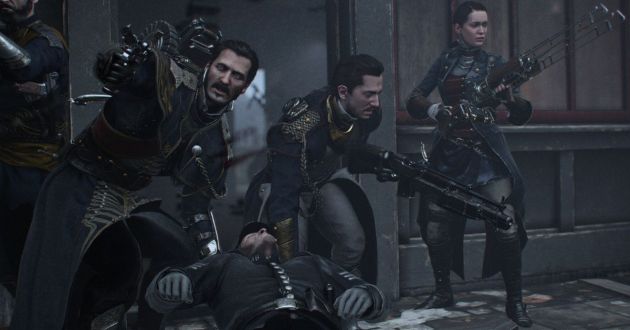
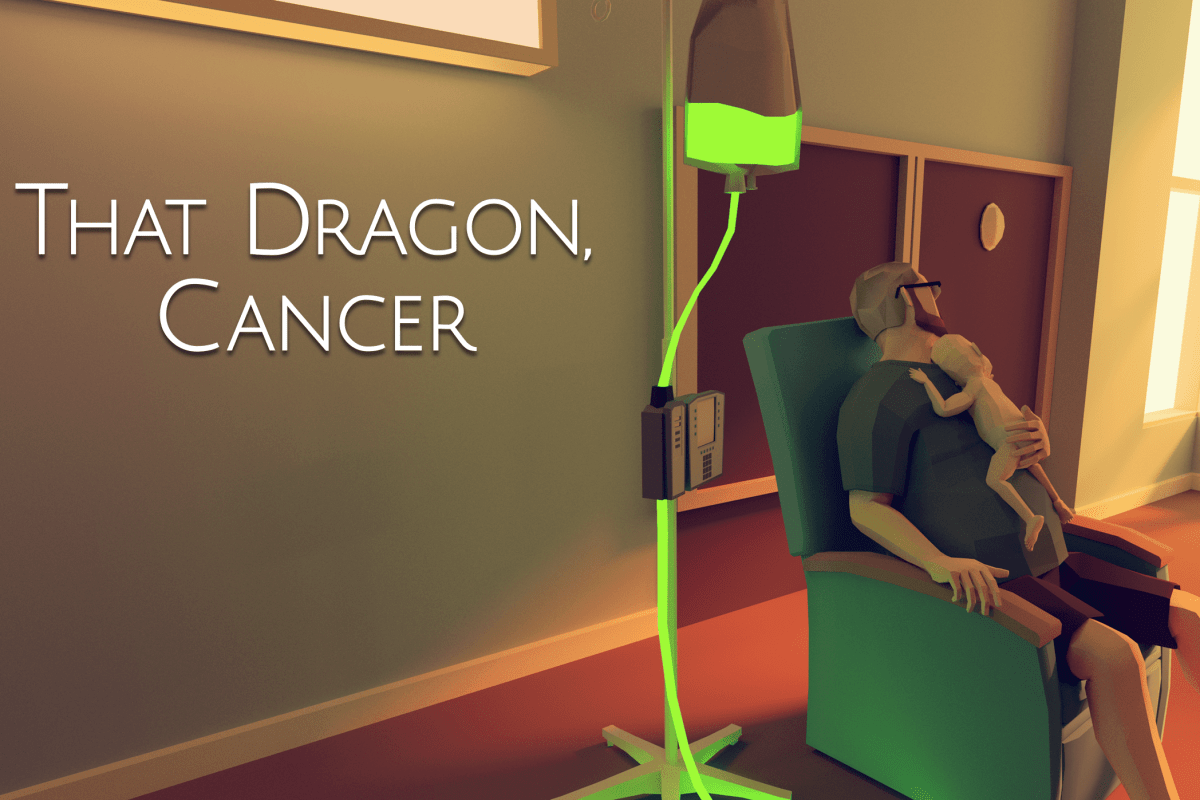


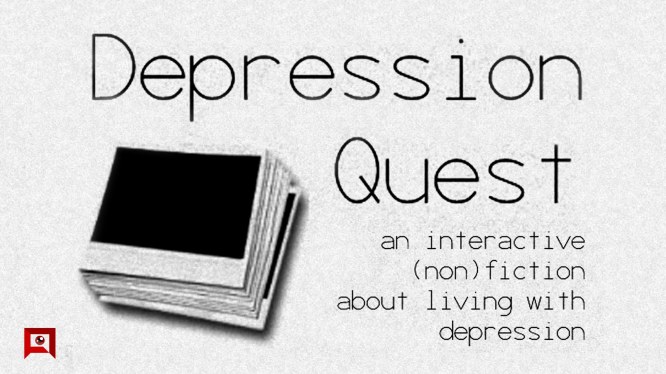



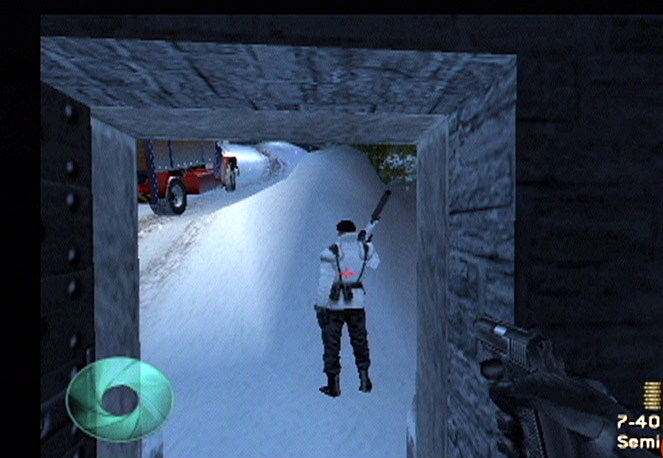


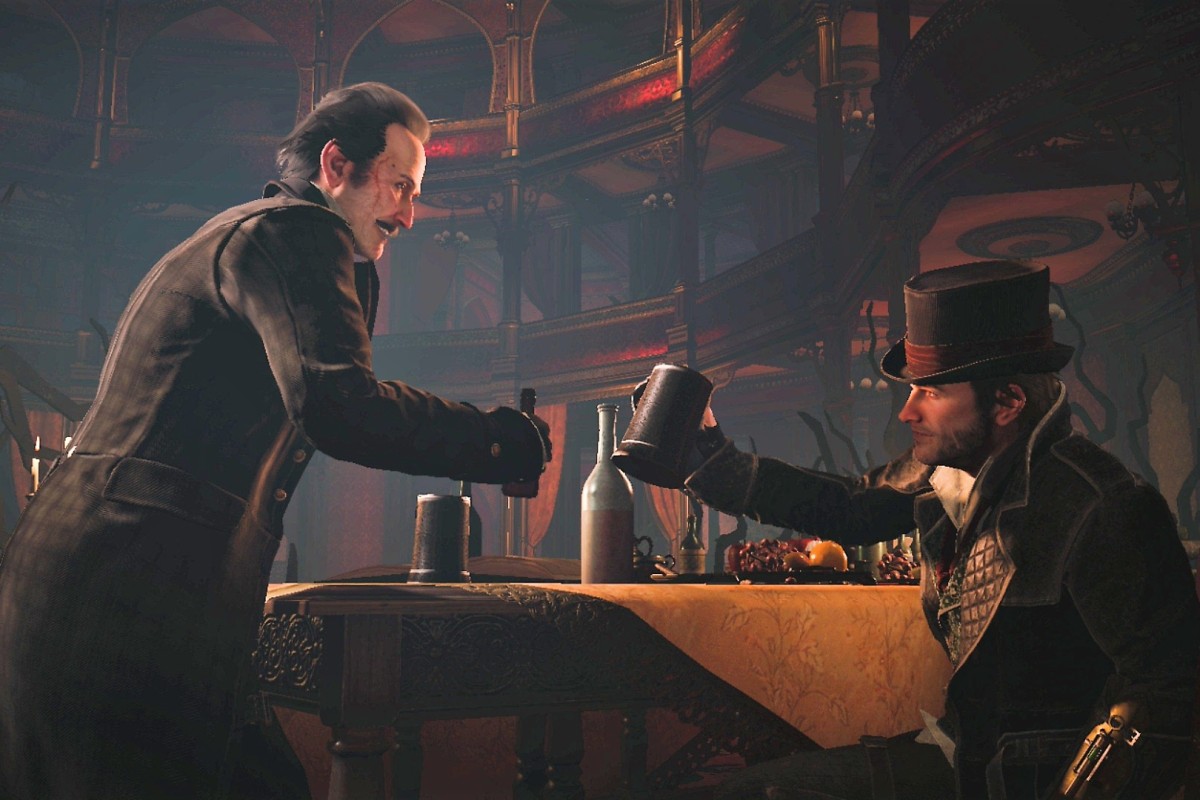
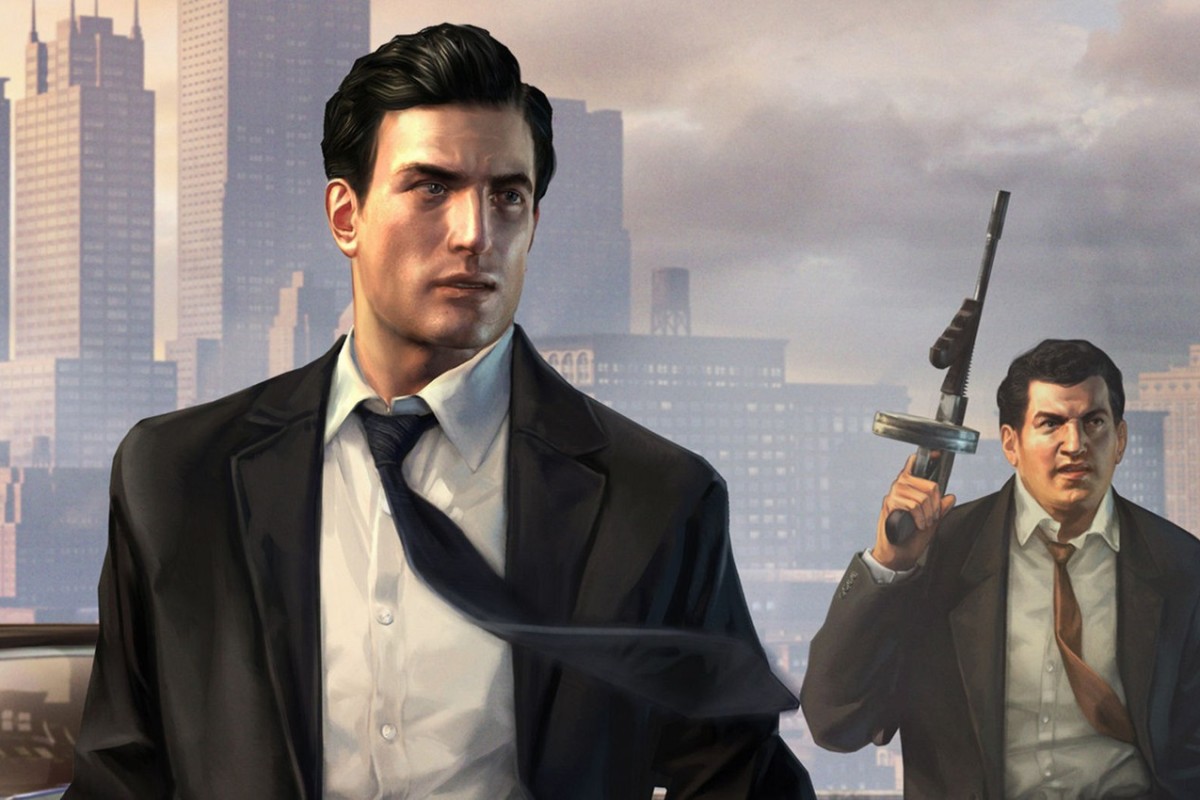
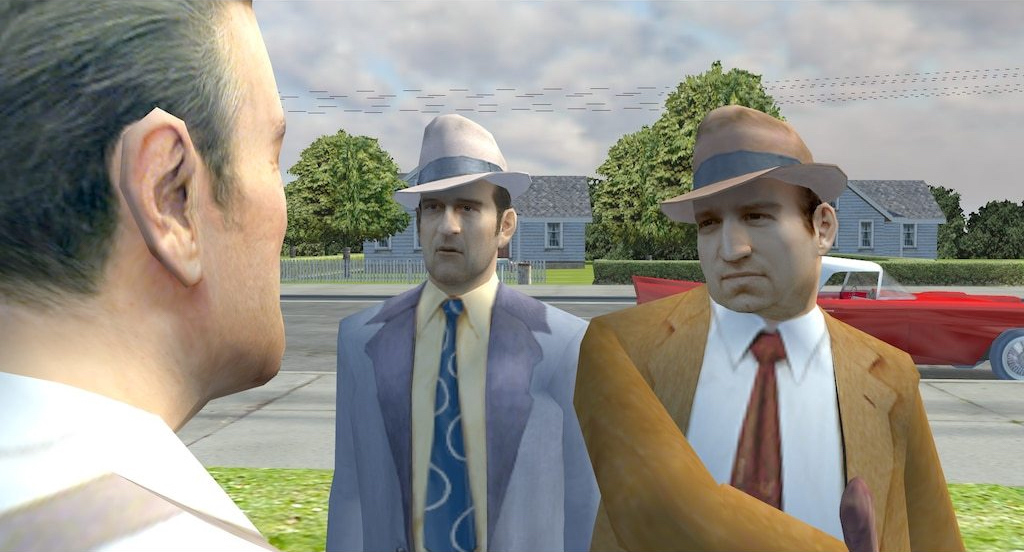
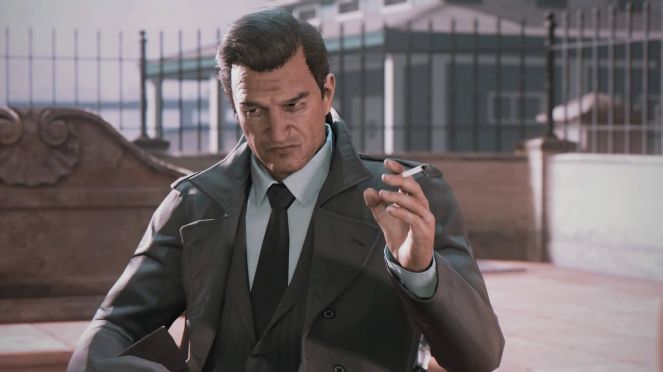
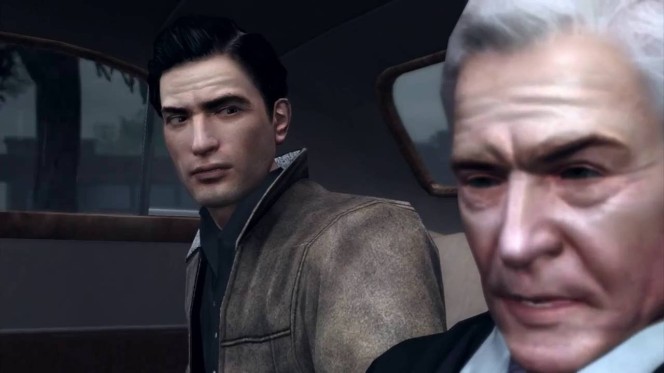
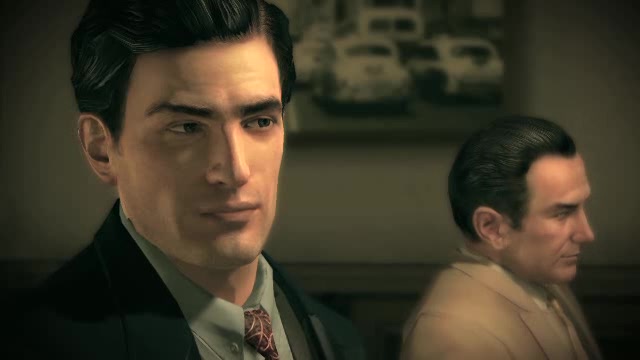
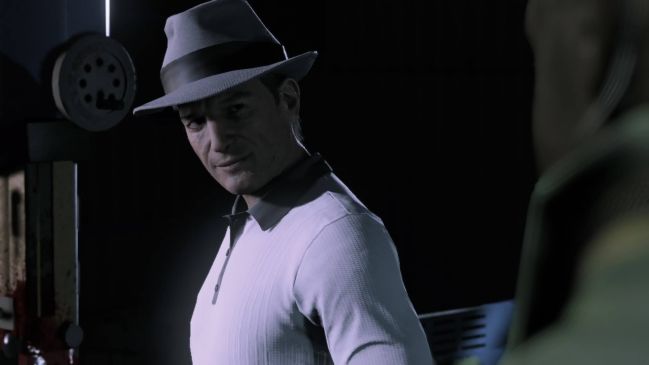
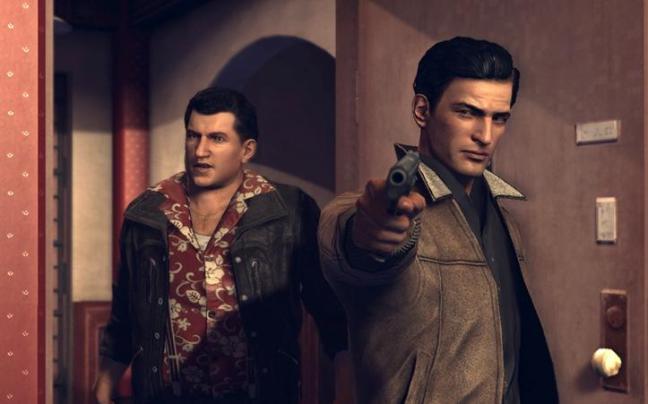


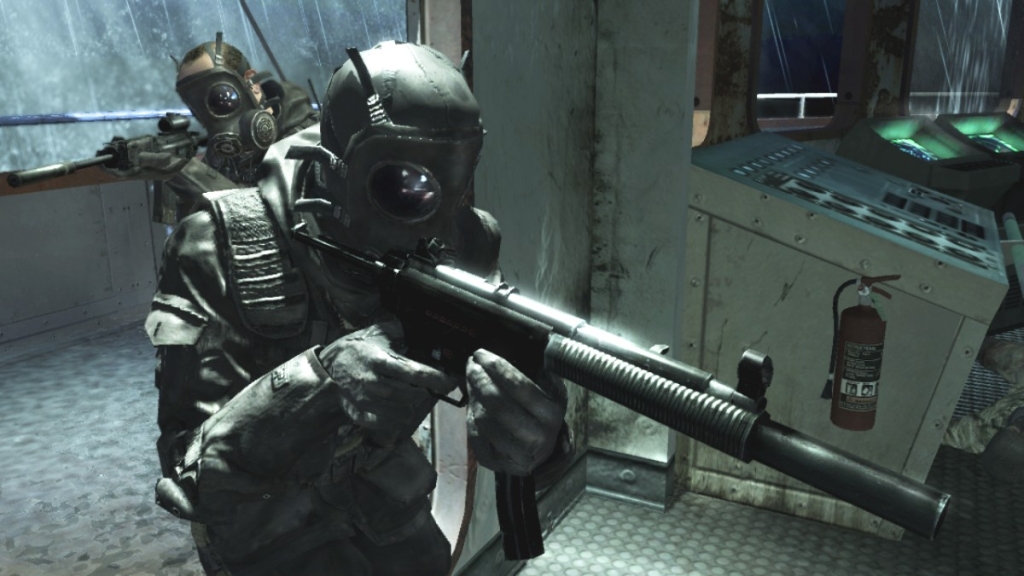


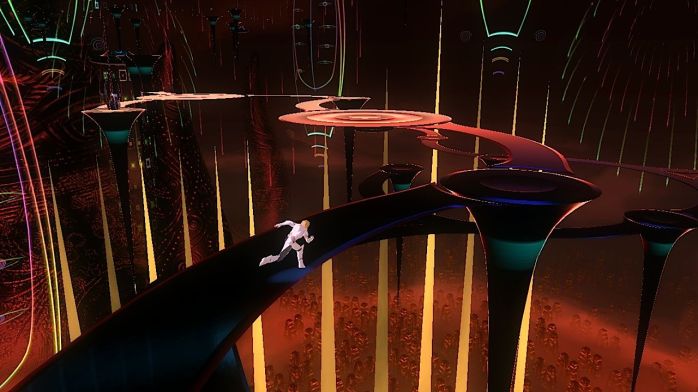


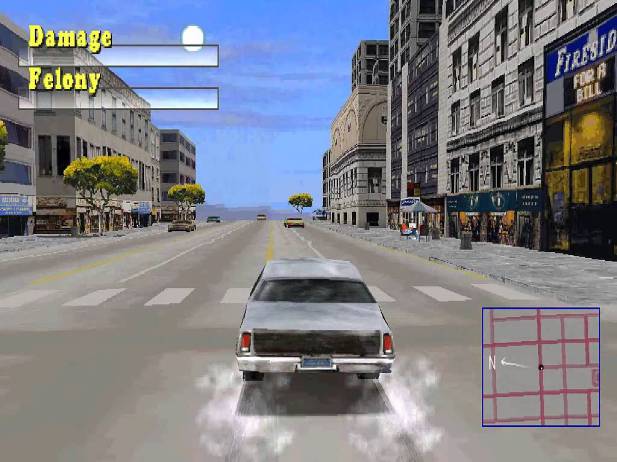
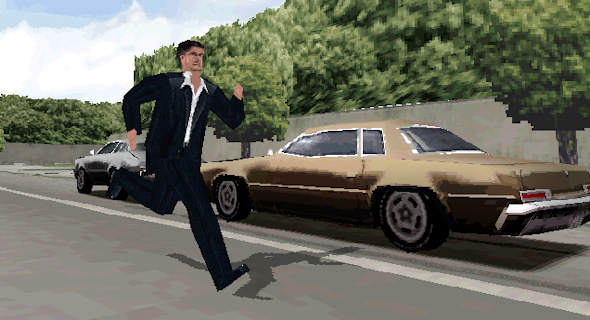
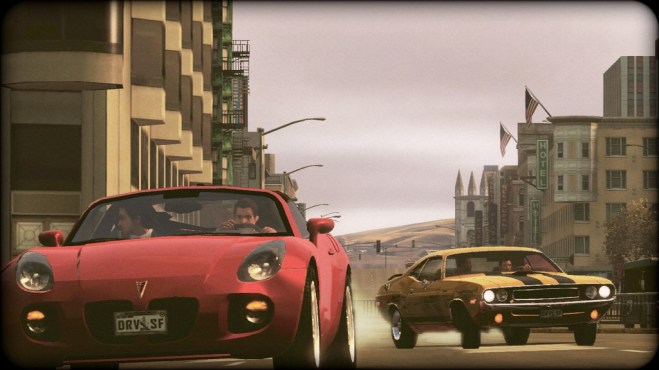

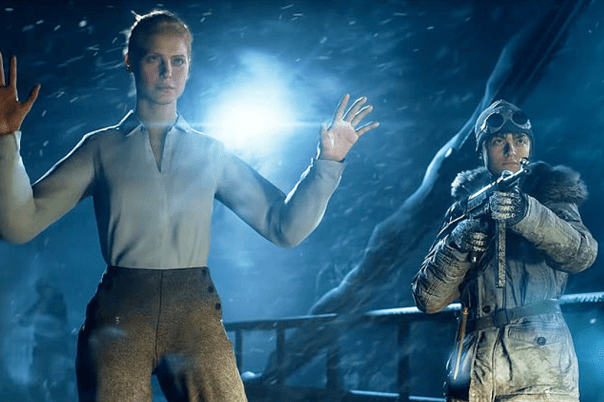
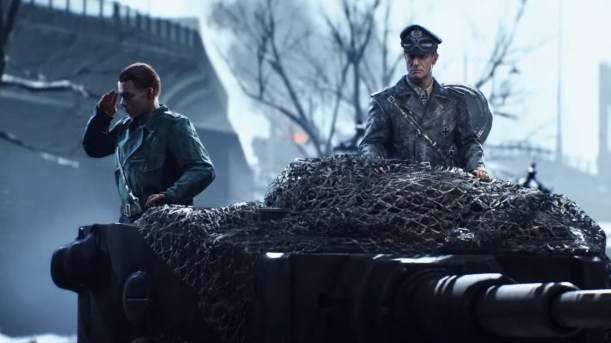
 TOM CLEMENT | GAME PRODUCER | NARRATIVE DESIGNER