Bully – Discovering a Classic

I’ve recently been doing a backlog binge of older open-world games I never got to play the first time around.

Titles have included the Guy Ritchie-inspired The Getaway, which simulates ten square miles of London for its story. Another is Mafia, which uses its city more for immersion into its 1930s world than for regular open-world hi-jinks.

The other old open-world game that I’ve been playing and has captured my heart is the infamous Bully.

Bully (also known as Canis Canim Edit) is such an unique game, even among Grand Theft Auto clones.

Despite releasing originally on the sixth generation PlayStation 2 and then re-released on the seventh, eighth, and now ninth console generation, the game never got a sequel, which I feel is a terrible pity.

I wanted to write about my experiences playing, because Bully deserves to be experienced, even so long after its time in the spotlight.

Dog Eat Dog – Why I Love Bully

Bully was developed by Rockstar Vancouver, a Canadian offshoot of the “Rockstar” brand, known for Grand Theft Auto.

While Rockstar North developed GTA, other studios effectively built GTA clones. Rockstar San Diego created Red Dead Redemption in 2010, and in 2006 Vancouver created Bully.

It’s both amusing and interesting to see GTA, the ultimate adults-only game, have to fit the mould of a schoolboy simulator.

Each new scenario took me by surprise as Bully would put its own spin on the standard GTA tropes.

The missions, vehicles, characters, authority, Bully has all the ingredients for GTA but they are tweaked just a little to accommodate both the cast and the age rating (Bully was released as a 15+ rather than the 18+ of GTA).

Things like spray-painting offensive words onto walls, riding a BMX into town to go to the carnival, Halloween pranks, Christmas snowball fights, Sports Days, it creates a charming atmosphere of being made for rebellious teens who aren’t allowed GTA, but doesn’t patronise the player either.

And while some games could lose shine as more time is spent in them, this charm of “new-yet-familiar” kept me coming back to Bully, both for the boarding school role-play and simulation, as well as the wilder moments that it invents for the story.

Hiding from the prefects after dropping a firecracker down the toilet…again. (Source: rockstargames.com)

Bully does actually play a lot like a roleplaying game with its school timetable. There are six classes; Chemistry, English, Art, Gym, Shop, and Photography.

While some main missions require a particular level (the second half of the game focuses a lot on photography), a player can easily play truant and miss out on classes all together, with no real consequences unless they are caught.

However these classes give you different abilities once you pass. Chemistry allows for restocks of the player’s arsenal (all schoolboy things like firecrackers, bags of marbles, and stink bombs among others).

Art allows the player to kiss girls and boys for a health boost, and Shop lets the player upgrade their BMX, one of the better ways to get around the world.

The game also works on a yearly calendar, starting with the beginning of school term in September and finishing sometime in the summer. This allows for standout missions around Halloween and Christmas, but it’s more than just one-off episodes.

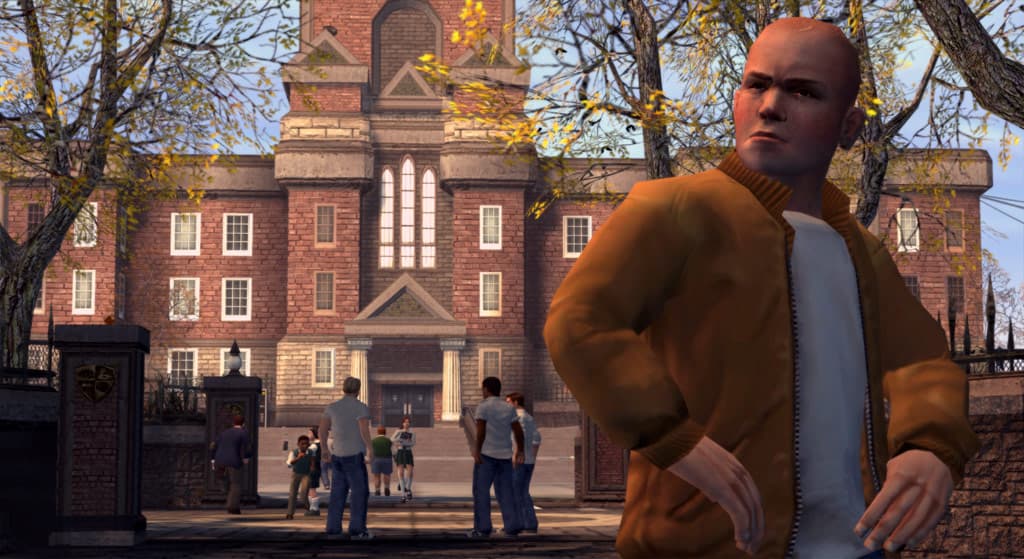
Being set in New England, the seasonal change is dramatic. At the start of the game, the leaves are coloured anywhere from red to yellow and occasionally fall from the trees alongside the odd the rain shower.

In the third chapter winter has come to Bullworth, with the cast now sporting big coats, hats, and gloves. The trees are leafless and it gets darker earlier. New props such as snowmen, snowballs, and shovelling snow as a detention are only available in this season.

Once the snow is gone and the trees sprout their new leaves, the rain continues to pour until the final chapter where the sun comes out and signals the start of an endless summer.

Climbing a tree and raining down chaos with your slingshot…a true schoolboy experience. (rockstargames.com).

Bully doesn’t have the most expansive of world compared with stablemates Vice City and San Andreas, but I think it is far more detailed that either of those games.

The school on its own is rather impressive with dorms, a library, gym, locker rooms, football stadium, basketball court, swimming pool, frat house, auto repair shop, and observatory.

Then the main building also houses the headteacher’s office, cafeteria, and the four classrooms, all of which are open and explorable in the game.

The town of Bullworth is split into four distinct areas. Old Bullworth Vale is for the preppy students and faculty members, with mansions overlooking the water and lighthouse.

Bullworth Town is a major shopping district where the Geeks hang out in the comic book store. New Coventry is an run-down urban estate for the Greasers, and finally Blue Skies is a trailer and industrial park where the Townies stay.

On top of the four neighbourhoods Bully also has a map full of extra locations that are used for maybe one mission or are just window-dressing, but give an extra flavour to the world.

Things like the Happy Volts Asylum, a fully working train yard, The Bullworth Dam, a church and graveyard with a preaching vicar, abandoned tenements, Billy Crane’s Travelling Carnival, and the half-sunken pirate ship next to of one of the many islands off the coast, each one gives a little extra spice or history to Bullworth and makes the city fun to explore.

Bullworth Academy is only one part of the map, but could easily be its own game. (rockstargames.com).

Bully does suffer from the same strong neighbourhood lines that were in Vice City and San Andreas, where distinct seams were visible between say the shopping district and the industrial estate, but it’s forgiven for its age.

And despite its small size, I think it feels richer, mainly due to the level of detail that could be afforded a smaller world.

One thing I do enjoy about the game being a small map is that I get to see the same characters again and again wandering around Bullworth.

While in GTA and Red Dead you do see a few of the same faces in the gang hideouts or the saloon, they soon became background characters to the main character’s individual pursuit, only to be interacted with in cutscenes.

With Bully, I always felt this growing sense of getting to know characters, even if there isn’t much outside of a simple positive/negative comment that I can throw out at them.

It perfectly mirrors being a new kid at school, slowing getting to know people as they pass by in the corridor or school grounds, some saying hello or others stopping you with a quest, some that don’t have any greater role in the game or cutscenes that just being a recognisable face in the crowd.

School’s out…but sliding down the handrail will still get you into trouble. (Source: rockstargames.com)

And after a while it’s fun to pass through the school and be able to recognise people; Gloria the kleptomaniac, Mandy/Pinky/Angie/Christy of the cheerleading squad, Algie the nerd, Russell the slow-witted but beefy tank, and Pete, the only sensible and rational character in the entire game.

But as the location is a school, it’s not just school kids walking around. Teachers walk around from class to class, giving a real sense of a school working to a timetable, rather than just cycling through character and animation loops.

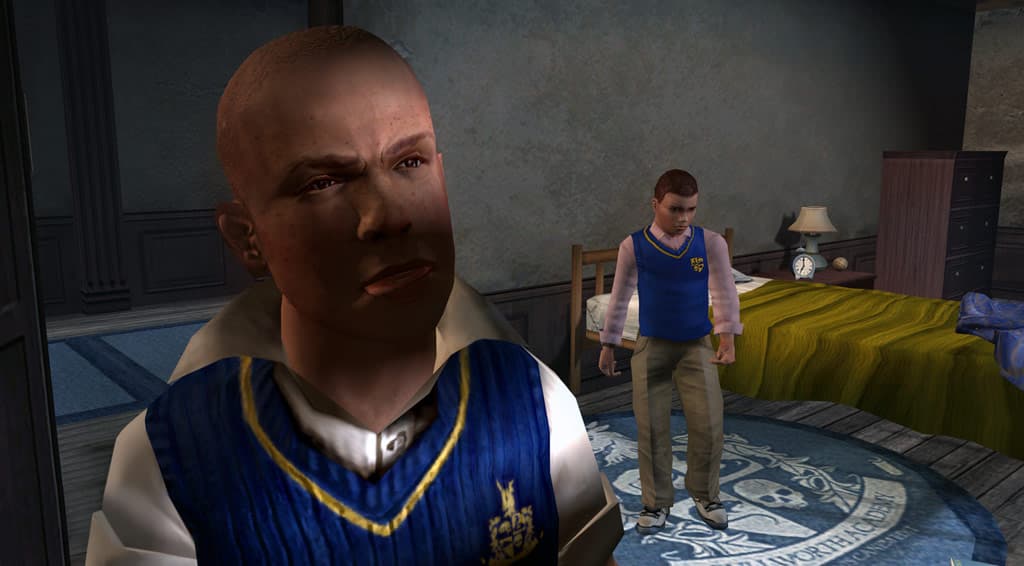
And Jimmy Hopkins, the playable lead, seems alright. He does act like a proto-form of a GTA character; he’s brash, confrontational, with streaks of sadism and misogyny, but I’ll excuse it due to him literally being a fifteen year old child.

While Jimmy is definitely ruthless, he is also shown to comfort other characters when they are feeling down and being heroic in other instances like putting out fires in the school.

Jimmy is actually quite interesting as a Rockstar lead, mainly due to his ambivalence to the entire school system. When he first arrives at Bullworth, Jimmy doesn’t look to take over and become its leader. He just wants to get through with the least amount of hassle and then leave.

It’s only to get back at the sociopathic schoolmate and current school ruler Gary that spurs Jimmy forward. The plot is relatively simple in its driving force, but once again it’s the surrounding essence that makes it shine.

The fact that Jimmy has to defeat all the head of the school gangs before ruling the school, how the different cliques vie for control and actually fight in the corridors and grounds, and how most the cast that give missions act like adults in a GTA game when none of them are older than sixteen is endearing.

It reminds me of games like Yakuza or films like Brick, where young characters have latched onto what they thinks makes someone “cool”, where in reality they are just massive dorks acting like their are in their own personal movie, with Jimmy being one of the only “straight men” in the game.

Every character in the game takes themselves way too seriously and it makes for some of Rockstar’s funniest work. (Source: rockstargames.com)

Like I said right at the start of this piece, the theme of Bully is its strongest suit, but that’s not to diminish its other qualities. It’s a classic sixth generation console game, with a strikingly detailed world, a strong and hilarious story, and a great mix of action, exploration, and set pieces.

So if you’re waiting with anxious breath for GTA VI and wanting something to hit that Rockstar itch, or you are just looking for a open-world game that has a different pace and flavour, I think Bully might just be the thing for you. And hey, maybe one day we’ll get a sequel…

Banner Photo Source: rockpapershotgun.com.

Star Wars: The Fighting Game

I am a big fighting game fan.

One-on-one combat is such a thrilling experience, knowing that through reading your opponent you clutch a win or deliver a flawless victory…it can’t be topped.

I’ve dabbled in all types of fighting games; the traditional martial arts of Street Fighter, Tekken, and  Virtua Fighter, to the sword fights of Soul Calibur, and the magical fantasy of Fantasy Strike.

My first proper fighting game though has been a single release, never got a sequel or a re-release, but is still one of the most fun games I played as a child. It is the movie tie-in game for Star Wars Episode III: Revenge of the Sith.

The mid-2000s were a goldmine for licensed games, being some of most fondly remembered gems of their generation.

Spiderman 2 from 2004 brought physics-based web-swinging into gaming.

King Kong is still one of the best first-person immersive survival games ever.

And X-Men Origins: Wolverine had a level of gore and violence hardly seen in any previous or following incarnation of the character along with real-time injury regeneration.

And then on top of those greats, Star Wars comes out with one of the best sword-fighting simulations of all time. So today I want to talk about it.

An Elegant Weapon, A More Civilised Age Star Wars and Lightsaber Duels

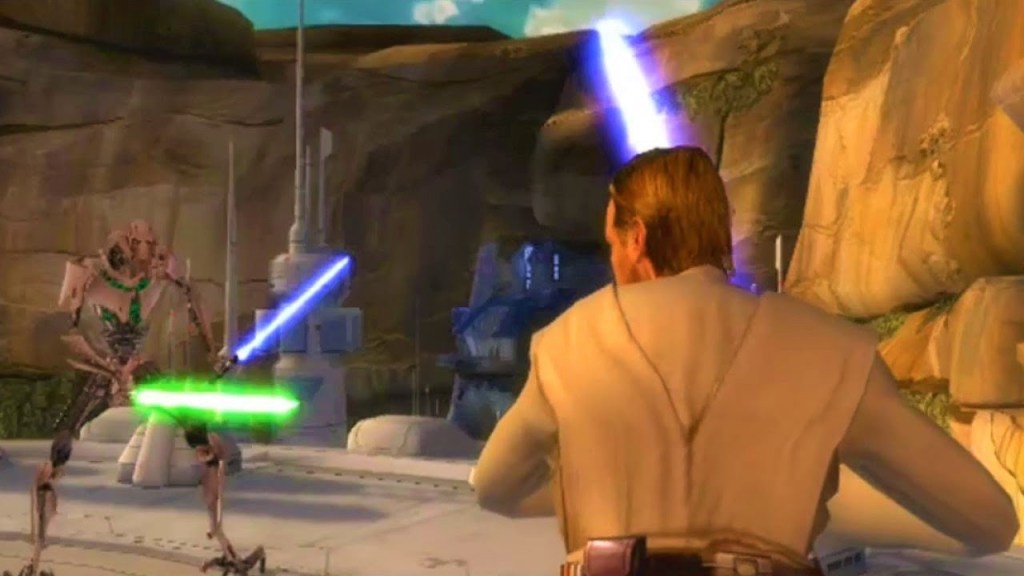
Episode III is for the majority of the time a brawling game. Playing as either Anakin Skywalker or Obi-Wan Kenobi, you fight droids, clones, and a few low-level Jedi through the locations of the film.

But every so often, these two will enter a duel with other fighters such as Count Dooku, General Grievous, Mace Windu, other Jedi Masters, and eventually each other in spectacular one-on-one fights.

Alongside the game’s storyline, you can participate in one-on-one fights either against an AI opponent, or in couch co-op.

While you only start out with Anakin and Obi-Wan and one location (the Jedi Temple), with each duel in the game’s storyline unlocks a character and the location.

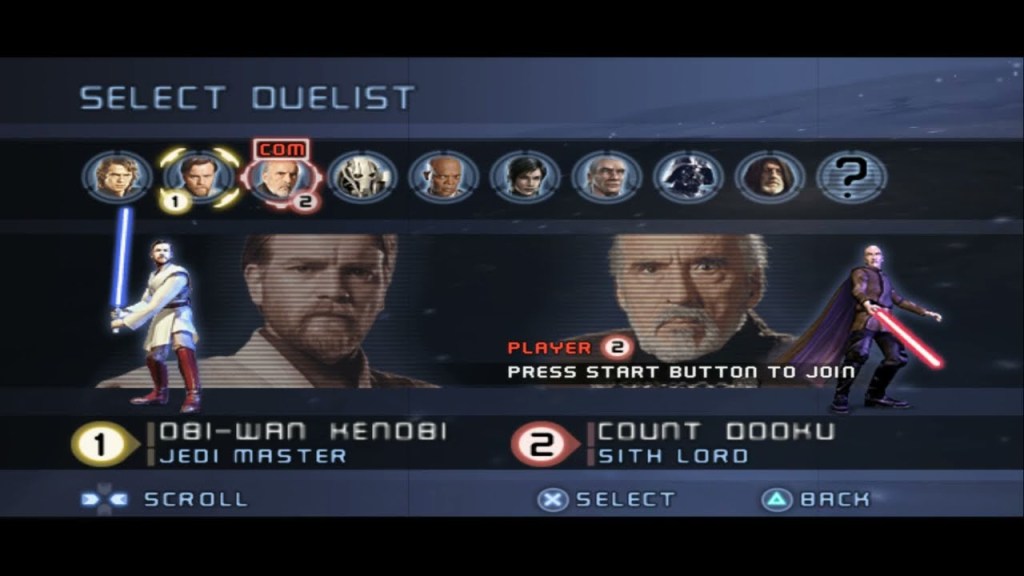
By the final credits there are nine fighters to choose from: Anakin, Obi-Wan, Count Dooku, Mace Windu, General Grevious, Jedi Masters Cin Drallig and Serra Keto, and finally Ben Kenobi and Darth Vader from Episode IV.

The duellists that you can choose from. For mirror matches each character has an alternate skin. (Source: Youtube – mrnygren2)

While it would have been easy to give all of these characters the same general moves and only a few signature moves, each one plays totally differently, giving players a proper choice in regards to playstyle.

Anakin is fast and powerful whereas Obi-Wan is slower but has the better defensive option. Count Dooku is based more on parries and thrusts, similar to a fencer.

Mace Windu is slower but has good reach and strong attacks, while General Grievous can overwhelm opponents with his four lightsabers and get a few cheap shots in with his concealed blaster.

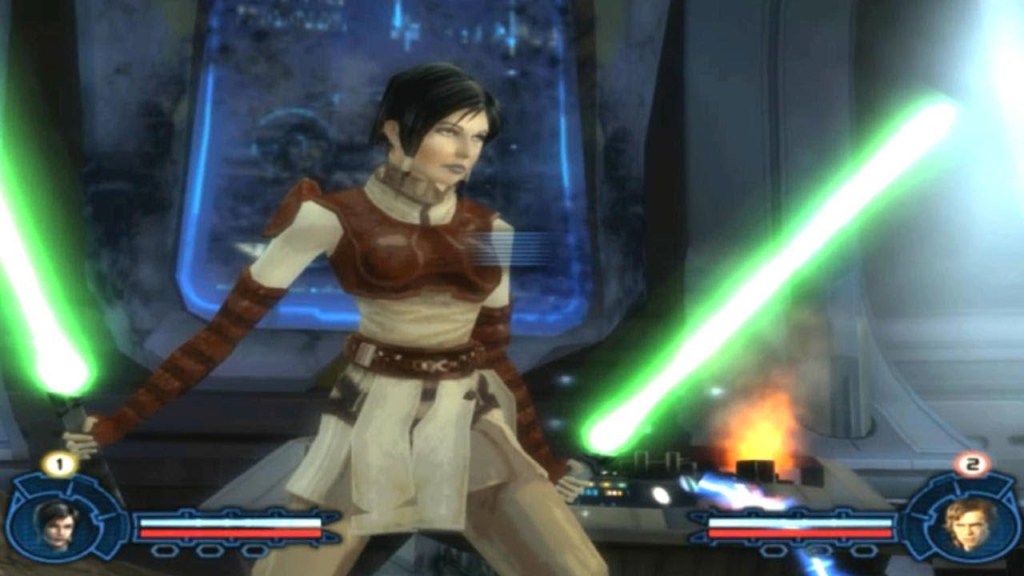
Non-canon Jedi Serra Keto and Cin Drallig (the latter being SW combat choreographer Nic Gillard, his name reversed) are two unique styles, with Keto employing two lightsabers and multiple acrobatic moves, and Drallig being able to literally blur himself during combat.

And finally, Darth Vader is the strongest but one of the slowest fighters in the game, and Ben sacrifices some speed with stronger attacks and Force powers.

One of the strongest characters versus the best defensive option…who will win? (Source: Youtube – CJR Gaming)

The combat is similar to your standard string-based fighting game like Tekken or Guilty Gear, meaning that inputting the attack buttons in specific orders will net you different attacks and sequences. As I said previously, each string gives a unique animation, which elevates the game higher than a standard movie tie-in.

Attacks are broken into light and heavy varieties, but what gives Star Wars a bit of flair is the Force, which adds a whole new system of control and power into the combat.

Despite eight of the nine characters being able to use the Force, it’s actually the thing which is most standardised across the fighters.

Every fighter has two variants of Force Push, one as a general move any objects around you, but then a more controlled version where they pick up a singular object and throw it, which can also be used on opponents.

All fighters can throw their lightsaber like a boomerang and can even heal themselves using the Force. The only main difference is the Force Stun (for the Jedi) and Force Lightning (for the Sith).

Force Stun…well, stuns the player, leaving them vulnerable for a few seconds to be attacked or for the opponent to heal, whereas Force Lightning is purely offensive, draining the health of the opponent. It’s an interesting trade off, going with a more offensive option or one that can be both offensive or defensive.

Anakin in the Duel Mode actually changes between the two as you progress in the story mode, using Force Stun until he falls to the Dark Side, where he will then start using Force Lightning.

Serra Keto is unqiue for her two lightsabers and her slow but unblockable Force-infused attacks. (Source: Youtube – RGLD Gamer)

General Grevious is the only outlier being a non-Force User, but he gets some additional help, with a rapid fire blaster replacing his Force Push and a charged-up shot replacing Force Lightning. His signature four-armed attack takes the spot over the Saber Throw.

The stages are all taken from the story mode, being unlocked at the same time as the other characters.

Since they are all focussed on Episode III, the locations span space-stations, landing platforms, the Jedi Temple, and the impressive vistas of both the sinkholes of Utapau and the volcanic rivers of Mustafar.

The locations in the game are broken up by area into smaller chunks as well. Take Mustafar for instance.

The first section is the landing platform that Anakin and Obi-Wan first clash sabers. It’s a wide area with several explosive crates to throw at your opponent.

The second area is the control room, with command tables splitting the room, allowing a player to be out of range of lightsaber attacks, and either regain some health or use a long range attack to keep their opponent back.

Out from the control room onto the third section, the balcony. It’s cramped and linear, the complete opposite of where the fight started. To add even more to the mix, the explosive crates are back, but since the area is so small any explosion could impact you as well.

Dropping down from the balcony onto the “Control Arm”, again a linear section, but extremely long, not the cramped quarters of the balcony.

And while there are no more explosive canisters, the control arm is constantly getting rained down on by lava, stopping players from either retreating or advancing, having to riskily jump towards their opponent or wait until the magma has cooled.

Finally, the fight culminates on the Lava Platform, the smallest map in the game, barely big enough for the two fighters to deliver their most devastating moves.

That’s just one planet and it gives such a variety of locations that either compliment or hinder certain styles of combat, with every other location also containing environmental hazards, barriers, or extremely linear or cramped fighting halls.

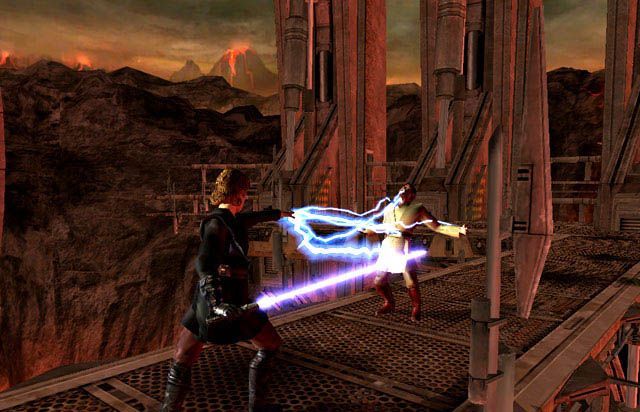
Darth Vader unleashes force lightning on his former master on Mustafar. (Source: ign.com)

In research for this piece I wanted to look at other players and see how they related to the game and found a small but thriving community that still plays the game competitively today.

Using a PlayStation 2 emulator, players have been continually hosting tournaments even up until a few months ago, with rulesets to keep things interesting (the main ones being no Force Heal and no Mustafar Lava Platform stage).

The fighting game tech has gotten so meta that players will use a particular save state that allows them to choose Anakin with Force Stun instead of Force Lightning.

It’s amazing to watch, with clutch matches and spectacular finishes, and the added bonus that it is a Star Wars game, with the characters, fighting styles, weapons, locations, and music that we all know and love.

***

When I wrote about my brief but fun time playing Star Wars Ep. I Racer recently, I lamented the lack of Star Wars games in recent memory. Since that post the only new game was Jedi Survivor, the sequel to 2019’s Fallen Order.

There has been a brief upsurge in announcements, with names such as Quantic Dream, Zynga, Ubisoft, and Skydance all developing some sort of game and a wide range of genres including strategy and interactive drama.

And while there were Star Wars games dedicated to duelling before (Masters of Teräs Käsi for PS1) and after (The Clone Wars – Lightsaber Duels for the Wii) neither have had the impact and staying power of Episode III.

Just like with Ep.I Racer, you can see the outline of a game that would sell great today. Having duellists from all three eras, different and expansive locations, selectable force powers and fighting styles, customisable lightsabers, and of course online play. But sadly I think the time has passed.

In my research I found several players reminiscing on playing the duel mode and wishing for more. Even I bought the game nearly fifteen years after it released because I hadn’t found anything that simulated lightsaber combat so well.

It was the duelling game that did Star Wars well, and it deserves to be remembered and played to this day.

Banner Photo Source: moddb.com

Learning to Drive a Formula 1 Car

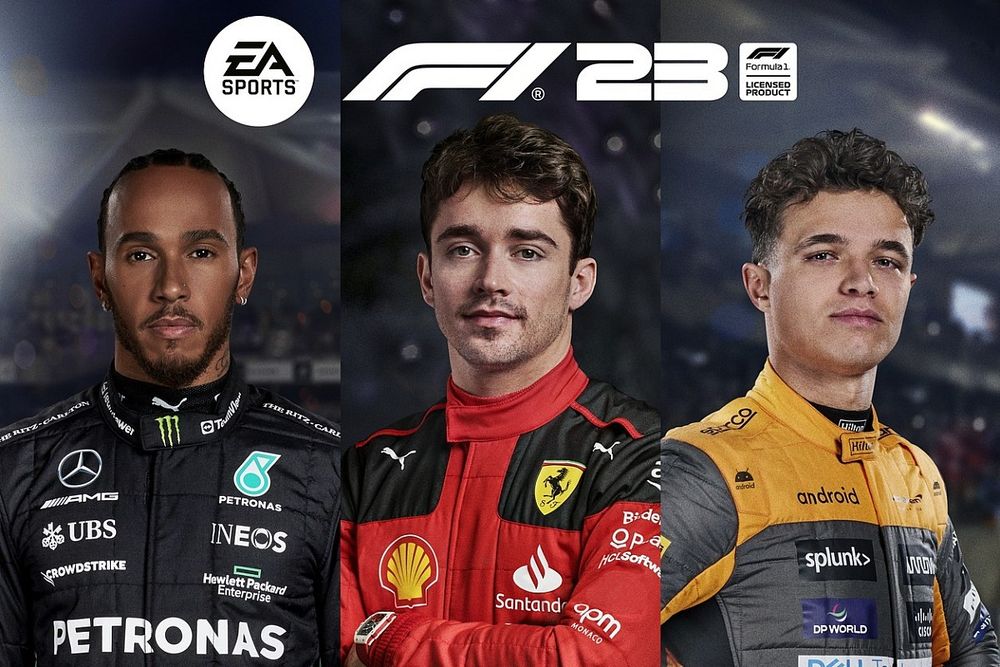
Formula 1: Drive to Survive, ridiculous subtitle aside, brought millions of new fans to F1, myself included.

The now multi-season Netflix series is sometimes mocked for its hyping of minor incidents and selective storytelling, but it is a thrilling look into the high speed and high drama that comes with the sport.

So naturally, I went and bought an F1 game.

Surviving the Drive – What 1000+ Hours with Guenther Steiner Looks Like

Racing games have always been a part of my gaming life.

I distinctly remember some of the first games I ever played were Gran Turismo 2 and Lego Racers on a PlayStation 1 (quite the opposite ends of the spectrum I must admit).

On the Nintendo 64, my days were spent switching from Mario Kart to Star Wars: Pod Racer (which recently got a remaster, which I thoroughly enjoyed).

As I graduated up to an Xbox 360 I had stints in Forza, Split/Second: Velocity and Pure.

And even amongst the PlayStation 4, I dabbled in Steep and the Crash Team Racing remaster.

So I had a background in racing from all genres and was looking for something to scratch that itch once more. And originally, I wasn’t going to go for F1.

I wanted the high speed and the iconic tracks, and I originally was going to go for the Wipeout Collection for PS4. I had played Wipeout before and had fun zooming around the courses and firing off rockets at other players.

But there was one thing missing that I was really yearning for…characters and a story.

Drive to Survive does an amazing job of creating a storyline each episode, focussing on different drivers, teams, and race courses, weaving them together into a satisfying narrative.

That’s what I was looking for in my racing game, a constant and emergent story that would develop as I would play.

Another weekend, another race. Slowly building up a story with your wins, losses, and everything in between. (Source: twinfinite.net)

Pod Racer and Split/Second had something similar with its ever-growing cast of characters that you could choose from, with drivers having ‘favourite’ courses, but aside from their vehicle stats there wasn’t much to separate them from each other.

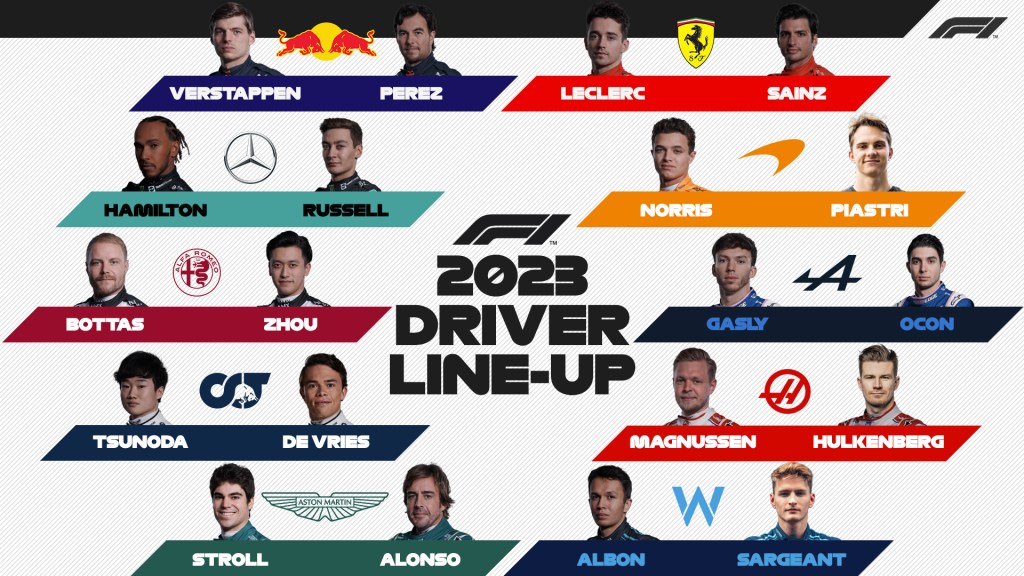
While I am bringing my knowledge from DtS with me, we as players get to see every driver multiple times in a single session. Through free practice, qualifying, then the starting grid where everyone’s faces are front and centre, and then finally seeing their abbreviated names on top of their cars, you get the sense that these are actual drivers, rather than just a name.

Depending on what car you are in and where you are on the grid, you will see the same names popping up around you, developing mini-rivalries as the races go on. People that I would support when watching races I became bitter enemies as they overtook me, and for the rest of the race I would be determined to beat them.

On top of these self-made rivalries, the game at certain points (in the guise of journalistic interviews) asks who you consider to be your rival. Points are given after every race, which your rival also gets.

Finishing on the podium obviously nets you more points, but also driving penalty free, getting the fastest lap in free practice, and so on allows you or your rival to advance quicker. It creates tense moments where you might not have the pace on track to beat them, but you can make up lost points in the aggregate. It’s a simple yet effective and I always had a thrill trying to beat my rivals.

Your rivals and your teammate for the season. Those two aren’t always mutually exclusive. (Source: total-motorpsort.com)

And beating them is quite hard. Accessibility is low on the game’s priorities, meaning you need to tweak and tinker to find the perfect set up. You have only just customised your driver avatar and chosen your team when the game throws a spreadsheet nightmare in your face of settings.

To be fair to the developers, nearly EVERYTHING is customisable.

Not just the aggressiveness of the other drivers, but the surface type, car damage, the damage rate, tyre temperature, pit lane entrance, pit lane exit…and that’s just the simulation settings.

In Assists, there is steering and braking assists, anti-lock brakes and traction control, along with a whole myriad of changes. You can even adjust the dynamic racing line (where the game tells you where to brake and how hard), either in 3D or 2D, and having it only appear in the corners.

I admit I was a little daunted at first, so I set most things on and brought the difficulty down to “Easy” and entered Bahrain. I ended up winning by a good thirty seconds and knew I had to switch to a harder difficulty.

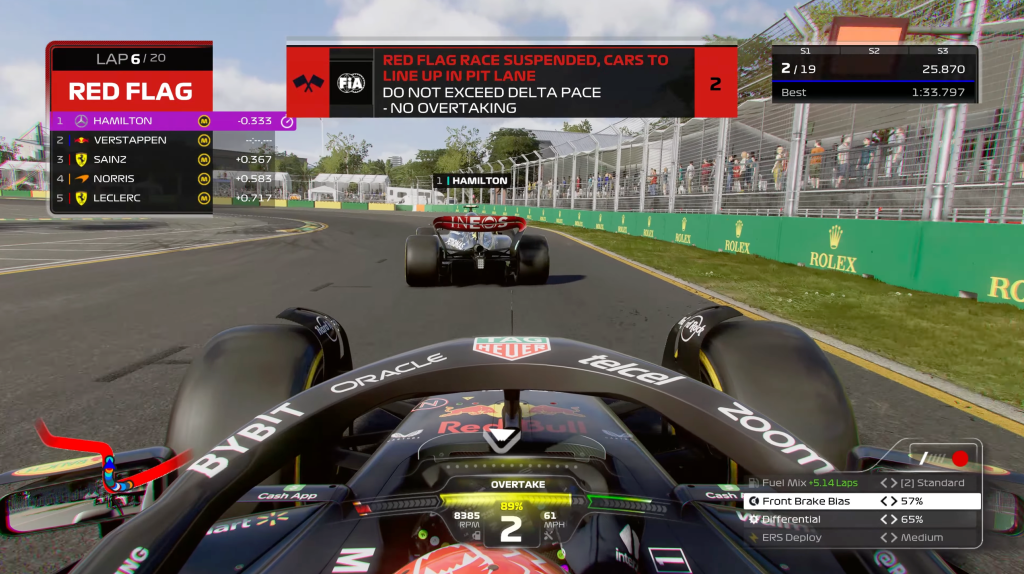
Notice the menu in the right corner, allowing for car customisations during the race. (Source: operationsports.com)

While other racing games I was always wanting to finish in 1st place, here I was fine with not always winning each race, partly because of the car I chose. Being a DtS fan, I went with the underdog, Haas.

The cars work on a tier system; the Red Bull and Ferraris can take corners better and reach faster speeds respectively, whereas teams like Williams and Haas usually fight for the bottom of the points, if not the bottom of the leaderboard.

But that comes at a cost. In Haas, the only requirement in the race is to beat my teammate. In Red Bull or Mercedes, they will expect a high points finish, with demotion or firing if you can’t deliver the team requirements.

But even in a slower, lesser powered car like Haas, the circuits are the main draw, and they are amazing.

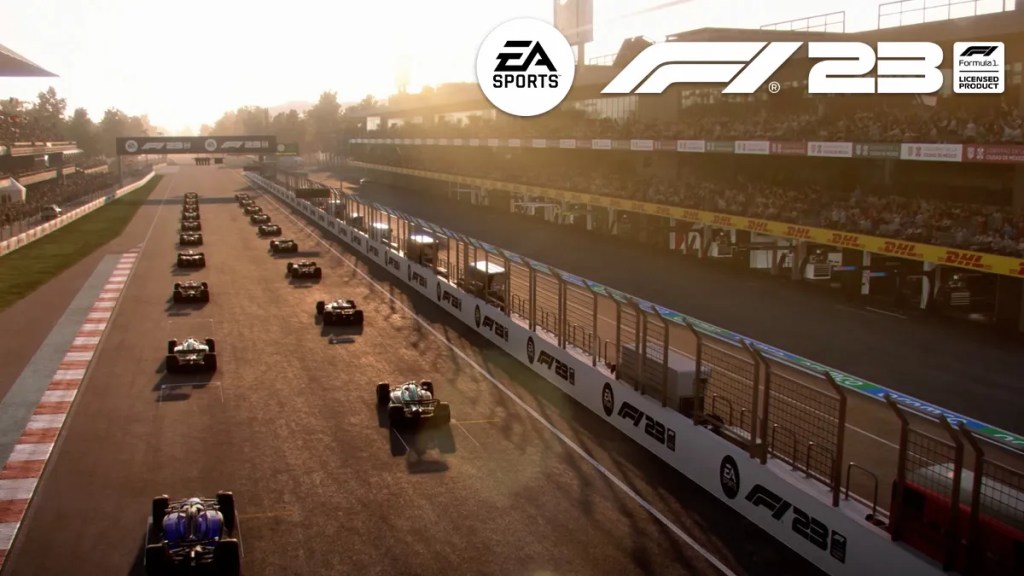
These tracks are iconic, some having been used for over one hundred years for races, but each one does feel distinctly different, leading to a thrilling challenge each time the next race weekend comes around.

The game follows the actual race calendar of the season, starting in Bahrain and ending in Abu Dhabi. And while Bahrain is listed as “Easy” in the course selection, the second track, Jeddah, is listed as “Hard”.

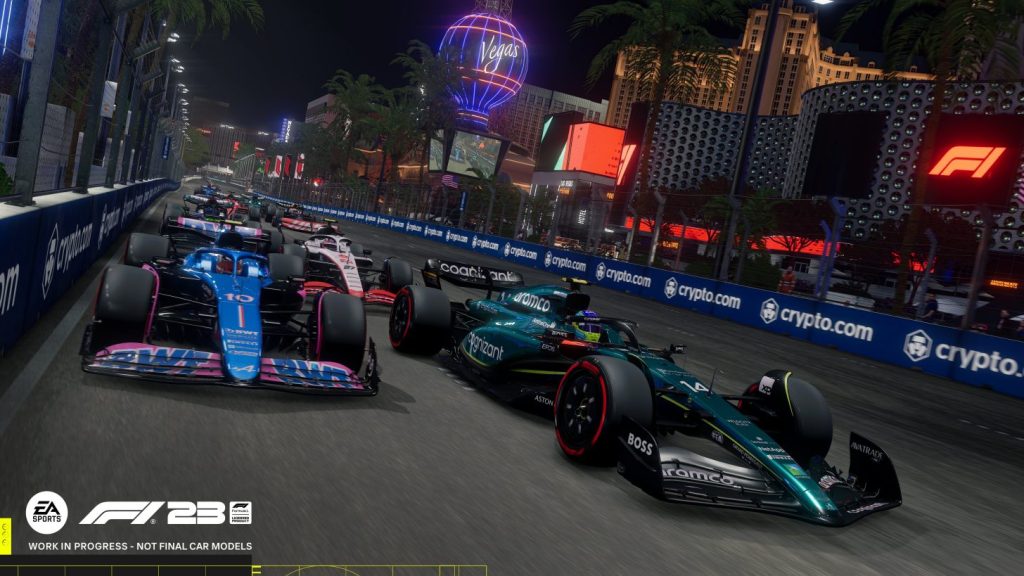
The Las Vegas course, new for 2023 and known for being one of the harder courses. (Source: insider-gaming.com)

The game boots you from one end of the difficulty ranking to the other (including “Very Easy” and “Very Hard”), requiring even more time spent in the settings to make certain races bearable. I had to turn off damage completely at Monaco otherwise I wouldn’t have been able to finish the race!

But while the tracks can sometimes be intimidating, the game actually gives the player plenty of chances to get used to the next race.

First comes the Pirelli Hot Lap, a small challenge that actually takes place each race weekend. Using a souped-up sports car rather than an formula car, the challenge will be something like get the highest speed in one particular section of the course or pass through every gate within the time limit. It’s still low stakes, but it gets the player used to some of the corners.

Next comes free practice, allowing teams to test out certain builds or styles, seeing which gets them the best times. Then after is qualifying, and then finally the race. Depending on the length of the session, free practice and qualifying can be up to an hour.

And while there are mini-challenges to work on in practice such as driving to conserve fuel or tire management, it all serves in learning the corners and straights, until you feel ready enough to go for the race.

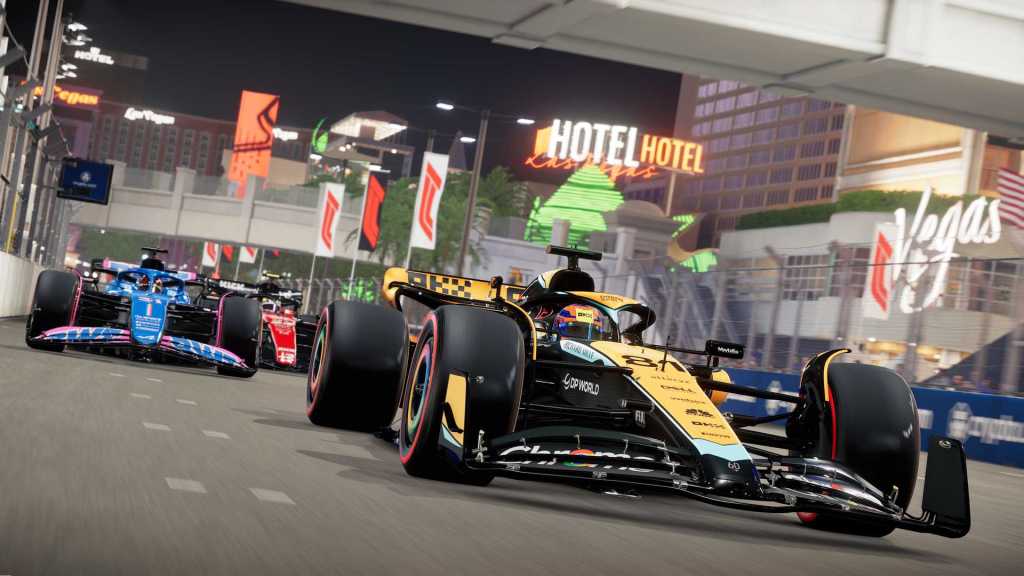
The game is gorgeous to look at, especially during night races. (Source: racefans.net)

And racing has me hooked. Driving a car that can reaches nearly two hundred miles an hour on a straight, sliding round corners with ease, fighting for places amongst the grid, it just has a magical quality that can’t be matched.

Also, no need to worry if you crash, spin out, or even just take the corner a little off the line, the game has a very nifty instant replay editor, going back to around the last five or so seconds, allowing you to start again from anywhere within that five seconds so you can try that corner again and again until you get it right.

I will admit I am a frequent user of the instant replay, but nothing does beat getting around the course or that one tricky corner without using it, leaving that section of the course with a giant smile on my face.

And then you get used to the track, you remember the sequence of corners, what comes next, enjoying certain parts of the track, dreading others…and then it’s done and onto the next one.

It’s thrilling yet fleeting, ever-changing yet the same, and that’s why I’ve fallen in love with F1 22 and will continue long after my first season is over.

Banner Photo Source: motorsport.com

Mirror’s Edge: Catalyst and Queer Coding

Despite coming out over fourteen years ago, Mirror’s Edge is still fondly remembered for both its amazing art direction and its superb gameplay.

While the concept of free running had been bubbling up under the surface of popular culture (highlighted in 2006’s Casino Royale, and reaching the gaming sphere in 2007 with Assassin’s Creed), no game had before (and in my opinion, since) made first-person free running a resounding success.

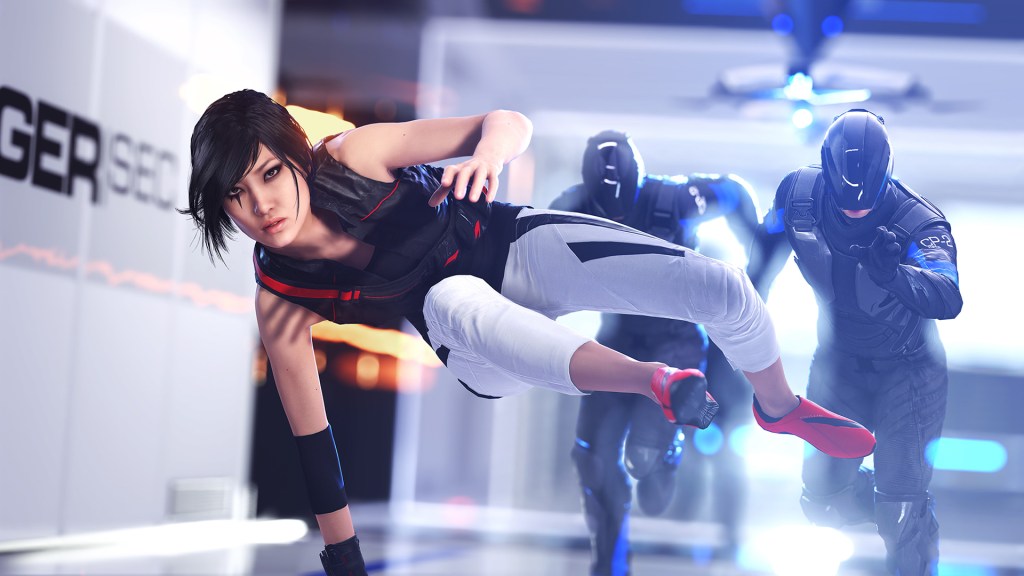
Fondness and fidelity kept it spinning in disc trays and hard drives, with lead character Faith Connors becoming instantly iconic, despite the story being quite sparse.

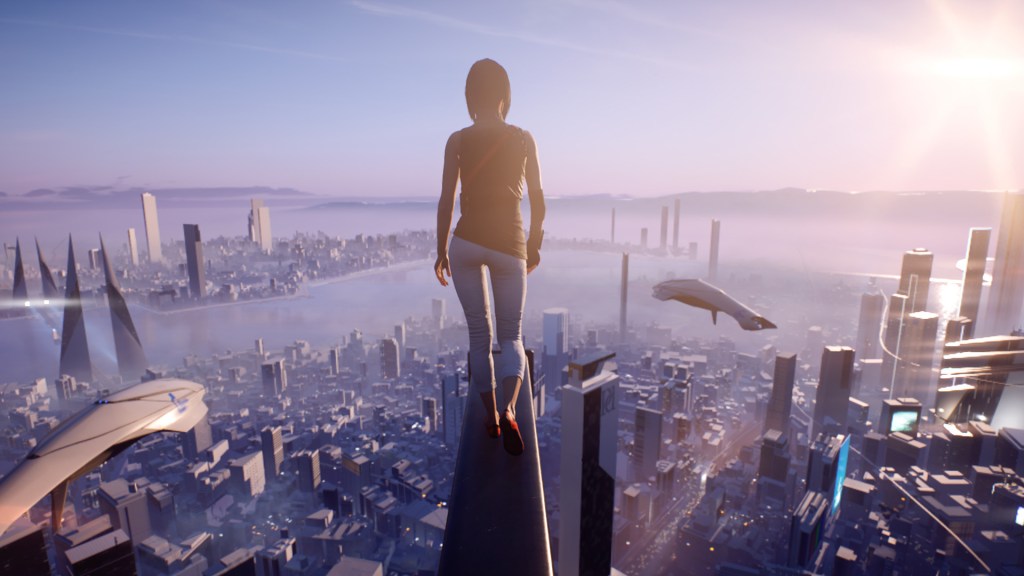
Eight years after the original, a sequel/reboot, Mirror’s Edge: Catalyst, was released. Keeping Faith and the “City of Glass”, it expanded upon the world and backstories of the characters, while maintaining focus on free running across the rooftops of a near-future city.

It’s one of these new characters I wanted to focus in on, one that got very little in terms of story and screen time, yet has left a lasting impression on me, all due to their interaction with Faith.

While never explicitly said in the games, many fans of the games have questioned Faith’s sexuality. Some claim she is gay, some say asexual, and others say she’s straight, all with their various evidence for their opinion.

While I could be swayed in any which way, there is this one character, one interaction of less than a minute and a half, that pushes me toward one direction. I like this scene, for all its coded phrases and hints, and that’s why I wanted to analyse it.

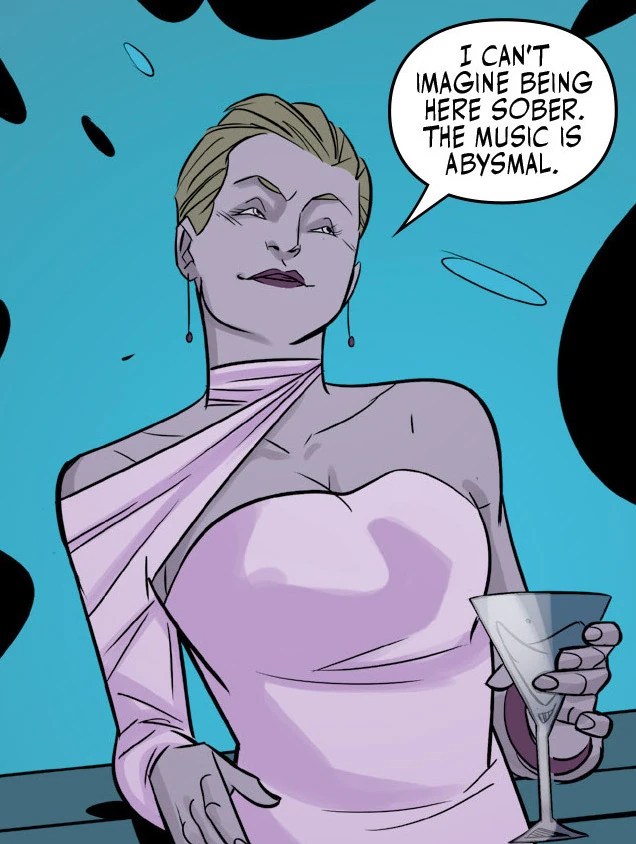
So, let me introduce you to Beatrix Bloch.

Exit Strategy – Faith, Beatrix Bloch, and Queer Coding

Beatrix Bloch’s entrance to the story is quite abrupt.

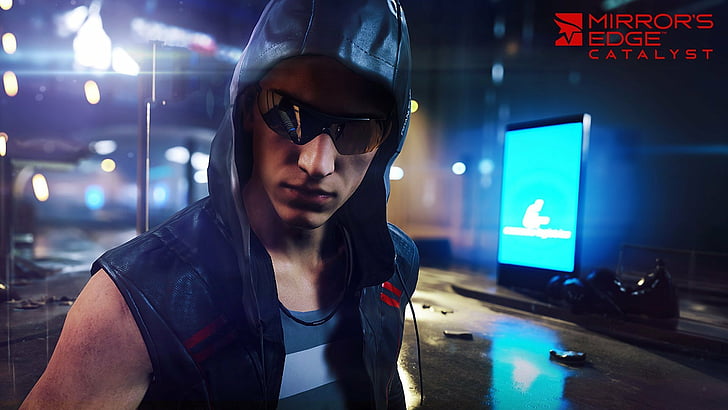
Catalyst has various side missions for the players to complete, mostly given by characters Faith has already interacted with, like free running mentor Birdman or whiz-kid hacker Plastic.

This is also how Beatrix Bloch enters the story, but not connected to any other character or mission; she calls out to Faith directly.

This is interesting for two reasons. First, Faith is quite a solitary character. She has rivalries and a few friends, but no one really close. Even Plastic, who Faith puts her…well, faith in several times during the game, they aren’t the best of friends.

Second, Faith is part of the underground resistance, whereas Beatrix is part of the hiCaste; the ruling elite of the city, putting these two characters at opposite ends of both the social and economical spectrum.

So for this woman to be able to call up Faith especially and exposing herself to an illegal underground network and banishment from the elite, she must be quite the character.

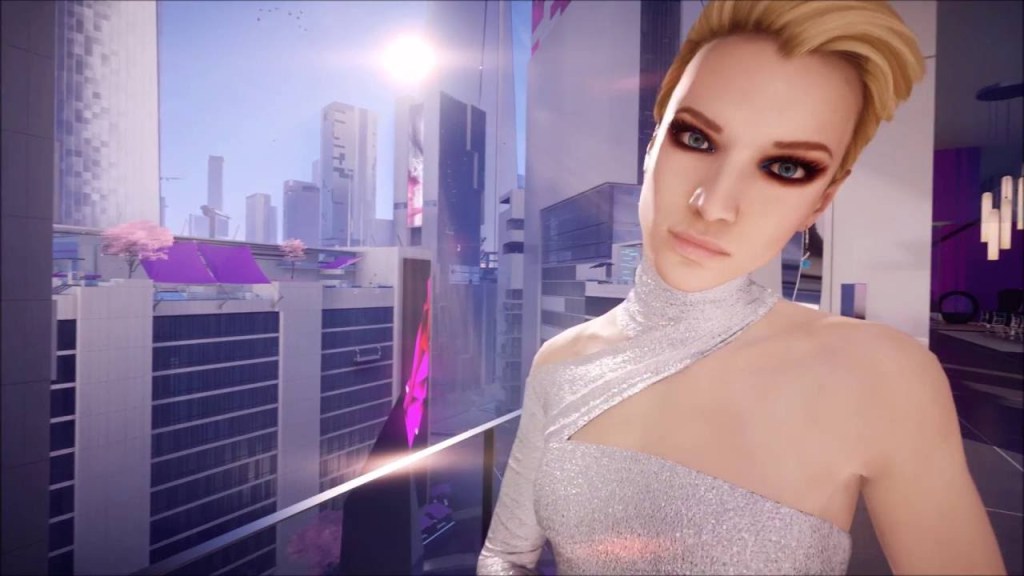
A striking presence…despite only being on screen for less than a minute. (Source: Youtube, ChriSEfron)

Upon reaching Beatrix’s apartment in the more affluent part of the city, a pop-up appears, giving players a little more backstory into Beatrix and Faith’s friendship. The transcript reads as follows;

“You met BEATRIX BLOCH briefly shortly before your capture two years ago and the two of you had a short, but honest conversation. She might be HICASTE, but there is something you can relate into in her. Now she needs your help with something, thought whatever a woman like her might need help with is beyond you.”

This prior meeting takes place in the associated comic book, where the two women met in a nightclub, and Beatrix told Faith how she was envious of the runners’ freedom, and wishing she didn’t have to follow the rules dictated by her caste, even who she wanted to marry. She even says she would trade places with Faith in an instant.

However, even though there is a lot to unpack there, I’m deciding to focus on the game, so we can discard the comic story from the discussion.

Even without the prior knowledge of the comic interaction, the mission’s briefing asks several questions.

How did these two characters, of completely different social standings, come together? What does Faith relate to in her, something that she sees reflected? How are they on first name terms after one meeting two years ago?

It speaks to something hidden; this is a society based around surveillance and security, yet these two made a connection that transcends that perceived threat, something that bonds them together on a more emotional level, something that Beatrix would risk to contact Faith, and Faith would risk capture to answer.

Beatrix Bloch as she appears in the prequel comic, Exordium. (Source: mirrorsedge.fandom.com)

The mission starts with Faith calling out to Beatrix. Beatrix is standing on her balcony, looking out over the city. It could be a peaceful moment, a place of tranquility, watching the hustle and bustle from on high.

Faith’s first comment; “I honestly never expected to see you again.”

It’s a small line and one that can be imbued with so much meaning. It’s to the point, no false niceties or societal “how-do-you-do’s”, but straight towards the sentimental quality we all have within us.

It’s something that only people with an intense connection could make, not something you say to someone you met for less than five minutes in a night club…not matter how honest the conversation was.

Faith’s delivery also has subtleties to give meaning. Throughout the rest of the game Faith speaks with a strong tone. Even in moments of great anger or sadness, she delivers she lines with stoicism and usually a commanding presence.

Here with Beatrix, Faith’s line delivery is notably softer, with even a slight quaver at the beginning of the sentence, as if daring herself to continue.

Beatrix’s responds with a reminder of when the two spoke last time, even asking what happened to Faith after their meeting (Faith went to prison for two years). Again, asking someone who you barely know about why they haven’t kept in contact is deeply personal and can be imbued with all sorts of meaning.

The “City of Glass”; a place where a board of directors control everything…even who you marry. (Source: YouTube, Foxy4)

After a few more pleasantries between the two, Faith asks what made Beatrix reach out to her.

Beatrix drops a big bombshell, she’s recently gotten married, although within the same sentence defines it as a “corporate union”. Faith asks if she had any say with the marriage, Beatrix dismisses it as a “board decision”.

Despite being an heiress to a major logistical firm, Beatrix is still having to be ‘sold off’ to a man, one who is in an even higher social circle than her. She is not allowed to strike out on her own, but instead reduced to a gilded cage.

And the ones making that decision; old-money elders who are in charge of the City of Glass, i.e. those who don’t want any change to the status quo, like say, someone have a non-normative (aka, non-heterosexual) relationship and denying the creation of heirs to the corporations (since the hiCaste would not use surrogates, wanting to keep bloodlines ‘pure’).

Faith risks arrest to reach Beatrix and complete her mission. (Source: giga.de)

Faith is outraged at the notion of marriage solely as a corporate decision, but Beatrix seems resigned to the fact, saying it’s now her “reality” and that she is, “…OK with it, duty and all…”

The mention of “duty” is an interesting one, not something one who is her own heiress would say, reinforcing the fact that it is other forces that are bringing this marriage together.

But “duty” doesn’t correlate with societal demands, it recalls more familial pressure. I can almost picture the scene, of Beatrix’s family explaining that she needs to carry on the Bloch legacy.

While it’s not mentioned in the game, it can be inferred that women, like everything else in the City of Glass, are treated like property, and by the fact Beatrix and her husband are part of the hiCaste system, that only pure offspring between the two would be heirs to their respective empire.

So Beatrix resigns herself to be married to a man, one who has the exact same level of apathy toward the marriage as she, reduced to providing the next generation of hiCaste people.

As the conversation between Faith and Beatrix continues, Beatrix reveals her new husband is violent, liking to “…argue with his fists.” Faith offers to break his wrists. Beatrix says it’s tempting, a slight smile on her face, but declines.

Faith leads a lonely lifestyle with only a few genuine connections. Is Beatrix one of them? (Source: steam.com)

Beatrix cannot simply annul the marriage though, she needs something stronger to present the board of directors, and she thinks she has a lead.

Beatrix knows her husband is sleeping with another woman, and so needs recordings of the two secretly meeting. This is where Faith comes in.

Beatrix presents a few listening devices and Faith immediately pockets them, saying she’ll help Beatrix. Again, a single five minute conversation, between a runner and a hiCaste, and Faith is willing to jump in without any hesitation…

As a final note before Faith heads out, Beatrix lightly touches Faith’s arm while thanking her. Throughout the game Faith talks with several characters, and only a few does she let touch her.

She visibly steps back when she reunites with Runner leader Noah (the two later hug). Later when Noah dies, Faith doesn’t hold Noah’s corpse or be close to him, only touching his arm and chest to try and wake him up.

In other scenes, Faith only lightly taps Birdman on the shoulder when he gives her his first dash, and she completely blanks Icarus when he offers his hand later in the game.

So it means something when Faith allows someone to touch her, and means an extra note that it is soft, not a steady handshake of a corporate board member, or a shoulder bump of a runner, it’s more intimate than that.

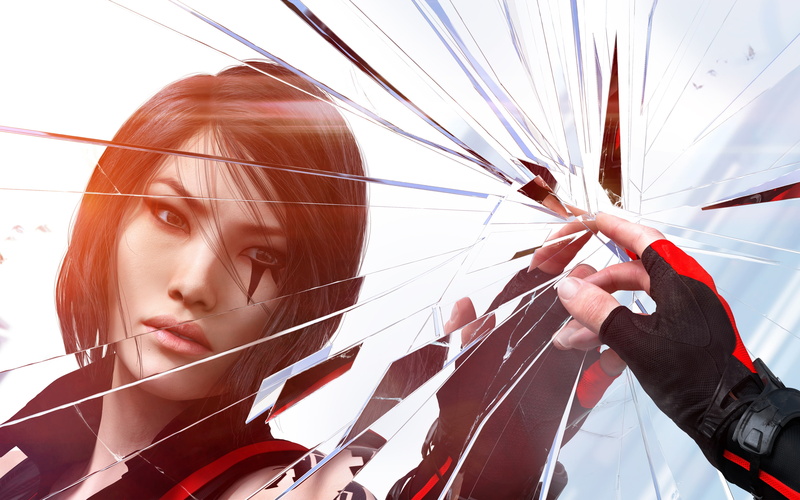
Faith interacts with several characters in Catalyst, but none like Beatrix. (Source: wallpaperflare.com)

After Faith leaves the level proceeds, with Beatrix giving directions to the places for the listening devices and Plastic hijacking the call to inform Faith of the increased security presence. Once Faith has placed all the bugs she hopes Beatrix gets what she needs and Beatrix responds with thanks.

And that’s it. No final note in a later level, no other radio transmission letting us know whether Beatrix was successful and what she plans to do after getting her divorce.

Conclusion

I find it both odd and amusing that this conversation and this character have stuck with me for so long.

I’ve been trying to understand why and I think it comes down to the light touch of it all. In the end, Faith (and Beatrix) don’t need to be identified as gay by the creators and it doesn’t really matter if they are. This entire dissection is purely speculation.

But in that speculation is a kernel of…something. LGBT characters and themes have reached wide prominence in the AAA sphere, and speculation of characters’ sexuality runs through nearly every genre, from Leon Kennedy in Resident Evil 4, to Rhys Strongfork in Borderlands 3, and Lara Croft in the most recent Tomb Raider reboot trilogy.

I feel Mirror’s Edge: Catalyst plays it delicately; it can be inferred and isn’t queer baiting with “almosts” and “what-ifs”, but if someone wanted to pick up on the threads, it can be seen.

In comparison to a character sexuality being directly stated in-game or other media (which has its place and I wholeheartedly support), here the light touch allows the right amount of colour and shade into Faith and Beatrix’s lives.

It makes space for other games to make off-hand comments about same-sex partners and coded references to non-heteronormative relationships (in itself a step towards normalisation) while not overshadowing the game or the mission with a heavy-handed “this character is gay” statement.

So while I can totally understand fans of Mirror’s Edge to go either way on this subject, I will hold up the coding and subtle references between Faith and Beatrix to be a strong standard for threading LGBT themes into characters and games and I would be interested in seeing more.

Banner Photo Source: wallpapercrafter.com

South of the Circle and Love, Memory, and Lost Moments

Romance has become quite the topic in the gaming landscape.

I’m a sucker for a good romance and am always interested in where the game will focus its attention.

While love stories have been a part of the medium forever (one of the most famous cases being “save the princess”), it’s only in recent times that gaming has started to take on some more bigger and mature themes when it comes to romance.

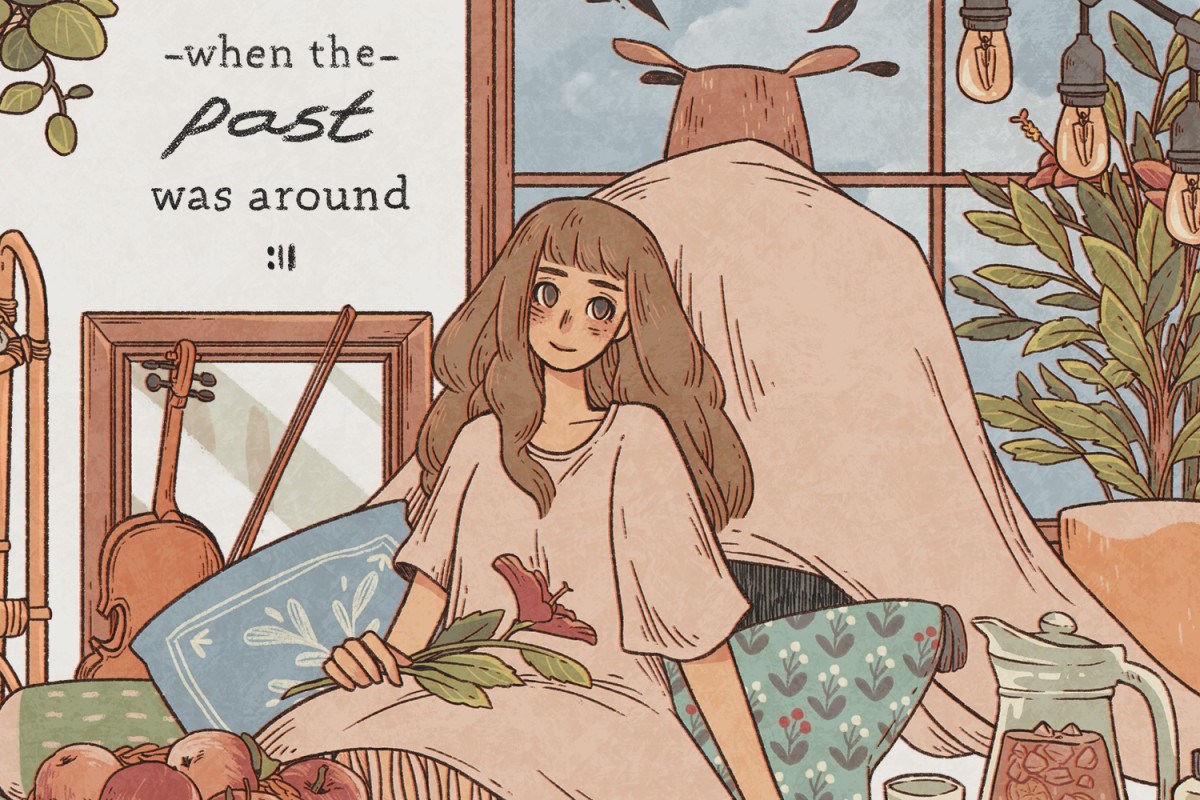
Ideas like teen romance (Life is Strange Season 1), infidelity and commitment (Catherine: Full Body), and reconciliation (It Takes Two). I’ve written about love, death and endings in games like When The Past Was Around.

And it just so happens I’ve played another game recently that tried to tackle deeper themes with love. 

South of the Circle is a narrative game first released for Apple Arcade in 2020, but was released late last year for consoles and PC.

I was immediately struck by its visuals and sound design, but was drawn in by it being labelled as a love story.

South of the Circle takes on the development of a whole relationship, societal pressures and conventions, but its main theme is memory, its failings and faults, and it perfectly works its way into the gameplay.

Best of British Luck – Love, Memory, and Lost Moments in South of the Circle

South of the Circle’s story focuses on two people, Peter and Clara, both lecturers at Cambridge University, how the two meet and fall in love, before a breakdown in communication leads to tragedy.

We play Peter throughout his time with Clara, but also during a research trip to Antartica, taking place after the two’s romance. This double story, of Peter searching for rescue at the South Pole and his growing relationship with Clara forms the narrative hook of the story.

The pair first meet on a train from Scotland down to Cambridge. It’s a perfect romantic introduction; Peter offering to help Clara put her suitcase on the top rack, her offering to share the carriage as everywhere else would be full.

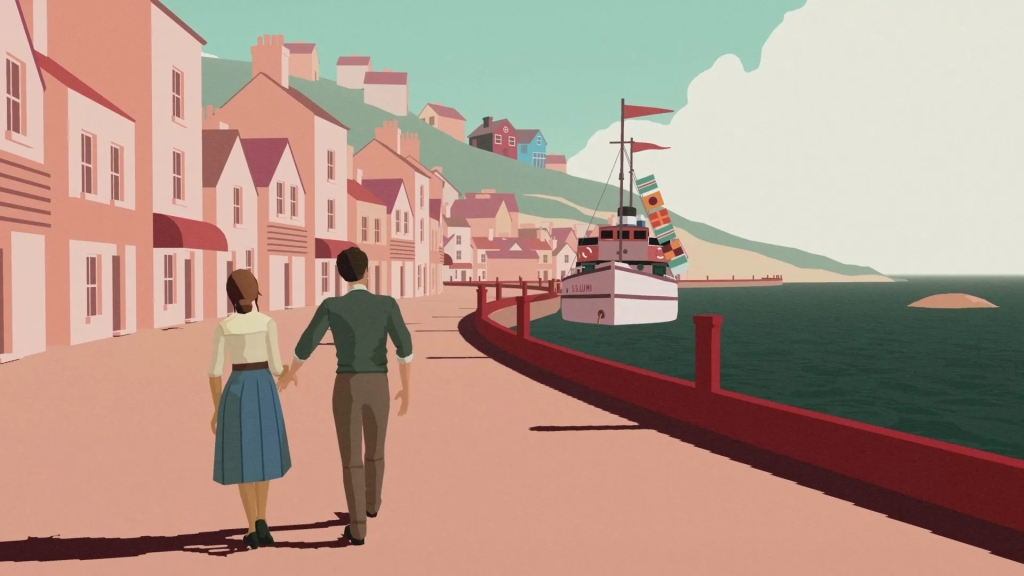
South of the Circle‘s art design is evocative of screen prints from the 1960s, full of clean lines and stark contrasts. (Source: mezha.media)

The main point of interaction in the game is dialogue choices, but instead of seeing a preview of words, you see a shape that gives a general emotion.

A red circle indicates panic, confusion, or concern. A green circle indicates caring and honesty. The black square is for being strong an assertive, a pink circle is negative and shy, and finally a sunshine image is for enthusiasm and interest.

Not all emotions are accessible with each interaction, only three at one time. It’s a great concept for a replaying a past love story, of people thinking back on moments and regretting acting in a certain way, whether shyness or being too forthright, and it’s great to get a general sense of how Peter could have reacted differently.

It’s also interesting that in certain conversations, one of the prompts comes up before the other. For example, when Peter helps Clara with her suitcase, two options come up in response, one being strong and assertive (the “be-a-man” approach) or honesty and openness. For a few seconds, the strong and assertive is the only prompt on screen.

It gives Peter a little bit of depth; so many characters with dialogue choices can change on a player’s whim in a certain situation, leaving their backstory a little vague and blank as to why they are acting in a certain way, but here it gives a small detail as to Peter’s background.

Source: playstationcountry.com

The two keep crossing paths once they arrive in Cambridge. Peter drives Clara to work when she misses catching her bus in the pouring rain, and she sits in on his lecture and asks question about his work. Again, it’s a perfect romantic setting, of two people in their element, thrown together by fate, both seeing sparks fly as they talk.

Chance meetings turn into coffee dates, into a night at a funfair, into seaside holidays, and finally into secret Scottish highland hideaways (with Clara remarking, “I don’t know what my father would say about me bringing an unmarried man up there.”)

It’s a gradual and believable slide into comfort and romance, yet it’s fleeting. It’s tableaus and snapshots, of little inside jokes (the game remembers what choices you’ve made and the characters reference them), the sort of thing someone remembering a relationship would envision.

Happy memories of times gone by. (Source: news.xbox.com)

Alongside the development of Peter and Clara’s relationship, we get further flashbacks into Peter’s life, such as his childhood and him with his fellow researchers.

His childhood doesn’t seem to be filled with fun, with an over-protective mother and a quick-to-anger father. A lot of the prompts in these sections are delayed; we see the prompt appear but it doesn’t become clickable for sometimes five to ten seconds, as if Peter is finding the courage to speak back to his parents. His responses are usually the panicked or negative choices.

With his friends, Peter is still a little shy and reserved, but given a few seconds the “man-up” choice is presented. A lot of the talk with his friends would be regarded as “locker-room talk”, with  the two researchers always hunting for new “conquests” and seeing Clara as, quote, “inspiration” for Peter.

Peter’s childhood and social life is also explored in the game, giving glimpses into other areas of his life. (Source: mezha.media)

And to be fair, they are right with Clara being a muse for Peter. For three years he has been writing a research paper and has been stuck for a long period. But when Clara comes into his life, she reads his work and helps him complete it.

From there, their relationship takes a turn for the worse, as society starts to turn its eye onto the couple.

First, it’s the time period. The game is set in 1964, the height of Soviet paranoia, anti-nuclear marches, and Russian spy rings working inside academia.

Second, the location. It’s only been fifteen years since women were first admitted to Cambridge University, and some of the old guard still believe they are, “not built for academic work”.

It’s both the sexism of the time and guilt by association that causes the breakdown of Peter and Clara, the British “stiff-upper-lip” being the finishing blow, of words left unsaid, and memories now tarnished with emotion.

While half the game is set in the English countryside and sunlit offices and streets, the other half is of Peter and his ill-fated research trip to the Antarctic.

Maps, radios, and scientific equipment are all used to great effect in mini-puzzle sequences. (Source: mezha.media)

The game takes a little while before explaining the contrasting locations. It drops little hints and off-hand mentions of geography and weather patterns at the start, only really coming to the forefront once Clara and Peter have settled into their relationship.

The scenery is bleak and other-worldly, yet it works perfectly with the developing romance back in England. It says that even in chaotic and unsettling moments there is always some pin of normalcy, of hope and clearer skies at a later date.

The story in Antartica is as desolate as the landscape around it, with an increasing sense of foreboding and mystery. I won’t spoil it here for the story takes some jaw-dropping twists and turns as Peter stumbles through the tundra.

The snow and cold starts to affect Peter, blurring the line between memory and locations, with conversations, atmosphere, and even set design switching from Cambridge to Antartica.

It’s interesting visually if a little jarring the first time; editing cuts like this haven’t really been done before (lest people think their game is lagging for the quick cuts).

It keeps Clara in the forefront of the mind, this warm presence that may be lost to Peter, but he is fighting to find her.

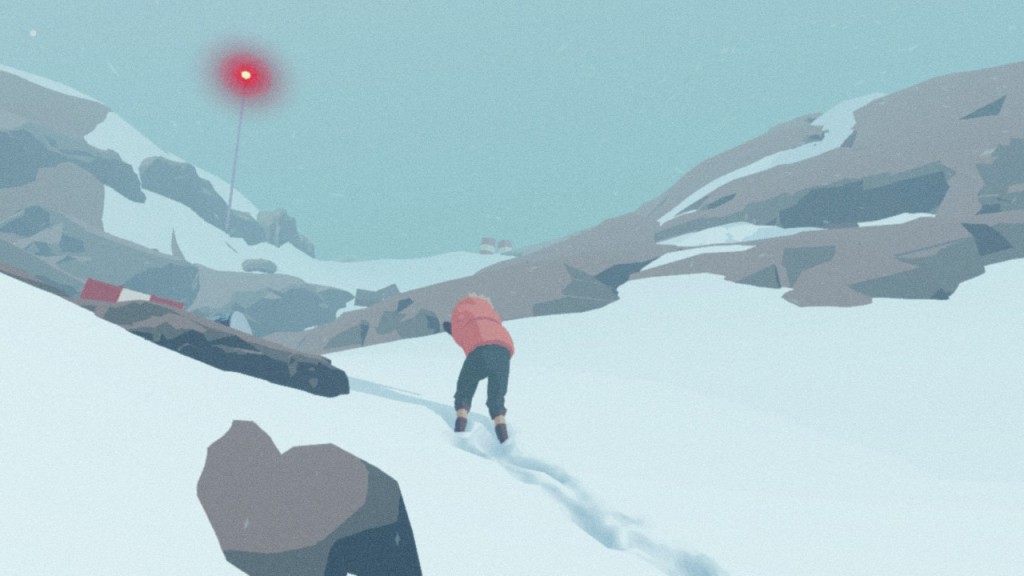
There is no camera movement in SotC, but there is always something on the horizon to guide you forward. (Source: polygamer.com)

The story is very structured with only little spaces for Telltale-style branching, which can lead players to feel frustrated any the lack of choice, but that is the central point of the story, that memory can be influenced by emotion, but can’t change what happened.

Peter is in the Antarctic no matter what; that is the present and everything else is in the past. Events and choices start to contradict, yet Peter is always seen as the sympathetic one and Clara starts to over-react.

While Peter is the protagonist, we as players have to come to the realisation that he isn’t presenting us with the whole truth. It reaches an apex as Peter sets off for the Antarctic, with the player’s feeble attempts to change what happened, but for Peter mentally torturing himself by the final moments.

It’s a devastating ending to come to, that all choices lead to the same conclusion for our protagonist, and it’s only how he chooses to remember himself (and how we as players guided him) that gives him comfort.

It’s a hearty mix of mature themes and aching loneliness and despite the short run time (an average of three hours), I highly recommend it as a great interactive story.

Banner Photo Source: nintendo.de

Why You Should Play – The Pillars of the Earth

As the Playstation 5 and Xbox Series X finally cement their place as ‘current-gen’, we should take a look back at some of the games that defined the eighth generation of consoles.

We’ve seen multiplayer greats like Call of Duty and Battlefield reinvent themselves with both the old and the new (WW1 for Battlefield and CoD with Modern Warfare).

We’ve watched CD Projekt RED go from critical darling with The Witcher III: Wild Hunt to an out-and-out failure with Cyberpunk 2077.

And narrative behemoths have graced our screens like Red Dead Redemption 2 as well as smaller indie hits such as Firewatch and What Remains of Edith Finch.

Today I wanted to talk about one of my favourite games from the last generation and hopefully turn a few players onto the gem that is The Pillars of the Earth.

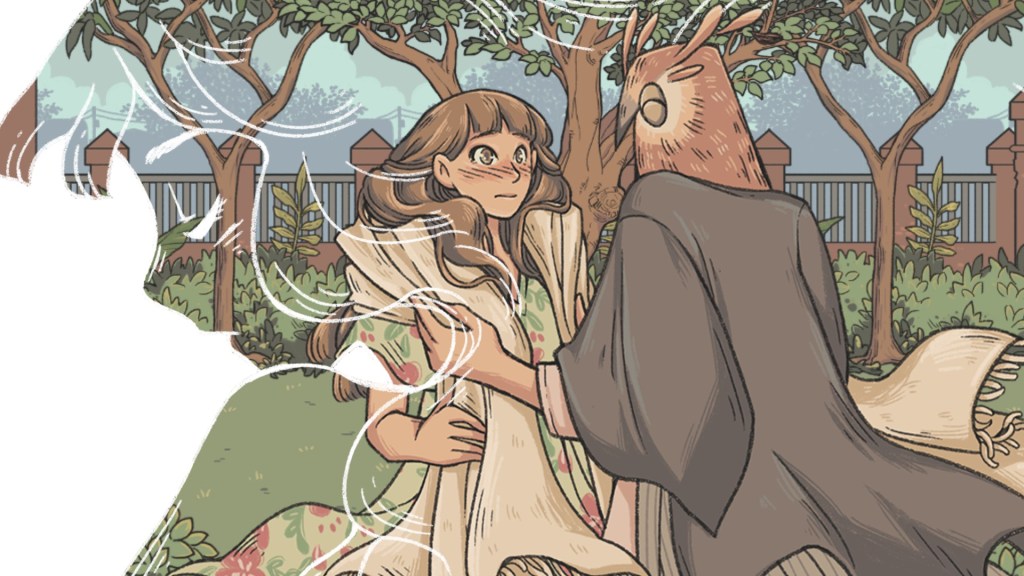
Based on a 1000+ page historical novel by Ken Follett and set over forty years in 12th century England, The Pillars of the Earth is about three characters, Phillip, a monk, Jack, an outcast, and Aliena, a former noblewoman.

The story sees the three cross paths as they try to grow their town of Kingsbridge, fend off rival noble families and vengeful bishops, and build a cathedral the likes the world has never seen before.

Jack and Aliena meet when both are still children and we get to see them change with age and experience. It’s an interesting scenario that hasn’t been explored much in gaming. (Source: amazon.de).

It’s not the first book to be translated to gaming. The most famous examples are the aforementioned The Witcher and the excellent Metro series.

But in comparison to those two franchises, The Pillars of the Earth doesn’t sound like it would be a blood-pumping adventure full of swords and shields. It’s a historical novel, not fantasy, so there are no mages or sorcerers to liven up the mostly downbeat and dark mood.

But it’s the moments where the characters cross paths, the battle of wits and scriptures, and the twists and turns as the lead characters sow the wind and reap the whirlwind that make The Pillars of the Earth one of the best narrative games of its generation, and why I want to talk about today.

By God and the Devil – Why The Pillars of the Earth is Great

The Pillars of the Earth is one of those games where everything perfectly comes together to build something remarkable. The artwork, the music, the 40+ hours of performance, and the story, each one is a singular piece that makes the whole that much more enjoyable.

The game is a point-and-click adventure that uses a large canvas as the background, scrolling left and right when the player character moves. The scaling is incredible, with entire cathedrals, estates, and even towns explorable, but still retaining exquisite details.

Due to the ‘static’ backgrounds, the game camera works almost like a film camera, highlighting points it wants to draw attention to but without taking control away from the player. This allows the player to feel like they are naturally discovering each location and the secrets they hold.

One repeated location, the crypt at the bottom of the cathedral, is one of my favourite spots in the entire game just from its atmosphere. The use of light and darkness in this one small room is played with so well that it can evoke fear or fascination, just with a simple change of lighting.

The crypt merges from dark and disturbing to a place of comfort and solitude, all through the lighting and camera focus of the stage. (Source: mathlidesound.de)

Part of the excellent atmosphere comes from the music by Tilo Alpermann. Since the game is primarily about religion, the majority of the music is ecclesiastical, mixing male choirs with strings and woodwind instruments with heavy brass approaching in Book 2 and 3. However, it’s in the less traditional aspects where the music shines.

Tracks like ‘Hell’, which incorporates faint chimes and cymbals into its rolling strings, or ‘Bishop Waleran’s Wrath’ which uses an electric guitar for its main beat and what sounds like reversed strings or brass on the second beat give this strange sense of foreboding, of power beyond the characters we control.

The tracks ‘Hell’ and ‘He That Committeth Sin’ blend in one of the darkest and disturbing moments of Book Two. (Source: gamingcypher.com)

While I love the graphics and the soundtrack, the story is the high-point of the game for me, and anyone wanting to experience a deeply engaging and philosophical narrative from the last generation should seek it out.

Set over three ‘books’, each with seven chapters, the story is expansive and slow-build, moving at an almost glacial pace at the start to set the major conflicts, but also the tone of those chapters.

Even the main menu helps establish the feeling of each book. Book One is dark and cold, with many thinking the Devil walks amongst them. Book Two is lighter, showing the characters and their town starting the rebuild. Book Three is shrouded in dust and debris as chaos reigns down once again. It’s a masterclass in simple yet effective narrative design.

The start of Book Three: “Eye of the Storm”, sees death and war come to England, with the landscape in every chapter shrouded in dark fog. (Source: cosmocover.com)

The game switches perspectives throughout, from Phillip, to Jack, then to Aliena, and back again, each character adding a tiny piece of the narrative puzzle until it all comes together for the final couple of chapters of each book.

You could in fact play each book as a standalone story as they build, climax, and resolve like a standard plot structure, but the fun is watching characters in Chapter Twenty-one reference decisions you made in Chapter Four.

At the end of every chapter you get a itemised list of what you did, what actions you took and who you spoke with. A lot of nouveau point-and-clicks like Detroit: Become Human, Life Is Strange, and Telltale’s The Walking Dead have these similar lists.

With The Pillars of the Earth there isn’t always the reference to something that didn’t happen like other games, it’s solely on what did happen, which I feel make it seem more personal, rather than a somewhat A/B approach to narrative.

The main gameplay loop is through dialogue, with your words and tone carving a pathway through the story. While it does have set story beats throughout, there are small paths of deviation that lead to gigantic turns later on, sometimes even in a different ‘book’, so far removed that you might have even forgot what your previous actions were.

Dialogue choices and quick-time-events from the main crux of the gameplay loop, yet from simple premises your choices can destroy families, lead countries to war, and even cause the optional deaths of central characters. (Source: daedlic.com)

While the story is mainly character-based, a major point that dragged me into wanting to see the next chapter are the themes the narrative plays with. Ideas like religion and devotion, sin and violence, even love and sex are explored deeply in The Pillars of the Earth.

Each book features powerful moments that make the story come alive with meaning and emotion. Scenes where characters find or lose their faith while others see the Divine and the Devil amongst them are seared into my mind due to the way they shake the very foundations of the cast, and how there hasn’t been many games that tried to do something similar.

The game also spans the entire development of a romantic relationship, from shy smiles and holding hands to spending passionate nights together (this game actually has my favourite sex scene in all of gaming), and eventually settling down and starting a family, something that up until recently games haven’t tried to depict with any meaningful, long-term effects.

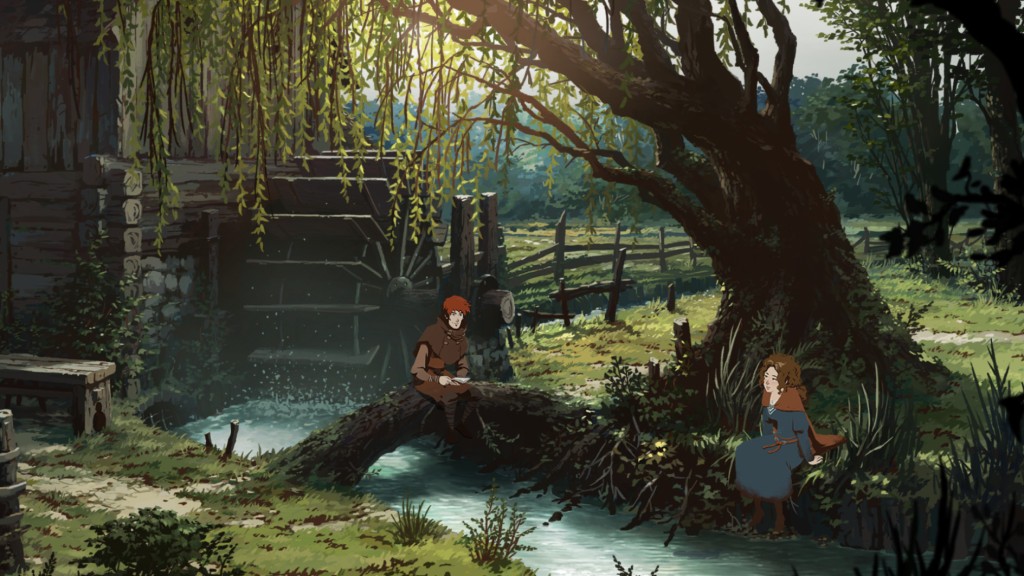
The water mill, where Jack and Aliena’s romance begins to flourish. (Source: steampowered.com)

It’s a mature story, not with depictions of violence and nudity but with its ideas and implications, and that’s why I absolutely loved every moment.

I hope that this short post has teased your appetite to experience this incredible game. The Pillars of the Earth was an absolute delight and I can’t wait to dive back in again to one of the best games of the last generation.

Banner Photo Source: iphonelife.com
Assassin’s Creed: Liberation – Discovering a Classic

I’ve just finished playing Assassin’s Creed: Liberation, originally a PlayStation Vita exclusive, now bundled with the recent Assassin’s Creed III remaster.

It feels refreshing and fun to go back to a game that uses the old AC formula, but with a new location, story and character.

And even after a short time playing it, Liberation is probably one of my favourite AC games, easily passing III and Black Flag in my ranking of the series.

So I thought a little breakdown of what I loved about it, and hoped to spread the good word to some AC fans that may want to return to something with a classic feel.

Ragin’ Cajun: Why I love Assassin’s Creed: Liberation

  1. Scope

As mentioned previously, AC: Liberation was originally released on the PS Vita in 2012, to tie-in with the mainline entry ACIII. With the smaller hardware, reductions were needed to be made, but every change seems to benefit the game.

Instead of an intensely expansive world, Ubiosft Sofia (creators of the Prince of Persia HD release as well as the AC spinoff, Rogue) decided to keep things small and contained.

New Orleans and the Bayou, the two main areas of the game, are comparable to AC2’s Florence or Venice than the sprawling maps in ACIII (here is a forum thread of players calculating the size of the cities).

Smaller design leads to more intimate and detailed sections of the map, and allows players to get quickly attuned to their surroundings.

The churches of New Orleans, with their towering spires, become waypoints, allowing players to orient themselves to the location without having to pull the map out every few seconds.

It’s similar to the original Assassin’s Creed in that regard; a small contained map with distinct areas and easily identifiable landmarks. It helps the city feel rich and unique, directly because it is smaller.

This direction of scope is even found in the story and characters. While ACIII spends almost five whole sequences setting up the tragic backstory and family dynamic of its lead, Liberation does it in less than thirty seconds, with only around ten lines of dialogue.

It’s a masterstroke of character and lore-building and gets you right into the story. So let’s talk about that next.

Despite its smaller scale, New Orleans feels as detailed, polished, and “living” as later games in the series. (Source: ign.com)

2. The Story

Written by veteran narrative designers Richard Faresee (who worked on Revelations and III) and Jill Murray (who worked on Black Flag, its expansion Freedom Cry, and recently Shadow of the Tomb Raider), Liberation is one of the more unique narratives of the AC franchise, with it winning the Writer’s Guild of America Award for game writing for 2012.
After the Ezio Trilogy, Assassin’s Creed started to play with the formula for its stories. During AC2, Brotherhood and Revelations, the Templars were moustache-twirling bad guys worthy of a Saturday morning cartoon.

From ACIII to Unity, the mood shifted to portraying the Templars and Assassins as two side of the same coin, with more in common than what separates them.

Liberation follows this theme, but takes it even further, having a fun meta narrative within the story.  Liberation is in fact a game created by Abstergo Entertainment, a video game branch of the Templar company, wanting to push their propaganda onto the public.

Your game signal is ‘hacked’ by an Assassin, who tells you the Templars are hiding the truth. The Templars doctor the events to suit their purposes, so you have to hunt down a ‘glitch’ known as ‘Citizen E’, who then reveals the truth behind each edited scene.

It’s a cool idea, echoing the interrogations and glitches from the first Assassin’s Creed, of a world beyond the one we are perceiving, of secrets and subterfuge that some of the other games have lacked (looking at you, Unity, where nearly every NPC knew who the Assassins were).

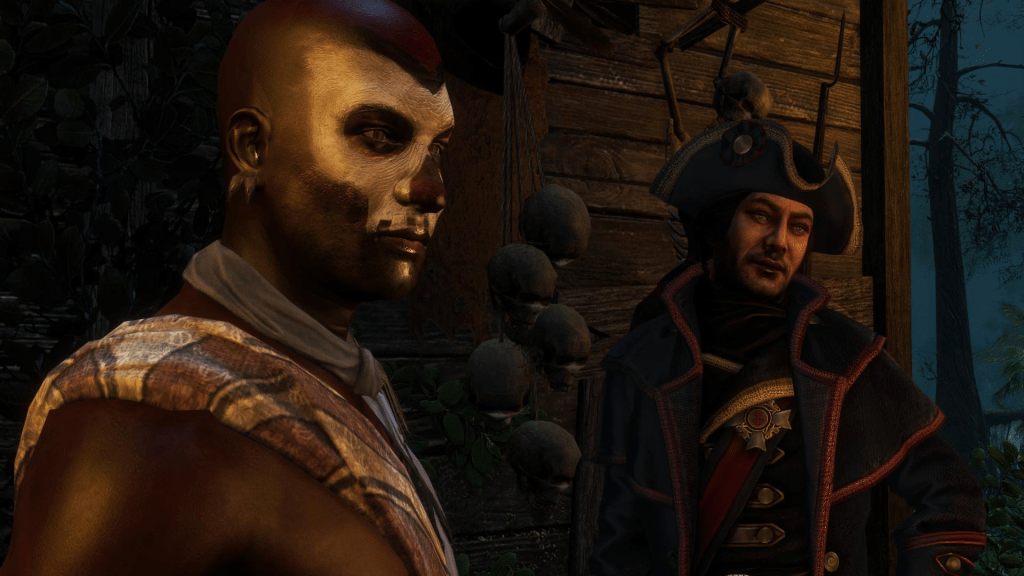
The ‘Citizen E’ missions add an air of mystery and suspicion to the narrative, making the player question Aveline, her allies, and her enemies. (Source: assassinscreedwiki.com)

The “Full Synchronisation” elements (where players can complete extra challenges during missions) are well thought out and aren’t just added difficulty. Ever since the concept was introduced in Brotherhood, I’ve felt that this was the most ‘game-y’ aspect of the series and didn’t  fit either with the mission or the previous freedom of gameplay choice.

Here the Full Syncs add to the narrative, giving hints to the main character, Aveline’s, backstory. For example, the first assassination of the game (and possibly Aveline’s first assassination) isn’t with a hidden blade but with a musket stolen from an enemy.

It’s such a small detail but adds a ton of information to Aveline’s first recorded kill just by what weapon was used.

The story, like all ACs, twists and turns, threading the role of women, race, and indigenous people, something powerful and note-worthy in a major franchise like AC.

Another franchise staple, the First Civilisation, is present, but it isn’t treated with the same world-shattering aspects like previous games.

It’s a small thing in the grand scheme of the game (and has a nice twist at the end), so I’m happy that this series thread is kept to the background.

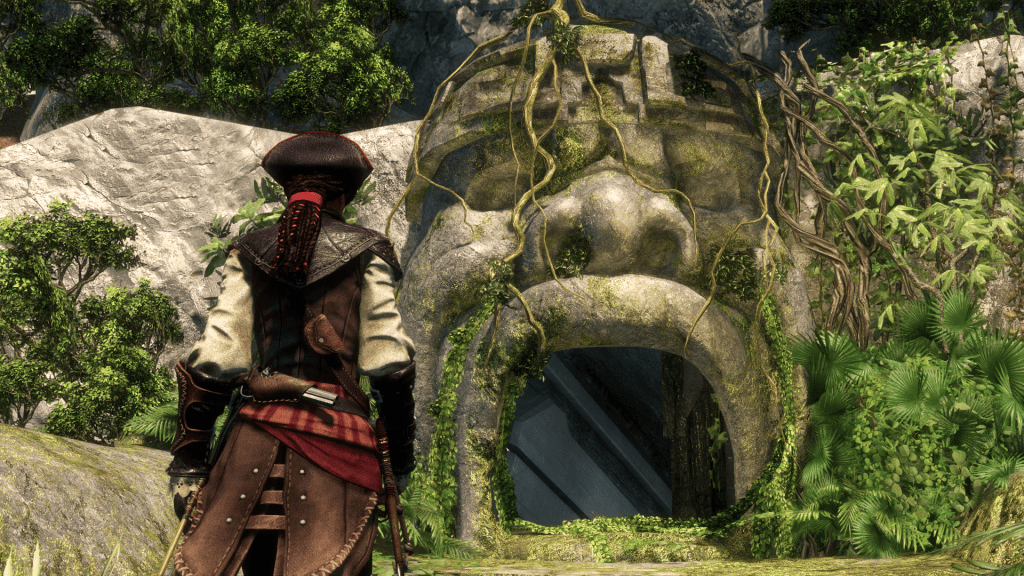
Liberation takes short detours to Chitzen Itza and Mexico, adding First Civilization temples and items, and uses them as standout platforming sequences (Source: assassinscreed.fandom.com)

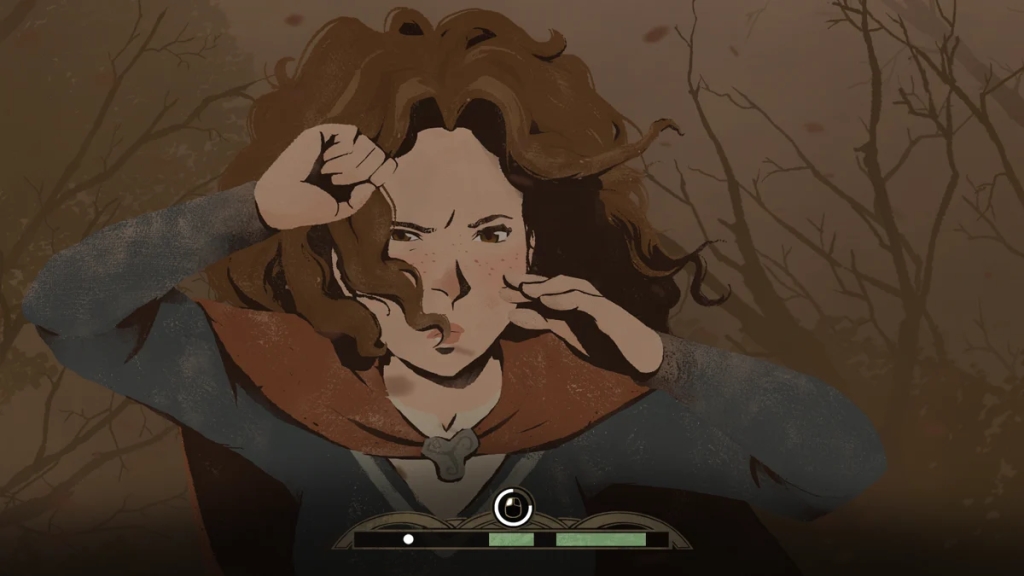
But the high point of the story is it never loses sight of its lead. The story is squarely on the Assassin, Aveline de Grandpré. We see her triumphs and defeats, and turning from naive freedom fighter, into stalwart Assassin, and finally someone who can see from all sides, and carves out a path of her own. 

Speaking of which…

3. Aveline

Aveline is such a cool character. While it would take another three years until a female protagonist became a lead character (Evie Frye sharing with her brother Jacob in Syndicate), Aveline is no slouch when it comes to characterisation.

Aveline is constantly torn between two worlds, playing all sides, creating an interesting dynamic not only in story but also gameplay.

The most on-the-nose is her status in New Orleans. Born to a white wealthy merchant and a slave mother, Aveline has known both the stuffy aristocratic life afforded to her by her father, but also the hardships of slave life, even having nightmares of being snatched with her mother by traders right off the street.

Throughout the game Aveline switches outfits, from her Assassin ‘robes’ to ball gowns to slave attire, each one with their own abilities and quirks.

Her Assassin outfit is the one suited for combat, allowing for all her weapons and tactics, and also shows some cool details on her personality. For instance, instead of the trademark hood, Aveline uses a tricorn hat, allowing her braided hair to flow freely.

It’s a small detail but something that gives her an edge, of defining herself by her own skills and attire, not standing by the tradition of the Assassins.

When in her ‘lady’ outfit, Aveline can ‘charm’ guards away from their post and has lower notoriety, but is only limited to her hidden blade and can’t freerun.

When dressed as a slave, Aveline also only has her hidden blade, but can blend with other slaves and free-run, while gaining higher notoriety when doing ‘high profile’ actions.

While incredibly gendered, it adds a small layer of choice and tactics to the game, using Aveline’s duality as part of gameplay, with Aveline even altering her speech when wearing different outfits. It’s a great mechanical example of one of the tenets of the creed, “hide in plain sight”.

Aveline uses a variety of disguises to achieve her goals. I love this aspect and wish it would make a return in the series. (Source: siliconera.com)

Storywise, Aveline’s status as an Assassin also rides the dual aspect. Neither her father or mother are Assassins, a far cry from the rest of the series where it is usually a family tradition.

She may be inexperienced, but Aveline has already earned her hidden blades, allowing the narrative to skip the ‘origin’ story and get right into the main events without showing us her discovering the Brotherhood.

The only person who ‘knows’ about her rooftop exploits is Gérald, an employee of Aveline’s father, who holds down Aveline’s base of operations in New Orleans. Gérald gives Aveline information and equipment and knows of the Assassin/Templar conflict, but he is not immersed in the Assassin life.

Aveline is alone in her pursuit, not chasing down her family’s murderers or looking to gain back her family’s honour like other AC leads, but just watching over New Orleans, leaving only when needs must.

She helps free slaves and guides them to the bayou, she disrupts over-zealous colonial rulers and greedy merchants, and kills any Templar that sets foot in her town.

Late in the game Aveline leaves New Orleans for Boston to hunt down a spy and enlists Connor Kenway’s aid. They fight side-by-side in a knockout cameo sequence (Source: assassinscreed.wikia.com)

Aveline’s actions sometimes bring her into conflict with her mentor as she goes against Assassin dogma, not in a ‘trying-to-be-edgy/I-don’t-play-by-the-rules’ way, but as Aveline’s internal struggle with the tenets of the Creed and wanting to act.

It’s such a departure from the rest of the series, but every other attempt at ideas like this in later games has come across as being contrarian for the sake of it (mostly in AC: Unity).

While Aveline is cool and calm under pressure, smart and resourceful, she isn’t afraid to lose her temper or her composure.

There are several stand-out scenes near the end of the game which top any other moment in the series with their levels of emotion, pathos, and engagement.

One other major section that helps build Aveline’s character is…

4. The Combat

Liberation uses the same combat as ACIII and Black Flag, but has its own quirks that for me add to Aveline’s characterisation and to the game as a whole.

Aveline has the regular assortment of swords, daggers, hidden blades, and accessories, but the animations and their usage are so powerful.

Take the sword for instance. While other Assassins are usually hacking and slashing (such as Connor), Aveline’s sword-work is based more on cut and thrusts, disengages and parries.

It’s more intricate and indicates some formal training, indicative of her childhood in one of the more affluent families of New Orleans.

Her short blade is at the complete opposite end of the social scale. In the first mission of the game Aveline frees a slave and then fights off the enraged owner with his own sugarcane machete.

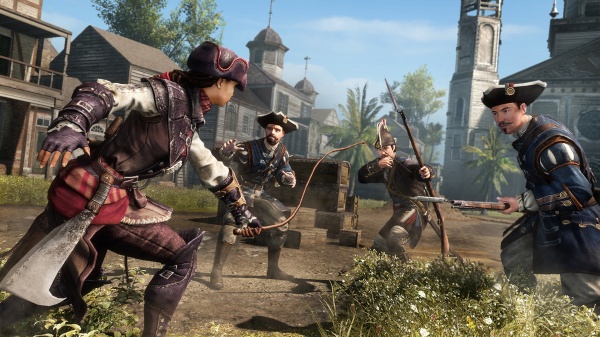
In another slave encampment, she wrestles away a slaver’s whip before turning it on him, and uses it to hang her enemies from tree branches.

It’s a powerful image of a young black woman using the tools of her oppressors against them, similar to Lincoln Clay’s rampages in Mafia III, a game which similarly stars a bi-racial main character fighting against the systemic racial prejudice of the time, also set in Louisiana.

Aveline strangling an enemy with her whip, getting ready to equip her machete to deliver the killing blow (Source: gamerstemple.net)

In the same camp where Aveline gains the whip, she builds her own hidden blades. Pickpocketing materials from around the camp; a small plank of wood here, a kitchen knife there, and finally a few soldier’s belts, Aveline lashes them all together to re-arm herself.

It’s a cool moment after a long section of having to work around enemies rather than face them head-on, now being able to break free and take on the rulers of the camp.

For many missions Aveline has to use her fists, which adds another layer to her characterisation. It’s mentioned in dialogue and appears in-game when she wears the slave disguise, Aveline is attacked by thugs that roam New Orleans.

In direct opposition to her bladework, Aveline’s hand-to-hand combat is brutal and lacks formal training. She swings wide haymakers, incorporates stomps and flying knees, it is the exact type of combat I would expect someone who had to fend for themselves on the street would have. 

And since the game is based off the updated ACIII engine, there is less of the stop/start counter combat from the earlier AC games.

Aveline has all the tools of the trade at her disposal and can easily go toe-to-toe with any Templar that gets in her way. (Source: spieltipps.de)

Conclusion

I did’t have much hope for Liberation when I first booted it up.

I wasn’t a major fan of either ACIII or Black Flag when I first played them, only really feeling the series had won me back when I played Syndicate.

And as the game was a PlayStation Vita exclusive when it first came out, it gave the impression Liberation was an also-ran, a stop-gap that played safe and didn’t offer anything of value.

But I gave it a chance and found myself relaxing into it, feeling comfortable in my controls and abilities, challenged by new locales and events and spirited away by an unspoiled story, but having a sense of familiarity, old yet new.

It’s been almost five years since AC has leapt from action-adventure to the RPG crowd, and I don’t fault it. Sale numbers and audience reception to Origins, Odyssey and Valhalla have been phenomenal.

But if you a looking for a change of pace, a palette cleanser between the big, bombastic games, something that tells a small story in a larger frame, or is just a nice reminder of a time and gameplay styling that has been absent, then AC Liberation might just be right for you.

It’s been a pleasure to play as Aveline, and my only wish is that I wanted more.

Banner Photo Source: gamestar.de

Assassin’s Creed, Evie Frye, and Older Female Characters in Games

I recently finished Assassin’s Creed: Syndicate’s Jack The Ripper downloadable add-on. It was a fun little side story featuring some stand out moments and mechanics, but what really sucked me into the story was the change to the playable character, Evie Frye.

Evie and her twin brother Jacob, the two playable characters in Syndicate, are in their mid-to-late twenties during the course of the main story. The Jack the Ripper DLC is set twenty years after the conclusion of the Fryes’ narrative, making the twins both over forty in the game. Jacob is missing from the story, having being kidnapped by Jack, meaning the entire narrative is played from Evie’s point of view.

And that struck me as something quite unique. When was the last time I had played as a female character over forty years old? Heck, when had I ever played as a female character that made a point of them being over thirty?

The gaming landscape is becoming more diverse with each game that comes out. Characters that are male or female (or in some cases neither), black, brown, or white-skinned, and LGBT+ are increasingly common on our screens. The only outlier is age, I can’t remember a playable character with graying hair or a few wrinkles.

Well, apart from male characters.

Some of the biggest characters in gaming are men in their later years, such as Ezio Auditore in Assassin’s Creed and Sam Fisher from Splinter Cell/Rainbow Six (around fifty years old), Max Payne in Max Payne 3 (forty-eight years old), Joel from The Last of Us (late forties), Geralt in The Witcher (late forties), and Solid Snake in Metal Gear Solid 4 (who even though is canonically forty-two years old, looks closer to eighty), yet I couldn’t think of a single female character that could fit the same age bracket.

So I went for a look.

More than a Number? – A Search for Older Female Characters

First, some people might take umbrage at my liberal use of the phrase ‘older female characters’. One person’s idea of old might be another’s thought of coming into the best years of their life. I’m going to use the phrase ‘older female characters’ just as a catch-all term, but I’m trying to match male for female characters, like the male characters listed before.

And secondly, this is only for PLAYABLE characters.

The first older female character that came to mind was Iden Verso, the lead character of EA’s Star Wars: Battlefront II. Iden is a member of Inferno Squad, the special forces of the Sith Empire, and her story plays out from the end of Return of the Jedi, as she slowly changes sides from the Empire to the Rebels.

Iden’s story comes to close a few months after the destruction of the second Death Star when she is still in her thirties, but the rest of her story continues in a downloadable epilogue, dubbed Resurrection. Here, Iden, now with graying hair, brings herself back into the fight against the First Order. However, these final levels amount to three playable sections out of thirteen overall levels.

Iden as she appears in SW: Resurrection. Iden was one of the only older female characters I could remember playing (source: reddit.com).

Evie and Iden are of the same cloth; the most elite warriors of their day, brought out of retirement to bring the fight to enemies once again (funnily enough they almost mirror each other, being brought away from familial duties by the disappearance/death of a loved one, to do battle against a former friend turned enemy).

And after Iden and Evie, I had to do a deep dive to find some more older female characters, which was much harder to do that I previously thought it would be.

First was Selene, the main character of the recent sci-fi-Souls-like Returnal. Selene is middle-aged in the game, but is just as smart, capable, and agile as any of the thousands of playable white men in her same age category. Without giving much away, Returnal is all about the passage of time, and so an older character with skills and knowledge that a younger person does not possess factors in pretty well.

Another character is the ‘Crime Granny’, Helen Dashwood, from Watch Dogs: Legion. This character, despite being nearly eighty years old, became the stand-out character of the E3 Reveal Trailer, and when she became freely playable in-game, we found she was just as capable as any of the other resistance fighters. However, Helen must come with a caveat; she is an optional character to play as, as all characters in Legion are, and so doesn’t carry the same weight as Evie, Iden, or Selene.

Helen fights to free London and isn’t afraid to pull out the big guns to get the job done (source: tweaktown.com).

Rainbow Six: Siege has twenty-five out of its sixty-one operators identifying as female. Most of these characters are actually in their thirties, with only a few outliers in their late twenties. The oldest is the Peruvian operator Amaru, who is forty-eight, but the oldest male operator is Zero (Sam Fisher under a different codename), who is sixty-three in the game.

One place I didn’t think would have older female characters were fighting games. While all fighting games have at least one old man archetype (usually doing some powerful ancient martial art), I didn’t realise that Chun-Li from Street Fighter is fifty-three in the most recent game. The same goes for Sonya Blade from Mortal Kombat, who in MK11 is now well into her fifties. But while these are both kicakss older characters, would we ever see Chun-Li reach the same age as Gen, one of the older men of Street Fighter, who is believed to be in his seventies?

***

So from everything above you could say there are quite a few older female characters. But all of these characters come with asterisks; most are character selections, or if they are the main character then they are relegated to a downloadable extra or an epilogue. Why is that? Why have older female characters not taken centre stage like older males?

Plausibility is out of the window. Iden and Evie are raised from birth to be fighters. Selene is an accomplished astronaut. Helen is a retired police engineer. All of Rainbow’s operators are hand-picked due to their combat skills. Chun-Li and Sonya have dedicated themselves to perfecting martial arts. Each of these women have learnt the skills to be competent and capable video game protagonists.

Is is just…the ‘M’ word? Possibly. But I would also posit that age factors into that discussion as well, as a younger woman on the cover is an easier sell than an old-age pensioner in the same position.

But then I have to think, are people coming to these games for the female characters, and not say the frenetic multiplayer, or the fact it’s another Souls-like game, or high review scores, or the myriad reasons that people chose to play their games?

Again, possibly. But somewhere there is someone playing the game because there is a woman in the main role. Anecdotal evidence aside…it’s me. I was drawn to Evie Frye for being the first female Assassin in the series, in the same way as I’m drawn to Kassandra and female Eivor. And upon learning that Evie was approaching middle-age in Jack the Ripper, I was hooked.

Time has changed Evie, both inside and out, and it was cool to see how she had developed into a different role and personality (source: steamcommunity.com).

An older character can give us something unique, bringing up questions that have rarely been explored in gaming like ageing and the concept of change. Losing skills that were once easy, a defiance against advanced/unemotional responses in war and peace…or even just to see a character grow and mould over time.

Not to mention, women are going to have different responses and issues to grapple with than their male counterparts, would this not also be something new and interesting for the industry to show?

And even if a game doesn’t tackle personal drama and age is relegated to cosmetics, just making the character look older would be something special.

I want to see Lara Croft raiding tombs in her 50s.

I want to see Chun-Li with graying hair still being able to go toe-to-toe with Ryu.

I want to see Ellie in TLoU3 be older than Joel was in TLoU2.

It’s possible and there is no real reason why it can’t be so.

***

Banner Photo Source: steamcommunity.com (User: EndsWithABulletOnline)

When The Past Was Around and Grief as Gameplay

Death and mourning aren’t explored much in gaming.

Sure, every now and again you’ll get some big budget, AAA video game where the main hero or heroine will lose someone close to them. The main character will shout, scream, maybe even cry, before they steel themselves and return to their gameplay activities.

You may get a little scene at the end of the game where they look longingly into the sunset and think of their lost friend or companion, but for the majority of games, the grief is tied solely to the moment.

It just so happens that I played a game earlier this year, When The Past Was Around, a point-and-click puzzle game, that tackles the issues around grief and death; the empty space, the silence now they are gone…and succeeds in perfectly evoking those feelings.

I wanted to share this game with you, its beautiful hand-drawn art, its excellent musical score, and small yet powerful story, and how it manages to capture the idea of grief into a way only games could do.

Mild spoilers ahead.

When The Past Was Around Dealing with Love, Loss, and Death

When The Past Was Around follows a young girl called Eda. She’s in her mid-twenties, recently moved into her own place, and is in a bit of a funk. We learn through her photos that she was once a violinist, but gave up when she was younger, and is now trying to get back into it.

It’s a simple scene, with only four photos chronicling Eda’s childhood, yet gives us so much on her mental state and her personality; talented, passionate, yet prone to criticism and overwhelming anxiety, all conveyed through through single snapshots of her previous performances.

Eda keeps a music box with an owl as the centre piece. One afternoon she hears the same tune the music box used to play (the one that inspired her to learn violin) being played on the street. She follows the sound, almost floating towards the music, and finds the violinist playing to patients in the child hospital.

The she sneezes, interrupting the performance, but coming face-to-face with Owl.

Yes, a man-sized owl, named, well…Owl. The game follows Eda and Owl’s time as a couple, until tragedy strikes, with Owl dying, and Eda being heartbroken.

Many stories that deal with grief usually personify it; a shadow, an item of clothing, something that ties the present to the past. So here, Eda’s lost love is an owl, and ties well into concept of grief and loss.

One of the main narrative signifiers is fallen feathers. The end of every chapter is signalled with one, such as in Eda’s finding one in a cardboard box when she’s unpacking, or when she is wearing Owl’s old scarf. Collecting these feathers are what unlock the next memory as she gets closer to Owl’s departure from the story, and that’s their real meaning.

The feathers are tokens of the memories that Eda and Owl have together, and as she collects them, more are taken away from him, until there can be none left. It’s and excellent metaphor for the passage of time, and yet cruelly bittersweet.

With each feather the story moves forward, bringing Eda closer and closer to tragedy. (Source: gonintendo.com)

The game switches between the memories of Eda and Owl together, and Eda at the graveyard at the ‘end’ of their story. During her time at the graveyard she is seemingly haunted by a shadowy silhouette of a man, enclosed in a giant bird cage.

When Eda finally reaches the silhouette after reliving all of her memories and collecting Owl’s feathers, the feathers attach themselves to the shadow man, revealing that he is Owl. It’s a great moment, showing how Eda’s memory of Owl had changed over time, and how he effectively became ‘entombed’ inside her head, only being set free once she looked back over her time with him. 

There is zero dialogue in the game, which I think is to its benefit. While it would have been easy to add voices to the characters, the silence of the protagonists allows the story to reach a broader audience and speak to more people. It’s that old adage of actions speaking louder than words, as Owl and Eda mentally and physically get closer (literally, they move closer to each other as the game progresses).

Some people may not be able to relate to Eda and Owl’s if they had talked about their love of the violin or the name of the stars in the night sky, but they can relate much more to a feeling or an emotion that the characters are going through, which the game captures perfectly.

Part of that excellent communication of emotion comes from the fantastic artwork by Indonesian artist Brigitta Rena. The character models have a stunningly simplicity to them, yet are incredibly expressive. The animations are through a standard fade effect between each character stance, bringing a dream-like quality to most scenes, but also capturing incredible immediate snapshots as there will be many moments of stillness, highlighting the emotion of the scene.

Eda and Owl’s first meeting. The character’s faces and style is so simple yet has layers of emotion. (Source: heypoorplayer.com)

While the characters are simple, the backgrounds are incredibly detailed, and given the feeling of being ‘lived-in’. 

Those backgrounds are a key part of the game’s core loop, as the player must find hidden objects to progress in the story by moving objects around. The game presents it as being constructive or destructive, clean vs. cluttered.

The cleaning and constructive might task you with tidying up Eda’s bedroom, putting posters on her walls, or hanging the washing up.

Construction is the main engagement when Eda and Owl are dating, including coffee and tea at Owl’s home, going to the beach together, or camping out overnight and looking at the stars.

In each of these scenarios the player has to ‘build’ the setting around them; collecting seaweed and shells to go in a glass bottle (which the couple keep in their apartment), setting up the campsite and building paper windmills, or even fixing Owl and Eda’s drink of choice at his house.

These little constructions exaggerate the fact that we are essentially going through Eda’s memories of Owl, and so she would focus on all the small things that she remembers from those times, the things that make it ‘her’ memory.

A date at the beach. Through these moments you feel the promise of two strangers growing closer together. (Source: taminggaming.com)

When the gameplay switches to destruction, you might find yourself smashing countless plant pots, throwing books off shelves, or pulling down curtains.

These aspects perfectly match up in the order of the story, with Eda being tidier when she is with Owl, but messier both before she met him and after he is gone, for different yet obvious reasons. Her final scene with Owl where Eda searches for his pills uses the clean vs. cluttered to great effect, as players have to frantically search the apartment, pulling books off shelves and knocking over chairs in a desperate bid to find them.

Music also plays a strong part of the story, with both Owl and Eda playing the violin, and music being the thing that brings them closer together. There is a leitmotif that runs through the entire game (the same one played by Eda’s music box), which subtly changes with each chapter.

At the start when Eda has given up on playing the violin, the stringed instrument is removed from the soundtrack, instead a mournful piano plays in the background. As soon as Owl enters the story, the violin features again, playing a much more cheerful tone. As their relationship grows more instruments and accents are added.

By the final scene when Eda is alone once again, the piano has returned, but her memory of Owl is so strong that the violin jumps in, with the entire song picking up speed as it reaches the climax.

The story is not just of love between Eda and Owl, but of Eda and herself, highlighted by her learning the violin again. (Source: indie-hive.com)

Even the title references music, with a stylised repeat sign incorporated into it. This sign in sheet music indicates a section to be played more than once, referencing Eda’s journey back through her life.

When The Past Was Around is a whole package of a game wrapped up in around an hour, maybe little over if you are intent on finding all the hidden clues that inform more about Eda and Owl’s relationship.

For anyone looking for a short game with fantastic visuals, a great sense of gameplay as narrative, or just something a little different than anything else on the market, When The Past Was Around is heartily recommended.

Banner Photo Source: nintendo.de

Five Things I Want to See in the Next Splinter Cell Game

I love Splinter Cell. I am a massive fan of James Bond and spy stories in general, so the main crux of Splinter Cell, being a super secret stealthy agent, greatly appeals to me. 

I’ve loved every game in the series, from the hard-as-nails original game to the modern and fluid games like Blacklist. Every game brings something new to the table, with ethical tales of the horrors of war, torture, war profiteering and the US government spying on its own people, with the series rarely dropping into po-faced American jingoism.

There have been recent rumours of a new Splinter Cell game coming in the near future. Indeed, it has been seven years since the last full game, Splinter Cell: Blacklist hit our shelves, with nearly every other game in the Tom Clancy pantheon getting regular updates.

Talking of those other games, Splinter Cell has been keen to get involved, with leading man Sam Fisher featured as a special guest in the most recent Ghost Recon games (Wildlands and Breakpoint), as well as a leaked Splinter Cell-inspired operator for Rainbow Six: Siege. Why would there be all this push for the series if no new game was to be announced?

Well, as a fan who has waited a very long time for a new game, I thought I would have a go at what I would want to see in a new Splinter Cell game.

Play it Again Sam – What I Would Like to see in the Next Splinter Cell Game

1. Sam

An easy one to start with, Sam Fisher needs to be in Splinter Cell. He is the face of the franchise and cannot be allowed to be absent from the game.

There was a big row during the release of the last game, Blacklist, as Michael Ironside, the iconic voice of Sam Fisher, was recast with Eric Johnson. Lots of fans were angry over the change, seeing Sam losing a big part of his character with Ironside being replaced.

Ironside however has voiced Sam during his last two cameos in the Ghost Recon games, so it seems as if Ironside is returning to the role.

This puts Sam in a precarious place though. Sam is fifty-five years old in Blacklist, and in his most recent appearances sees him going grey and wrinkled. Sam is a superman, but his is still only human. I think it would break the laws of physics to see a pensioner taking on heavily-armed militias all around the world.

So there are two compromises; Eric Johnson (or another actor) returns to give us a younger Sam, essentially rebooting the series, or Sam moves into a support role with Ironside voicing him and a new Splinter Cell agent steps into the frame. It looked like in Blacklist they were going to do that with the character of Briggs, but it is unclear what they will do now.

SamFisherWildlands
Sam is getting old. Is it time for him to retire and give his goggles to a protege? (Source: dailytech.page).

2. No Open World

The company in charge of Splinter Cell, Ubisoft, are known for their open worlds. Everything from Assassin’s Creed, The Crew, Far Cry, and other Tom Clancy properties The Division and recently Ghost Recon have all been set in expansive environments, ranging from cities to entire countries.

While Ubisoft would want to get another open world extravaganza out of their properties, it would not work for Splinter Cell.

Splinter Cell is all about sneaking and stealth, unseen and unheard. High-security buildings and compounds are Splinter Cell’s bread and butter, it doesn’t need a whole country to explore.

This quite nicely leads onto my third point…

3. Level Design and Locations

What I also love about Splinter Cell is the…mundanity of the locations. Let me explain. Most spy thrillers and games take place in exotic locations, partly inspired by the ‘travelogue’ aspect of James Bond films. Splinter Cell rejects those ideas.

Locations from the games are noticeably different and much more lifelike. Sure, every now and again you’ll get a standout level such as an oil tanker stuck in frozen waters off the coast of Japan, a high-security bank in Panama, a terrorist-owned villa-turned-fortress in Malta, or the 88-floored Jin Mao Hotel in Shanghai.

But for every mind-blowing location, the others are nice and tame in comparison; office buildings and embassies across the world, a police station in T’blisi , abandoned factories and dockyards in London, a shopping mall in Chicago, and an overnight train heading from Paris to Nice. This is the essence of Splinter Cell, the normal and drab turned into the battleground for tense spy vs. spy standoffs, with the fate of the world hanging in the balance.

When Splinter Cell decides to come out of the shadows, it needs to stick to single levels.

SplinterCellBorderCrossing
Border crossings, embassies, highly populated areas, these are the places where Splinter Cell shines. (Source: splintercellwikia.com)

4. A Blend Of Stealth And Combat (and Player Freedom)

Splinter Cell has always been about sneaking around in the shadows, slipping unnoticed by the guards and enemies, or silently taking them out when nobody is looking.

The fifth game in the series, Conviction, turned this on its head and made aggression a core tenant. The next in the series, Blacklist, also followed this push towards combat, but adding back the stealth experience.

While I sometimes like the ability to go full Rambo on enemies, it doesn’t scream Splinter Cell to me. The majority of the game should be stealth, sneaking around in the dark with your night-vision goggles, being a ghost.

However, giving Sam every single ability under the sun is a great way to let players play how they want. Lethal and non-lethal hand-to-hand combat, gadgets to distract, incapacitate and complete objectives, aggressive ways to move forward like breaking open doors, and if needs be, some combat in there as well.

Conviction and Blacklist both implemented an upgrade system where players could choose to customise their equipment. While Conviction was limited to just combat, this made the upgrades skew towards that. In Blacklist, players could choose between stealth-focused and combat-focused upgrades. This would work…until mandatory stealth or combat sections would start, leading to many level restarts on my end.

If players are going to be given freedom of choice, then every situation and level has to be built for it. A great example would be the modern Deus Ex games, where nearly every situation and scenario can be tackled from any and every angle.

SplinterCellCombat
Splinter Cell: Blacklist gave the player the freedom to tackle objectives and missions how they wanted. This needs to continue in the next game. (Source: steamcommunity.com)

5. The Story (And The World Of Spies)

I won’t write a summary or synopsis, but rather a few things that might be cool to see.

The games are set in the modern day, focussing on what could be the next big threat to come along. These have included North Korea, former Soviet states, Indonesian rebels, Iranian hit squads, war profiteers, and traitorous United States officials, as well as the identikit Middle Eastern terrorists that littered shooters for the better part of a decade. While Blacklist was an interesting proposition (former spies becoming turncoats), I wouldn’t mind going in a different direction, namely the Cold War in the 1980s.

The Cold War gives Sam the greatest of stages as a spy. The setting gives the all-American spook some beautiful Communist-controlled nations to visit such as Cuba, Russia, and the best setting for any Cold War spy, Berlin, complete with Wall. The time period also allows Sam to face off against his Soviet counterparts. In Conviction and Blacklist players were introduced to Agent Kestrel of Voron, the Russian equivalent to Sam’s Third Echelon. Having East vs. West as the backdrop allows for tense spy battles as each tries to outwit the other. The 1980s also allows the game to have ‘prototype’ gadgets like the iconic trifocal goggles, OPSAT computer and trusty SC20k rifle. It doesn’t need to be an origin story or Sam’s first mission as a Splinter Cell, but just a retro-fitted adventure.

KestrelArcher
Voron’s Kestrel (L) and 3E’s Archer (R), the two leads of Splinter Cell: Conviction‘s co-op story. These two opposing forces led to an excellent dynamic of trust and mistrust. (Source: pinterest.com)

The stories have always been the usual Clancy fare about rogue nations and terrorist cells, hoping to cause damage to America. Sam works for the NSA, who are specifically based on protecting the United States, whereas the CIA focus their tasks on foreign interests. This has always led Sam and the NSA into morally dark territory, where they are spying on the CIA, FBI, the government, US citizens, and carrying out illegal assassinations (known as the ‘Fifth Freedom’ in-game). That darker edge is always an interesting angle, with Sam not always agreeing with his superiors. Add the murky ethical questions with all the declassified defections, false nuclear alerts and NATO/Warsaw Pact war games from the entire history of the Cold War, it is a great canvas for the game to build on.

Another note to mention, during his excursion in Wildlands, Sam was shipping out on a mission due to an “empty quiver” (codeword for a missing, lost, or stolen nuclear weapon). Could this be the plot of the next SC game? It wouldn’t be first time for a Tom Clancy property; the book The Sum Of All Fears also focuses on a similar premise. Aside from the original Rainbow Six, the games have strayed further from Clancy’s original text. Is this a sign they’ll be making their way back?

Conclusion

In the final cutscene during his mission in Wildlands, Sam remarks that “they don’t make ’em [spies like him] anymore.” It’s a sad remark on the nature of stealth games. Metal Gear Solid has gone the way of the dodo. Thief has slipped back into the shadows.

Hitman is still going strong, but had to go through a whole heap of publisher interference, a radical change of release, and finally developer IO Interactive going independent, all while Hitman 2 was still in development.

Aside from these games, there isn’t a true stealth game left in the market. Sure there are games like Alien: Isolation and Deus Ex which have stealth elements, but they are both influenced by other genres, namely survival and RPG respectively.

With Rainbow Six Siege now entering its fifth year, alongside the release of The Division 2 and Ghost Recon: Breakpoint in 2019, Ubisoft look set on bringing back their Clancy properties.

It took eight years between Rainbow Six: Vegas 2 and Siege. It took five between Ghost Recon: Future Soldier and Wildlands. It has been seven years since Splinter Cell: Blacklist. With all the Clancy properties on the rise (not mention Sam’s appearance), along with no true stealth competitor left in the market, the time is now for Splinter Cell to come back.

Photo Banner Source: shopify.com