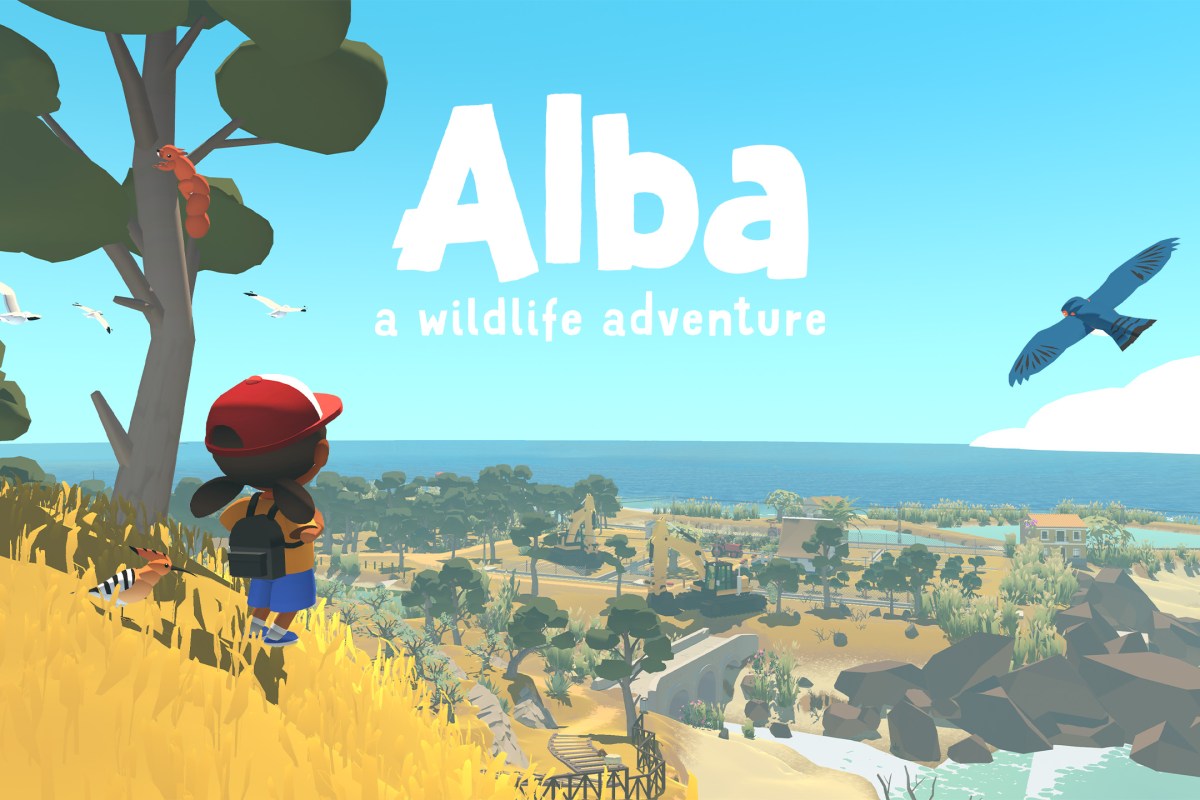
Alba: A Wildlife Adventure and Childhood Fun

I was thinking back on an article I wrote a few years back about noticeably older playable characters in games and a thought occurred to me, “Would I be able to name any child playable characters in games?”

A few examples came to mind quickly such as Link in The Legend of Zelda, Max in Life is Strange and the two siblings in Brothers: A Tale of Two Sons.

An odd one from a few years ago also popped up, 2019’s Call of Duty: Modern Warfare, which had an entire level where players are in the shoes of a child during an invasion. And a short while ago I wrote about the great time I spent with Rockstar’s Bully.

But recently during a game sale I picked up a title that does a great job of recreating childhood, of giving that sense of wonder and exploration that children have.

The game is called Alba: A Wildlife Adventure, and is one of the most charming and adorable games I’ve had the pleasure of playing recently, so I wanted to talk about it today to pass on this gem of a title.

State of Play: Alba and the Wonders of Childhood Holidays

Alba follows the titular character of Alba as she visits her grandparents for summer holiday on a Spanish island of Pinar del Mar they have retired to.

Alba’s holiday starts standard enough; eating ice cream and paella, spending time at the beach, and playing with her island friend Ines.

But when it turns out the island mayor is ready to tear down the nearby nature reserve for a luxury hotel baron, Alba and Ines decide to create a nature club and rebuild the reserve, gathering signatures for a petition to stop it.
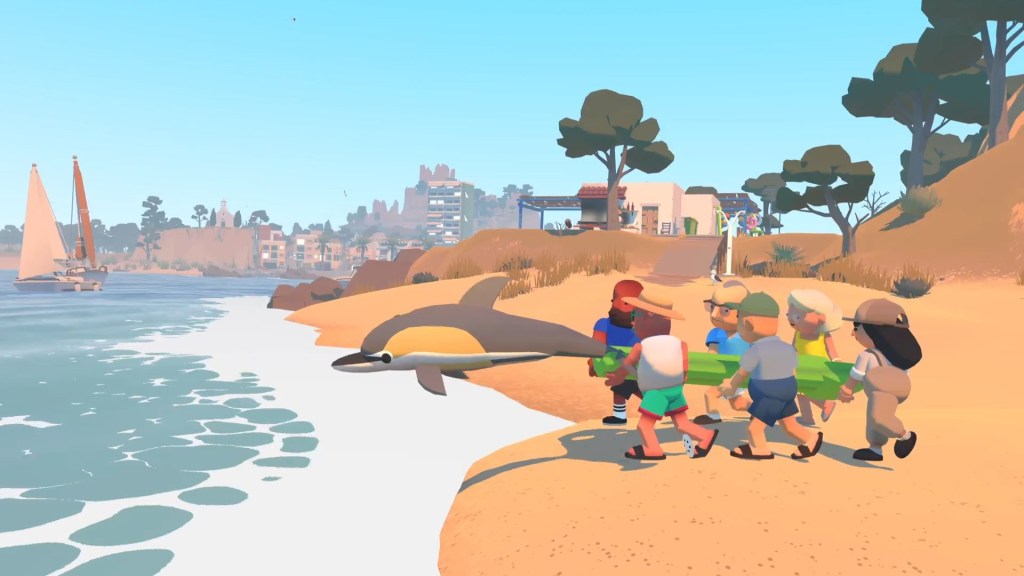
The island of Pinar del Mar gets involved to help Alba and protect the wildlife (Source: psnprofiles.com).

Many other games have child or teen characters in stressful or strange environments, but for Alba it is an environment to learn from, to learn about through exploring, and in general a refreshingly calm and stress-free place, where standing up for your beliefs and challenging authority is a main bedrock of the title.

The main loop of Alba is creating a database of the animals that inhabit the island. Alba is given a nature guide and a phone app by her grandparents to try and catalogue all the animals that live on  Pinar del Mar.

Alba is an open world game, so the main section of playtime is spent researching the animals in the database, learning about their unique markings, habitat, and call, before tip-toeing through the biome and taking a picture of them.

Alba originally standard as an iOS game and I could definitely see the same style working here, popping in for a few minutes every day, wandering around the incredibly detailed world and taking a few picture before heading off again.

It’s a charming little loop that I ended up spending many hours in, just learning about different animals and feverishly trying to fill out the entire book, staying out way beyond the time when Alba’s grandparents texted her to come home just to get that one last animal in a certain biome.
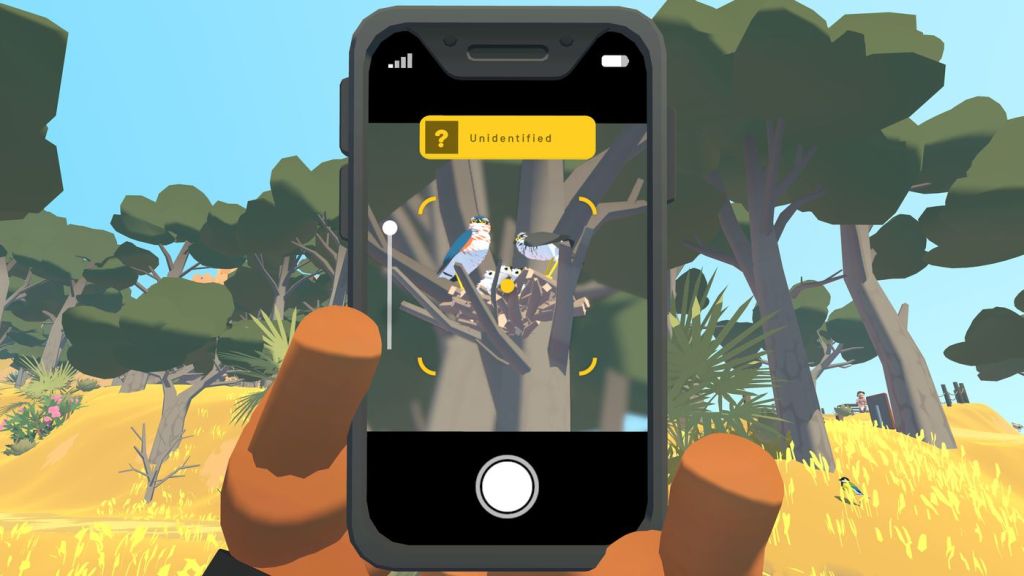
Some animals can be found quite easily, others require knowledge of their habitat and routines. Source: polygon.com

Some of the animals for the book are only spotted in the sky, meaning you have to find the perfect spot to zoom in and out with your camera and get a good chance of catching it as it flies by.

The island of Pilar del Mar is split into eight different biomes; the beach, town, terraces, farmland, forest, marshlands, and the mountain. You would think with such widely diverse locations that Pinar del Mar might feel disjointed but each location flows seamlessly into one another.

Alba has a map that can aid in traversal, but the game’s world is easily navigated just through sight.

Need to go to the mountain? Just look upwards pretty much anywhere in the game. Want to go bird-watching by the beach? Head down the hill and you’ll get there. Buying supplies in the town? You can just see a chimney across the way, maybe the town will be somewhere close by.

It’s always lovely to play an open-world game that can give players a clear HUD, especially after years of experiencing POI to POI marker.
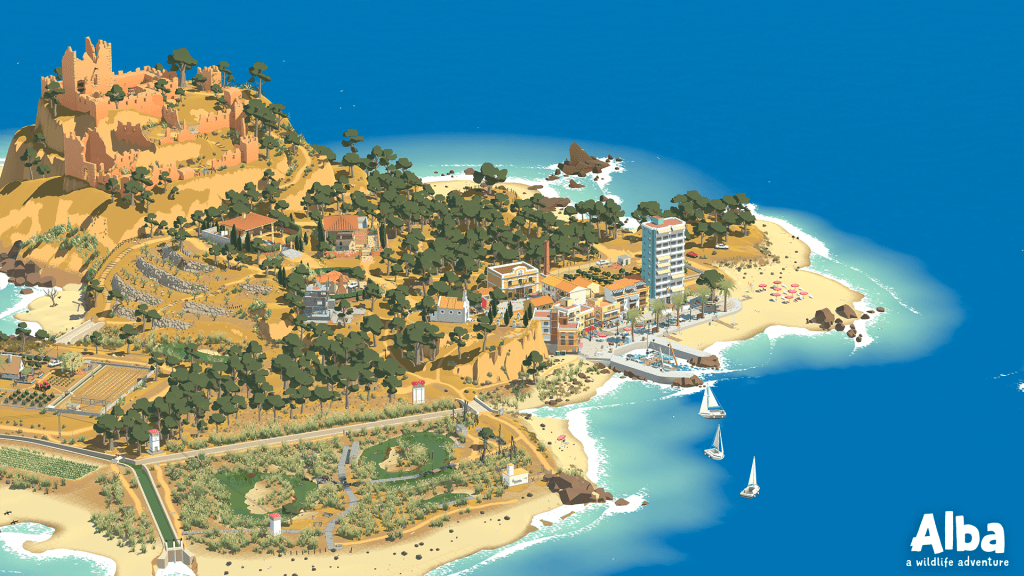
The map of Pinar del Mar with all the different biomes. (Source: medium.com)

For a moment during the opening chapters I thought there might be a speed upgrade, something like Alba getting a bicycle to help make the trek across the island (another hallmark of holidays, bike trips). But nothing like the sort came, and I can see two reasons why.

One, the bird-watching loop. Many a time I would be trekking through the world and see an animal I hadn’t catalogued. It’s a little hard to do that if you’re speeding through the island.

The second reason is such a small one but I was charmed every single time it happened; Alba’s animations. Alba walks and runs normally, but every now and again she’ll change it up. Sometimes she skips, sometimes she runs with her arms out like a plane. These little animations give such detail to Alba and her childhood play, I wish other games would do something similar.

Throughout the game players will journey all across the island and none of it is locked by progression through the game. While some animals will only appear later in the story, the player can easily wander anywhere on the island, cataloguing animals they can see, or interacting with Pinar del Mar and its population.

Talking of the islanders, part of Alba and Ines’ mission is to get fifty signatures from the townsfolk to petition the mayor to stop the hotel build. While some of the signatures come from rebuilding the wildlife reserve the rest need to be collected from the townsfolk, each with their own little stories or dilemmas.

Clara the head of the Wildlife Association, Simón the local vet, María the carpenter, each have tasks like cleaning up the trash left by people, clearing away pesticide spillages, or fixing bird boxes across the island.
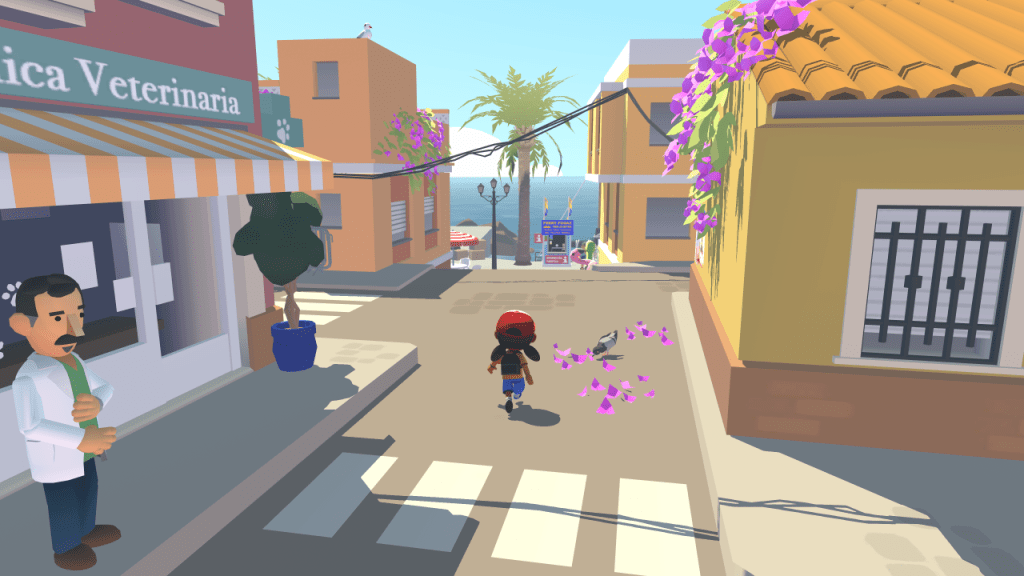
Heading into Town, where most of the island residents can be found (Source: zkm.de).

There are are other characters who are just there by add a little extra charm to the island. Jaineba the ice cream merchant (who gets Alba to test new flavours), Laura the strict and stern police officer, or the two nameless older women who spend their time near the church and talk of their weekly bungee jumping classes.

Every character can be interacted with and will have a few lines of dialogue about them or the day and it gives and extra incentive to explore every nook and cranny of Pinar del Mar. It got to the point where I would interact with my favourite characters each day, despite it never being more than one or two lines, it was a joy to pass by so many recognisable faces.

I also appreciate the diversity of the cast. There are a wide range of skin tones across Pinar del Mar, different languages spoken, some same-sex relationships, and a few visible signs of faith (such as the character Alia, who wears a hijab).

Alba also fits into this diverse cast, with her last name Singh and flying to Spain from the UK, it could be referenced that she is of British, Indian, and Spanish descent. And the game doesn’t highlight any of these points, but just quietly and confidently places the characters into the world.

One of the reasons I was initially drawn to Alba was the apparently short run time. I really like quick and condensed games and according to How Long To Beat the 100% runtime for Alba is around 4 hours. Yet I know I spent far longer in the game.

The satisfying loop of bird-watching, trekking across a beautiful island populated with a fun cast of characters, I whiled away Alba’s days, scouring every biome, sneaking to the perfect picture spot and even returned after the game was done to soak in the atmosphere again.

It’s a charming little game with a strong message about care and conservation, standing up against authority, and that with teamwork anything is possible. If you’re looking for a new game that is a change of pace, for something both calming and enjoyable, and can be enjoyed by all ages, I recommend it wholeheartedly.

Banner Photo Source: store.epicgames.com

The Best Star Wars Game?

One of the first games I ever played was Star Wars Episode I: Racer. As a defender and fan of the Star Wars prequel trilogy, having a racing game based on the high-octane drag racing sequence was a formative gaming experience, and one of the main reasons I play games today.

While the original game was on the Nintendo 64, the game recently got an re-release for the PlayStation 4, Xbox One, and Nintendo Switch. The update was a simple polish and shine, updating the graphics and the frame rate so the game would run smoothly (sometimes the N64 would play like a powerpoint) and that was it.

It was kind of refreshing to see a game of a very particular time be brought to a modern console. The early 3D graphics where every shape needs a right angle, the stripped-down story, and sometimes odd animations, it has a retro charm that goes a long way to papering over its failings. Being a Star Wars game it would have been so easy for the Game Overlords that run the SW brand to force micro-transactions or some daft online ranking to the game, but it’s thankfully been kept as pure to its original form.

So, as a defining game of my childhood, I decided to pick it up and blasted through it over a lazy weekend. Despite the rather short lifespan of the game, I loved every moment, so I wanted to list a few reasons why it is one of my favourite games of all time.

Start your Engines! Why I Love Star Wars Episode I: Racer

1. The Universe

While we’ve only seen pod racing once in the entire cinematic Star Wars canon (in one of the best sequences of the entire saga) the game builds upon the work the film did with new tracks and worlds that are not even seen in the other movies.

I think a lot of SW films are kind of boring when it comes to their landscapes, mainly just reusing the same sand/snow/forest landscapes, but in Racer we have a whole host of planets and racetracks.

While the game has the sands of Tatooine and the snowy mountains of Ando Prime, it also has the methane lakes and geysers of Malastare, the smoky quarries of Mon Gazza, and the modern architecture and rocky cliffs of Aquilaris. Those are just the tame ones.

The game also features some standout tracks such as the abandoned gas stations of Ord Ibanna, suspended in low orbit, just like Cloud City from The Empire Strikes Back. Another is Oovo IV, which is a space prison situated on an asteroid belt, complete with cells and airlocks. My favourite tracks are on Baroonda, a planet of tropical jungles, swamps, and beaches, complete with Moai-inspired statues as well as the odd volcano.

While the locations are a high point, the are pushed even further by their individual quirks that helps bring them to life. Ando Prime is inhabited by monk-like aliens, with statues and flags reminiscent of temples in Nepal and Tibet. The race course on the asteroid Oovo IV has several sections without gravity and rogue asteroids. The spice mines of Mon Gazza feature everything from massive diggers to transports that litter the courses. The machines slowly move backwards and forwards so that they are not in the same place as each tracks progresses.

Each planet has its own look and feel, which leads onto…

2. The Tracks

While the game only has eight planets, it manages to keep each one rather fresh, even while refusing certain sections of a map. When attempting a new course it’s a fun mixture of certainty and fear, knowing how to tackle some corners and sections, while at the same time having to pick up on the fly how to navigate other sections of the map.

While the earlier tracks are definitely the easier and less interesting with wide open spaces and flat plains, there are always a few little extras to spice up runs, be they secret areas obscured by vines or waterfalls as well as branching paths that take you to completely different areas of the track than your competitors, or just really big jumps that let you glide effortlessly above the other racers.

Later tracks becoming increasingly difficult with sequential hairpin bends (with nothing to stop you flying of the side of the rocky cliff face that you’re racing on) or erupting volcanos that change the layout of the course.

Even in some of the earlier tracks there are hazards. Pod racers are good on solid terrain, but when going across the ice lakes of Ando Prime, the swamps of Baroonda, or the methane rivers of Malastare, pods can start to drift, sending them careening off course, usually to an explosive end.

The Boonta Classic, the track that is featured in The Phantom Menace and the last track of the game, also features sharpshooting Tusken Raiders and moisture pockets, both are severe dangers to weave through. These little features are great, as it throws a curveball into racing so even if you’re ahead of the pack, one wrong move could have them catching up to you.

3. The Podracers

Podracing to me is so cool. Taking the high speed of Formula 1/drag racing, place them on dangerous terrain, and just boost everything to as much as it could be. The idea of a small pod that by the sheer speed and force of the massive engines makes it float is such a novel and interesting concept, and Racer replicates that dangerous sense of speed perfectly.

While we only saw a fraction of the racers in the film, the game goes all out, adding all the racers that were included in the deleted scenes, each with different strengths and weaknesses. And while some racing games’ vehicles would be simple re-skins or little tweaks, here every pod racer is unique. You have the monster truck equivalents of Sebulba and Mars Guo, to the dainty butterflies like Anakin Skywalker and ‘Bullseye’ Navoir. My favourite is Neva Kee, who is unique in the fact that his pod has no cables (that purple energy bar that connects the engines), and is essentially just a tiny cockpit glued to two giant rockets.

As you complete each race you usually unlock a new pod racer which can be useful considering the different tracks layouts as you aren’t stuck with one machine. If you’re on a course that has a lot of tight corners, you can choose a racer that is more suited to turning. On a course with long straights, you can pick someone with a fast boost and high acceleration. Size and weight also plays a factor in choosing a podracer. Smaller pods are generally faster, but can’t take as much damage as the larger, slower, pods.

The pods do everything they do in the film, which is something unique in the racing genre. While they have the standard boost, the pods can also flip sideways to fit through narrow gaps and have air brakes that allow you to float over jumps and gaps. It’s thrilling on tracks like Ando Prime where you can boost off the top of a mountain peak and then just gently float across ice gorges and alien monasteries of that planet.

Each pod can be customised, either through buying from Watto’s Shop or by exploring for parts in the junkyard. While these custom options are more for building stats than changing the look of your pod, it’s still great fun to max out your speed and boost stats, leaving you on the edge between ‘in control’ and ‘totally lost it’.

The sounds design helps sell the illusion of the pods with every single engine having a beautiful hum and rev. Even the small things like shutting down an engine to repair it or put out a fire, to the whistling air as you fly across a gap, to the hiss of the air brakes, each one is solid, sounding exactly like what would you think these gigantic machines would sound like, and mixing perfectly with the ‘vroom’ of the pods around you.

And it doesn’t hurt to having the excellent John Williams score layered over the top. Nothing beats hearing the boost of a pod over the pulsing strings of ‘Duel Of The Fates’ our soaring through the air to the blaring trumpets of ‘Battle of Naboo’, and making you want to shout, “NOW THIS IS PODRACING!”

Conclusion

Despite being over twenty years old, I had a so much fun with Episode I: Racer. And while there was a sequel by the same studio for the PlayStation 2 called Racer Revenge, it was met with mixed reviews.

Episode I: Racer is still fondly remembered by many, featuring highly on several ‘Best Star Wars’ game lists, and was happily received with its re-release. It took a sequence that was only about fifteen minutes of the first film, and delivered all the promise that it offered.

I was partly raised on racers, with things like Gran Turismo, Forza, and Mario Kart being pretty much constants throughout my gaming life. And while each of those is fun in their own right…there is just something better about Racer.

I could be biased, but there is just something about the sense of speed, trying to control two full force engines, flying through impressive vistas and winding corridors that no other game has replicated.

The only other game that really worked in the same way is Split/Second: Velocity, a beautifully daft arcade racer, also published by Disney. Split/Second is filled to the brim with powerful looking and sounding cars, interesting and unique locations, and explosive gameplay. It too, like Racer, has been left behind by Disney, a one-and-done game that deserved a sequel.

Despite Disney breathing life back into the Star Wars property, the games have been few and far between, with only two controversial Battlefront games, one action adventure (Jedi: Fallen Order) and one flight sim (Squadrons) being released. With the new trilogy finished, now would be the time for games to fill the space between new films and television shows being created.

If we were to ever get more Star Wars games, I hope that one is based on pod racing. With today machines, Disney could push it further and farther than before. New tracks from planets across the saga, new racers, more customisable options, a strong story, and even the option to build your own pod racer from scratch.

There is so much that could be created and improved…and with a name like Star Wars, it’s all but guaranteed to make money.

Banner Photo Source: nintendo-insider.com