
I’ve recently been doing a backlog binge of older open-world games I never got to play the first time around.
Titles have included the Guy Ritchie-inspired The Getaway, which simulates ten square miles of London for its story. Another is Mafia, which uses its city more for immersion into its 1930s world than for regular open-world hi-jinks.
The other old open-world game that I’ve been playing and has captured my heart is the infamous Bully.
Bully (also known as Canis Canim Edit) is such an unique game, even among Grand Theft Auto clones.
Despite releasing originally on the sixth generation PlayStation 2 and then re-released on the seventh, eighth, and now ninth console generation, the game never got a sequel, which I feel is a terrible pity.
I wanted to write about my experiences playing, because Bully deserves to be experienced, even so long after its time in the spotlight.
Dog Eat Dog – Why I Love Bully
Bully was developed by Rockstar Vancouver, a Canadian offshoot of the “Rockstar” brand, known for Grand Theft Auto.
While Rockstar North developed GTA, other studios effectively built GTA clones. Rockstar San Diego created Red Dead Redemption in 2010, and in 2006 Vancouver created Bully.
It’s both amusing and interesting to see GTA, the ultimate adults-only game, have to fit the mould of a schoolboy simulator.
Each new scenario took me by surprise as Bully would put its own spin on the standard GTA tropes.
The missions, vehicles, characters, authority, Bully has all the ingredients for GTA but they are tweaked just a little to accommodate both the cast and the age rating (Bully was released as a 15+ rather than the 18+ of GTA).
Things like spray-painting offensive words onto walls, riding a BMX into town to go to the carnival, Halloween pranks, Christmas snowball fights, Sports Days, it creates a charming atmosphere of being made for rebellious teens who aren’t allowed GTA, but doesn’t patronise the player either.
And while some games could lose shine as more time is spent in them, this charm of “new-yet-familiar” kept me coming back to Bully, both for the boarding school role-play and simulation, as well as the wilder moments that it invents for the story.

Bully does actually play a lot like a roleplaying game with its school timetable. There are six classes; Chemistry, English, Art, Gym, Shop, and Photography.
While some main missions require a particular level (the second half of the game focuses a lot on photography), a player can easily play truant and miss out on classes all together, with no real consequences unless they are caught.
However these classes give you different abilities once you pass. Chemistry allows for restocks of the player’s arsenal (all schoolboy things like firecrackers, bags of marbles, and stink bombs among others).
Art allows the player to kiss girls and boys for a health boost, and Shop lets the player upgrade their BMX, one of the better ways to get around the world.
The game also works on a yearly calendar, starting with the beginning of school term in September and finishing sometime in the summer. This allows for standout missions around Halloween and Christmas, but it’s more than just one-off episodes.
Being set in New England, the seasonal change is dramatic. At the start of the game, the leaves are coloured anywhere from red to yellow and occasionally fall from the trees alongside the odd the rain shower.
In the third chapter winter has come to Bullworth, with the cast now sporting big coats, hats, and gloves. The trees are leafless and it gets darker earlier. New props such as snowmen, snowballs, and shovelling snow as a detention are only available in this season.
Once the snow is gone and the trees sprout their new leaves, the rain continues to pour until the final chapter where the sun comes out and signals the start of an endless summer.

Bully doesn’t have the most expansive of world compared with stablemates Vice City and San Andreas, but I think it is far more detailed that either of those games.
The school on its own is rather impressive with dorms, a library, gym, locker rooms, football stadium, basketball court, swimming pool, frat house, auto repair shop, and observatory.
Then the main building also houses the headteacher’s office, cafeteria, and the four classrooms, all of which are open and explorable in the game.
The town of Bullworth is split into four distinct areas. Old Bullworth Vale is for the preppy students and faculty members, with mansions overlooking the water and lighthouse.
Bullworth Town is a major shopping district where the Geeks hang out in the comic book store. New Coventry is an run-down urban estate for the Greasers, and finally Blue Skies is a trailer and industrial park where the Townies stay.
On top of the four neighbourhoods Bully also has a map full of extra locations that are used for maybe one mission or are just window-dressing, but give an extra flavour to the world.
Things like the Happy Volts Asylum, a fully working train yard, The Bullworth Dam, a church and graveyard with a preaching vicar, abandoned tenements, Billy Crane’s Travelling Carnival, and the half-sunken pirate ship next to of one of the many islands off the coast, each one gives a little extra spice or history to Bullworth and makes the city fun to explore.
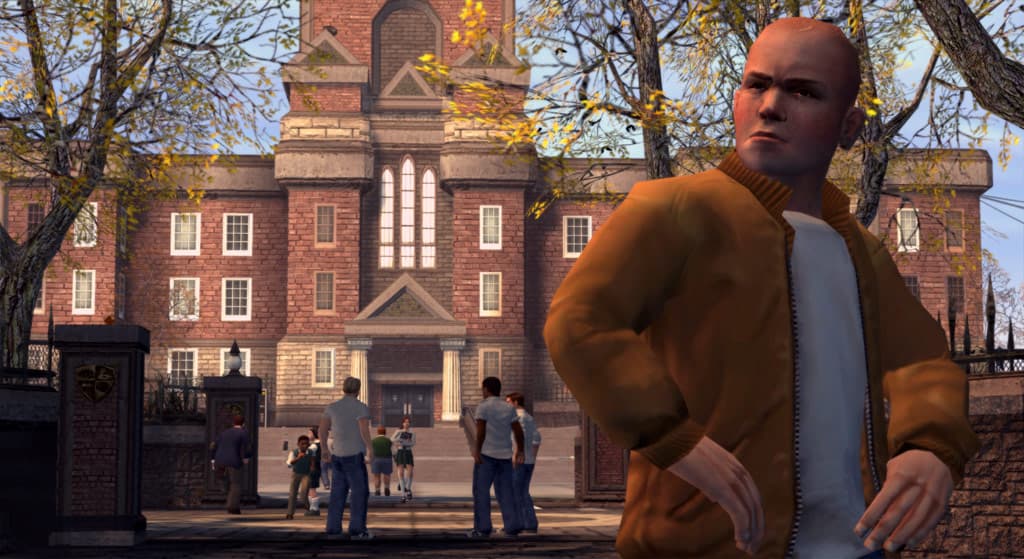
Bully does suffer from the same strong neighbourhood lines that were in Vice City and San Andreas, where distinct seams were visible between say the shopping district and the industrial estate, but it’s forgiven for its age.
And despite its small size, I think it feels richer, mainly due to the level of detail that could be afforded a smaller world.
One thing I do enjoy about the game being a small map is that I get to see the same characters again and again wandering around Bullworth.
While in GTA and Red Dead you do see a few of the same faces in the gang hideouts or the saloon, they soon became background characters to the main character’s individual pursuit, only to be interacted with in cutscenes.
With Bully, I always felt this growing sense of getting to know characters, even if there isn’t much outside of a simple positive/negative comment that I can throw out at them.
It perfectly mirrors being a new kid at school, slowing getting to know people as they pass by in the corridor or school grounds, some saying hello or others stopping you with a quest, some that don’t have any greater role in the game or cutscenes that just being a recognisable face in the crowd.

And after a while it’s fun to pass through the school and be able to recognise people; Gloria the kleptomaniac, Mandy/Pinky/Angie/Christy of the cheerleading squad, Algie the nerd, Russell the slow-witted but beefy tank, and Pete, the only sensible and rational character in the entire game.
But as the location is a school, it’s not just school kids walking around. Teachers walk around from class to class, giving a real sense of a school working to a timetable, rather than just cycling through character and animation loops.
And Jimmy Hopkins, the playable lead, seems alright. He does act like a proto-form of a GTA character; he’s brash, confrontational, with streaks of sadism and misogyny, but I’ll excuse it due to him literally being a fifteen year old child.
While Jimmy is definitely ruthless, he is also shown to comfort other characters when they are feeling down and being heroic in other instances like putting out fires in the school.
Jimmy is actually quite interesting as a Rockstar lead, mainly due to his ambivalence to the entire school system. When he first arrives at Bullworth, Jimmy doesn’t look to take over and become its leader. He just wants to get through with the least amount of hassle and then leave.
It’s only to get back at the sociopathic schoolmate and current school ruler Gary that spurs Jimmy forward. The plot is relatively simple in its driving force, but once again it’s the surrounding essence that makes it shine.
The fact that Jimmy has to defeat all the head of the school gangs before ruling the school, how the different cliques vie for control and actually fight in the corridors and grounds, and how most the cast that give missions act like adults in a GTA game when none of them are older than sixteen is endearing.
It reminds me of games like Yakuza or films like Brick, where young characters have latched onto what they thinks makes someone “cool”, where in reality they are just massive dorks acting like their are in their own personal movie, with Jimmy being one of the only “straight men” in the game.
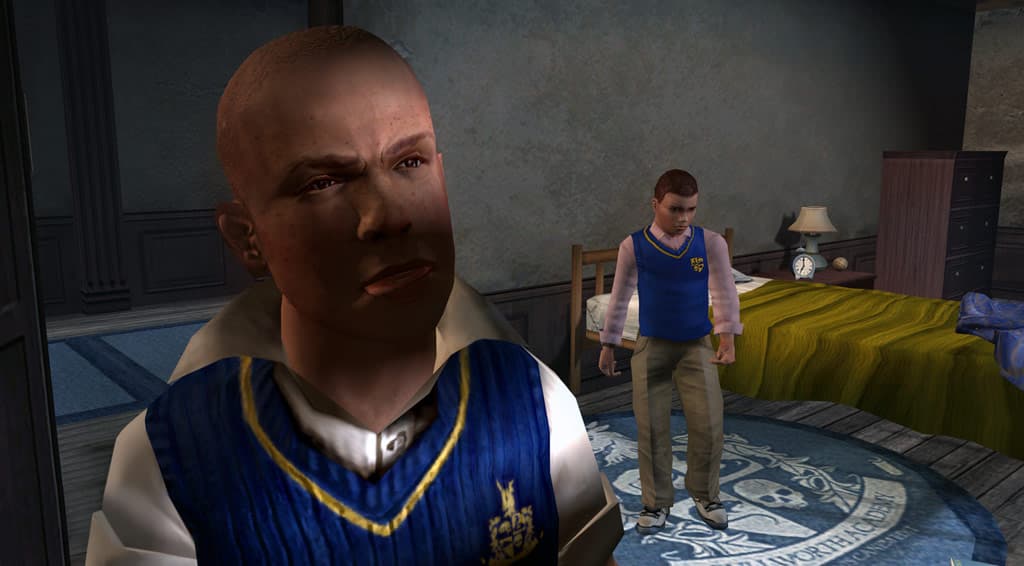
Like I said right at the start of this piece, the theme of Bully is its strongest suit, but that’s not to diminish its other qualities. It’s a classic sixth generation console game, with a strikingly detailed world, a strong and hilarious story, and a great mix of action, exploration, and set pieces.
So if you’re waiting with anxious breath for GTA VI and wanting something to hit that Rockstar itch, or you are just looking for a open-world game that has a different pace and flavour, I think Bully might just be the thing for you. And hey, maybe one day we’ll get a sequel…
Banner Photo Source: rockpapershotgun.com.




 TOM CLEMENT | GAME PRODUCER | NARRATIVE DESIGNER