For the last year I have been working through a backlog of Xbox and 360 games that I never played before.
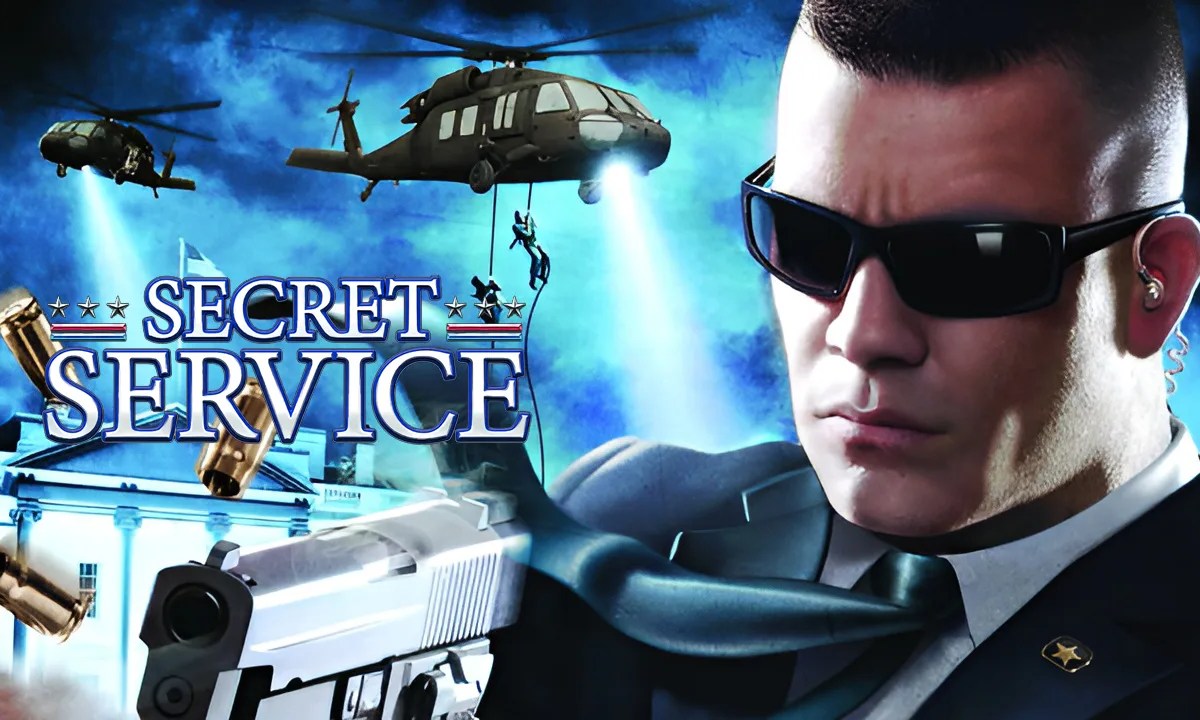
Alongside stone cold-classics like the original Halo or Medal of Honor: Frontline, I decided to pick up a game I had seen on store shelves for nearly two decades; Secret Service.
As the name suggests, the game has the player take on the role of a Secret Service agent protecting the President of the United States of America.
Now, to anyone that frequents game-review videos on YouTube, it might sound odd that I want to play Secret Service.
Even just a cursory glance at its Google page or YouTube search results would indicate it is one of the the worst games ever made.
However, I think with getting older, my priorities within gaming have changed. When I was younger, narrative was the sole thing I was interested in. Then a little older, solid gameplay became the main reason to play.
Nowadays, I’m all about the concept. A log line, a 20-seconds elevator pitch, something that makes me say, “I want to play that right now!”, that’s what will make me try a game out.
It’s not the first game I’ve chosen for its concept. Other games were Medal of Honor (2010), Mafia III, and Assassin’s Creed: Valhalla, all games that were seen as generic in gameplay but had solid concepts, and that alone gave me joy.
If I can see the concept through the game, then I’m sold. So I decided to give Secret Service a try.
“The President is in the crosshairs. Is the assassin in yours?” (Source: gamewatcher.com)
***
“Get Down Mr. President!” – Two Brief Playthroughs of Secret Service
I don’t usually remember the first thought I have about a new game, but I do remember it for Secret Service.
Oh god my eyes!
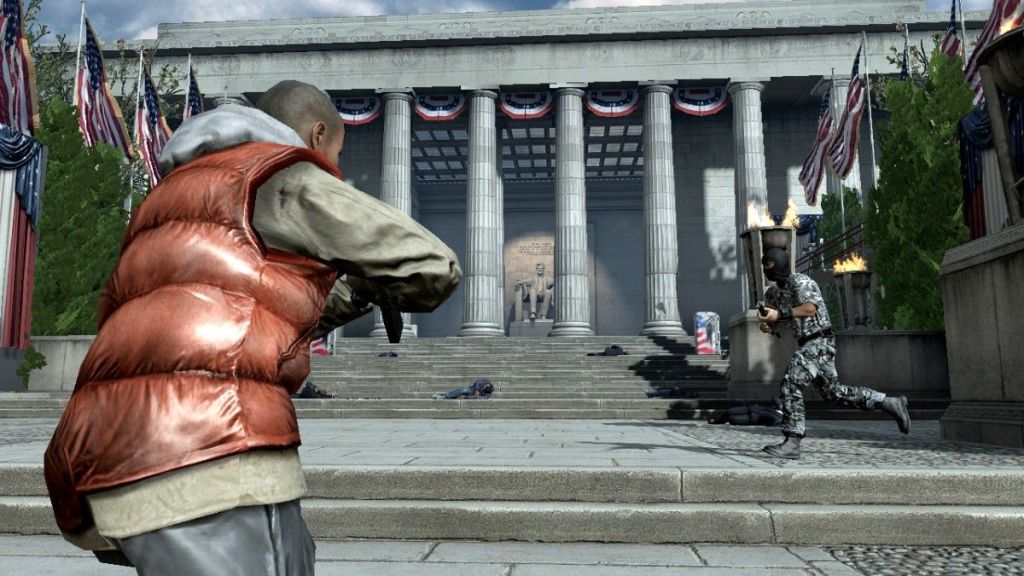
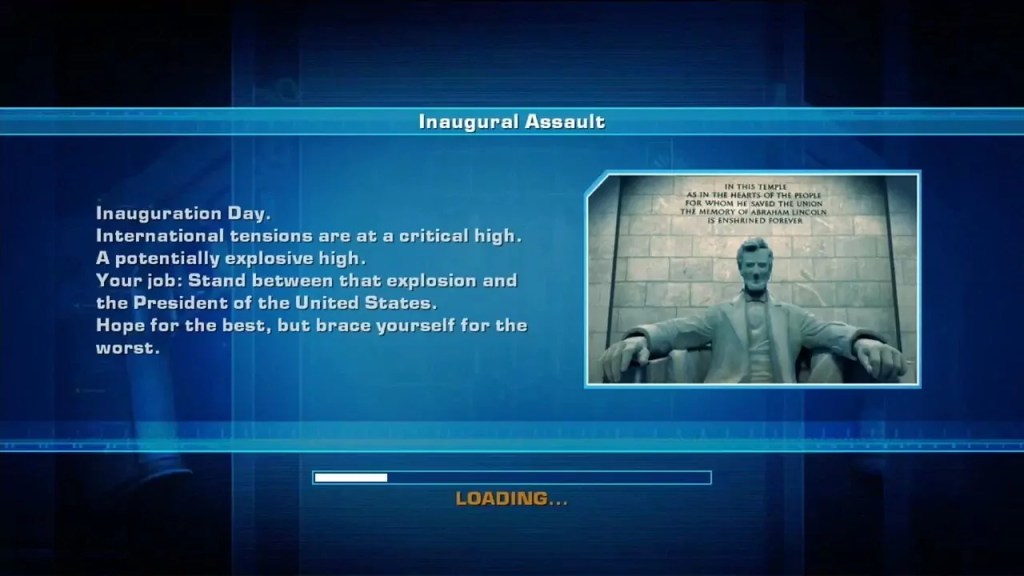
The game starts at the Lincoln Memorial, where the out-going President is making a pilgrimage to the famous statue, when bang/whizz/flash, terrorists storm the event and shoot the Prez in the stomach.
The player is then armed and told to keep the terrorists back while a helicopter can be flown in to get the President to safety.
Dropping players right into a shootout is an exciting opening, it’s just the gunplay here is lousy.
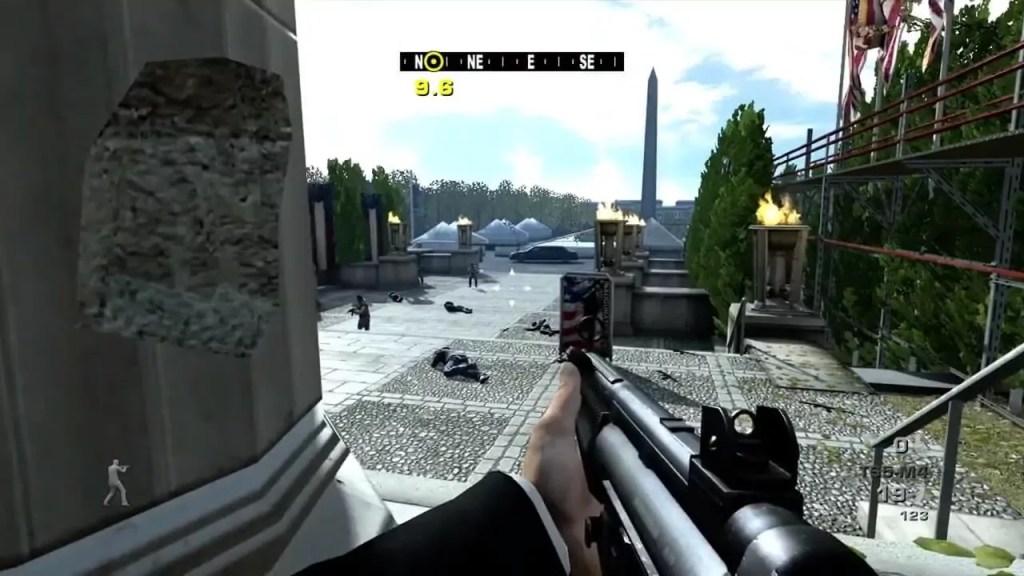
Whenever I fired a gun when aiming down the sights, the crosshair flinched right into my brain. Hip-firing is even worse, with bullet spread mimicking Jackson Pollock’s painting style.
And the weirdest addition of all, reloading a weapon causes the FOV to focus-rack, blurring everything but the gun. I’ve never seen this before in a game and it’s so confusing…like, why? In what way does that feel good as a player or designer?
Controls aren’t any better. Movement is comparable to a tank stuck in the mud. I quickly headed to the settings to up the sensitivity, but the main thing that enraged me was the walking speed, which felt closer to a tractor than a special agent.
I was not having fun. But I powered on. I had my concept and I was seeing it through.
A cool concept opening that sadly shows the worst of the game (Source: myabandonware.com)
***
The shooting of the outgoing President is only the start of hostilities.
Washington D.C. and the new President are also under attack by foreign invaders, and so it is up to us, Special Agent Pierce, to work our way through famous landmarks in Washington and stop the terrorists by any means necessary.
Onto the second mission, fighting through the halls of Capitol Hill. The core loop in this level is clearing out the terrorists, going room by room, corridor by corridor, retaking the building and disarming some bombs that have been smuggled in.
After the first few rooms, I gave up on the MP5 the game had given me as my primary weapon. The bullet spread was just too bad to play with. I decided to switch back to the service pistol.
And it was here where I found enjoyment for the first time in Secret Service. Using the service pistol, it gave sense of role playing, using the same gear as a proper agent would. Not to mention the pistol had a quick Aim-Down-Sights, meaning I could pick shots easily and decidedly.
I settled into a groove, playing more like original Rainbow Six, cautious movement and small sporadic violence, than the reaction-based fights of Call of Duty.
In general, the game’s vibe actually does lean more towards Rainbow Six. It’s no surprise that the developer of the game, Cauldron HQ, are more well-known for their tactical war games like Arma and Operation Flashpoint, modern military games that focus on hyper-realism.
The game aims more for spectacle than slow-burn gameplay (Source: gamewatcher.com)
***
You can almost see the threads of that pedigree in the game. The quick Time-To-Kill (where enemies can put the player down with one well-placed shot), a dedicated peek button to have a tactical advantage in firefights, and later working as a team to protect the President from harm.
The finale of the second level takes place in the main Capitol Congress Hall, facing enemies firing from the viewing balcony at the cowering politicians below.
It’s a cool set piece, having to move from table to table as the bad guys circle from above before they attempt to storm the ground floor.
One interesting point in this mission is the simple but effective visual design change of the bad guys.
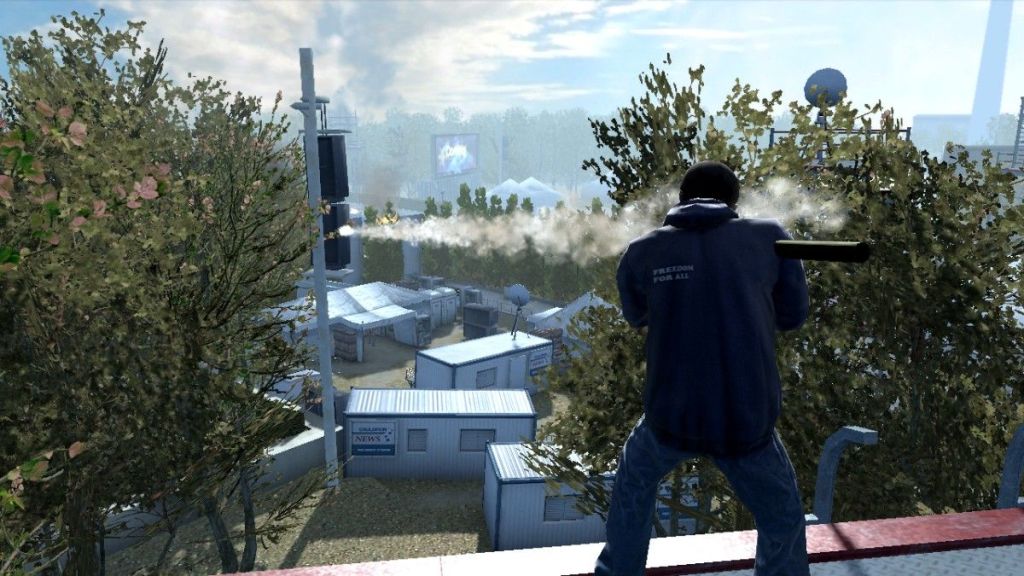
In levels that take place in public, they are usually dressed as civilians. Missions inside government buildings like the Congress level have the enemies wearing militarised vests and holsters, and the final levels have them dressed in full special forces gear as they attempt to take the White House.
It’s just a nice touch showing the coup attempt going from rush attacks to an all-out invasion.
Talking of the invasion, let’s discuss the story of the game…or what is left of one.
A story like this is inherently political; your role and the gameplay is literally saving the President of the most powerful country in the world.
And coming from a developer outside the USA (Cauldron HQ come from the Czech Republic), this might have been an interesting take on how the USA is seen from an outside perspective.
Loading screen text between missions doesn’t do much other and set up the next location (Source: myabandonware.com)
***
The game starts a with a vague and slightly incomprehensible Call of Duty 4-style opening cutscene about a fictional South American country called Costa Sentava.
It’s a smash-cut of new reels and dates, flying through oil fields, attempted coups, biological nerve gas, and possible CIA subterfuge in the country.
Then skip forward to the presidential inauguration and then it’s all, “For El Presidente”…and that’s it.
Sure, there are more twists than an M. Night Shyamalan film about pretzels, with double crosses, fake-out double crosses, and triple crosses that by the end I was more baffled than anything.
The story does have some interesting ideas, but they are all in “Cell Phones” dropped by enemies, essentially CoD4 intel (oh, the beauty of 2008-era technology, where all the pickups are all clam-style flip phones).
These voice messages start out with the Costa Sentavan forces justification for invading, then slowly turning as they learn about the atrocities their comrades are performing, and finally breaking into factions, fighting each other, and attempting to flee back to Costa Sentava.
It’s interesting to read and would have been great to acknowledge in the game. One cell phone voicemail has a terrorist break down after a famous Sentavan poet at the US inauguration is shot dead. It could have been a powerful moment to show, cutscene or not.
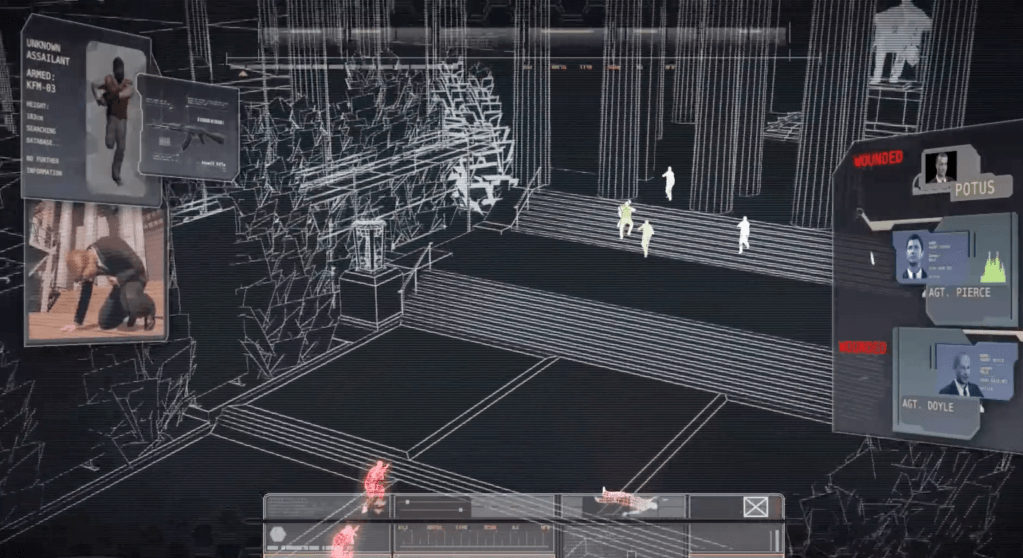
All the cutscenes in the game are wireframe briefings, but none make much sense. (Source: YouTube, Global Gaming)
***
Back to the missions. So while my hopes were raised by Mission 2, then were quickly tempered back down again by three huge sewer levels; long grey corridors of supposedly the secret bunker of the President.
It’s here where the game becomes a puzzle platformer as you have to navigate several electric fences and laser trip mines that you can only see with Night Vision goggles.
Night Vision that coincidentally has a limited battery, meaning sometimes you have to wait in the dark for it to recharge.
There are brief moments where the level design is cool, like fighting through bunker offices and break rooms, at one point there is a missile about to be launched that needs deactivating. Who knew that the basement of the White House held a nuclear missile?
Halfway through these sewer levels, the Secret Service think you are a double agent and they begin trying to stop you.
Player character, Special Agent Pierce (voiced by Nolan North, more well-known as Nathan Drake of Uncharted fame) is told to stop heading towards the White House, but goddamit someone has to save the President, and he’s the only one who can!
However, because the other Secret Service agents are simply misguided people following orders, you can’t kill them, and so you can only use a taser to take them out.
Later on there are a mix of Secret Service and Costa Sentavans aiming to kill the player, meaning having to switch weapons constantly between lethal and non-lethal. This would be an interesting subversion of gameplay, if the weapon switch didn’t take an age to do.
Unlike CoD4‘s pistol switch (which, and say it with me now, “is always faster than reloading”), Secret Service has a rack-slide animation every time you equip a gun.
Talking of weapons, they are the default set for a modern military First-Person-Shooter. Pistol, SMG, AK, Assualt Rifle, Shotgun, Sniper, RPG, all that good stuff.
The shotgun is fun and quick, and I’ve already praised the pistol as a prop for roleplay. All the machine guns are terrible, bar the one we get in the final missions of the game.
The sniper surprisingly doesn’t need breath control, which actually is probably for the best. The sticky controls severely impact the gunplay, so to rip another gameplay idea from CoD would be too much.
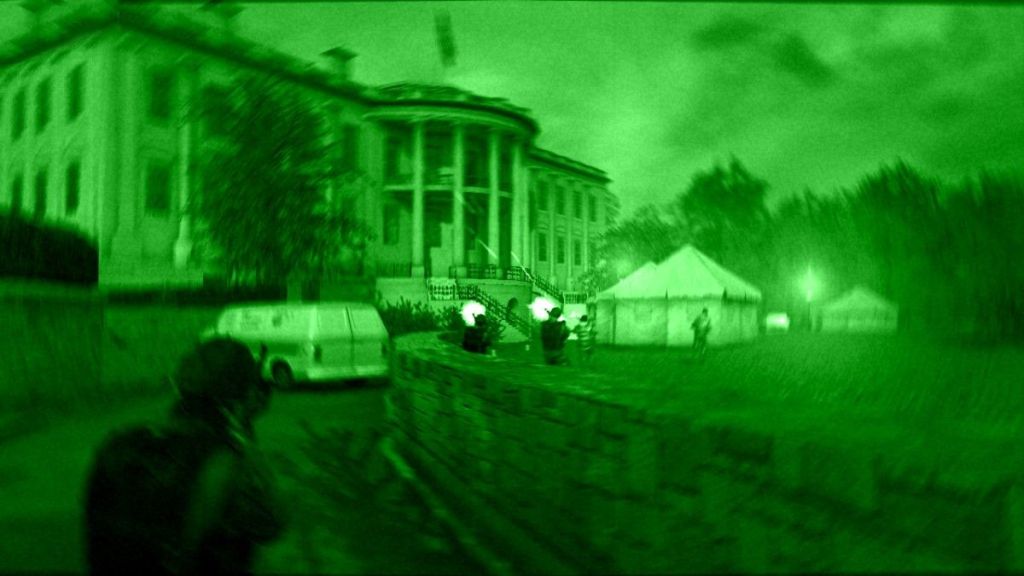
The iconography of Washington D.C. is used quite well, including the finale at the White House. (Source: gamewatcher.com)
***
The player finally emerges from the three long sewer levels into the White House. It’s a fun segment, the game has given us the best weapons and plenty of cover. Night begins to fall as the Sentavan Special Forces close in, ready to finish the job.
We defend the Oval Office from terrorists coming through the Rose Garden, making quick dashes across the patio to defend different parts of the complex.
The game then tasks us with going up and down stairs and switching from short range engagements to long-range sniper battles, and it actually feels like the game is starting to come together.
Then after a quick helicopter ride on Marine One, where Special Agent Pierce commandeers the machine gun on the side in a very watered-down recreation of the AC-130 mission from CoD4, we arrive at the final mission.
It’s another CoD4 rip-off, this time “Mile High Club”. The Speaker of the House and evil Secret Service agents have taken the President hostage on Air Force One, and you are the only one able to stop them.
Just like “Mile High Club”, it’s a quick dash up and down the plane, shooting anything that moves, and ends with you having to take the shot that kills the bad guy and saves the President.
Fun fact, you can intentionally botch this final shot, giving you a 0G Acheivement titled, “The Exact Opposite of Your Job”.
Everything feels like placeholders and hurts the game’s style. (Source: Video Game Museum)
***
Conclusion
I have mentioned Call of Duty 4 so many times in this retrospective, because for all intents and purposes, this is just a quick CoD clone, released almost one year after CoD4. And hey, it was even published by Activision.
Everything from the titles to the UI feels basic or like placeholder assets, would it have been so hard to give the team the CoD4 engine and reskin it?
Released on 4th November 2008 (the LITERAL day of the US Presidential election, poor-taste-be-damned), this game feels pulled in two directions.
I commented earlier about the more tactical approach to gameplay, and it’s probably what this game was originally going to play like.
But with the election being a perfect marketing gimmick and CoD4 being the game of the decade, the team was probably ordered to follow the market (not the first time a publisher, or even Activision, would have told a team, “make it like CoD.”).
I don’t think this is the worst game ever as so many YouTube videos have described. It’s probably the worst first level I’ve ever played, but when the game manages to get all its cylinders firing in the right direction, it becomes a passable CoD variant.
And conceptually, I was thrilled.
Moving through famous locations like the Lincoln Memorial, Congress, and the White House, playing a role seldom seen in gaming, using some punchy weapons (which on lower difficulties can be fired from the hip with startlingly accuracy, turning Secret Service into a fun Doom mod), I got more than I expected from Secret Service.
I’m not going to say go out and buy it or that it is an underrated gem, I think I more pity it. With more time and a stronger tactical approach, I think it could have found a niche audience.
My childhood curiosity of the game was satisfied and I had some fun in the brief hours it lasted, and that’s all I can ask for.
As the 2020s have rolled on, I enjoy looking back at games from my childhood and teens as they reach important milestones.
I’ve talked before about some big anniversaries, such as the original Assassin’s Creed and its sequel turning ten years old, the Medal of Honor reboot turning fifteen, and Driver reaching twenty.
Another game of my early teens had its 20th anniversary in 2025, and I would love to write about it because as it stands it doesn’t get as much as attention or love today.
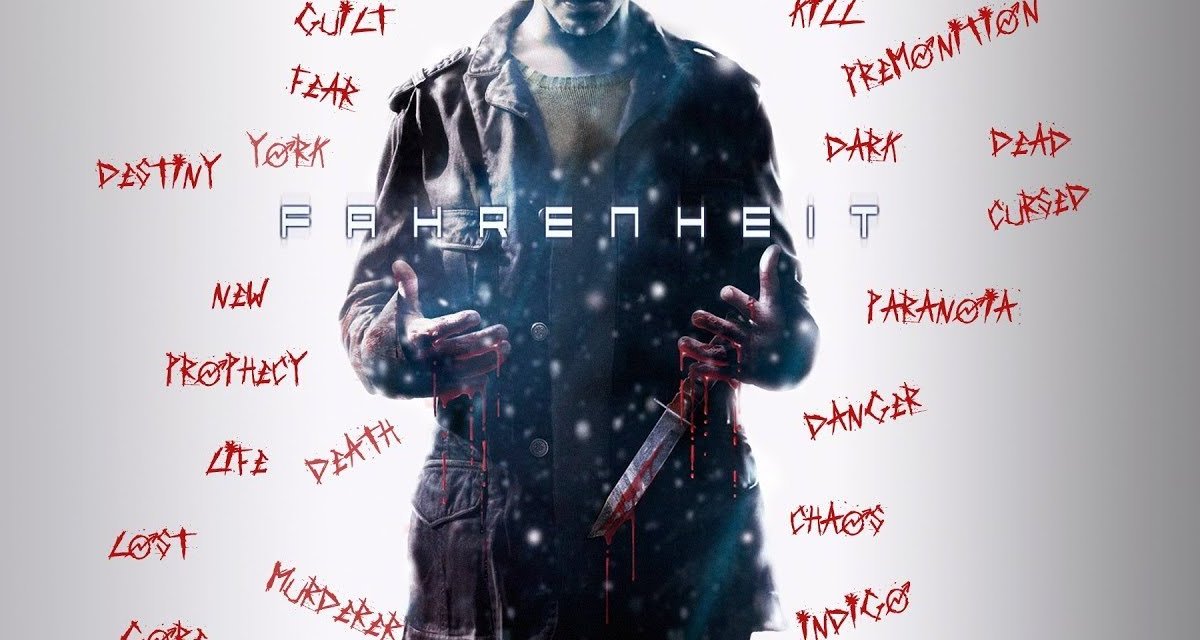
Let me introduce you to Fahrenheit: Indigo Prophecy.
Guilt is a Chilling Feeling – Fahrenheit at 20 Years Old
First off, I have to address the name. The original title is Fahrenheit, and is named that Europe. However, the game came out in 2005, a year after the Michael Moore documentary Fahrenheit 9/11.
As to not make American audiences think the game was in any way connected to the film, the game was renamed to Indigo Prophecy, a name that fits the story better, but is 100% less cool than “Fahrenheit”.
And just for clarity and for my sake, I’ll be referring to it as Fahrenheit throughout this look back.
So, what is this game and why do I love it?
Fahrenheit was created French developer Quantic Dream, more well known nowadays for their games Heavy Rain, Beyond: Two Souls, and most recently, Detroit: Become Human.
Quantic Dream games are focussed heavily on their cinematic quality, featuring long, winding stories connecting several characters, and recently use the voice and performance of Hollywood talent such as Elliot Page, Willem Dafoe, Clancy Brown, and Lance Henriksen.
Fahrenheit is the first game that Quantic Dream tried to make that followed this “cinematic” aspect, so is a fascinating artefact of a team working on the first of what would be their signature gameplay style.
The gameplay in Fahrenheit is a focussed mainly on quick-time-events that take over for major actions in the game, like performing feats of strength. The other half of the game is filled with dialogue sequences, guiding the story through our choices. But before I get too bogged down in the tech, I want to talk about the story, as it is the high point of the game.
Source: omikrongame.blogspot
***
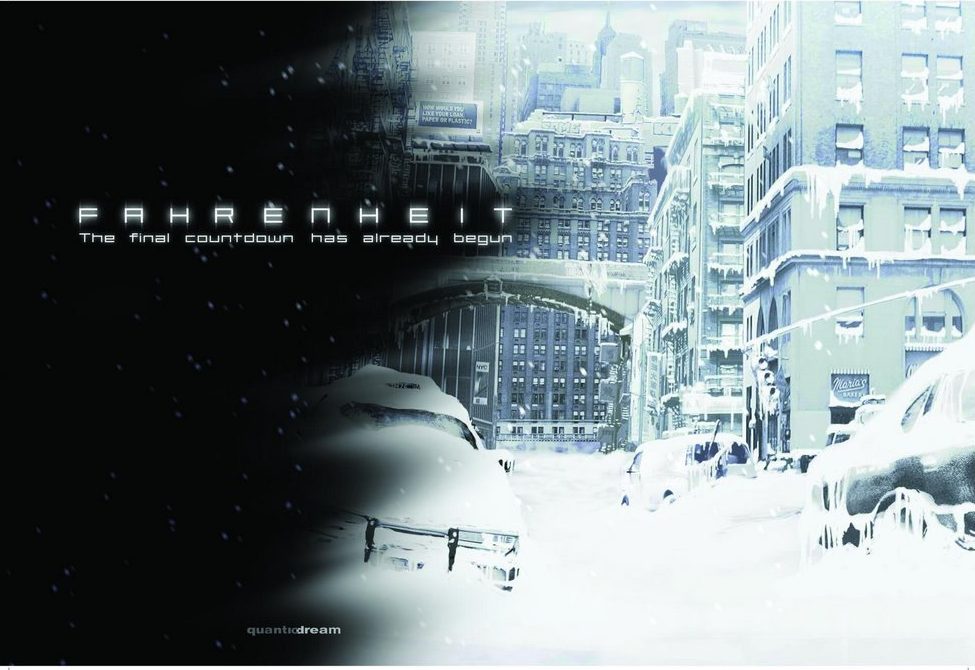
Fahrenheit is a modern-day murder mystery, where the player works on both sides of the case. First, the murderer Lucas Kane, who believes he was possessed into killing a random person. Second, the “smouldering” detective, Carla Valenti, who will hunt down Lucas through the largest snowstorm in history.
The story flies between genres freely, so alongside a murder mystery story we get an occult conspiracy, a hyperaction movie, a “deep” philosophical treaty on humanity, and in the end, an absolute mess of a story.
But however bad and ridiculous this game becomes, the opening is one of the best starts to a game I have ever played. Even for the 15th anniversary, the team at Quantic Dream talked about their favourite moments, and all three team members said the opening.
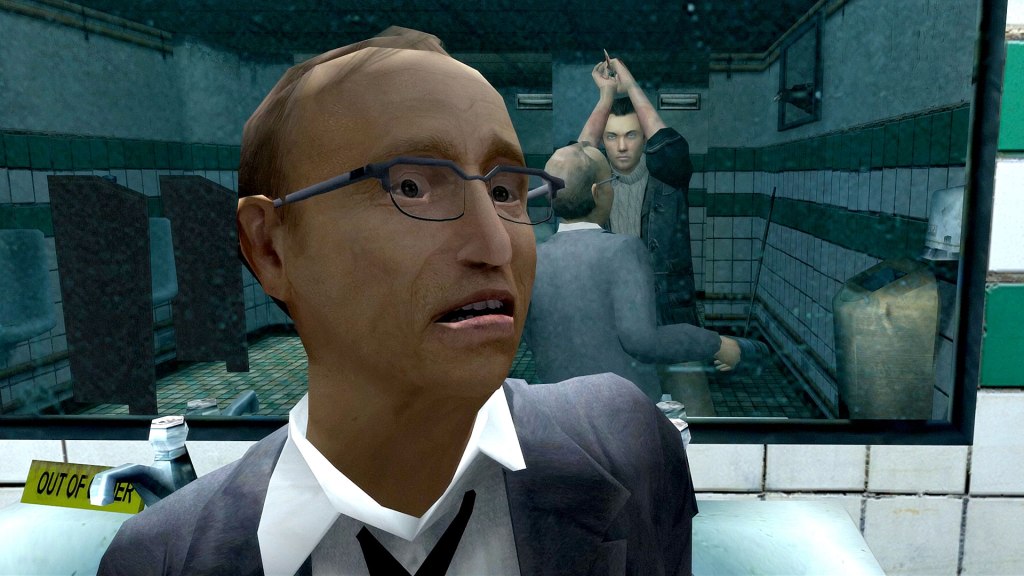
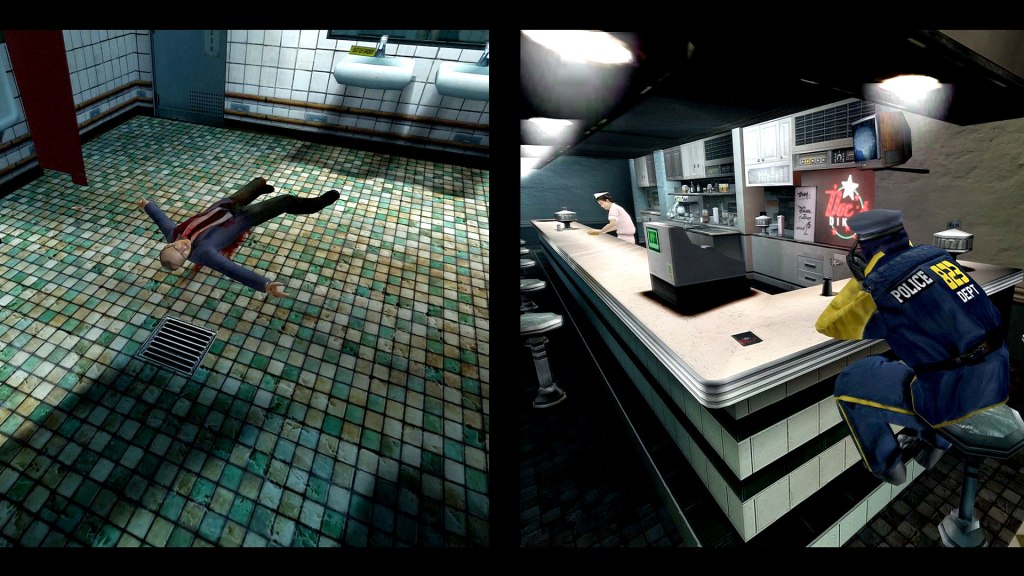
After sweeping shots over New York City at night, we arrive at Chapter 1: “The Murder”. In the dirty, cold bathroom of “Doc’s Diner”, a man, Lucas Kane hides in a bathroom stall.
Using a knife he had taken from his table, Lucas carves archaic symbols into his arms, before exiting the stall and heading for the unsuspecting man washing his hands.
As Lucas staggers forward, eyes rolled back in his head, we see a shadowy man surrounded by candles, guiding him through the same actions. Lucas eventually reaches his prey and attacks, stabbing the victim three times in the chest.
As soon as the murder is complete, Lucas is pulled back to reality, and it’s here where the game begins.
The opening is instantly iconic, cementing a player’s interest and establishing a dark, brooding tone over the game. It’s a perfect microcosm of the game that works as its own mini-story, and worked so well the did a very similar thing for the opening of Detroit: Become Human.
Source: blog.quanticdream.com
***
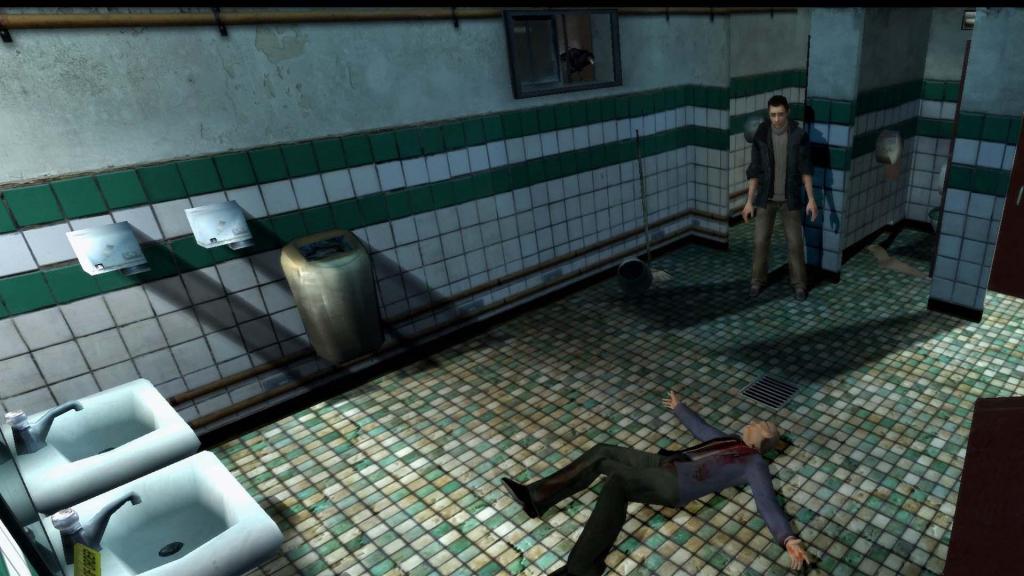
Now a player is in control of Lucas, but what to do? And just to make the situation a little more tense, there is an off-duty police officer having a cup of coffee right outside the bathroom door.
The situation can feel overwhelming at first, but luckily the game guides you subtly with its camera angles. To interact with objects in the world, the character must be within reaching distance from them.
Luckily, Lucas’ starting point allows him to pick up the man and drag him via a QTE into a bathroom stall and close the door. It’s here where another mechanic of Fahrenheit comes into play, the “Sanity Meter”.
Certain actions in the game have a hidden point score attached to them. If the action is something “positive”; taking an aspirin when feeling ill, talking with your estranged brother…or hiding a body you just murdered in a toilet stall, will increase the Sanity Meter.
Doing actions like remembering you killed someone, not kissing your girlfriend on the way out of the door, or losing a game of basketball taking place in sub-zero weather, will deplete the Sanity Meter.
There are six points, 100% (Neutral, because in Fahrenheit nobody is enjoying a moment of their life), then Tense, Anxious, Depressed, Overwrought, and finally Wrecked.
If one of the characters ever “gets rekt” then the game ends. Lucas commits suicide, and the two police officers, Carla and Tyler, resign from the Police Force.
Source: blacknut.net
***
Back to the bathroom, it’s amazing how many permutations there are. This scene was the demo for the game so probably got the most amount of attention paid to it, but it’s amazing how a player can intentionally mess up the story to make things harder for themselves.
The general first level moments are Lucas hiding the body, cleaning the blood on the floor, washing his hands, hiding the knife, paying for his meal, and then leaving (via taxi or subway), with a few extras like playing the jukebox or buying condoms in the bathroom (because why not?).
But if the player wants, they can immediately leave the bathroom in a panic, bloody arms on displayed, knocking into the waitress and alerting the police officer. The police officer starts moving towards Lucas, and now the only way out is through the backdoor.
If you’re not fast enough to escape, Lucas will be caught and the game ends with an iconic line, “That’s the end of my story…”
Lucas will wax lyrical about him, the place he was in, and how everyone thinks he’s a murderer, before you reload the save. Every time you are in a no-win situation it will start with this same phrase, and will become meme-worthy by the end of a play through.
Of course, successfully escaping the police is a different story due to the controls. The characters work on momentum, so you have to hold the directional stick for a very long time to get the character to move, which in chase sequences or moments of action, makes it agonisingly slow.
At least you think the movement could be solved by camera controls, but since we are going for a “cinematic” game, there is no traditional camera moment.
Instead, the player can switch between different camera angles reminiscent of old Silent Hill or Resident Evil games. The problem is with tank controls, switching the camera may switch the direction of travel and make the character do a complete 180 spin.
After a while you get a general sense of it, learning to quickly flick between cameras until you find the optimal one.
Source: blog.quanticdream.com
***
Now that Lucas has escaped the diner, we switch to the other side of the coin, Detective Carla Valenti.
Carla (and partner Tyler Miles) analyse the crime scene and interrogate a witness via a new gameplay mechanic; the dialogue system.
Dialogue trees were nothing new in games, with text-adventures and some RPGs having different dialogues that could be chosen, but having the majority of a game focussed heavily on this one aspect is quite revolutionary for the time.
You have to remember, this game was five to ten years away from the nouveau point-and-click boom that really cemented the concept, with games such as Telltale’s The Walking Dead or ZA/UM’s Disco Elysium.
There is a set path to the dialogue in Fahrenheit, but it isn’t telegraphed, allowing the player to either stumble upon it naturally or make it feel as if the conversations flows that way.
For example, in the Diner when Carla is talking to the off-duty cop that was there, you may talk first about the waitress witness, moving the story forward to the next moment.
But you can also ask about the cop and why he was there, before it segues into conversation of the suspect, to the weapon, and eventually back to the waitress.
And it’s not just conventional optional dialogue, these dialogue trees wind around one another so certain topics will be off-limits if you take a different path. It’s neat and gives a sense of role-playing, acting how you think Carla would talk to people.
The only real downside is how the conversation mechanic works in practice. When a conversation mechanic starts, the game just throws up three or four different topics.
For that first conversation in the diner, the choices are “Martin”, “Suspect”, “Witnesses” and “Victim”, with nothing else to go on about what will be discussed.
On top of that, there is a timer, from anywhere from ten to five seconds, leading some dialogue systems to be a mad scramble to hit which topic you want. I get why there was a timer, so the player isn’t stuck in any down time pondering their choices like in Mass Effect, but does make the moments more tense than it needs to be.
Source: reflectivegamer.wordpress
***
If players feel inclined they can switch between Carla and Tyler in the game, but apart from a few bits of dialogue, they play mostly the same.
Having two cops playable is an interesting dynamic, and Carla and Tyler do have good banter and enough of different personalities to work off each other, Carla being the forever-single workaholic and Tyler the more laid-back and in a long-term relationship.
If the player does switch to Tyler though, the most generic of RnB Hip-Hop beat begins the play. No other character has an “underscore” theme like this, and it only plays with Tyler. It’s so tonally off and outright racist that I would have to believe someone at Quantic Dream thinks this is great compliment to Tyler.
So the plot continues on these two threads, Lucas trying to figure out what happened to him, and Carla (with sometimes Tyler) trying to identify and catch the killer.
It’s a fascinating double thread, of getting to piece together a story from both sides and on a first play through you will wonder how it will all fit together (oh the sweet innocence of wanting a mystery to be solved!)
Source: amazon.com
***
But for a while, the story does actually work.
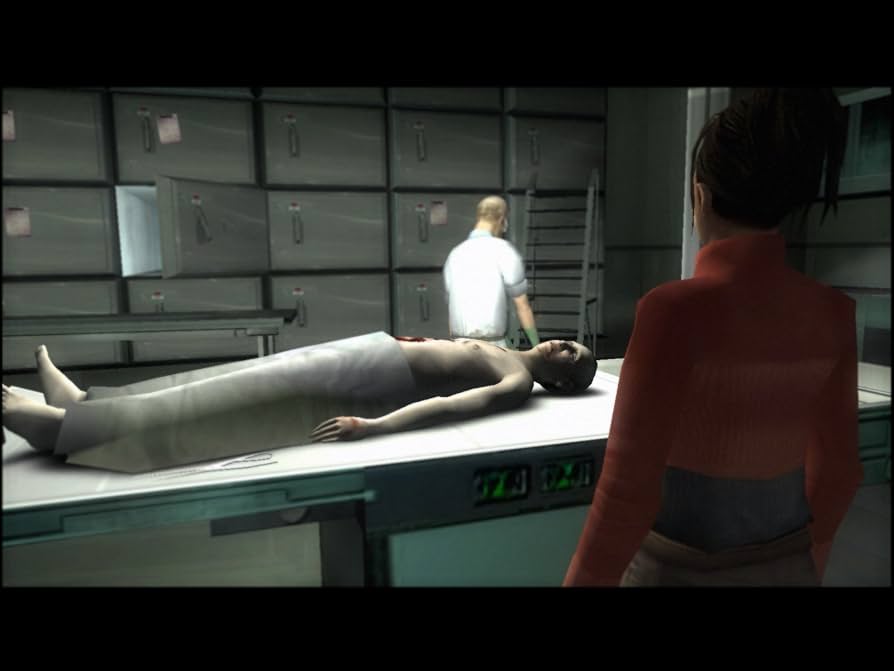
Carla’s search for answer leads to old case files, a suspicious autopsy and two sequences based on claustrophobia which she suffers from, the first a spooky trip to the police archives (which looks like Arkham Asylum) and then to an actual asylum (where the power goes out, leading to the inmates to chase her through the dark).
Lucas struggles with his guilt in self-destructive and dangerous ways, and begins to have visions (of giant Matrix-green dust mites trying to eat him).
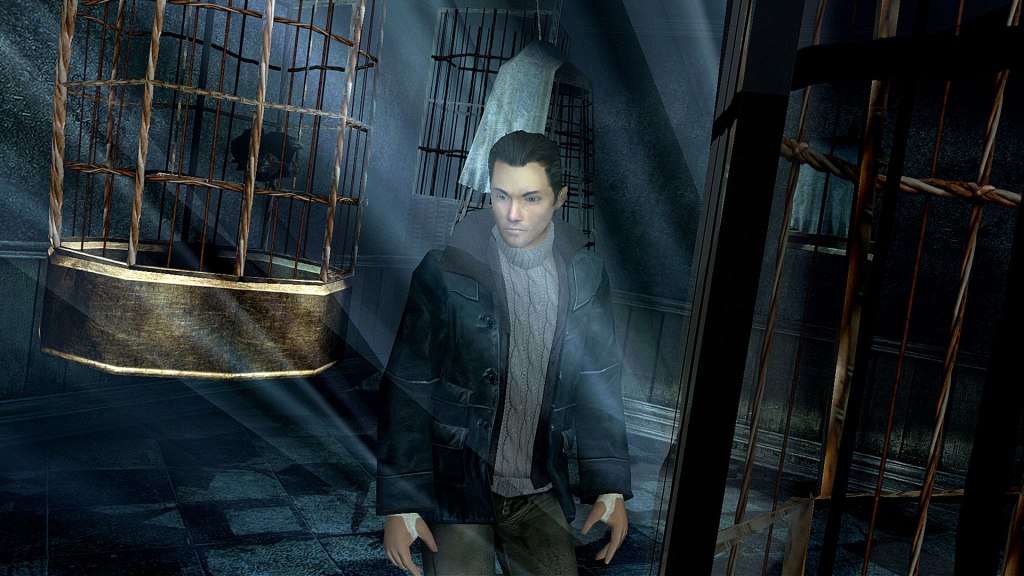
He goes to visit a psychic, a blind wheelchair-bound woman called Agatha, who hypnotises him back to the night of the murder and is honestly one of the best scenes of the entire game.
The scene replays multiple times as Agatha talks Lucas through the scene. She guides him to his table, but he is already gone, inside the bathroom murdering his victim. Lucas starts to panic but Agatha calms him down and it’s genuinely a high point of the voice acting.
We go through the scene again, skewed camera angles, blurred lighting, different vignettes of the scene playing out, is feels much more powerful and yes…”cinematic”.
Source: blog.quanticdream.com
***
Despite it being Quantic Dream’s first time at this gameplay style, they nail the aesthetic. And playing this game for the first time as a teenager, that artistic flourish pulled me in.
It’s the little things throughout game like the inventive multiple angle technique, the editing, dual cameras for simultaneous actions, even the main menu saying “New Movie” instead of “New Game”.
And since this was 2005, it was a good few years before Naughty Dog and the entire “cinematic” genre collapsed in on its own smug self-importance, and so Fahrenheit still feels unique, even twenty years on.
Unfortunately the game comes to a complete halt after the the halfway point, right after we get the first face off between Lucas and Carla at his place of work. It’s an interesting moment, playing the fugitive but now having to bluff your way out of all your hard work you’ve done as a police officer.
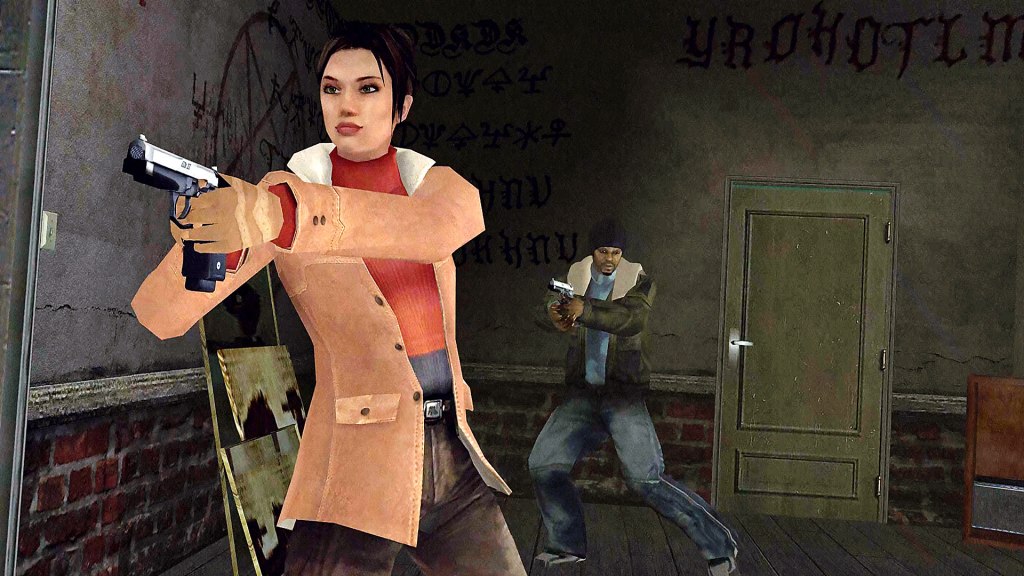
But Lucas can’t keep the suspicion off him for too long, and soon Carla and Tyler come to Lucas’ apartment to arrest him. He’s not at home, instead with Agatha, but someone has been in his apartment, as blood-red pentagrams and satanic symbols adorn the walls and lit candles cover the floor.
Source: blog.quanticdream.com
***
Lucas senses the police presence as he returns home, and gets spotted and arrested on the spot. But this isn’t a game over. It’s the start of the game spiralling into bad movie ripoffs and nonsensical writing.
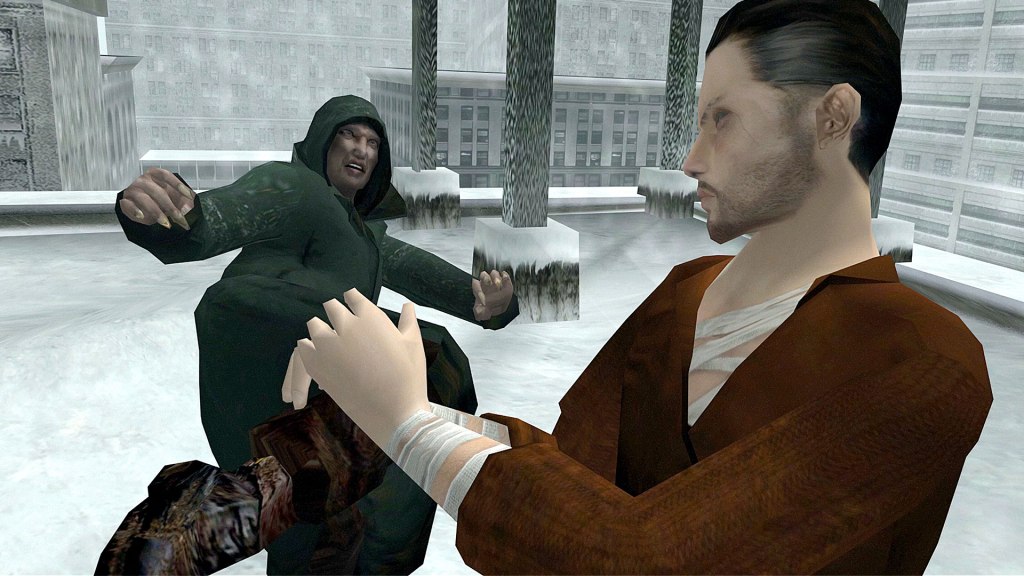
Ever since the murder Lucas has been experiencing heightened senses; he can hear thoughts, sees visions, and has also discovered his possessed Chi-based martial arts and acrobatics.
So instead of simply being arrested he begins running up walls, throwing Hadoukens at the cops, dodging bullets by leaning out the way, and all-in-all gloriously fucking up the story…which still has another twenty chapters to go!
Any semblance to a gritty crime thriller with a dash of the supernatural has been slam dunked into a bin. Now we have secret societies, Mayan death rituals, stone statues coming to life, the Internet becoming sentient (and taking over Agatha’s body) and Lucas being killed by the Mayans and then revived by the Internet being.
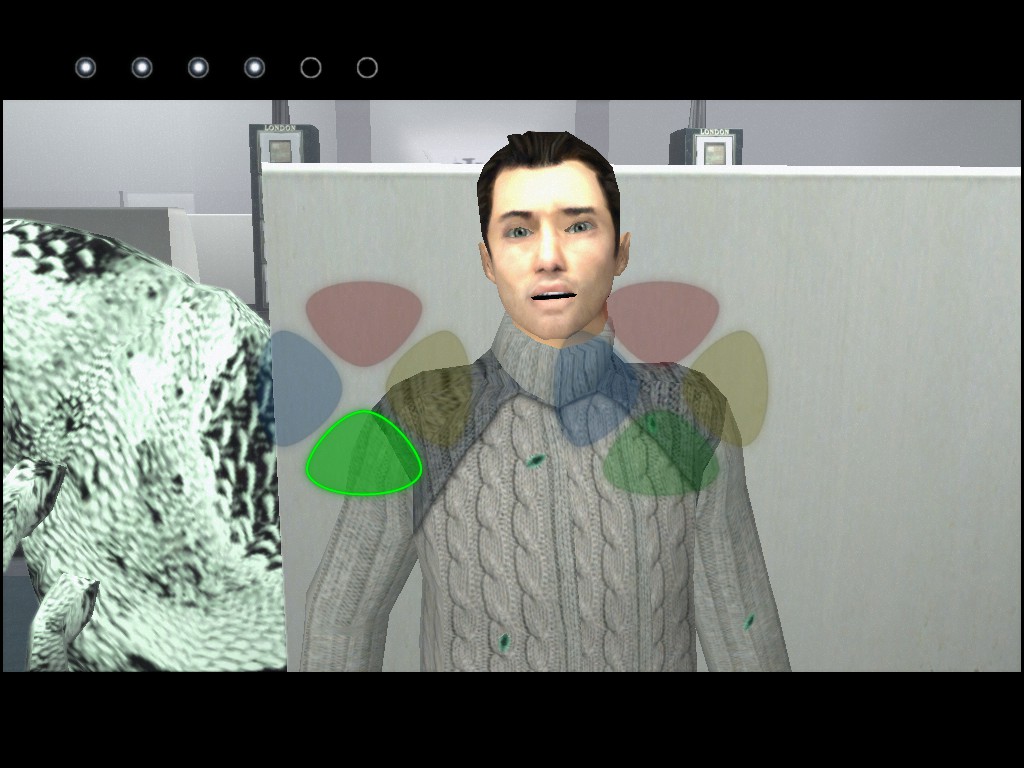
There is hardly any more dialogue sequences, the focus is now on the worst of the gameplay aspects. It’s another QTE variation, using a bizarre sequence of buttons reminiscent of the Simon Says board game.
Eight sets of coloured arrows appear on the screen, mirroring the two analog sticks. When the arrows flash up, the player must move the stick in that direction as fast as possible.
It’s not very intuitive and since they are in the middle of the screen it obscures any action taking place, and is something that Quantic Dream quickly improved and iterated on for the rest of their games.
Source: rollnplay.com
***
But back to the tailspin of a story.
The Internet and the Mayans are fighting a secret war, the snow (controlled by the Internet) is about to wipe out the entire world, but there is a secret weapon yet to be used. Lucas has been seeing a little girl during his visions (called the Indigo Child, hence IndigoProphecy).
The Indigo Child holds the secret to unlimited power and both the Internet and the Mayans want her to help them rule of the world. So Lucas and Carla team up to kidnap the child and take her to a place called “The Chroma”, a secret military base that Lucas grew up on that was studying aliens or something, I wasn’t quite sure.
Since the snow is covering most of the world they have to use a secret underground militia of homeless people to shepherd them across the country…but only before Carla and Lucas put aside their differences and have sex in a disused train compartment.
There are a total of three sex scenes in this game. And one of those is PLAYABLE, with full-on “analog stick” control.
So the plot nonsenses its way to its conclusion, where we learn Lucas was given his Psycho Mantis powers by whatever this Chroma is when he was a baby.
The game rips off The Matrix and Dragonball Z for a final showdown, where either the Mayans, the Internet, or Lucas will hear the Indigo Child reveal her prophecy and we get other a good, bad, or mid ending.
Lucas sits around and monologues on the state of the world and who heard the prophecy, and Carla is revealed to be pregnant with their train compartment sex baby, who will be the next Indigo Child.
And Tyler…where is he? His girlfriend guilt-tripped him into quitting the police force and selling sneakers in Florida six chapters ago. You can intentionally say “No” to leaving with her, but Tyler never appears in the story again either way.
He doesn’t get to join the homeless resistance. He doesn’t get to meet the Indigo Child. He doesn’t even get to have sex in a dirty disused train compartment with a zombified Lucas. He’s just cut from the entire ending, as if he never existed at all.
Source: blog.quanticdream.com
***
It might sound like I hate this game. And to be fair, I spent a good amount of the this retrospective tearing into the gameplay and story. But when I think about Fahrenheit, I can’t help but smile.
I think of the opening, the wide-eyed awe I had at the dialogue sequencing, the action, the mood and style of the game. And also part of me loves that it went so far off course yet still tries to take itself seriously.
It’s interesting to see the bones of Quantic Dream’s later games in here. Each chapter you will see a nod to Heavy Rain or Detroit: Become Human, like seeing an early draft that has all the pieces but just slightly misses the mark. And maybe that’s why Fahrenheit isn’t as fondly remembered, when its spiritual sequels do things so much better.
Yet, the game still lives on. For its 10th Anniversary, the game got a quick update by remake titans Aspyr, who cleaned up the textures and gameplay for the PC but was released with little fanfare. Around the same time it was released as backwards compatible on both the PlayStation and Xbox Online Store.
But now, another ten years after that, maybe Fahrenheit will get some of the recognition it deserves. Not only as a fascinating crime mystery (for the first half of its run time), but as a model that hundreds of cinematic games and nouveau point-and-clicks stand on the shoulders of.
It’s adorably weird and wonderful in the way only a pet project from an auteur is, and that’s why it deserves to be remembered.
I recently got my Xbox 360 out of storage solely for the Splinter Cell series.
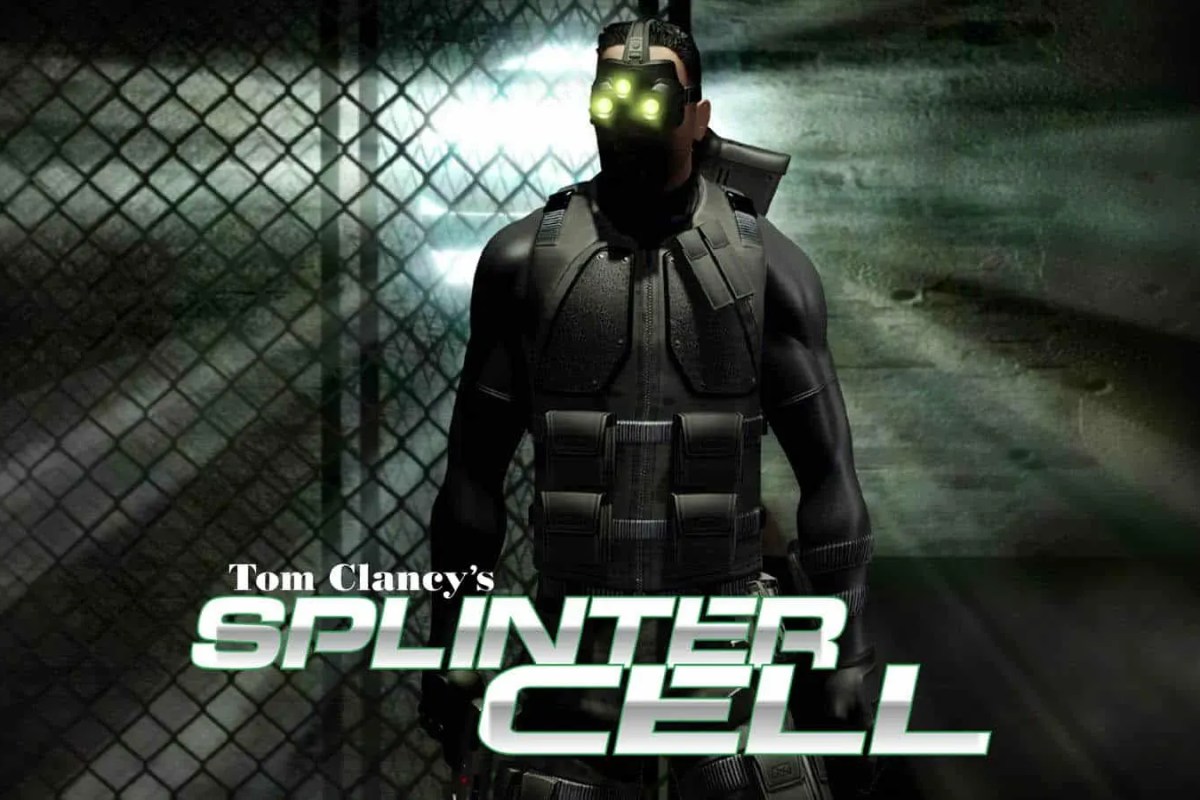
A stealth series endorsed by author Tom Clancy and featuring super-sneaky-solider Sam Fisher, it’s a landmark for both the stealth genre and for its cutting edge lighting and physics wizardry.
Even the original game that came out in 2002, still convincingly pulls off light and dark better than AAA games to do this day.
And so after playing through all the main line titles of the series, I thought a little review of the best levels from each was given. Let’s start!
Splinter Cell – CIA HQ
Despite being over twenty years old at the time of writing, the first Splinter Cell gives players one of the best locations of the series.
The first few levels of the game have been okay, Sneaking through the back streets of Georgia, infiltrating a government office building and police station, and working our way around an oil rig; it’s been fun but nothing truly awe-inspiring.
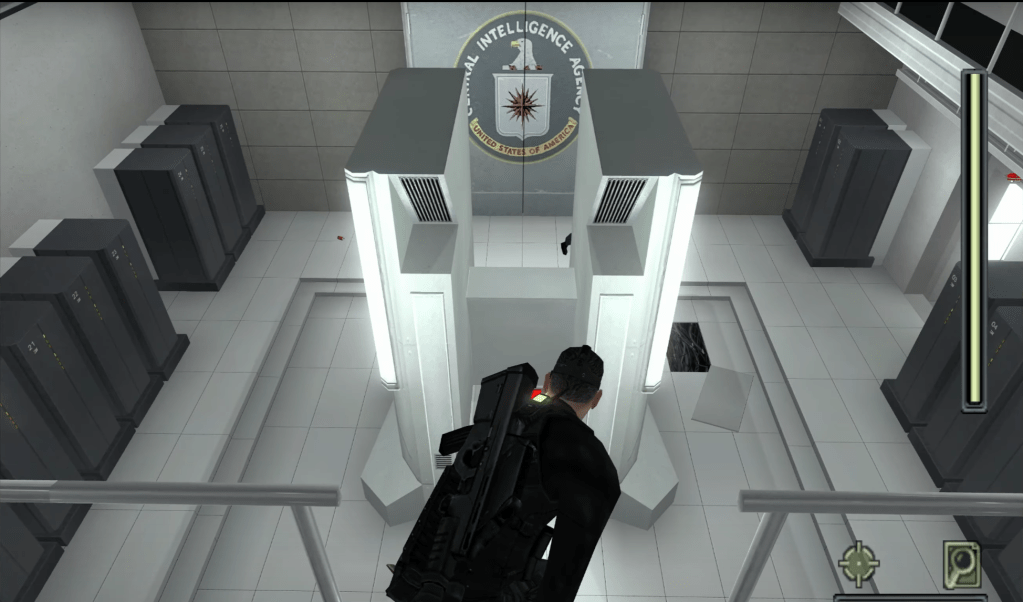
But when Sam’s investigation leads to a possible leak from the Central Intelligence Agency, he is tasked with breaking into the mainframe so his team can trace it back to its source.
Already, the set up is amazing. Being a stealthy ninja and getting to break into probably one of the world’s most guarded buildings is a dream scenario for a stealth game. But the fact it is another US spy agency pushes it higher than all the other levels in the game.
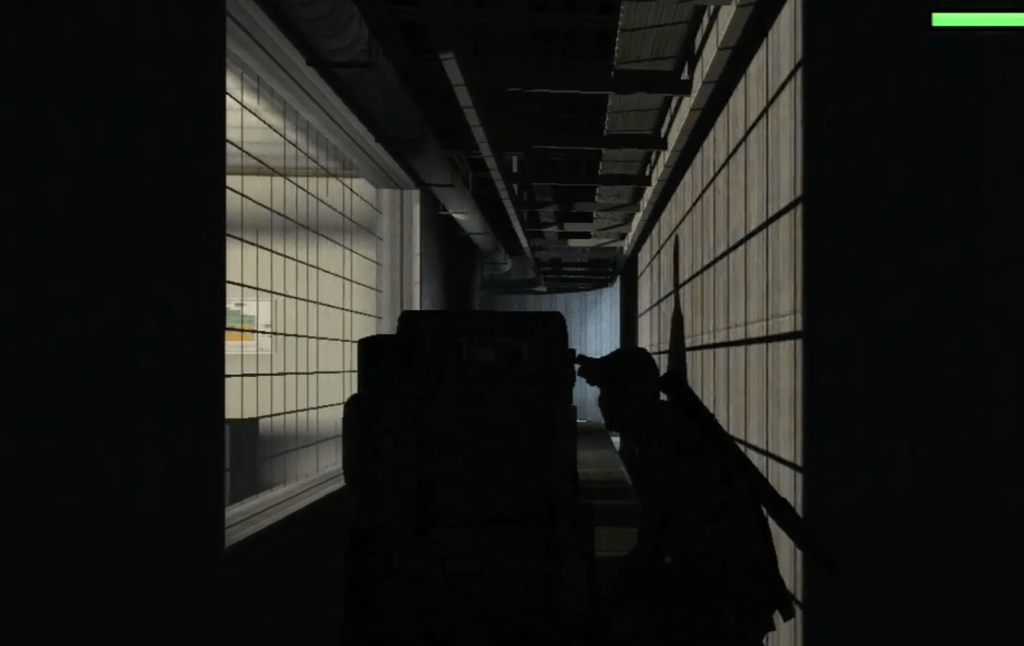
The development and exploration of the level is cool, with the initial break-in through the cooling system (lined with razor-sharp bladed fans), through the basement and main lobby, then up the elevator to the office cubicles, each location is a playground for sneaking around.
When breaking into the mainframe, the floor is made of light panels, meaning it is impossible to sneak in via the shadows, and the player must time it correctly so the they aren’t spotted by any of the workers.
And the cherry on top, Sam doesn’t have his trusty pistol to take out any lights. Nearly the entire level has to be done without a side-arm, meaning the player has to trust their own sneaking skills, rather than make their own path of shadows.
Source: YouTube (Centerstrain01)
***
Splinter Cell: Pandora Tomorrow – LAX International Airport
Pandora Tomorrow, the second game, pushed the boundaries for the Splinter Cell series by placing a focus on highly-populated areas, as opposed to the mostly military locations in the first game.
The night time streets of Jerusalem, a TV station in Jakarta, and a overnight train heading from Paris to Nice (which Sam has to both climb under and on top of to reach his goal). Pandora Tomorrow takes these normal locations and makes them the battleground for the fate of the world, with “LAX” being the pinnacle of the game.
Terrorists have infiltrated Los Angeles Airport and are intent on releasing a smallpox virus inside the terminals. Sam must kill all the terrorists and stop the virus from detonating, all while not being spotted.
Starting outside the service gate, Sam has to make his way through the parking, baggage drop-off, offices, and eventually into the lounges and terminals. It’s a great blend of real-life normalcy and high-tech zones, with Sam having to use moving cargo trucks or luggage on conveyer belts as cover.
The terrorists are disguised as airport staff, but have all been recently vaccinated against smallpox, leading them to have higher body temperatures than those around them. It’s a great way of utilising Sam’s goggles outside of their standard gameplay loop, making the player study more than just their opponents’ movements.
The final section is brutal, with the terrorist leader, an ex-CIA spy, using night vision goggles to spot you hiding amongst the shadows as you plot your way to intercept him.
Pandora Tomorrow has some of the best levels of the series, but “LAX” tops them all with its pulse-pounding action.
Source: YouTube (Centerstrain01)
***
Splinter Cell: Chaos Theory – MCAS Banco De Panama
Splinter Cell: Chaos Theory is widely regarded not only as the best game in the series but of stealth games in general.
The graphics, gameplay, and art design all got overhauled from Pandora Tomorrow, presenting breathtaking locations, satisfying stealth, new mechanics like a sound meter, and some of the best level design period. Case in point, “MCAS Banco De Panama”.
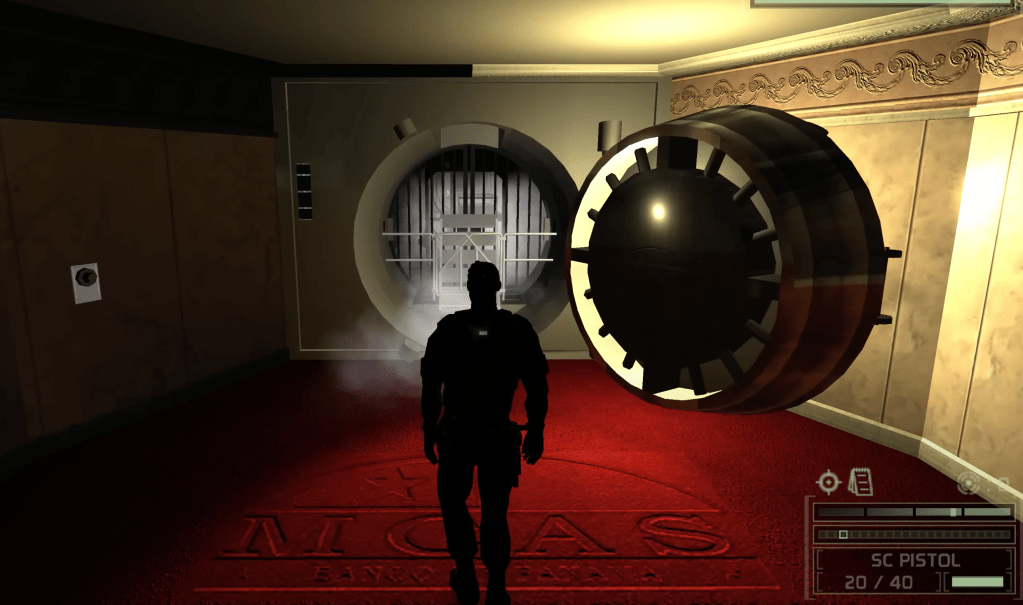
MCAS Banco De Panama shows you what Sam might turn to if he wasn’t a spy. Following a terrorist lead from a previous mission, Sam has to break into a high-security vault to follow the trail of their account transactions. To make sure the bad guys don’t get suspicious, Sam also has to steal $50,000 and plant emails to make it look like an inside job.
The skills of a top-secret agent seem to gel well with the high-concept criminal life; scaling around the building, rappelling through the skylight to the lobby floor, disabling security lasers and finally a flashy electric pulse to unlock the vault (with some expert assistance from a incarcerated bank robber directing Fisher from his prison cell).
It’s a great concept for a mission and the banter between Fisher and his team makes it seem like they don’t have a care in the world; breaking in is a piece of cake and the hired goons guarding it are in no way a threat.
There is also a nice little reference to Sam having previously raided this bank back in 1989 while he was with the Navy SEALs, giving a little indication of Sam’s life before Third Echelon, and Grim remarking that while he was in a ditch during the Gulf War she was still in tenth grade.
The funny lines keep coming when the laser grid for the bank comes online. Grim says lasers reminder of the 90s, but Sam says that laser remind him of the 70s, before he chastises Grim for making him feel old.
Once Sam is in the vault and holding $50,000 worth of currency, he negotiates a pay raise from his boss Lambert.
Lambert: “Hm…twenty-five cents an hour and not a penny more.”
Sam: “Deal.”
Source: YouTube (Centerstrain01)
***
Splinter Cell: Double Agent (Version 1) – Shanghai, Jin Mao Hotel
There were two versions of Double Agent that were released in 2006, one for the “last-gen” of consoles (such as the PS2 and Original Xbox) and one for the at-that-point cutting edge of technology, the Xbox 360. The 360 version is known as Version 1.
The team at Ubisoft Shanghai knew they needed to show off the incredible graphical capabilities of the new generation and crafted some beautiful levels, like the opening geothermal plant in Iceland or a cruise ship off the coast of Mexico. But I’m going for the height of spectacle.
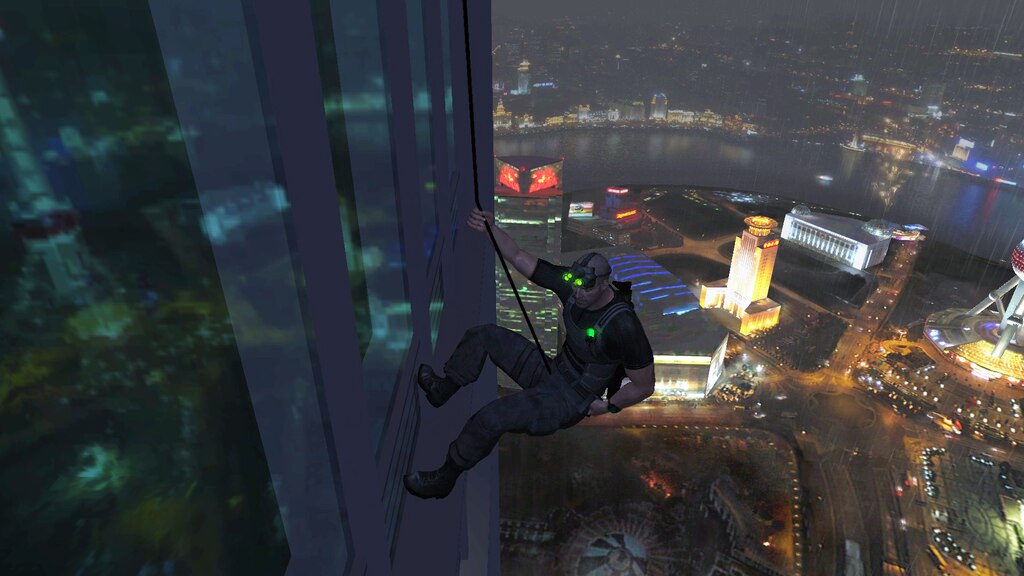
“Shanghai” tasks Sam with listening in on a terrorist weapons deal and steal notes containing valuable intel, pretty standard stuff. The problem is the meeting is taking place in the 88-floored Jin Mao Hotel (a real-life location). Fisher isn’t present for the meeting, so he has to climb along the outside of the hotel and record through the windows. Tom Cruise eat your heart out.
The scenery is stunning, taking place on Chinese New Year, the city and sky awash with bright colours, while light rain lashes against Sam as he descends to the meeting room. Once Sam has successfully recorded the meeting he then has to infiltrate the hotel room of his target for intel.
The New Year party continues inside, with a giant illuminated dragon filling the atrium and guards patrolling the circular walkways surrounding the sculpture.
I always liked how Splinter Cell locations were grounded; office buildings, embassies, skulking through city streets. But every now and then the series pulls a stunner out of the hat, and “Shanghai” takes the title of “Best Looking Level” in the entire series.
Source: steamcommunity.com
***
Splinter Cell: Double Agent (Version 2) – New York City
Version 2 of Double Agent is quite different to Version 1. While they follow the same basic story beats, the missions and intricate story parts are much more varied, with certain levels being exclusive to either version. “New York City” is a mix between both, having similar gameplay but a different location.
The story of Double Agent is exactly that, Sam going undercover as a double agent, infiltrating a terrorist organisation and tasked with taking down from the inside. Throughout the game Sam has to keep both the terrorists and the NSA happy, with a trust meter tallying whether he is a traitor or not.
The opening cutscene for “New York City” ends with Sam’s cover being blown and the terrorists knowing he is coming to stop them. The small set-up is excellent with the already nervous terrorists now or high-alert about the traitor close by.
When Sam grabs enemies they cuss him out and fire off sarcastic insults, but the best interactions are when Sam has to deal with the friends he has made in the organisation. The first two characters that Sam has to kill are Sykes and Jamie.
Sykes is the tech nerd of the group, not a hardened terrorist like his comrades and he begs for his life and for Sam to let him escape. It’s rather uncomfortable to witness his desperation.
On the other side, Jamie was Sam’s ticket into the terrorist organisation, helping him break out of a prison in one of the earliest missions.
When Sam grabs Jamie here, Jamie believes they are still friends and that the boss, Emilie, is wrong. He tries to get Sam to be reasonable, but Sam has to break Jamie’s illusion that they are friends. Again, it’s uncomfortable to see Jamie’s convictions fall away as Sam must do what needs to be done.
Another terrorist member, Enrica, has begun a small romance with Sam throughout the game. They plant to run away together at the end, but another Splinter Cell agent kills her before they can go. Sam then kills the other agent in a fit of rage.
It’s a great character moment, of Sam stepping fully over the line, seeing the cool and collected spy we know break down, before fleeing into the darkness at the end of the game.
Source: YouTube (Centerstrain01)
***
Splinter Cell: Conviction – Kobin’s Mansion
While Splinter Cell: Conviction is seen as a lesser game by hardcore fans due to its faster pace and focus on action rather than stealth, it still has its fair share of well-designed playgrounds of fun.
Late-game missions like Third Echelon HQ (where Sam has to infiltrate his old company) or the delightfully absurd finale in the White House are fun locations, but the best is actually the second level, “Kobin’s Mansion”.
Following the trail of his daughter’s killers, Sam with infiltrating a mansion in Malta that has been taken over by arms dealer and all-round scumbag Andriy Kobin.
Starting in the street outside, the level is reminiscent of levels like Georgia’s Old Town or Jerusalem from the first two games. Sam can recon around the mansion, finding the best entryway into the building, using a broken car-door mirror as a makeshift snake cam.
The mansion, having at one time been a fortress on the Valetta coast, is a perfect blend of old and new, glass panelling alongside Renaissance architecture. Exposed piping and inconsistent lighting fixtures allow Sam to slip by unseen, and his acrobatics are on full display as he climbs outside the building on numerous occasions to get the drop on enemy guards.
The final room where Kobin and his goons are waiting is great climax, with the best players being able to methodically take out the entire room in a few quick motions (bonus points for using the shotgun like John Wick) and then interrogating Kobin, smashing his head against a grand piano.
Source: gamebomb.ru
***
Splinter Cell: Blacklist – American Consumption
Splinter Cell: Blacklist was seen as a return to form for the series, bringing Sam Fisher back into the spy world as the head of the new “Fourth Ecehlon” team.
The story concerned itself with a new terrorist group called The Engineers, former spies that began waging a secret war against the United States, called The Blacklist.
The Blacklist is focussed on American interests, each with a name. “American Fuel” targeted a natural gas terminal, “American Freedom” focussed on travel links. The best mission, and best Blacklist attack is the first one; “American Consumption”.
Terrorists have taken several hostages in a shopping mall and are negotiating with police, giving Sam enough time to slip in and stop the Blacklist attack.
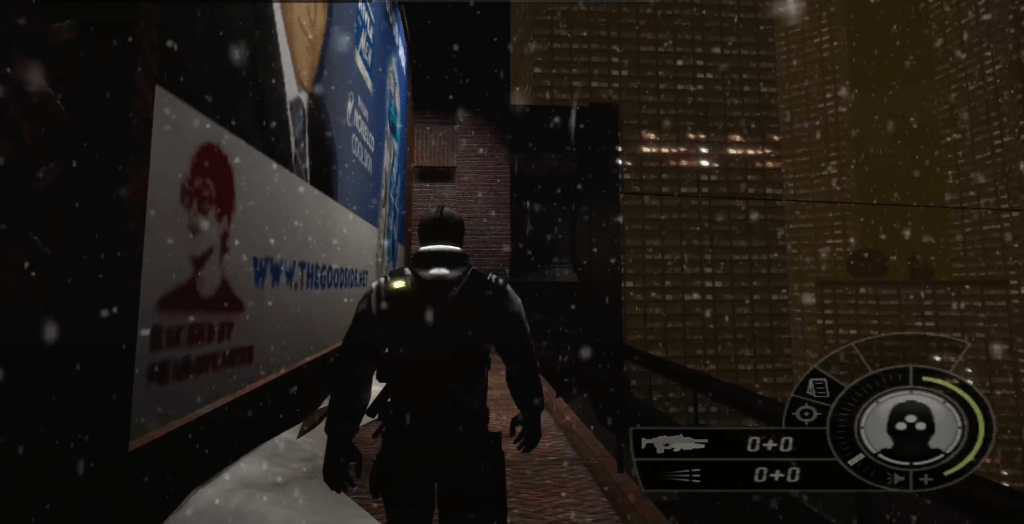
It’s the first night-time mission of the game, with the shopping mall decorated for Christmas. Fairy lights dangle from beams, fake snow litters the ground, and a little wooden village has been set up in the main hall.
It’s the perfect playground for Sam, climbing across the rafters to avoid detection or sliding from gingerbread house to model train, hiding in the shadows and waiting for the bad guys to pass by.
Sam quickly saves the hostages being held, but feels the mission is too simple and obvious for the Blacklist.
Fourth Echelon do some quick research and realise that the shopping mall is next to the city’s water filtration station. The terrorists have taken over the station and are planning to dump chemical weapons into the city’s water supply (a nice twist on the meaning of “American Consumption”).
The filter station is a maze of ladders, walkways, and tunnels, with zero solid cover. Not to mention that the terrorists have positioned two chemical dumps at either end of the station, leading Sam to have to make a mad dash to stop both bombs in time.
Splinter Cell: Blacklist blended the faster pace of Conviction with design reminiscent of Chaos Theory, making “American Consumption” one of the best levels in the series.
I always have a sense of excitement and trepidation when picking up a new Call of Duty game.
I don’t play online shooters so I know I’m not the target audience who love their team deathmatches and their Battle Royale modes, rather I drop my cash for the story.
Call of Duty 4: Modern Warfare sparked an interest in this sometimes-maligned side of CoD with its depiction of stealthy SAS toughs behind enemy lines as well as the big bombastic spectacles of an invading US force.
When Modern Warfare got rebooted in 2019 I picked it up to see what new narrative threads had been added. I wasn’t too bowled over (you can read more here), but I was interested to see where the franchise went next.
And so a few days ago I played through all of the new Modern Warfare games to get a full overview of the for a deep dive analysis.
“Bravo Six Going Dark” – The Modern Warfare Reboot Trilogy: An Analysis
Call of Duty 4: Modern Warfare is one of the best paced games in the history of gaming.
Its sense of timing and when to ratchet up tension is perfect displayed by its two playable factions, the SAS and the US Marines.
The SAS sneak and use subterfuge while the US Marines use every weapon known to man to obliterate their enemy.
It is a balancing masterclass of the scalpel and the sledgehammer.
CoDs from World at War through MW2, Black Ops, MW3, and beyond dialled back the scalpel in for more sledgehammers, until 2019 when the first of the MW reboot released.
This game is 90% scalpel, a complete reverse of the previous CoDs and in retrospect quite refreshing.
Super sneaky “tactical” games had been popular in the years preceding CoD4, mainly helmed by the Rainbow Six series and it seemed that the new CoD was going to take more of a stealthy approach to a first-person shooter.
This is exemplified by the most well-known mission from MW 2019, “Clean House”. The player works as part of the SAS and clearing out a terrorist cell that has set up shop in a town house in north London.
Bathed in the green light of night vision with hardly any musical notation, the mission is tense, with many tight corners, hidden terrorists and tough calls needing to be made on the use of lethal force.
A night-time raid on a house in Camden Town is tense and thrilling, with tight corners and hidden enemies. (Source: callofduty.fandom.com)
The coin-flip of rules of engagement and civilian presence is highlighted quite a lot in the game, with “Embedded” and “The Embassy” asking the player to leave unarmed civilians to be hanged or shot and “Old Comrades” putting the player on the other side and threatening a terrorist’s family with a gun.
These missions show the new face for the story in relation to the hot contemporary political topics of the time. CoD4 visually referenced the invasions of Afghanistan and Iraq, and CoD 2019 takes similar inspiration with terrorist attacks in highly populated areas, siege events like Benghazi and female-led resistance forces.
Speaking of which, the character of Farah who is the head the resistance of Urzikstan (the fictional Black Sea country and centre of conflict) is very welcome in a game series that does not have much space for female roles. She speaks both English and Arabic, and its refreshing to have entire sections with subtitles, again, something that until recently wasn’t widely accepted in gaming.
Players experience a lot of key moments with Farah and her brother Hadir, with a memorable missions including the two as children and having to use improvised weaponry like scissors to defend themselves from invading Russian forces, or being waterboarded when they are taken prisoner.
The rest of the cast are also good characters, with CIA instrument “Alex” being entrenched with Farah and the rebels, his handler Laswell (another female character and one in authority), and then the two British lads, Kyle “Gaz” Garrick and Captain Price. All the actors put in stellar performances.
From L to R: “Alex”, Price, Gaz, and Farah, the main characters of Modern Warfare (2019). I was happy to see all of these characters returns across the trilogy. (Source: metro.co.uk)
However, the reasoning behind Gaz and Price being involved in the story is an annoying stretch. Price is with the SAS and Gaz is part of the CTSFO but then the CIA spook Laswell can just call up and get him to seemingly abandon his post to hunt down a terrorist leader.
It’s a weird exceptionalism that was pervasive towards the end of the previous MW trilogy, of Price playing four-dimensional chess with his enemy and being excused because he is the only man capable of averting world destruction.
Price even says that to Gaz towards the end of MW 2019. Gaz is frustrated by the rules of engagement in the CTFSO and so Price recruits him for his taskforce. But when Prices threatens and unarmed woman and child as “leverage” over a terrorist, he moralises it to Gaz, saying,
“End of the day somebody has to make the enemy scared of the dark. We get dirty and the world stays clean.”
Price talks about the blood on his hands and lines in the sand and it feels like it’s going to crescendo with a message, a personal story of violence and limits to rationalise his view, but it’s left as it is and ends more as an encouragement rather than an indictment of morally grey warfighters.
In “Hometown” a seven-year-old Farah has to defend herself from Russian troops, but doesn’t have the physical strength to pull the trigger. (Source: callofduty.fandom.com)
The game ends on a sledgehammer peak with all the characters joining forces and sieging a Georgian chemical plant and taking back Farah’s homeland from the invaders.
It’s notable also for the death of “Alex”, who doesn’t go out in a blaze of glory, firing his weapon with one hand and killing several enemies, but instead with a smile and a “yes ma’am”.
The bombs the team places are damaged and someone has to stay behind to detonate them. Farah is ready to sacrifice herself to her cause, but “Alex” tells her someone still needs to deal with the rogue Russian General Barkov and that should be her task.
“Alex” says, “I’ve been on assignment my whole life. This…is one I believe in.” While he is dedicated to the fight, he can’t win the war for her. It has to be Farah to free her country from Barkov and in the end she “orders” him to blow up the plant while she defeats the general.
It’s a great moment of small heroics and knowing where one is placed in the grand scheme of the world and the only downside is that “Alex” is a warm and calming presence in a game of dark and cold look through inhumanity.
“Alex” and Farah’s connection is one of the lighter points of the story and something rarely seen in shooters, let alone a CoD game. (Source: YouTube: BabyZone)
So the world is saved, Urzikstan is freed, and Price talks with Laswell about a new taskforce with some choice friends from the SAS. He names himself, Gaz, Soap, and Ghost as his core team and gives them the name 141.
Obviously being a reboot there were going to be some mentions of characters, places, events and reworks.
Garrick being revealed as Gaz was nice and lends a smidge of diversity to the core characters, but apart from that there wasn’t any big or well-reasoned connections to the original.
Sgt. Griggs returns in a blink-and-you-miss it role in “Hunting Party”. General Shepherd, Zakhaev, Pripyat, and Al-Asad all get name dropped in the end credit scenes.
The most egregious references for me were of memes from the original Modern Warfare.
The line “check your corners” in CoD4 became an internet joke due to the way Price performs and repeats it in the level “Crew Expendable”.
The line is used again by Price in the reboot during a terrorist attack in “Picadilly” and would fit the moment…expect it has over a decade’s worth of meme-baggage attached to the phrase.
The same happens in the mission “Highway of Death”, where while testing a high-powered rifle the player is asked to shoot a piece of fruit.
When a shot is landed a friendly NPC says, “His fruit-killing skills are remarkable.” Again, it could fit the scene, but just pulls me out of the moment.
But with that final note, let’s move onto Modern Warfare II.
For the following, MW2 will refer to the 2009 game and MWII will refer to the 2022 game.
From L to R; Alejandro, Soap, Ghost, Price, and Gaz, the leads of MWII and TF141. (Source: callofduty.com)
Modern Warfare II follows in its namesake’s tradition of being bigger, bolder, and brasher than its predecessor, dialling in a few more sledgehammers but having them disguised as scalpels.
Like the original MW2, the story in the previous game is mostly left in the past, with only passing references to the Al-Qatala (AQ) terrorist organisation and Urzikstan. Instead MWII carves out its own special forces story and to most intents and purposes it succeeds…just.
Just like MW 2019, it has a great collection of characters who perform the hell out of the script, with interesting locations and missions.
Mexican Special Forces characters Alejandro and Rodolfo are cool additions to the multi-culti team of 141 and add the sense that global terror can lay anywhere (with a large dose of dialogue in Mexican Spanish with subtitles).
Ghost and Soap join the gang, with a fun buddy-cop dynamic between the two adding a great dose of levity throughout the game. Farah returns for a fun vehicle-based mission, and Gaz and Price seem to have grown further than a simple mentor/mentee connection. Everyone gets more to play with and there is a real sense of teamwork and camaraderie between the factions.
We also get a clearer introduction to another player in the MW series, Shadow Company and its leader, Commander Graves.
Shadow Company always struck me as an curveball inclusion in the old Modern Warfare series, but that was before I understood what PMCs were and what they did.
Still, it was unclear what Shadow Company’s role was in relation to Shepherd in the original, but in the reboot I think their uneasy quasi-affiliation with TF141 is an interesting comment on the nature of a modern war setting.
Graves is charismatic and calculating, always with a smirk on his face. No wonder he became a villain. (Source: rumble.com)
Like the original MW2, the story of MWII focuses on the power vacuums left after Western aggression and what fresh horrors arise when left unchecked.
The stealthy aspect is back with the majority of missions featuring silencers and night-time settings.
Some standout set-pieces including infiltrating an Amsterdam harbour through water, avoiding enemy patrols in Mexico during a rainstorm, or breaking into a cartel lord’s mansion for a face-to-face confrontation.
Every other mission feels new for the series with dialogue sequences, improvised weapons, swimming, climbing, and rappelling, and rarely are they one-and-dones, trotted out for a single sequence and then dropped like previous titles.
Instead most missions layer these aspects atop one another, leading to a more versatile play session.
The references to previous games are a 50/50 split on how they land. Two missions highlight it perfectly. First is the mission “Recon by Fire”. Taking notes from what is considered to be the best mission in CoD history, “All Ghillied Up”, “Recon by Fire” is a sniping/stealth mission on a remote island.
Price and Gaz are in Ghillie Suits, they have their long range silenced rifles, and they are heavily out-gunned by the occupying force, just needing to get to their objective with as few casualties as possible.
It even remakes the hiding-in-the-grass-as-enemies-pass scene from CoD4, with Price voicing a one-to-one recreation of MacMillan’s lines. And it just doesn’t work for me.
Part of “All Ghillied Up”’s charm was its tension. You had to use stealth and tactics because you were extremely outgunned. When the tanks rumble past as you hide in the tall grass, it’s meant to make you feel small and powerless.
In “Recon by Fire”, no tanks roll past, just a squad walks around you. A squad that two minutes later I could take out with my rifle with no issues.
The game goes semi-open world with how to approach its objectives and how to shoot, giving the complete opposite of having to be stealthy and tactical because at some point the bullets have to start flying.
A lot of the news posts and videos name “Recon by Fire” as “All Ghillied Up 2”. Nearly twenty years on it is still the high point of Modern Warfare. (Source: sportskeeda.com)
Contrast this with “Dark Water”, a double mission where the player first has to infiltrate an oil rig hosting missiles and then a container ship close by which has the launch capabilities. It is a direct reference to “Crew Expendable” and “The Only Easy Day…Was Yesterday” from the first two MW games respectively.
But while it recreates similar settings, it has the player do different tasks. On the rig it’s a search and destroy rather than a rescue, leading to different tactics. On the ship, the cargo containers are sliding around, creating hazards and blockages for the player.
That isn’t to say that MWII is just a greatest hits of previous levels. One levels that I feel is unique is “Borderline”, with Mexican Special Forces leads Alejandro and Rodolfo seeing an Iranian major smuggled over the US border wall and following him over despite knowing they are breaking the rules of engagement.
The mission is a suspenseful evening chase through the backyards of a sleepy border town, with short but punchy engagements and civilians getting mixed up in the action.
Several times the civilians will threaten and attack Alejandro and Rodolfo as the two follow their target. The NPCs hold baseball bats or reach for guns with the player instructed to “de-escalate” the situation…by aiming their gun at the other person.
It’s a little shocking at the start but questions start to arise as soon as it appears. Alejandro and Rodolfo break into these peoples’ houses to follow their target. They could easily call out that they are Special Forces to pre-emptively de-escalate the situation and move on as quickly as possible.
In later levels the game uses a wide branching dialogue system so the thought could be why not use it here to verbally de-escalate? Instead the only option is to threaten anyone who gets in the way.
Branching dialogue is used a lot in “Recon by Fire” between Gaz, Price, and Laswell and it’s delightfully charming and light banter, something I wish the game had more of.
“Borderline”‘s pacing and escalation of combat encounters are good, with spikes of controlled gunfire punctuating the tense atmosphere. (Source: medium.com)
But a final point I want to make is that while we have these great set pieces and characters…yet there is an underlying hardline conspiratorial edge to the story.
While the Americans in MW 2019 annoyed me for their frat-boy egos and Captain Price unnerved me with his “Hard Times Deserve Strong Men”-esque speech, MWII ties together both Middle Eastern terrorist organisations and the Iranian Military with Mexican cartels and traffickers.
It sounds like the most buzzworthy radical viewpoints born out of too much Fox News and a Tom Clancy marathon. They even try to rationalise it when Alejandro says, “terrorists don’t cross the southern border”, only for Laswell to reply, “They know that and we know that and that’s exactly why they are going to do it.”
There are multiple conversations between Gaz and Price and Alejandro with the rest of 141 about how the relationship between Iran and the cartels work, but most of it comes down to “money” or nebulous “power”, without any further dissection of the topic.
While the original MW trilogy could never be thought of as critical of American military might or nuanced with geo-political matters, it never got deep into outright paranoia over the enemy.
All the previous Russian baddies were labelled as “Ultranationalists” to differentiate them from the state and people of Russia. In MWII it seems as if the baddies are a cabal of different groups all bent on weakening the West.
As usual with MW sequels, there are several twists and turns on loyalties and alliances throughout the campaign. While I saw breadcrumbs to a final surprise, in the end I was preparing for a curveball that never came.
There are subtle references that the Mexican army have taken over cartel business, or that fan-favourite Ghost was taking orders not from 141 but General Shepherd and Shadow Company and it felt like there would be one final twist on who can we trust.
But no, MWII ended rather like how MW2 ended, with Shadow and Shepherd pushed to the sides so that the stage was free for series baddy Vladimir Makarov to take centre stage in time for Modern Warfare III.
The great moustachioed one returns, with new actor Barry Sloane giving Price both warmer tones and darker shades. (Source: news.blizzard.com)
Modern Warfare III released only one year after MWII with a development time of only sixteen months.
It was an incredibly rushed development schedule and I do not want to pour scorn on the developers, artists, writers, producers, QA, sound, and anyone else who helped make these games.
It seems every aspect of the game from campaign to multiplayer has already been criticised for its lower quality, but I wanted to make a mention of it before I got to my position first.
Because the game does have some excellent moments, including its opening.
We start literally and metaphorically in the dark, with only a submarine’s sonar blips for a soundscape. We see soldiers in wetsuits preparing for a stealthy mission, swimming through the darkness and surfacing outside a island prison fortress.
The missions title “Operation 627” indicates that this will be a breakout mission, referencing MW2’s famous “The Gulag”.
As the team ascends the fortress walls and picks off lone guards, they all speak with British or American accents. They use slang words commonly used by Price and Gaz. Their use of weapons and tech indicates they are highly trained.
A diversionary explosion allows the soldiers to slip into the prison, where they then descend, taking out guards along the way and freeing prisoners as an extra layer of chaos for their escape. The intruders reach their end goal, freeing a prisoner in solitary confinement, who turns out to be Vladimir Makarov.
The whole operation was a bait-and-switch, giving the impression of a 141 mission but instead conducted by Makarov’s private military.
Makarov was front and centre for a lot of the promotion, being almost a deuteragonist of the Modern Warfare brand. (Source: pixground.com)
It’s a cool opening, heavily-scripted as the start of most CoDs are, and it has a great contrast of both scalpel and sledgehammer woven throughout. While some may call it a cheap switch trick, I think it’s a short yet strong opening to pump players up and get them into the action.
We’ve had Russian characters speaking English before, (one of the most infamous lines from CoD is “No Russian”) and the 627 is more a wink and a nod to players who remember, so the reversal works for me.
Makarov’s return was inevitable, yet it seems to have fallen rather flat in comparison to the original.
While Makarov was also first introduced at the beginning of MW2, I think players saw him as a “bogeyman”, always being just one step ahead of the player, in our minds but never in our crosshairs.
This was strengthened by “No Russian”. Having Makarov next to you and committing atrocities gave him a sense of permanence in the story. In MWIII, I feel he is mainly relegated to cutscenes, always somewhere but never a strong presence.
While names in a reboot will always bring a form of background knowledge, Makarov’s credentials in MW2 were strengthened by his association with original MW baddy Imran Zakhaev.
Here, he’s just a guy who wants to watch the world burn. But maybe the vague impulses of Makarov will come clearer later in the game. So let’s move onto the next mission, “Previous Cargo.”
We welcome the return of Farah…and then blink and scratch our heads at the return of “Alex” and Commander Graves, both apparently alive and well after their supposed explosive ends in MW and MWII respectively.
When I saw “Alex” and Graves return I had to search if I had missed a cutscene or a line of dialogue that indicated they had escaped alive in either campaign.
Sure the player never sees a definitive end of the two characters, but “Alex” being alive negates his character development in MW, and Graves being alive and then also a “friendly” hurts the Shadow Company arc of MWII.
I think this is what people refer to when they criticise the game, the fact that two dead characters, one from nearly five years ago, just pop up without a hint of how they survived.
Farah’s mission twists unexpectedly with the arrival of the “Konni” group attacking Farah’s militia and stealing missiles. While Konni haven’t been mentioned by name before in the series, they did feature in one mission in MWII, and are Makarov’s private army.
I’ll forgive the name not being dropped previously. Game scripts get cut and shuffled around numerous times so it could have been a point that was announced earlier that didn’t make the final cut.
I do actually like the background we get on Konni being a private military army with an aim to bring glory back to Russia.
“Timing…is everything.” A lot of the cutscenes in MWIII focus on Makarov and his Konni soldiers, fleshing out the organisation. (Source: dotesports.com)
Makarov’s abilities in MW2 and MW3 were always a bit tenuous, committing a terrorist attack and framing the USA, that works. But then the logical leap to Russia invading the USA, then Makarov somehow orchestrating an invasion all of Europe as well. It just stretched plausibility on how logistically it all connects.
Having Makarov’s soldiers be a private military group with a stated goal of restoring a nation’s glory, and have funding and resources for their “missions”, it works better than what in the original seemed to be a single terrorist cell conducting World War Three.
Konni steal missiles that the USA had been giving Farah to use if her country was ever invaded again with their next target being a chemical plant in Russia. 141 deploy but arrive too late to stop Konni from taking them.
Some of the chemicals get leaked and Price nearly succumbs to the gas, falling unconscious once he gets outside. It’s interesting to see the lead character and face of the franchise be put into a situation like that but as Price is a superhero he just sleeps it off on the helicopter ride out.
In the helicopter ride the team discuss what type of gas was being stored there and Gaz mentions that it is, “remnants of Barkov’s program.”
The rogue Russian general that invaded Urzikstan in MW 2019 and the invasion and chemical weapons are mentioned a lot in MWIII, which makes me think that this story might have started as a direct sequel instead of MWII.
I have no inside knowledge on the development of the story but just the connections made with MW 2019 and the return of “Alex” and Farah outside of cameos that were completely absent in MWII make me suspect they could have been plot points that just got shuffled into the sequel.
“Alex”‘s appearance gets little explanation (apart from him now having a prosthetic leg) and has only one in-level appearance in the story. (Source: theloadout.com)
So with both Farah’s missiles and the late general’s chemical weapons, Makarov combines the two and plans to launch from a disused Soviet bunker, and Price and team along with Farah go to stop, but only succeed stopping one missile, which hits Russia.
The whole mission is a reversal of “Ultimatum” from the original MW, of missiles being launched from disused Soviet bunkers.
In the original MW the launch was during gameplay while here it is in a cutscene. It would have been nice with today’s graphics to see such a jaw-dropping sight in-game, but it’s a small thing in the grand scheme of things.
Since the missile that was fired originally belonged to Farah’s group, the world starts to believe that they are committing terrorists acts on Russia. Makarov then sets up another terrorist act, one which looked to be familiar…
Of course the sight of Makarov in an airport, in front of departure boards sent anyone with memory of “No Russian” reeling. Of all the missions to recreate, that one? Well no, not quite.
Again, reboots play with names and iconography and “No Russian” will go down as one of the most infamous missions to ever be in CoD, and the new mission, “Passenger” does try and hit the same note, but with less of an interactive component.
Playing as a retired member of Farah’s female militia, Konni members kidnap the player mid-flight and strap a bomb to her chest, allowing her to take the fall for their plans. There are moments of fighting against air marshals and Konni members, but for only a few minutes.
The missions ends with Konni and Makarov escaping via parachute, and pushing the player character back into the passenger area. The character pleads with other passengers to help them disarm the bomb, but they instead attack and subdue her, with the bomb exploding and the plane crashing in the wild.
As with “Recon by Fire” and “All Ghillied Up”, “Passenger” is referred to as “No Russian 2.0”. (Source: dotesports.com)
With two terrorists attacks to their name, Farah knows the world is about to turn on her militia and country, and so head to the crash site first to delete any data that would incriminate her forces. She does so…and then it never comes up again.
It’s a bit odd that this thread just ends, instead of Makarov having maybe some backups or other events ready to go, instead betting all is hopes of these two events. The story feels like it has three ending peaks…and its actual ending isn’t any of those peaks, but we’ll get to that later.
With 141 and now the US military on the hunt for Makarov, the team once again join forces with General Shepherd and Graves’ Shadow Company and Price tells the story of his first meeting with Makarov.
Cue flashback sequence, where 141 are responding to a terrorist attack in the fictional city of Verdansk, with Makarov having two locations which may have bombs in them but only enough time to stop one. It’s a classic Dark Knight villain plan and it’s a cool mission, fighting Konni troops in a football stadium filled with fleeing civilians.
It culminates with Soap and Price seeing for the first time Makarov in the flesh, arresting him and exfiltrating, only for it to be revealed Makarov planned another decoy, detonating bombs in a different location.
Makarov attempts to flee in an ambulance, a nod to the ending of MW2‘s “No Russian”. (Source: gameranx.com)
Makarov sneers at the team as their helicopter flies away and tries to goad Soap into shooting him, but they instead let him go to prison, hence his breakout.
Okay, so we get the reveal of why Makarov was in prison, it works, I get it. But the arrest of Makarov doesn’t really fit with the characters of the reboot.
As mentioned before, Price has threatened innocent civilians with a gun and in the original has beaten targets to a pulp. Later he will carry out an illegal assassination in the seat of military power in Washington USA. But here…he leaves Makarov to face his crimes.
Also Makarov seems overly evil. Sure, he’s a terrorist, but I feel Makarov from the original was always a bit cowardly, never fighting his battles, always fleeing or getting others to do his bidding, which gave him some texture. Here he is right in the action and begging 141 to kill him so they are reduced to his level.
Again, this feels like a direct sequel and a wow-pop ending for CoD, of getting Makarov but failing the mission, of his indirect win over 141 (ya know, the second in a trilogy always being the darkest thematically), and his cryptic threat of seeing Soap again at a later date.
Back in the present, Konni are about to detonate a bomb in London, and obviously the four Brits that compose 141 are not about to let anything happen to their home turf.
The team fight their way to the bomb site, where Soap and Price work together to try and detonate the bombs…when Makarov appears out of nowhere and shoots Soap in the head, killing him.
A lot has been said about the scene, about the casual way Soap, THE original playable character in CoD4 and a figurehead of the Modern Warfare brand, is offed without a big show, just during an incoherent scuffle and then boom…yeah it does kind of sting.
Soap does die in the original trilogy in MW3. Players help carry a wounded Soap through an entire level and then see Price break down into sobs and screams as his friend takes his last breath and all in-game as well.
It’s then followed up with another iconic scene, “Why in bloody hell does Makarov know you?”, creating a bookend to the character across the trilogy.
Soap’s death in the original MW trilogy was drawn out for extended pathos. In the reboot, I wish we had got to spend more time with the man. (Source: callofduty.fandom.com)
But here, there is no cool final shot or memorable line. Makarov flees, Price disarm the bomb, and then the game ends.
The three remaining 141 boys scatter Soap’s ashes, Graves and Shepherd escape their comeuppance at the Supreme Court so Price kills the latter.
Makarov escapes to fight another day…which I guess makes this trilogy analysis a bit underwhelming, as it’ll be another untold amount of games until the one-man war between Price and Makarov ends.
***
I’ve had a whole lot of feelings across this trilogy.
When I first saw the announcement trailer with Price and the name Modern Warfare being used, I thought it was a purely cynical release.
CoD had been struggling in the years before the MW reboot.
2016’s Infinite Warfare’s trailer had at one point the second most-disliked video on YouTube. CoD4’s remaster, releasing at the same time, was only available via Infinite Warfare’s collector’s edition.
2017’s WWII was seen as a naked attempt to course correct from the increasingly future-based combat, and then Black Ops 4 didn’t even have a single player story mode.
So it seemed to me and many people that 2019’s offering was going to play it safe, a nice jaunt down memory lane with Captain Price and be nothing more. And while I had issues with MW 2019, I was interested in seeing where it went afterwards.
Not to mention, in 2020 there was Black Ops: Cold War, one of the best first-person shooter campaigns of its generation, which also took a series which was skewed to sledgehammers and did the same 90% scalpel reverse to tremendous results.
Everything in Cold War, from its characters, to its pacing, twists, and even how it ties back to the original game make it one of the best CoD campaigns to date. (Source: news.xbox.com)
MWII‘s story and new additions have grown on me the more I played it with time, and I wished that it had carried over a few more points into MWIII.
Speaking of which, MWIII isn’t bad. And I get the story is probably the thing which takes lowest priority in comparison to multiplayer and Warzone. Not to mention the incredibly rushed development time probably wasn’t the best place to write in.
But with Makarov only really coming into the trilogy in the final game, coasting on his reputation from the original, and then fleeing the scene just before the end credits, the death of Soap, and the muddy nature of continuity, I just have to say I’ve lost my spark of interest for now.
Give it some time and a proper development schedule and I’m sure it can come back to greatness. I think that’s a wish we can all get behind.






 TOM CLEMENT | GAME PRODUCER | NARRATIVE DESIGNER