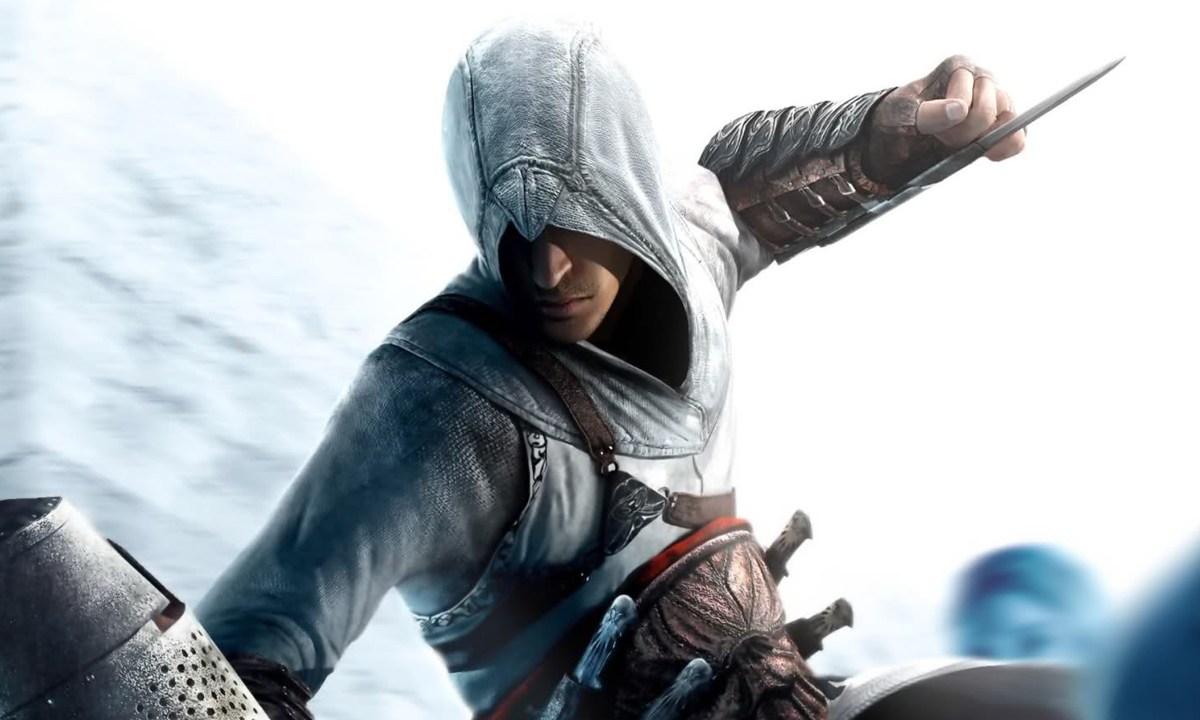
A flick of the wrist, a flash of metal…and someone falls to the ground dead. Is there any gaming weapon more iconic than the Hidden Blade?
A symbol and mark of justice, freedom, and commitment, passing through many hands over centuries, and yet still widely recognisable the default weapon of the Assassin Order, the Hidden Blade has cemented itself with its unique look and historic use.
It’s well known as the Assassins’ trademark and holds fascinating insight into both its users and its victims, and so I thought it was worthy to be analysed.
A Blade in the Crowd – What Makes the Hidden Blade an Iconic Weapon
Out first sight of the Hidden Blade in the Assassin’s Creed franchise is in the opening cinematic from the first game.
A public hanging has just been committed in the town square of Acre. The crowd roar in anger as the Templar soldiers jeer at them from the gallows, pointing to the swinging corpses behind them.
As the Assassin, Altaïr Ibn La’Ahad, moves through the crowd below, the knights spot him and try to attack. Altaïr shoots one solider with a crossbow and trips another, using the prone soldier as a ramp to leap into the air.
Altaïr flexes his hand, raised aloft, then brings it down squarely onto his target. Altaïr lands with a satisfying thunk! and the knight in front of him now lies dead.
Even from this short intro, it tells us so much about both the Assassins and their weapon. The hidden blade is not for all-out combat, it’s to be used as a surprise.
Like a eagle with its talons, the hidden blade strikes only when the time is right, and most importantly, it hits with conviction.
When Altaïr hits, the target immediately slumps. The knight doesn’t get to contest the assassination, he doesn’t even have a chance to draw his sword, he’s dead.
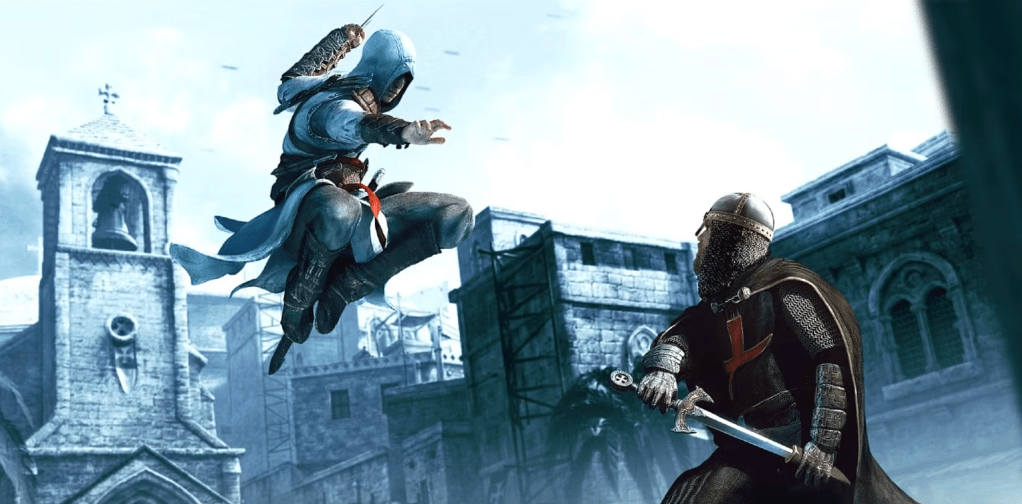
Altaïr in the opening cinematic. (Source: screenrant.com)
***
Psychologically, it should strike terror into a target; if you see this blade then you are going to die and you can’t stop it.
Then add on top the placement of Altaïr’s strike.
While we see later in the game that Altaïr can kill a target by stabbing them in the gut, in this intro Altaïr hits the target in the neck, between chainmail and the helmet.
This is not a drawn-out sword fight where you might glance off a shield or breastplate. The Hidden Blade finds the soft squishy part of the human body, somewhere no sword or dagger could find in a fight.
Again, it’s psychological warfare; no matter how armoured you are, you will die and nothing you can do will stop it.
And for the most part, the blade works exactly like that in the first game.
The blade can only be used in low profile situations (or as a counter), but if you achieve the hit, the target will fall.
It’s then interesting that the Hidden Blade immediately changed across the sequels, having it’s own arc of development in the confines of game mechanics, impacting the story as well.
In Assassin’s Creed II, Ezio’s Hidden Blades (note the plural, another notable step) were made of a special alloy that Altaïr discussed in his Codex (No.13), ostensibly to “deflect incoming blows” but allowed them to be used in standard combat.
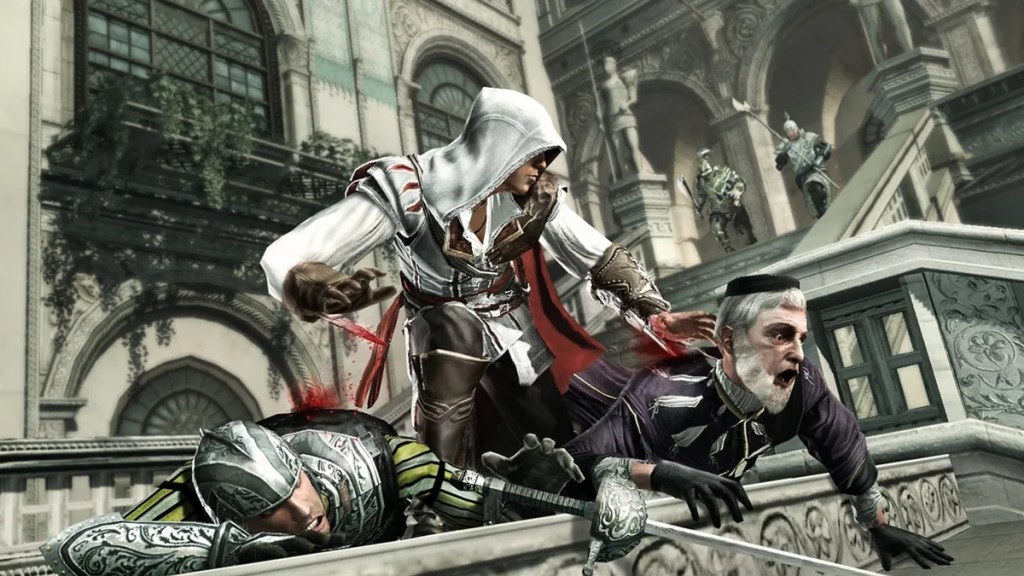
ACII‘s Dual Blades allowed for simultaneous takedowns on targets (Source: gamesradar.com)
***
What’s more, the new Hidden Blades were a fast attack and would get an immediate counter kill, unlike the sword or dagger, effectively dooming those weapons into irrelevance.
This continued in the sequels Brotherhood, Revelations, Assassin’s Creed III and Black Flag, before they changed with the new console generation in Assassin’s Creed: Unity.
In Unity, the Hidden Blade could not be equipped, but was a one-hit kill on unaware enemies. This change in mechanics carried the original spirit of the Hidden Blade, if not all of its unique attributes from the first game.
The same mechanic continued in Assassin’s Creed: Syndicate before it changed again with Assassin’s Creed: Origins.
In Origins, the Blade can only be used as a stealth kill weapon, but…RPG ELEMENTS!
The Hidden Blade needs to be a one-hit kill. It is the reward for getting close to your target without them being alerted. So it makes no damn sense that the Hidden Blade, whose sole use is killing someone undetected, needs to be bloody UPGRADED to make it worth using.
Well done Origins, you managed to screw up the one defining aspect of Assassin’s Creed!
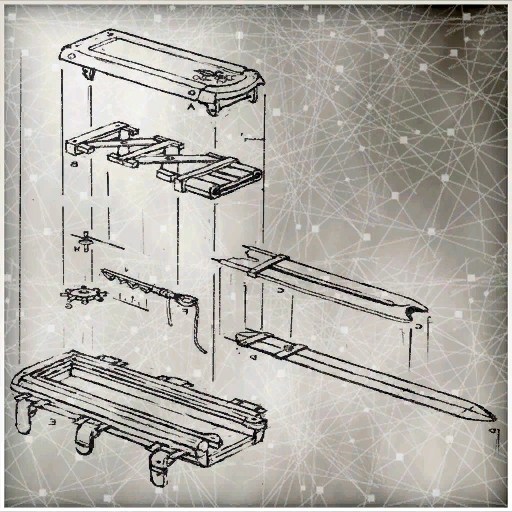
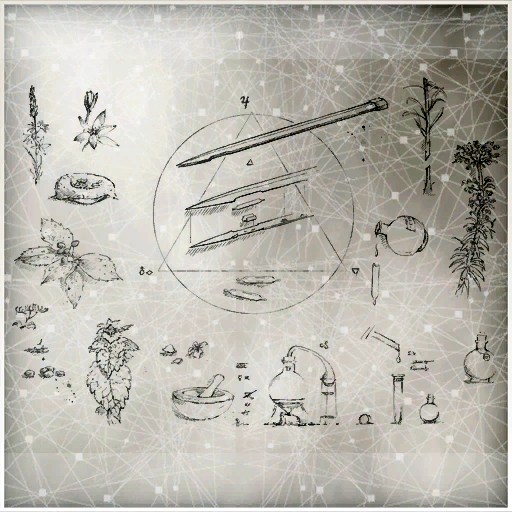
The Hidden Blade schematics from Altaïr’s Codex (Source: assassinscreed.fandom.com)
***
While I’m on the topic of Origins rewriting Assassin Lore…the ring finger.
Ever since the original AC, the ring finger of the Assassins’ has been an important part of the lore. To show an Assassin was worthy to wield the Hidden Blade, they had to sacrifice their ring finger.
You can actually see this on Altaïr’s model in the original AC, which is pretty cool that Ubisoft added it despite not many players actually looking that closely at the hands.
As noted in Altaïr’s Codex, the Assassins stopped removing the ring finger, as it was an easy identifiable mark and the new blades Altaïr developed didn’t require its removal.
In ACII, when Ezio is finally inducted into the Assassin Order, they brand his ring finger, a small token of their traditions.
In Origins, Bayek incorrectly uses the Blade and gets his ring finger sliced off during an assassination.
In theory, I don’t hate the idea and I’m not against subverting a trope or a previous incarnation (hello I love the reboot Tomb Raider trilogy which goes out of its way to subvert every preconceived idea of Lara Croft and Tomb Raider).
I would like it if the blade needed the ring finger to be taken off and Bayek just didn’t know.
But the fact that another iconic point of the Assassin Order came about because someone used the tool wrong and his failure to use the Blade correctly becomes a defining mark of the Assassins’…it stings.
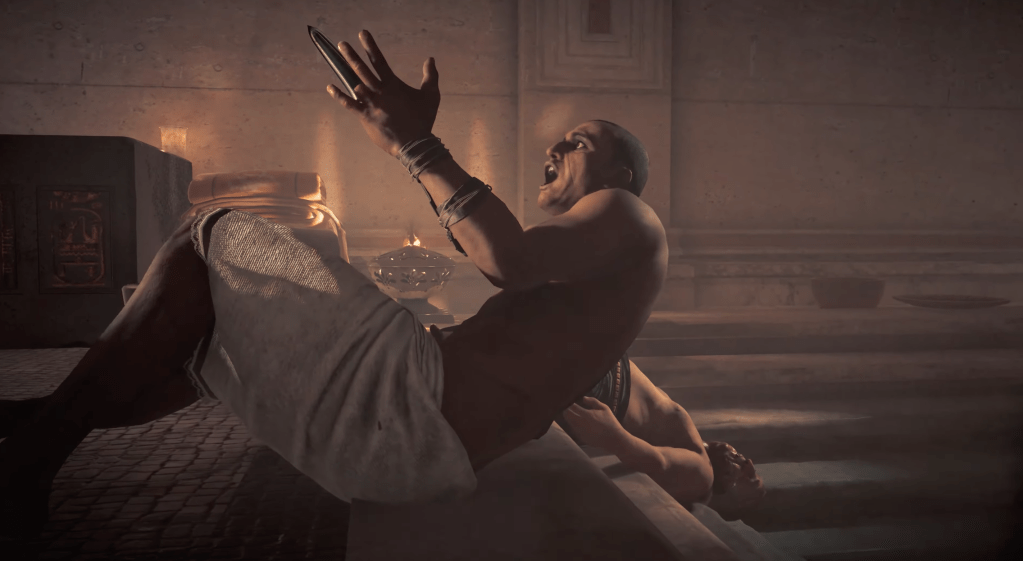
It’s a cool shot, but it destroys the established lore. (Source: YouTube, Drake Platinum)
***
If you want to talk about subversion that does work, the series has two very good examples.
The first is Templars using the Blade, mostly notably Haytham Kenway and Shay Cormac, both former Assassins that switched sides. Despite turning their back on the Creed, they still wield the blade, almost as a sign of pride.
They know the power of the Hidden Blade, the psychological warfare that I mentioned earlier. Now they are turning that onto the Brotherhood, and over the course of their games, Assassin’s Creed III and Rogue, they decimate the Colonial Brotherhood.
The second subversion is removing the “Hidden” from the Hidden Blade. In Assassin’s Creed: Odyssey and Valhalla, the Hidden Blade is worn on the outside of the hand, negating the loss of a ring finger.
In Valhalla, Eivor is gifted an incredibly bejewelled Hidden Blade and when told by Assassin Basim that it is usually under the arm, she replies, “I have no wish to hide this.”
It’s a cool switch up, and is in-keeping with the franchise, as every since Assassin’s Creed II, the Hidden Blade has been modified again and again into non-Blade things. As Altaïr says in his codex when referring to how the Assassins operate, “…our tactics, too, must change.”
First came the Poison Blade and then the Hidden Gun (in its best form when it was slow to aim and fire, instead of the machine-gun-level insta-murder weapon of Brotherhood), both detailed in Altaïr’s Codex from ACII.
Assassin’s Creed: Revelations brought forward the Ottoman Hookblade (which if you didn’t know has two parts; the Hook and the Blade).
While it could be used in combat to trip guards, it’s true use was in traversal, allowing for further jumps and accessing the many ziplines that dotted the rooftops of Constantinople.
Assassin’s Creed III introduced the Pivot Blade, where the blade would spin in the hand into an Ice Pick grip, allowing the Assassin Connor to effectively dual-wield it with his tomahawk.
And then two more ranged variations appeared, first the Phantom Blade in Unity being a silent but deadly mini-crossbow, which eventually evolved into the Darts of Assassin’s Creed: Syndicate.
Syndicate also introduced the Rope Launcher, a possible improvement on the Hookblade, acting as a zipline and traversal tool that was essential for the wider rooftop layout of Victorian London.
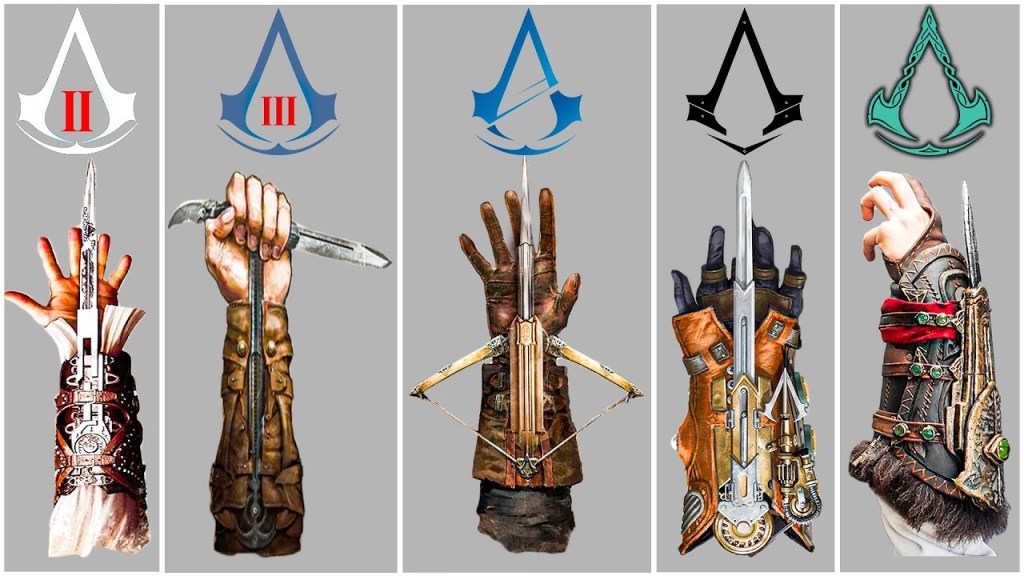
Hidden blades throughout the series, from Ezio to Eivor. (Source: YouTube, AKG29)
***
With each development, a new form of assassination was made, but was something lost with all the new ways to kill a target? Does a Hidden Blade make sense to use when one could easily use a Hidden Gun?
However, I may be falling to my own biases. As someone who loved the first Assassin’s Creed, I grew up with the “Levantine” method; sneak close to the target, perform a high-profile public assassination, and then escape amongst the crowds, the exact style that Altaïr perfectly displayed in the intro video.
And whenever I play a new Assassin’s Creed game, I fall back on my gameplay groundings, performing that same style of assassination in Unity, Syndicate, Origins and Valhalla, and so I wish the Blade would remain as it is.
But even Valhalla explicitly called out this rigidity of thought. When Eivor is gifted the Hidden Blade, the Assassin Trainee Hytham is not impressed, saying it is “unorthodox” to give a blade to a non-Assassin, claiming it is a “sacred tool”.
Basim responds, “Do not make a fetish out of cold metal Hytham.”
But then Altaïr in his Codex says, “The Hidden Blade has been a constant companion of ours over the years. Some would even say it defines us…”
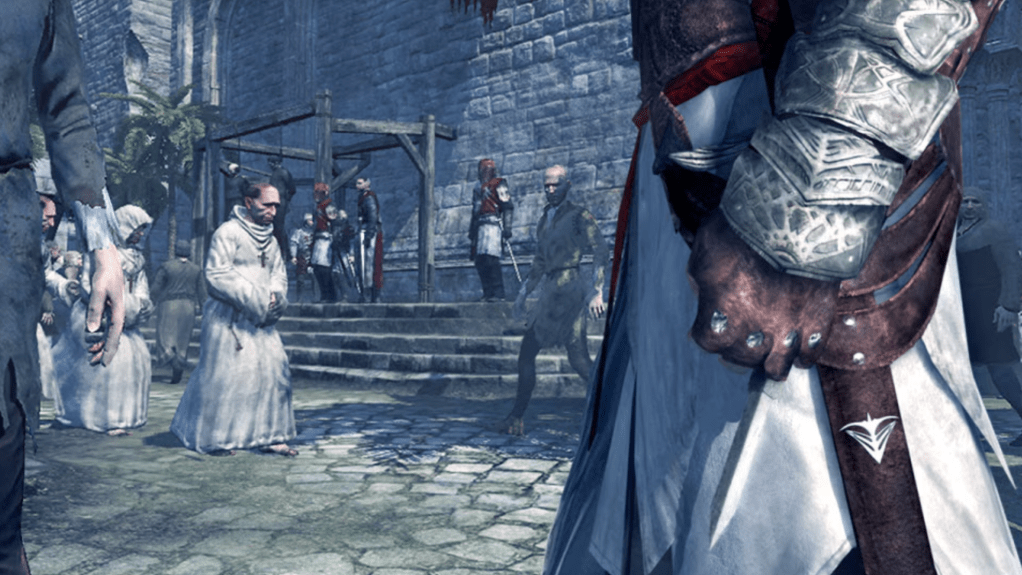
The Blade in the Crowd, searching for its next victim. (Source: ubisoft.com)
***
As Assassin’s Creed has continued, the iconic qualities have changed. The white robes and hood were discarded, first with different colours and then without hoods at all.
The stealth and the parkour were reduced, instead all-out combat was favoured for a while.
The Assassins and Templars were renamed to the Hidden Ones and the Order of Ancients, so that their stories could continue in different forms.
Even the parallel modern-day parts of the narrative have been tinkered and toyed with, before being utterly discarded in some games.
But the defining thing that ties them together, the Hidden Blade.
It is entirely iconic, a final flourish to the many lives it has taken, and is well and truly a character in its own right.
***
P.S. I don’t actually hate Origins, I actually think it’s one of the best of the series, easily better than Brotherhood or Black Flag. Yeah, I said it!
Banner Photo Source: gamesradar.com
 TOM CLEMENT | GAME PRODUCER | NARRATIVE DESIGNER