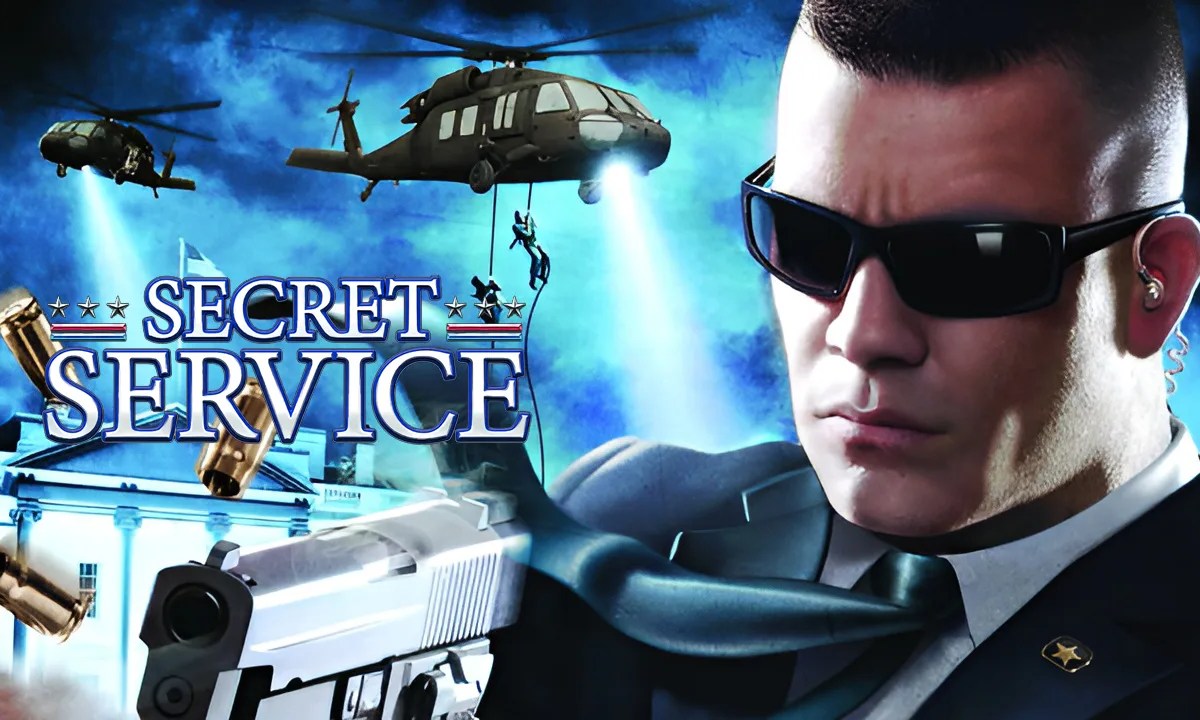
For the last year I have been working through a backlog of Xbox and 360 games that I never played before.
Alongside stone cold-classics like the original Halo or Medal of Honor: Frontline, I decided to pick up a game I had seen on store shelves for nearly two decades; Secret Service.
As the name suggests, the game has the player take on the role of a Secret Service agent protecting the President of the United States of America.
Now, to anyone that frequents game-review videos on YouTube, it might sound odd that I want to play Secret Service.
Even just a cursory glance at its Google page or YouTube search results would indicate it is one of the the worst games ever made.
However, I think with getting older, my priorities within gaming have changed. When I was younger, narrative was the sole thing I was interested in. Then a little older, solid gameplay became the main reason to play.
Nowadays, I’m all about the concept. A log line, a 20-seconds elevator pitch, something that makes me say, “I want to play that right now!”, that’s what will make me try a game out.
It’s not the first game I’ve chosen for its concept. Other games were Medal of Honor (2010), Mafia III, and Assassin’s Creed: Valhalla, all games that were seen as generic in gameplay but had solid concepts, and that alone gave me joy.
If I can see the concept through the game, then I’m sold. So I decided to give Secret Service a try.
***
“Get Down Mr. President!” – Two Brief Playthroughs of Secret Service
I don’t usually remember the first thought I have about a new game, but I do remember it for Secret Service.
Oh god my eyes!
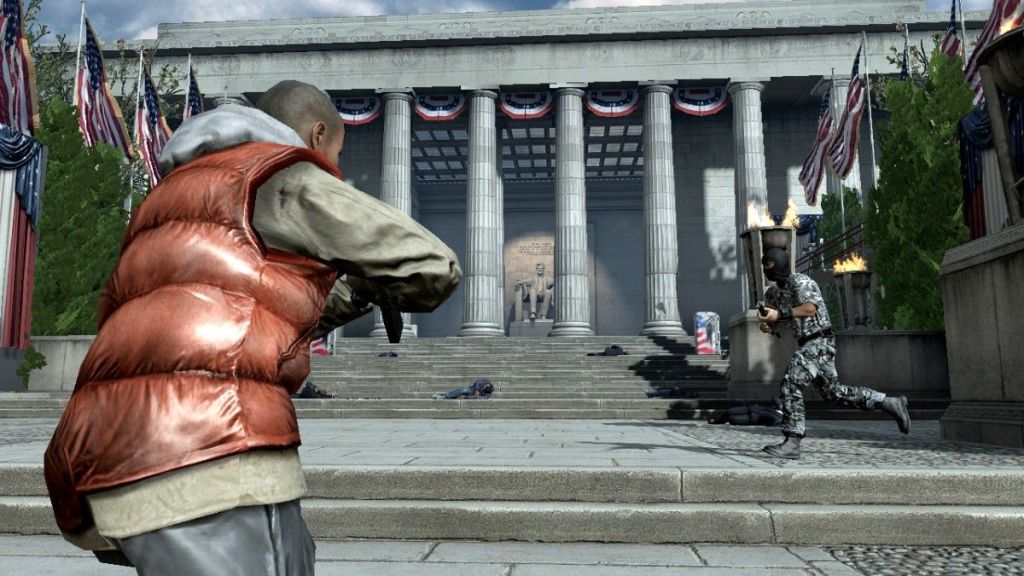
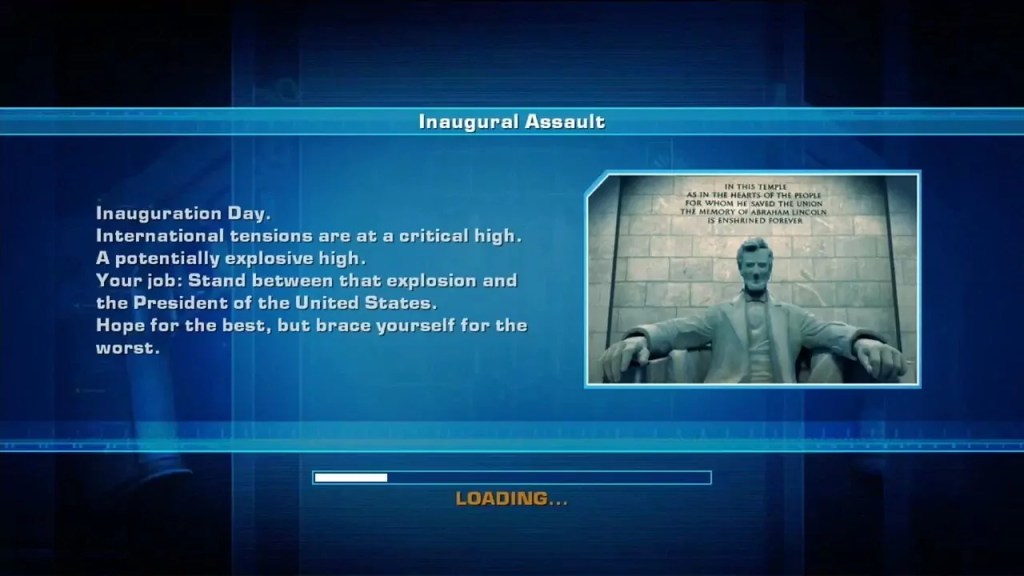
The game starts at the Lincoln Memorial, where the out-going President is making a pilgrimage to the famous statue, when bang/whizz/flash, terrorists storm the event and shoot the Prez in the stomach.
The player is then armed and told to keep the terrorists back while a helicopter can be flown in to get the President to safety.
Dropping players right into a shootout is an exciting opening, it’s just the gunplay here is lousy.
Whenever I fired a gun when aiming down the sights, the crosshair flinched right into my brain. Hip-firing is even worse, with bullet spread mimicking Jackson Pollock’s painting style.
And the weirdest addition of all, reloading a weapon causes the FOV to focus-rack, blurring everything but the gun. I’ve never seen this before in a game and it’s so confusing…like, why? In what way does that feel good as a player or designer?
Controls aren’t any better. Movement is comparable to a tank stuck in the mud. I quickly headed to the settings to up the sensitivity, but the main thing that enraged me was the walking speed, which felt closer to a tractor than a special agent.
I was not having fun. But I powered on. I had my concept and I was seeing it through.
***
The shooting of the outgoing President is only the start of hostilities.
Washington D.C. and the new President are also under attack by foreign invaders, and so it is up to us, Special Agent Pierce, to work our way through famous landmarks in Washington and stop the terrorists by any means necessary.
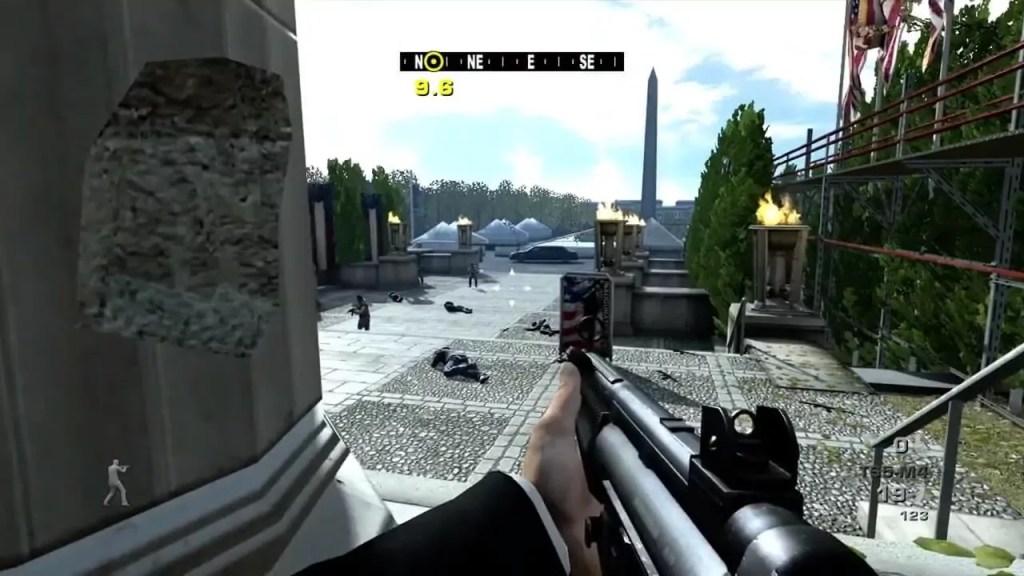
Onto the second mission, fighting through the halls of Capitol Hill. The core loop in this level is clearing out the terrorists, going room by room, corridor by corridor, retaking the building and disarming some bombs that have been smuggled in.
After the first few rooms, I gave up on the MP5 the game had given me as my primary weapon. The bullet spread was just too bad to play with. I decided to switch back to the service pistol.
And it was here where I found enjoyment for the first time in Secret Service. Using the service pistol, it gave sense of role playing, using the same gear as a proper agent would. Not to mention the pistol had a quick Aim-Down-Sights, meaning I could pick shots easily and decidedly.
I settled into a groove, playing more like original Rainbow Six, cautious movement and small sporadic violence, than the reaction-based fights of Call of Duty.
In general, the game’s vibe actually does lean more towards Rainbow Six. It’s no surprise that the developer of the game, Cauldron HQ, are more well-known for their tactical war games like Arma and Operation Flashpoint, modern military games that focus on hyper-realism.
***
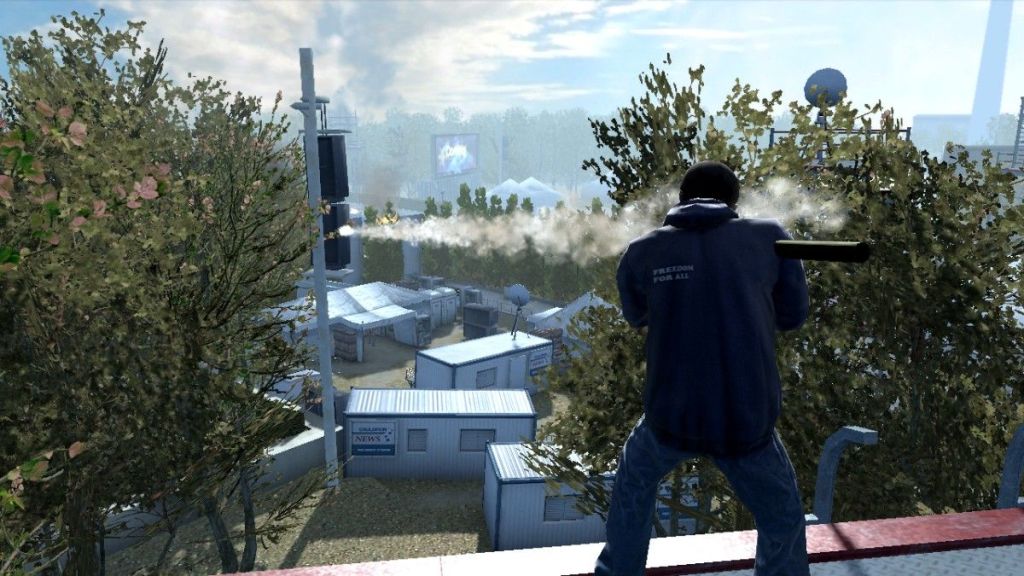
You can almost see the threads of that pedigree in the game. The quick Time-To-Kill (where enemies can put the player down with one well-placed shot), a dedicated peek button to have a tactical advantage in firefights, and later working as a team to protect the President from harm.
The finale of the second level takes place in the main Capitol Congress Hall, facing enemies firing from the viewing balcony at the cowering politicians below.
It’s a cool set piece, having to move from table to table as the bad guys circle from above before they attempt to storm the ground floor.
One interesting point in this mission is the simple but effective visual design change of the bad guys.
In levels that take place in public, they are usually dressed as civilians. Missions inside government buildings like the Congress level have the enemies wearing militarised vests and holsters, and the final levels have them dressed in full special forces gear as they attempt to take the White House.
It’s just a nice touch showing the coup attempt going from rush attacks to an all-out invasion.
Talking of the invasion, let’s discuss the story of the game…or what is left of one.
A story like this is inherently political; your role and the gameplay is literally saving the President of the most powerful country in the world.
And coming from a developer outside the USA (Cauldron HQ come from the Czech Republic), this might have been an interesting take on how the USA is seen from an outside perspective.
***
The game starts a with a vague and slightly incomprehensible Call of Duty 4-style opening cutscene about a fictional South American country called Costa Sentava.
It’s a smash-cut of new reels and dates, flying through oil fields, attempted coups, biological nerve gas, and possible CIA subterfuge in the country.
Then skip forward to the presidential inauguration and then it’s all, “For El Presidente”…and that’s it.
Sure, there are more twists than an M. Night Shyamalan film about pretzels, with double crosses, fake-out double crosses, and triple crosses that by the end I was more baffled than anything.
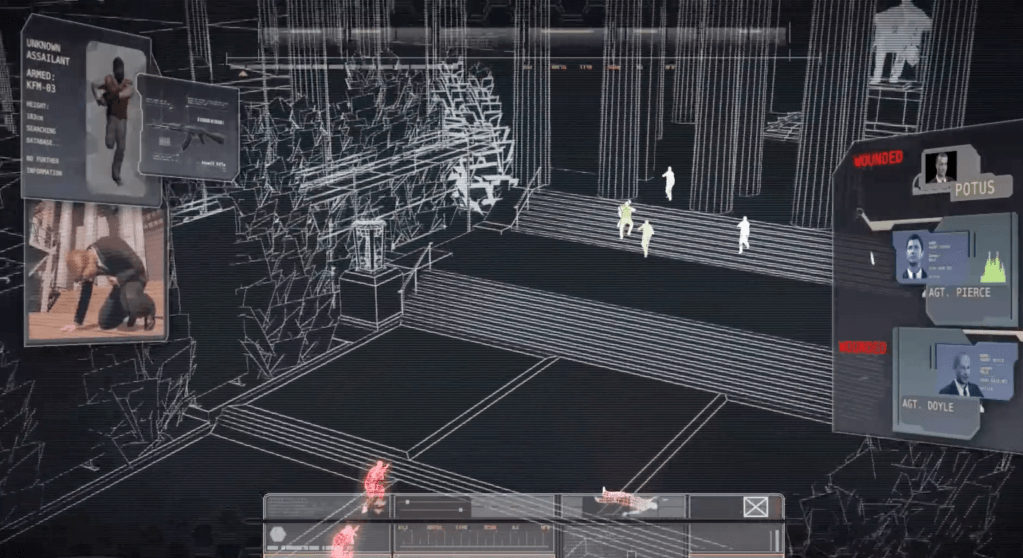
The story does have some interesting ideas, but they are all in “Cell Phones” dropped by enemies, essentially CoD4 intel (oh, the beauty of 2008-era technology, where all the pickups are all clam-style flip phones).
These voice messages start out with the Costa Sentavan forces justification for invading, then slowly turning as they learn about the atrocities their comrades are performing, and finally breaking into factions, fighting each other, and attempting to flee back to Costa Sentava.
It’s interesting to read and would have been great to acknowledge in the game. One cell phone voicemail has a terrorist break down after a famous Sentavan poet at the US inauguration is shot dead. It could have been a powerful moment to show, cutscene or not.
***
Back to the missions. So while my hopes were raised by Mission 2, then were quickly tempered back down again by three huge sewer levels; long grey corridors of supposedly the secret bunker of the President.
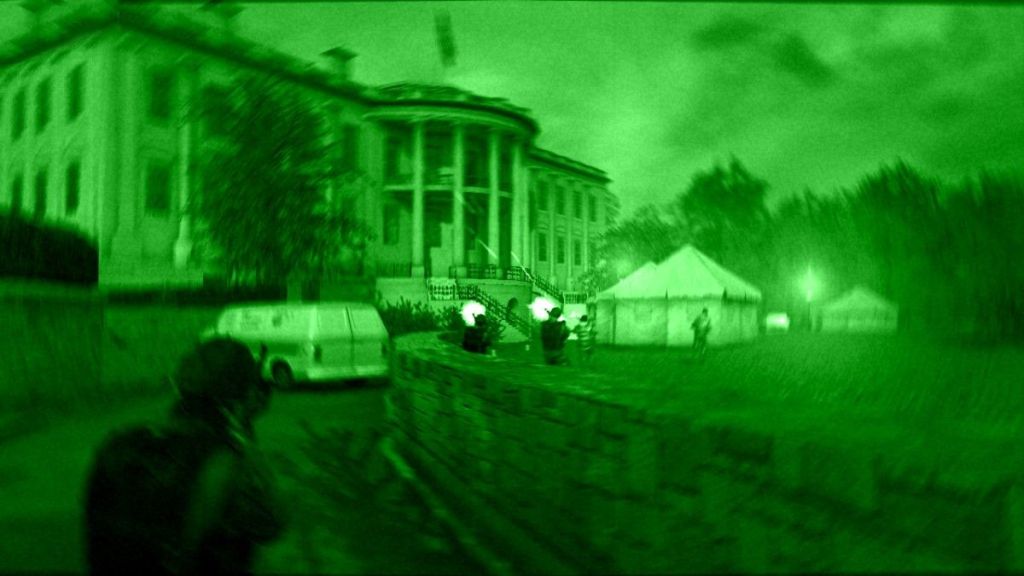
It’s here where the game becomes a puzzle platformer as you have to navigate several electric fences and laser trip mines that you can only see with Night Vision goggles.
Night Vision that coincidentally has a limited battery, meaning sometimes you have to wait in the dark for it to recharge.
There are brief moments where the level design is cool, like fighting through bunker offices and break rooms, at one point there is a missile about to be launched that needs deactivating. Who knew that the basement of the White House held a nuclear missile?
Halfway through these sewer levels, the Secret Service think you are a double agent and they begin trying to stop you.
Player character, Special Agent Pierce (voiced by Nolan North, more well-known as Nathan Drake of Uncharted fame) is told to stop heading towards the White House, but goddamit someone has to save the President, and he’s the only one who can!
However, because the other Secret Service agents are simply misguided people following orders, you can’t kill them, and so you can only use a taser to take them out.
Later on there are a mix of Secret Service and Costa Sentavans aiming to kill the player, meaning having to switch weapons constantly between lethal and non-lethal. This would be an interesting subversion of gameplay, if the weapon switch didn’t take an age to do.
Unlike CoD4‘s pistol switch (which, and say it with me now, “is always faster than reloading”), Secret Service has a rack-slide animation every time you equip a gun.
Talking of weapons, they are the default set for a modern military First-Person-Shooter. Pistol, SMG, AK, Assualt Rifle, Shotgun, Sniper, RPG, all that good stuff.
The shotgun is fun and quick, and I’ve already praised the pistol as a prop for roleplay. All the machine guns are terrible, bar the one we get in the final missions of the game.
The sniper surprisingly doesn’t need breath control, which actually is probably for the best. The sticky controls severely impact the gunplay, so to rip another gameplay idea from CoD would be too much.
***
The player finally emerges from the three long sewer levels into the White House. It’s a fun segment, the game has given us the best weapons and plenty of cover. Night begins to fall as the Sentavan Special Forces close in, ready to finish the job.
We defend the Oval Office from terrorists coming through the Rose Garden, making quick dashes across the patio to defend different parts of the complex.
The game then tasks us with going up and down stairs and switching from short range engagements to long-range sniper battles, and it actually feels like the game is starting to come together.
Then after a quick helicopter ride on Marine One, where Special Agent Pierce commandeers the machine gun on the side in a very watered-down recreation of the AC-130 mission from CoD4, we arrive at the final mission.
It’s another CoD4 rip-off, this time “Mile High Club”. The Speaker of the House and evil Secret Service agents have taken the President hostage on Air Force One, and you are the only one able to stop them.
Just like “Mile High Club”, it’s a quick dash up and down the plane, shooting anything that moves, and ends with you having to take the shot that kills the bad guy and saves the President.
Fun fact, you can intentionally botch this final shot, giving you a 0G Acheivement titled, “The Exact Opposite of Your Job”.
***
Conclusion
I have mentioned Call of Duty 4 so many times in this retrospective, because for all intents and purposes, this is just a quick CoD clone, released almost one year after CoD4. And hey, it was even published by Activision.
Everything from the titles to the UI feels basic or like placeholder assets, would it have been so hard to give the team the CoD4 engine and reskin it?
Released on 4th November 2008 (the LITERAL day of the US Presidential election, poor-taste-be-damned), this game feels pulled in two directions.
I commented earlier about the more tactical approach to gameplay, and it’s probably what this game was originally going to play like.
But with the election being a perfect marketing gimmick and CoD4 being the game of the decade, the team was probably ordered to follow the market (not the first time a publisher, or even Activision, would have told a team, “make it like CoD.”).
I don’t think this is the worst game ever as so many YouTube videos have described. It’s probably the worst first level I’ve ever played, but when the game manages to get all its cylinders firing in the right direction, it becomes a passable CoD variant.
And conceptually, I was thrilled.
Moving through famous locations like the Lincoln Memorial, Congress, and the White House, playing a role seldom seen in gaming, using some punchy weapons (which on lower difficulties can be fired from the hip with startlingly accuracy, turning Secret Service into a fun Doom mod), I got more than I expected from Secret Service.
I’m not going to say go out and buy it or that it is an underrated gem, I think I more pity it. With more time and a stronger tactical approach, I think it could have found a niche audience.
My childhood curiosity of the game was satisfied and I had some fun in the brief hours it lasted, and that’s all I can ask for.
Banner Photo Source: altarofgaming.com
 TOM CLEMENT | GAME PRODUCER | NARRATIVE DESIGNER