I have been on-and-off learning German for five years now.
Through online classes, a dash of Duolingo, and general real-world-exposure, I am able to get by in most situations and conversations, only struggling with speed and specialised words.
General linguistic wisdom tells a student to immersive themselves in a language, such as reading books and watching films and TV in the target language. But as gaming fought with TV time, I decided I was should start playing games in German to increase my vocabulary.
While I had pondered whether to play a game I knew the dialogue of for a fun challenge, I also had a behemoth of a game on my “to-play” pile, and decided to go for that.
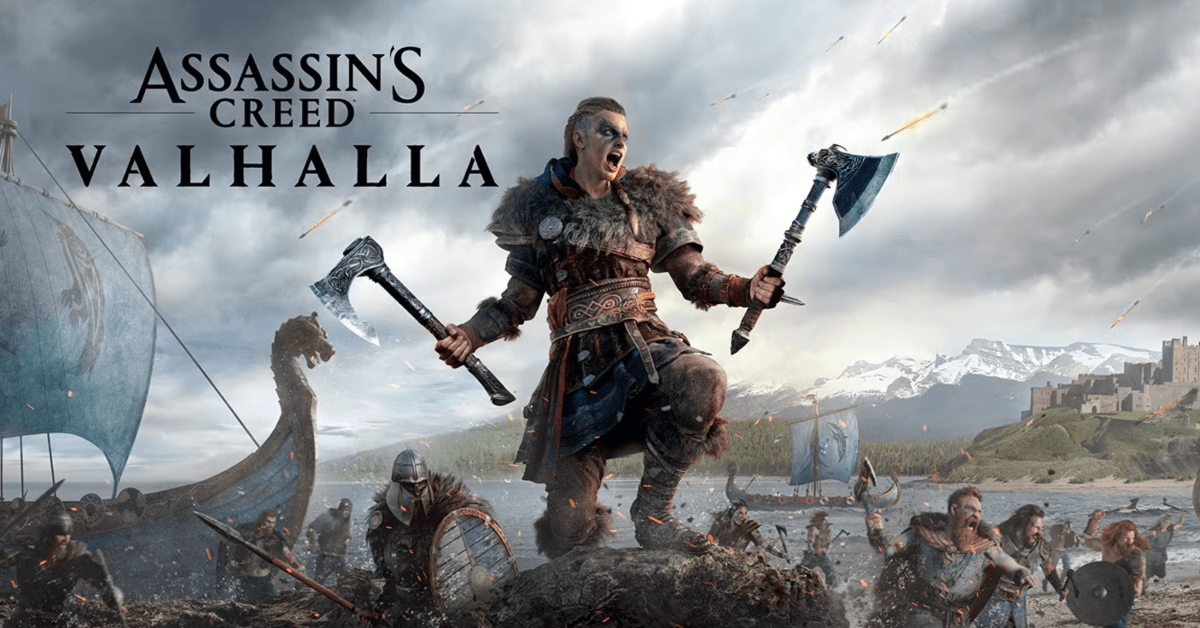
The first game I would play in German would be Assassin’s Creed: Valhalla.
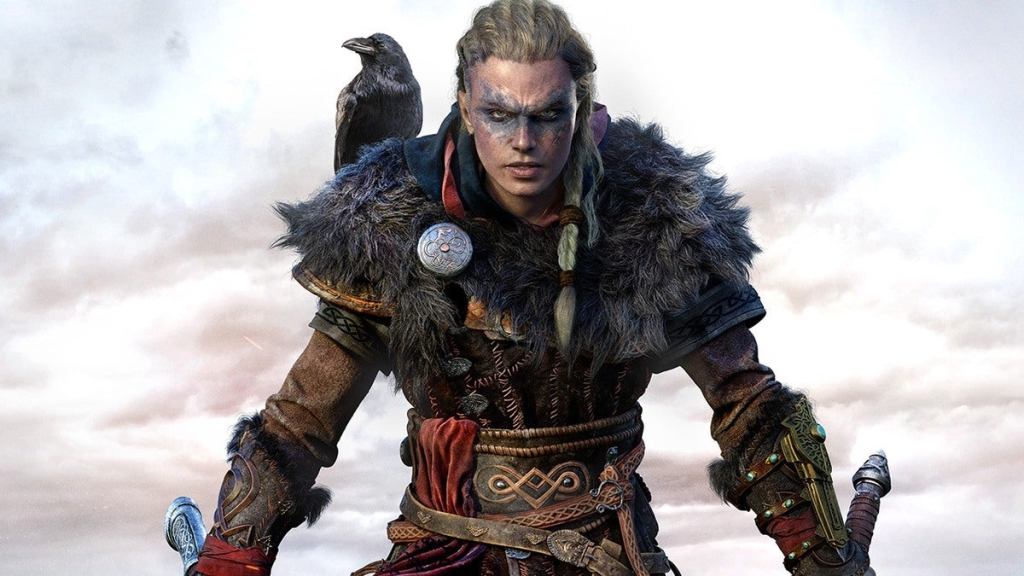
So, let me have an indulgence as I write about my time in Viking England, with a German valkyrie as my avatar guide (because who plays Valhalla as male Eivor? Female Eivor forever!)
“Ich bin Eivor vom Raben-Clan!” – Learning German With Assassin’s Creed: Valhalla
I have written before about the use of other languages in games, even using Assassin’s Creed as an example.
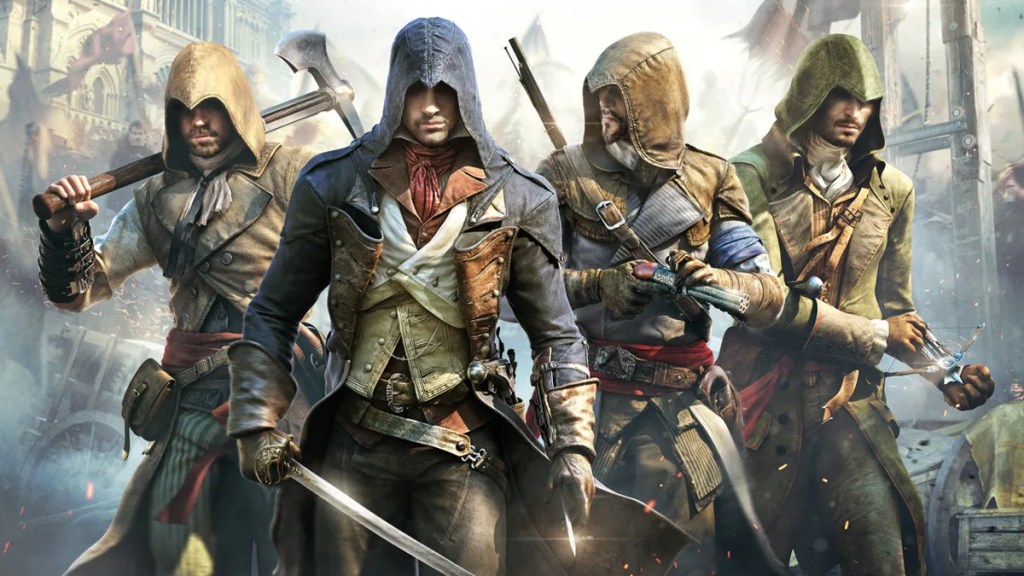
When I had played AC: Unity and Liberation, I set the language for both to French, as Unity is set in Paris and Liberation in colonial-era New Orleans. However, these switches were for immersion rather than to learn, but they had started an interest in me to search for language settings in games.
And actually, Ubisoft, creators of Assassin’s Creed, have a great track record for doing languages in games. So many games, even AAA ones, don’t make a distinction between language audio, subtitles, and game text.
You may want a different language for dialogue, but keep the text and subtitles in another, and most games won’t let you. It’s a luxury in development time and extra tech logic to separate them. But Ubisoft separates the individual components, so players can customise how they would like.
***
One of the main reasons I chose AC: Valhalla for my start in German is for the story. Not the narrative per se, but the nuts-and-bolts dialogue and missions.
If I had played something like Call of Duty in German, I might learn the words for “missile”, “tango” and “terrorist”. Interesting for sure, but not words I would be able to use every day.
A big part of Valhalla is the role-playing aspect, dialogue trees and quest-based design. It would give ample opportunities and for every day words to be used in-game.
So whenever I would play, I would sit down with my pen and paper and when I would hear a word that I could use, I would note the English from the subtitle and write down a phonetic sound-by-sound version of the word.
After playing I would go through and edit my notes to be the correct spelling or straighten up any mis-aligned phonetics. When I started, my focus was on singular words, meaning I could easily match subtitle to phonetic, something like “sofort”, meaning “exactly”. I eventually graduated to full sentences and questions.
And after marauding across the English hills for many hours, I had an eye-opening moment. I heard Eivor ask, “Habe ich eine Wahl?” (“Do I have a choice?”) and I could understand each and every word without even glancing at the subtitles.
It was a true light-bulb moment, of words I had learned through classes, exposure, or TV, and my brain made the snap translation almost immediately.
***
Something that I learnt about while playing was German dubbing culture in film, TV, and games.
While a lot of films and TV made in the US or UK are shown in Germany and Europe as a whole, that can be two different ways it is presented.
Many films and TV shows are shown in their original language, but with subtitles (this is how a lot of non-English speakers learn English, and why sometimes they come away with specific accents because of a show they watched).
The second is dubbing, where voiceover actors are attached to one or two real-world actors. For example, Maria Koschny, female Eivor’s German dub, also dubs for Jennifer Lawrence, and does all the films that Jennifer Lawrence has starred in.
Being voiceover specialists, these voice actors are usually brought in for games and anime dubbing, even if the real-world actor they are attached to is not present. This led to a great moment where my partner, in earshot of me playing, asked “Why is Julia Roberts playing a Viking princess?”
***
One of the best things about a narrative-heavy game as Valhalla is its interpersonal connections. Eivor has several deep discussions with allies, enemies, and everyone in-between.
Valhalla has a sprawling 300+ hours of content with main story missions, as well as a variety of in-world encounters and side-quests.
The people that Eivor encounters in each mission life to talk about a whole range of topics such as life, history, politics, and philosophy, mainly advancing character development rather than advancing a plot point.
It was here where I found the most advantageous words and phrases, rehearsed their sounds and how to use them in a sentence, and then brought them out into the world.
And still, when I think of those specific words, my memory returns to those exact moments in the game. Eivor walking through a night-time market, celebrating with friends after a successful siege, arguing with ice giants in Jotenheim, and returning relics to the Saxon king Alfred.
When the end credits came, I was a little emotional. Not only for the countless hours and months I put into the story, but also something deeper. A learning experience, personalised to not feel like memorisation of key words. And so I will continue to change languages where I can and adding to my word list.
But AC: Valhalla has a soft spot in my heart, for being the first and being a great introduction to learning through play.
Photo Banner Source: gamerant.com
 TOM CLEMENT | GAME PRODUCER | NARRATIVE DESIGNER