007: First Light – Trailer Reaction

Sony Playstation’s “State of Play” event was broadcast yesterday, announcing games and showcasing trailers for PS games set to release in the next few years.

Despite lots of cool teasers only one trailer has got me fully invested in the hype-cycle; 007: First Light.

Initially teased five years ago as of writing with the codename Project 007, First Light is…well, the first look at the newest James Bond game since 2012. I even wrote a post speculating what we might see in the final game back when all we had to go on was the teaser.

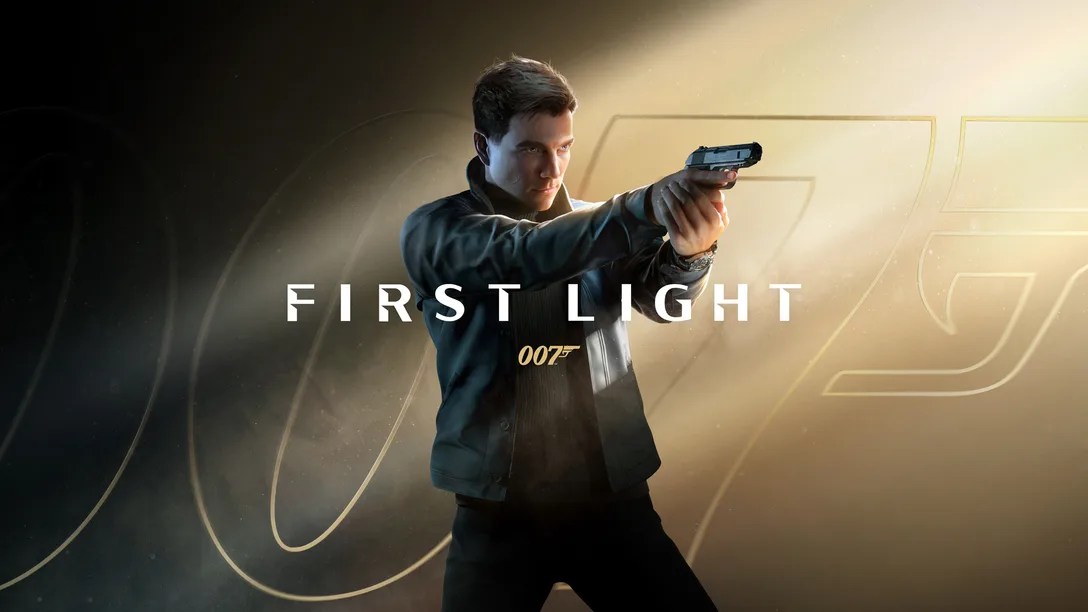
Developed by IO Interactive, the studio behind the Hitman series, First Light looks to be giving us a radically different Bond to any we’ve seen before, but with a few classic references for fans to find.

And as a fan of both 007 and Hitman, I wanted to dissect as much as I can from it. If you haven’t seen the trailer, here it is!

***

On His Majesty’s Secret Service – Dissecting the 007: First Light Trailer

I think anyone that would glance at the trailer for a second could mistake it for the trailer of a new James Bond film. It’s that good.

The pacing, the music, the mix of character charm and action set pieces, it all blends together and hits all the points to get fans excited. It even has the product placement, with Omega watches and Aston Martins being given prime real estate time on the screen (probably courtesy of Amazon’s acquisition of the Bond license back in 2021).

Despite hitting several Bond motifs and references, IOI have stressed in all their statements about the game that it will be an entirely new “origin” story for the character, disconnected from all previous works. It’s the right way to go, cutting off any preconceived notion of who or what James Bond to build him up for a new generation.

The opening dialogue between M and a new character, Greenway (played by The Walking Dead’s Lennie James) sets up our hero excellently, taking Bond’s original backstory from the books and giving it subtle tweaks; witnessing his parents die in a mountaineering accident, bouncing from private school to private school, then enlisting in the Navy and acting with reckless abandon.

It all adds up the M describing Bond as a “bullet without a target”, very similar to how Judi Dench’s M described Bond in Casino Royale, “a blunt instrument”.

And then we see our new James Bond for the first time. It’s a good reveal, seeing his silhouette to begin with, him stepping out into the light, his hand shielding his face for a second, before the corner of his mouth twitches into a grin.
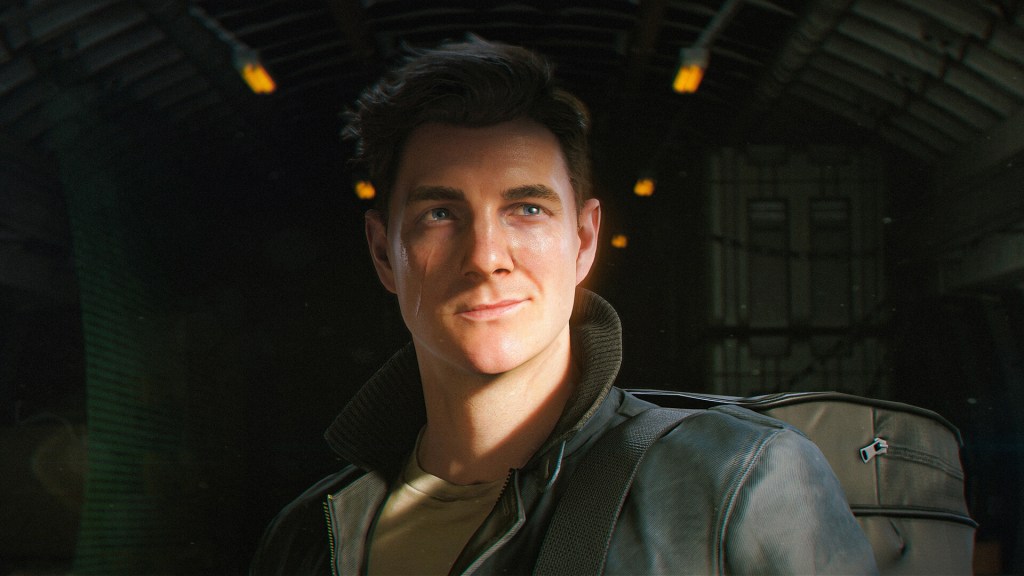
Supposedly modelled and voiced by Irish actor Patrick Gisbon (most well-known as playing Dexter Morgan in the television series Dexter: Original Sin), he’s the youngest Bond we’ve ever seen (IOI list him as 26 in their press-release), yet he still has a few of the marks of Bond from the original text such as the thin vertical scar on his cheek and blue-grey eyes.

The settings look stunning, matching the high-quality of the Hitman trilogy, with locations such as South-East Asian beach resorts, French chateaus, rooftop chases and fireworks shows, and if my eyes do not deceive me…James Bond in a nightclub!
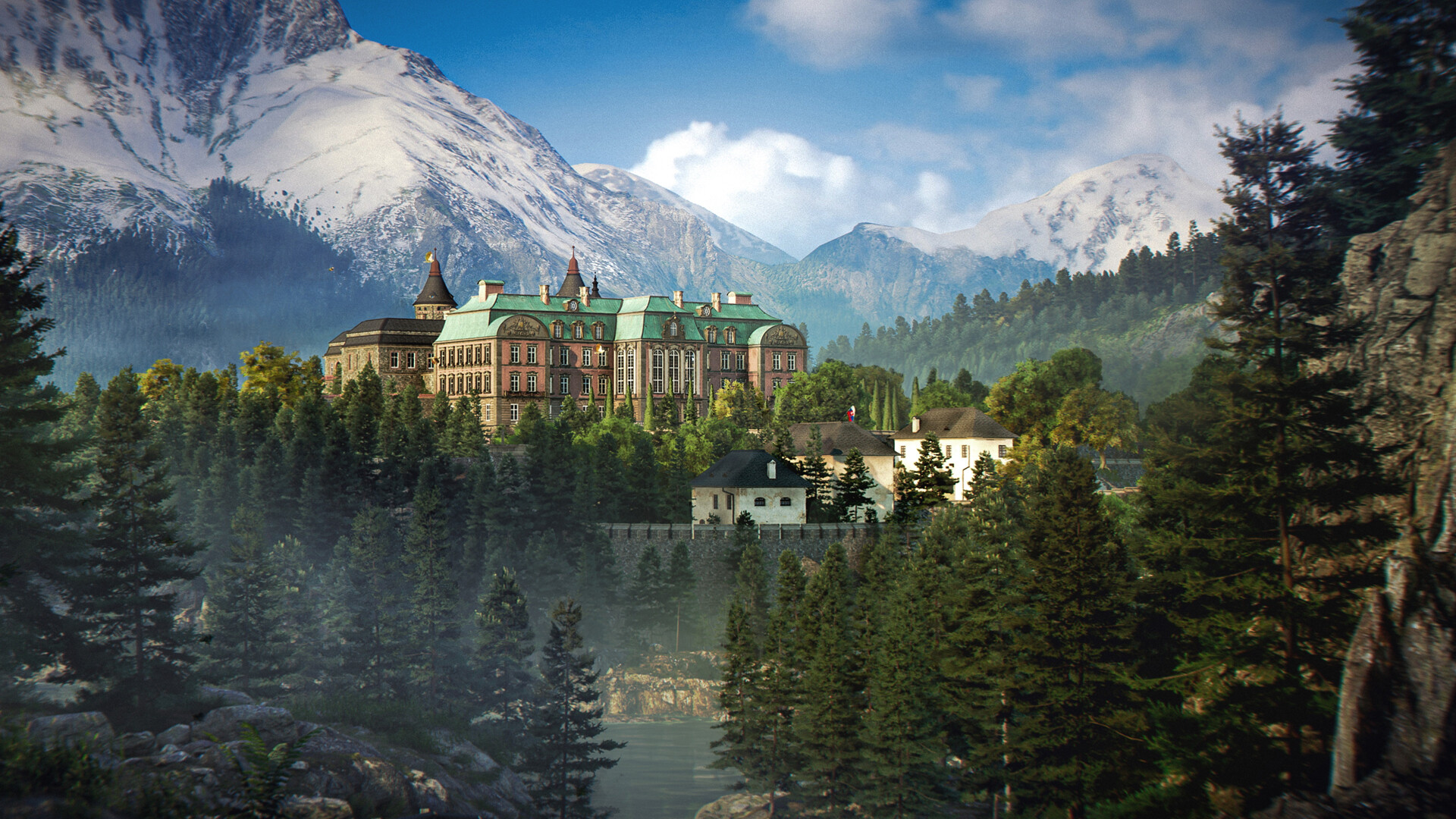

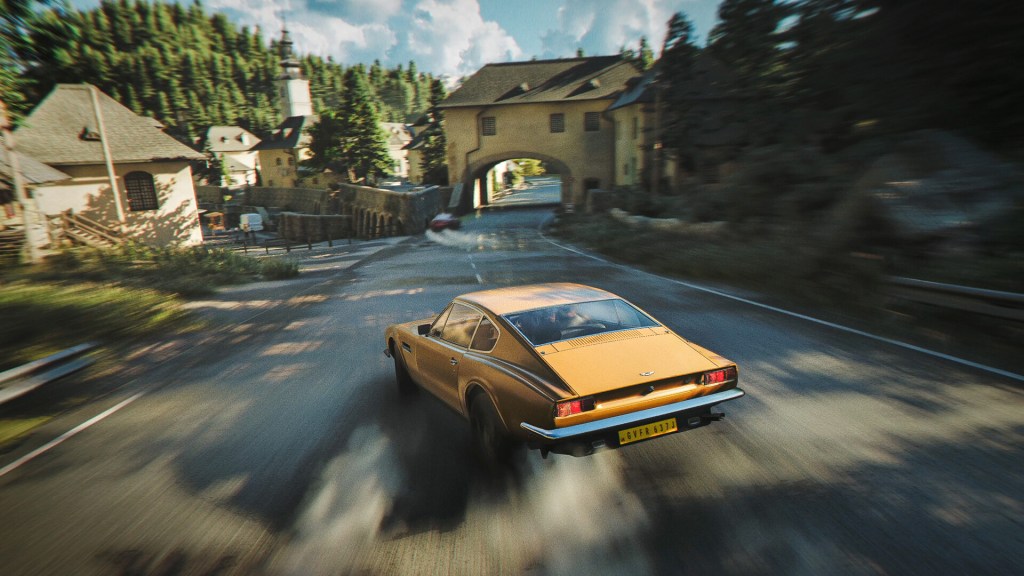
Speaking of the locations, one of the most exciting teases in the trailer is Bond barreling down country roads behind the wheel of an Aston Martin DBS, last seen in 1969’s On Her Majesty’s Secret Service.

I speculated in my previous post that driving missions would make their way back into the series and I hope that IOI have done their homework on previous Bond games. Other 007 games have excellent driving missions giving players a small open world to complete their objectives rather than just simple chases.

Another prediction I made of the game would be the return of gadgets. During Craig’s tenure as Bond in both films and games there were less about the individual gadgets of Q Branch, instead cramming all the agent’s needs into his mobile phone.

But two scenes stand out in the trailer; Bond using some sort of dart device to put a guard to sleep, as well has using his laser watch to temporarily blind a bad guy. The laser watch is a staple of the movies and so I’m happy to see it replicated here. I hope we have more gadgets on show with each one being its own item rather than just being interchangeable parts.
Alongside gadgets, the rest of the gameplay loop looks solid, as anyone would expect from the creators of Hitman. Hand-to-hand combat looking nice and weighty (I think I see a Judo hip throw at one point) and Bond looks effortlessly cool catching guns in mid-air or kicking them into his hands.

IOI have also teased that players can use “charming wit” to overcome challenges, so maybe their will be short dialogue sequences or wry comments to choose. There are a few jokes in the trailer along with Bond smiling, so it seems we are getting a more light-heartened Bond that we have in the most recent films.

One final part I want to point out in the trailer is MI6 as an organisation. We get the usual suspects of M, Q, and Moneypenny sprinkled through the trailer, as well as scenes of Bond taking part in combat and firearms training amongst other recruits.
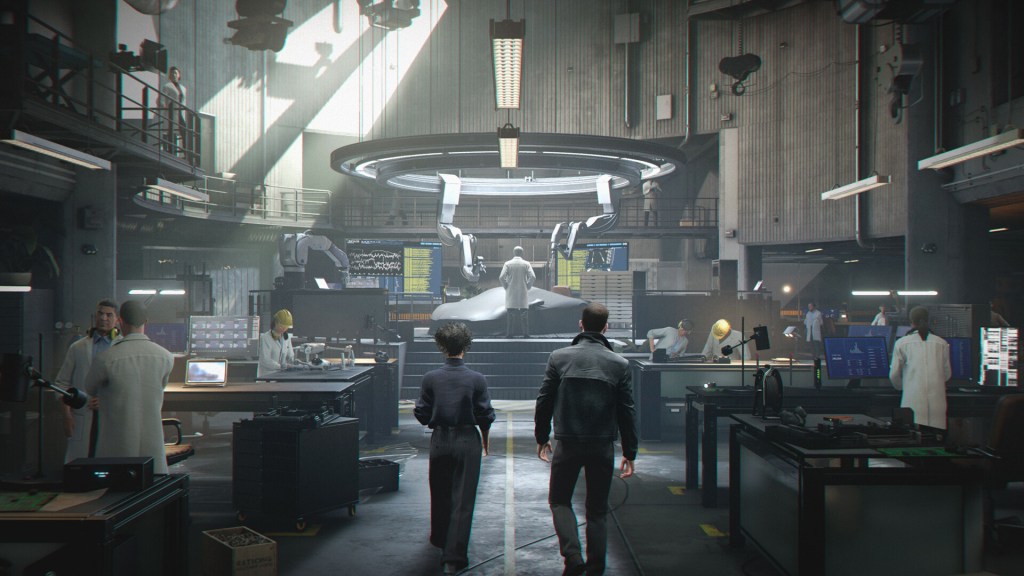
One scene later features M speaking to a group of people that look around Bond’s age, saying “I need all my pieces on the board”. Another line later in the trailer says “009 is a master manipulator. Whatever the endgame is we won’t see it coming.”

In both the books and the films the other 00 agents are only mentioned in passing, usually dying early on and spurring MI6 to send in Bond to clear up the mess. But here it seems that Bond might be working with and also against other agents, which is a unique scenario both for new and old Bond media.

Hakan Abrak, CEO of IO Interactive stated in an interview that they are aiming for a trilogy of 007 games and so I hope that with this cast of potential co-workers we get to see them grow too and interact with them in gameplay.

Either way, this is just the first teaser with the game aiming for a 2026 release date. I am excited to see more as First Light looks like its shaping up to rightfully take the mantle from GoldenEye of being the best James Bond game ever.

Banner Photo Source: blog.playstation.com

Screenshot Source: gamefront.de

South of the Circle and Love, Memory, and Lost Moments

Romance has become quite the topic in the gaming landscape.

I’m a sucker for a good romance and am always interested in where the game will focus its attention.

While love stories have been a part of the medium forever (one of the most famous cases being “save the princess”), it’s only in recent times that gaming has started to take on some more bigger and mature themes when it comes to romance.

Ideas like teen romance (Life is Strange Season 1), infidelity and commitment (Catherine: Full Body), and reconciliation (It Takes Two). I’ve written about love, death and endings in games like When The Past Was Around.

And it just so happens I’ve played another game recently that tried to tackle deeper themes with love. 

South of the Circle is a narrative game first released for Apple Arcade in 2020, but was released late last year for consoles and PC.

I was immediately struck by its visuals and sound design, but was drawn in by it being labelled as a love story.

South of the Circle takes on the development of a whole relationship, societal pressures and conventions, but its main theme is memory, its failings and faults, and it perfectly works its way into the gameplay.

Best of British Luck – Love, Memory, and Lost Moments in South of the Circle

South of the Circle’s story focuses on two people, Peter and Clara, both lecturers at Cambridge University, how the two meet and fall in love, before a breakdown in communication leads to tragedy.

We play Peter throughout his time with Clara, but also during a research trip to Antartica, taking place after the two’s romance. This double story, of Peter searching for rescue at the South Pole and his growing relationship with Clara forms the narrative hook of the story.

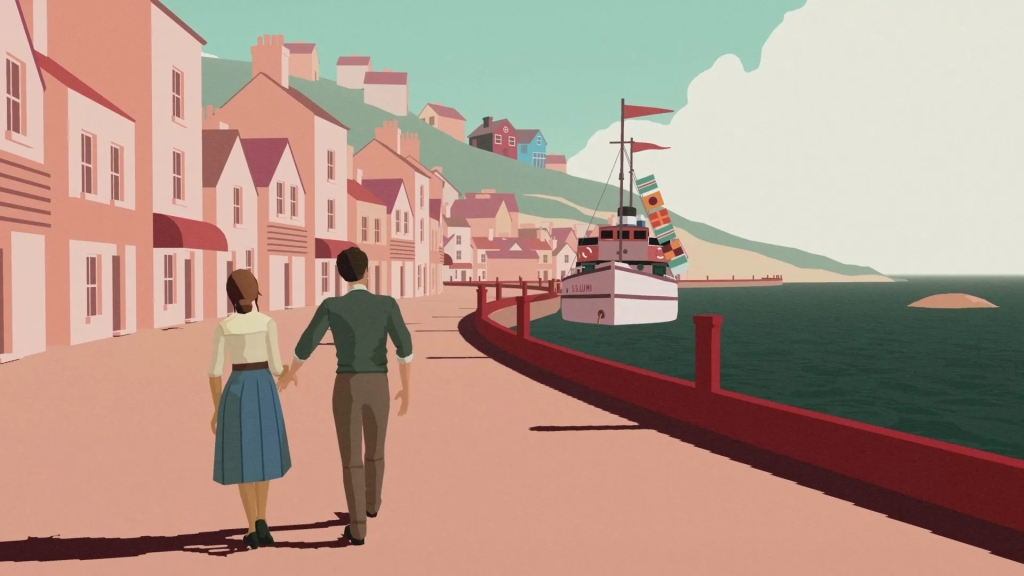
The pair first meet on a train from Scotland down to Cambridge. It’s a perfect romantic introduction; Peter offering to help Clara put her suitcase on the top rack, her offering to share the carriage as everywhere else would be full.

South of the Circle‘s art design is evocative of screen prints from the 1960s, full of clean lines and stark contrasts. (Source: mezha.media)

The main point of interaction in the game is dialogue choices, but instead of seeing a preview of words, you see a shape that gives a general emotion.

A red circle indicates panic, confusion, or concern. A green circle indicates caring and honesty. The black square is for being strong an assertive, a pink circle is negative and shy, and finally a sunshine image is for enthusiasm and interest.

Not all emotions are accessible with each interaction, only three at one time. It’s a great concept for a replaying a past love story, of people thinking back on moments and regretting acting in a certain way, whether shyness or being too forthright, and it’s great to get a general sense of how Peter could have reacted differently.

It’s also interesting that in certain conversations, one of the prompts comes up before the other. For example, when Peter helps Clara with her suitcase, two options come up in response, one being strong and assertive (the “be-a-man” approach) or honesty and openness. For a few seconds, the strong and assertive is the only prompt on screen.

It gives Peter a little bit of depth; so many characters with dialogue choices can change on a player’s whim in a certain situation, leaving their backstory a little vague and blank as to why they are acting in a certain way, but here it gives a small detail as to Peter’s background.

Source: playstationcountry.com

The two keep crossing paths once they arrive in Cambridge. Peter drives Clara to work when she misses catching her bus in the pouring rain, and she sits in on his lecture and asks question about his work. Again, it’s a perfect romantic setting, of two people in their element, thrown together by fate, both seeing sparks fly as they talk.

Chance meetings turn into coffee dates, into a night at a funfair, into seaside holidays, and finally into secret Scottish highland hideaways (with Clara remarking, “I don’t know what my father would say about me bringing an unmarried man up there.”)

It’s a gradual and believable slide into comfort and romance, yet it’s fleeting. It’s tableaus and snapshots, of little inside jokes (the game remembers what choices you’ve made and the characters reference them), the sort of thing someone remembering a relationship would envision.

Happy memories of times gone by. (Source: news.xbox.com)

Alongside the development of Peter and Clara’s relationship, we get further flashbacks into Peter’s life, such as his childhood and him with his fellow researchers.

His childhood doesn’t seem to be filled with fun, with an over-protective mother and a quick-to-anger father. A lot of the prompts in these sections are delayed; we see the prompt appear but it doesn’t become clickable for sometimes five to ten seconds, as if Peter is finding the courage to speak back to his parents. His responses are usually the panicked or negative choices.

With his friends, Peter is still a little shy and reserved, but given a few seconds the “man-up” choice is presented. A lot of the talk with his friends would be regarded as “locker-room talk”, with  the two researchers always hunting for new “conquests” and seeing Clara as, quote, “inspiration” for Peter.

Peter’s childhood and social life is also explored in the game, giving glimpses into other areas of his life. (Source: mezha.media)

And to be fair, they are right with Clara being a muse for Peter. For three years he has been writing a research paper and has been stuck for a long period. But when Clara comes into his life, she reads his work and helps him complete it.

From there, their relationship takes a turn for the worse, as society starts to turn its eye onto the couple.

First, it’s the time period. The game is set in 1964, the height of Soviet paranoia, anti-nuclear marches, and Russian spy rings working inside academia.

Second, the location. It’s only been fifteen years since women were first admitted to Cambridge University, and some of the old guard still believe they are, “not built for academic work”.

It’s both the sexism of the time and guilt by association that causes the breakdown of Peter and Clara, the British “stiff-upper-lip” being the finishing blow, of words left unsaid, and memories now tarnished with emotion.

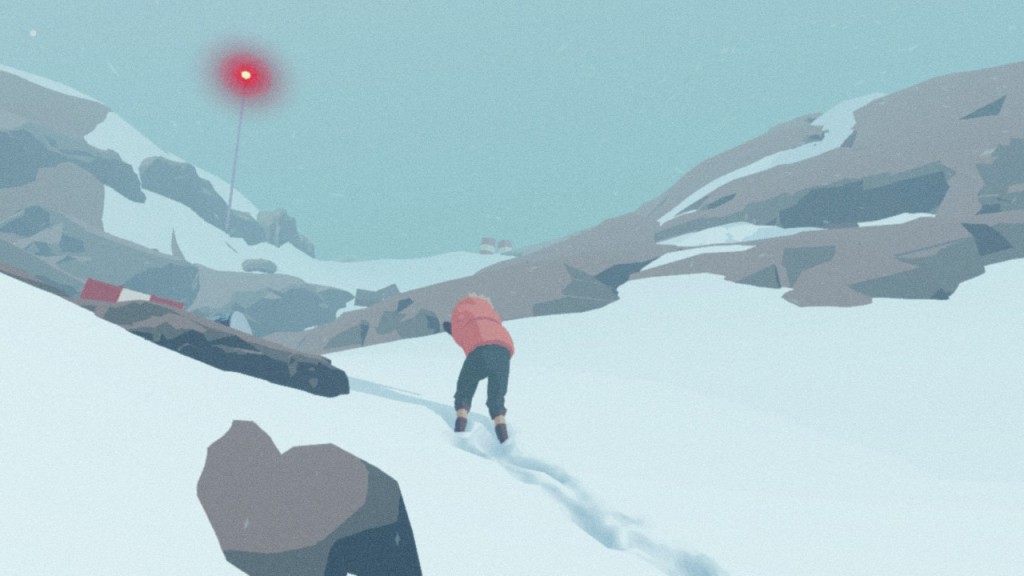
While half the game is set in the English countryside and sunlit offices and streets, the other half is of Peter and his ill-fated research trip to the Antarctic.

Maps, radios, and scientific equipment are all used to great effect in mini-puzzle sequences. (Source: mezha.media)

The game takes a little while before explaining the contrasting locations. It drops little hints and off-hand mentions of geography and weather patterns at the start, only really coming to the forefront once Clara and Peter have settled into their relationship.

The scenery is bleak and other-worldly, yet it works perfectly with the developing romance back in England. It says that even in chaotic and unsettling moments there is always some pin of normalcy, of hope and clearer skies at a later date.

The story in Antartica is as desolate as the landscape around it, with an increasing sense of foreboding and mystery. I won’t spoil it here for the story takes some jaw-dropping twists and turns as Peter stumbles through the tundra.

The snow and cold starts to affect Peter, blurring the line between memory and locations, with conversations, atmosphere, and even set design switching from Cambridge to Antartica.

It’s interesting visually if a little jarring the first time; editing cuts like this haven’t really been done before (lest people think their game is lagging for the quick cuts).

It keeps Clara in the forefront of the mind, this warm presence that may be lost to Peter, but he is fighting to find her.

There is no camera movement in SotC, but there is always something on the horizon to guide you forward. (Source: polygamer.com)

The story is very structured with only little spaces for Telltale-style branching, which can lead players to feel frustrated any the lack of choice, but that is the central point of the story, that memory can be influenced by emotion, but can’t change what happened.

Peter is in the Antarctic no matter what; that is the present and everything else is in the past. Events and choices start to contradict, yet Peter is always seen as the sympathetic one and Clara starts to over-react.

While Peter is the protagonist, we as players have to come to the realisation that he isn’t presenting us with the whole truth. It reaches an apex as Peter sets off for the Antarctic, with the player’s feeble attempts to change what happened, but for Peter mentally torturing himself by the final moments.

It’s a devastating ending to come to, that all choices lead to the same conclusion for our protagonist, and it’s only how he chooses to remember himself (and how we as players guided him) that gives him comfort.

It’s a hearty mix of mature themes and aching loneliness and despite the short run time (an average of three hours), I highly recommend it as a great interactive story.

Banner Photo Source: nintendo.de