Alba: A Wildlife Adventure and Childhood Fun

I was thinking back on an article I wrote a few years back about noticeably older playable characters in games and a thought occurred to me, “Would I be able to name any child playable characters in games?”

A few examples came to mind quickly such as Link in The Legend of Zelda, Max in Life is Strange and the two siblings in Brothers: A Tale of Two Sons.

An odd one from a few years ago also popped up, 2019’s Call of Duty: Modern Warfare, which had an entire level where players are in the shoes of a child during an invasion. And a short while ago I wrote about the great time I spent with Rockstar’s Bully.

But recently during a game sale I picked up a title that does a great job of recreating childhood, of giving that sense of wonder and exploration that children have.

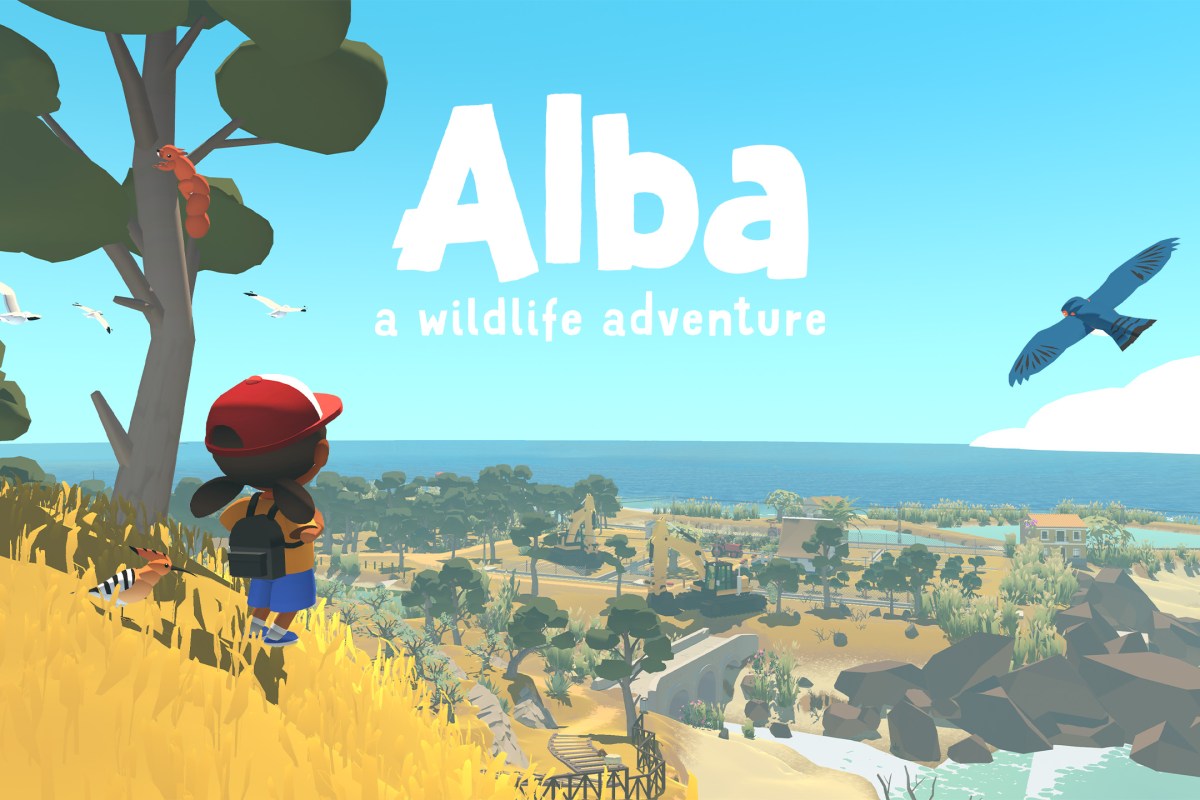
The game is called Alba: A Wildlife Adventure, and is one of the most charming and adorable games I’ve had the pleasure of playing recently, so I wanted to talk about it today to pass on this gem of a title.

State of Play: Alba and the Wonders of Childhood Holidays

Alba follows the titular character of Alba as she visits her grandparents for summer holiday on a Spanish island of Pinar del Mar they have retired to.

Alba’s holiday starts standard enough; eating ice cream and paella, spending time at the beach, and playing with her island friend Ines.

But when it turns out the island mayor is ready to tear down the nearby nature reserve for a luxury hotel baron, Alba and Ines decide to create a nature club and rebuild the reserve, gathering signatures for a petition to stop it.
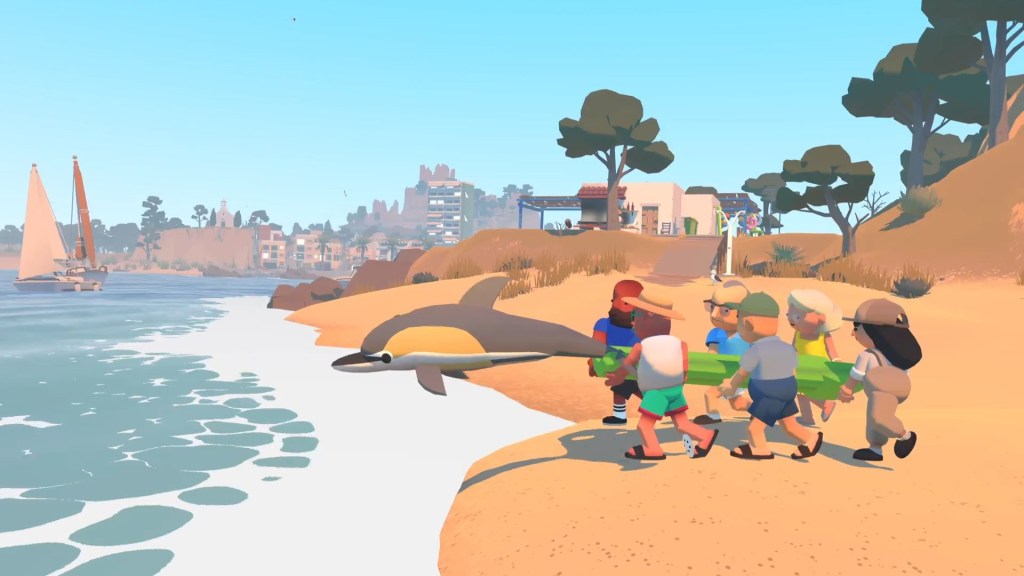
The island of Pinar del Mar gets involved to help Alba and protect the wildlife (Source: psnprofiles.com).

Many other games have child or teen characters in stressful or strange environments, but for Alba it is an environment to learn from, to learn about through exploring, and in general a refreshingly calm and stress-free place, where standing up for your beliefs and challenging authority is a main bedrock of the title.

The main loop of Alba is creating a database of the animals that inhabit the island. Alba is given a nature guide and a phone app by her grandparents to try and catalogue all the animals that live on  Pinar del Mar.

Alba is an open world game, so the main section of playtime is spent researching the animals in the database, learning about their unique markings, habitat, and call, before tip-toeing through the biome and taking a picture of them.

Alba originally standard as an iOS game and I could definitely see the same style working here, popping in for a few minutes every day, wandering around the incredibly detailed world and taking a few picture before heading off again.

It’s a charming little loop that I ended up spending many hours in, just learning about different animals and feverishly trying to fill out the entire book, staying out way beyond the time when Alba’s grandparents texted her to come home just to get that one last animal in a certain biome.
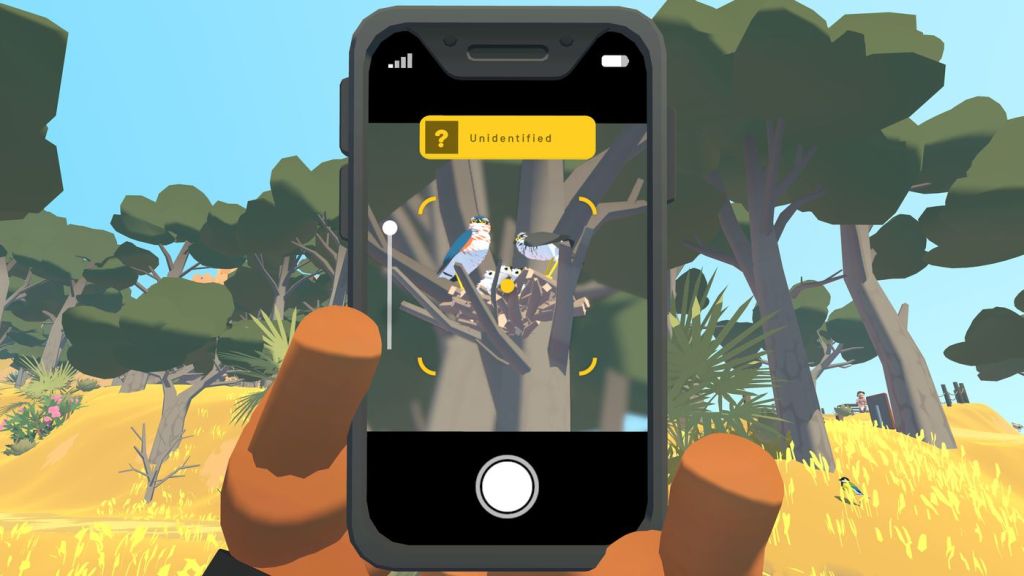
Some animals can be found quite easily, others require knowledge of their habitat and routines. Source: polygon.com

Some of the animals for the book are only spotted in the sky, meaning you have to find the perfect spot to zoom in and out with your camera and get a good chance of catching it as it flies by.

The island of Pilar del Mar is split into eight different biomes; the beach, town, terraces, farmland, forest, marshlands, and the mountain. You would think with such widely diverse locations that Pinar del Mar might feel disjointed but each location flows seamlessly into one another.

Alba has a map that can aid in traversal, but the game’s world is easily navigated just through sight.

Need to go to the mountain? Just look upwards pretty much anywhere in the game. Want to go bird-watching by the beach? Head down the hill and you’ll get there. Buying supplies in the town? You can just see a chimney across the way, maybe the town will be somewhere close by.

It’s always lovely to play an open-world game that can give players a clear HUD, especially after years of experiencing POI to POI marker.
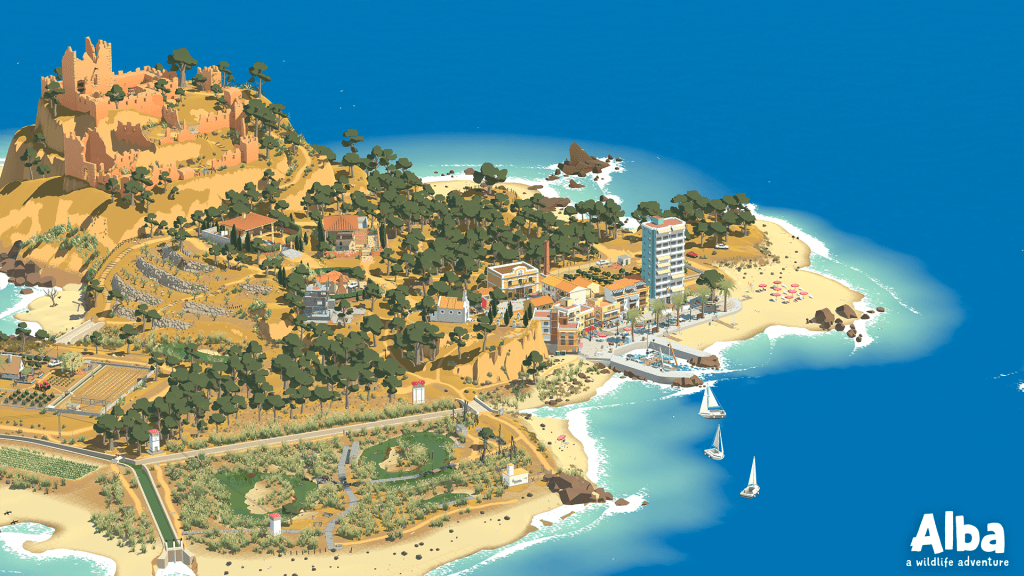
The map of Pinar del Mar with all the different biomes. (Source: medium.com)

For a moment during the opening chapters I thought there might be a speed upgrade, something like Alba getting a bicycle to help make the trek across the island (another hallmark of holidays, bike trips). But nothing like the sort came, and I can see two reasons why.

One, the bird-watching loop. Many a time I would be trekking through the world and see an animal I hadn’t catalogued. It’s a little hard to do that if you’re speeding through the island.

The second reason is such a small one but I was charmed every single time it happened; Alba’s animations. Alba walks and runs normally, but every now and again she’ll change it up. Sometimes she skips, sometimes she runs with her arms out like a plane. These little animations give such detail to Alba and her childhood play, I wish other games would do something similar.

Throughout the game players will journey all across the island and none of it is locked by progression through the game. While some animals will only appear later in the story, the player can easily wander anywhere on the island, cataloguing animals they can see, or interacting with Pinar del Mar and its population.

Talking of the islanders, part of Alba and Ines’ mission is to get fifty signatures from the townsfolk to petition the mayor to stop the hotel build. While some of the signatures come from rebuilding the wildlife reserve the rest need to be collected from the townsfolk, each with their own little stories or dilemmas.

Clara the head of the Wildlife Association, Simón the local vet, María the carpenter, each have tasks like cleaning up the trash left by people, clearing away pesticide spillages, or fixing bird boxes across the island.
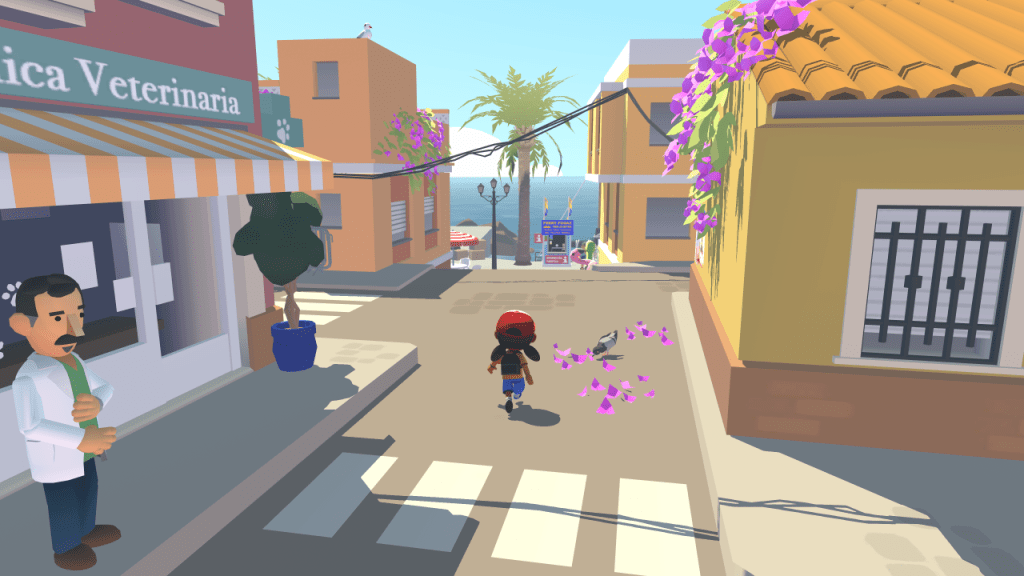
Heading into Town, where most of the island residents can be found (Source: zkm.de).

There are are other characters who are just there by add a little extra charm to the island. Jaineba the ice cream merchant (who gets Alba to test new flavours), Laura the strict and stern police officer, or the two nameless older women who spend their time near the church and talk of their weekly bungee jumping classes.

Every character can be interacted with and will have a few lines of dialogue about them or the day and it gives and extra incentive to explore every nook and cranny of Pinar del Mar. It got to the point where I would interact with my favourite characters each day, despite it never being more than one or two lines, it was a joy to pass by so many recognisable faces.

I also appreciate the diversity of the cast. There are a wide range of skin tones across Pinar del Mar, different languages spoken, some same-sex relationships, and a few visible signs of faith (such as the character Alia, who wears a hijab).

Alba also fits into this diverse cast, with her last name Singh and flying to Spain from the UK, it could be referenced that she is of British, Indian, and Spanish descent. And the game doesn’t highlight any of these points, but just quietly and confidently places the characters into the world.

One of the reasons I was initially drawn to Alba was the apparently short run time. I really like quick and condensed games and according to How Long To Beat the 100% runtime for Alba is around 4 hours. Yet I know I spent far longer in the game.

The satisfying loop of bird-watching, trekking across a beautiful island populated with a fun cast of characters, I whiled away Alba’s days, scouring every biome, sneaking to the perfect picture spot and even returned after the game was done to soak in the atmosphere again.

It’s a charming little game with a strong message about care and conservation, standing up against authority, and that with teamwork anything is possible. If you’re looking for a new game that is a change of pace, for something both calming and enjoyable, and can be enjoyed by all ages, I recommend it wholeheartedly.

Banner Photo Source: store.epicgames.com
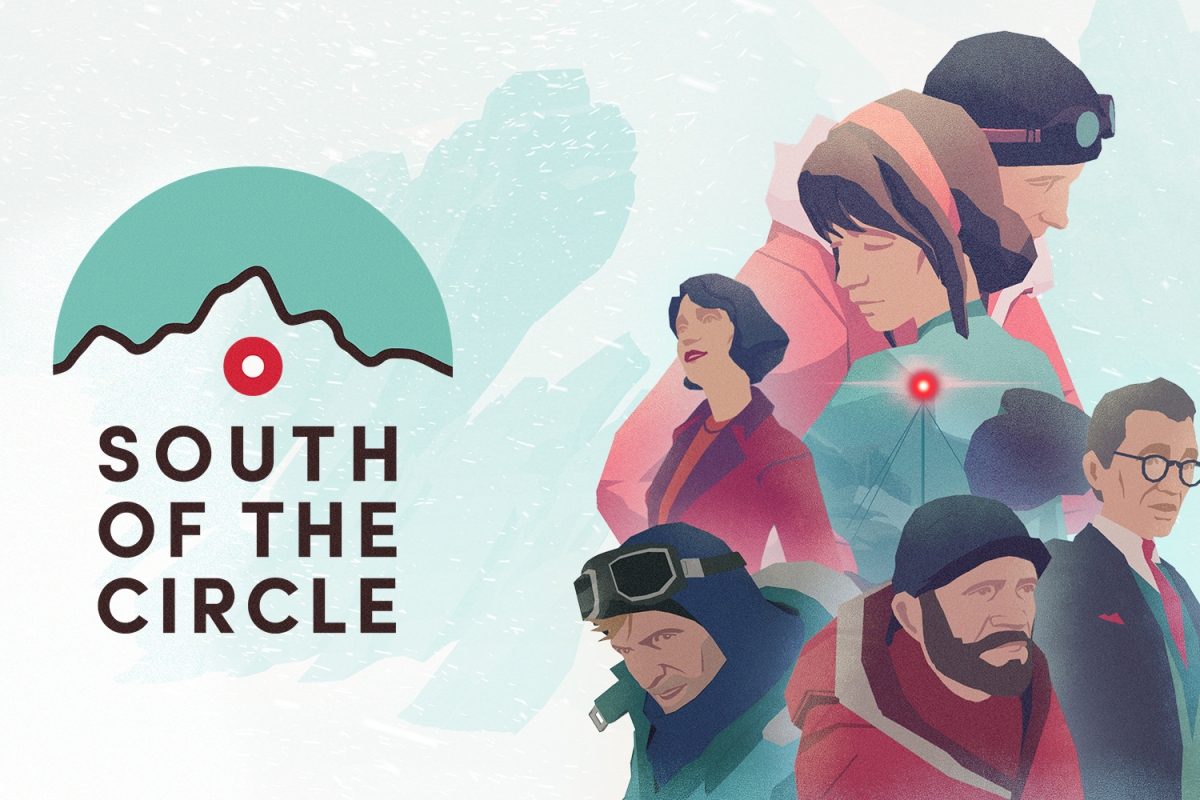
South of the Circle and Love, Memory, and Lost Moments

Romance has become quite the topic in the gaming landscape.

I’m a sucker for a good romance and am always interested in where the game will focus its attention.

While love stories have been a part of the medium forever (one of the most famous cases being “save the princess”), it’s only in recent times that gaming has started to take on some more bigger and mature themes when it comes to romance.

Ideas like teen romance (Life is Strange Season 1), infidelity and commitment (Catherine: Full Body), and reconciliation (It Takes Two). I’ve written about love, death and endings in games like When The Past Was Around.

And it just so happens I’ve played another game recently that tried to tackle deeper themes with love. 

South of the Circle is a narrative game first released for Apple Arcade in 2020, but was released late last year for consoles and PC.

I was immediately struck by its visuals and sound design, but was drawn in by it being labelled as a love story.

South of the Circle takes on the development of a whole relationship, societal pressures and conventions, but its main theme is memory, its failings and faults, and it perfectly works its way into the gameplay.

Best of British Luck – Love, Memory, and Lost Moments in South of the Circle

South of the Circle’s story focuses on two people, Peter and Clara, both lecturers at Cambridge University, how the two meet and fall in love, before a breakdown in communication leads to tragedy.

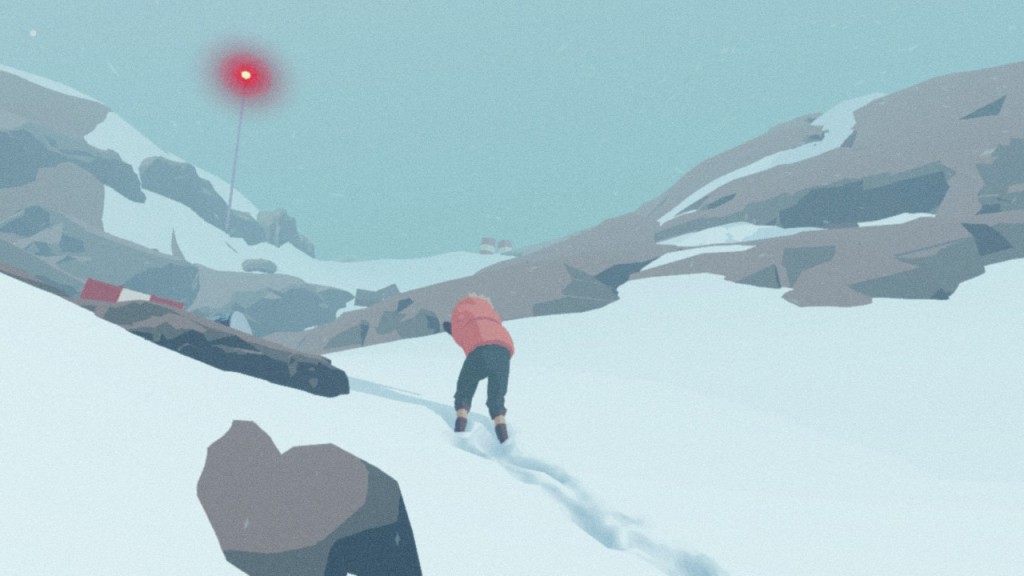
We play Peter throughout his time with Clara, but also during a research trip to Antartica, taking place after the two’s romance. This double story, of Peter searching for rescue at the South Pole and his growing relationship with Clara forms the narrative hook of the story.

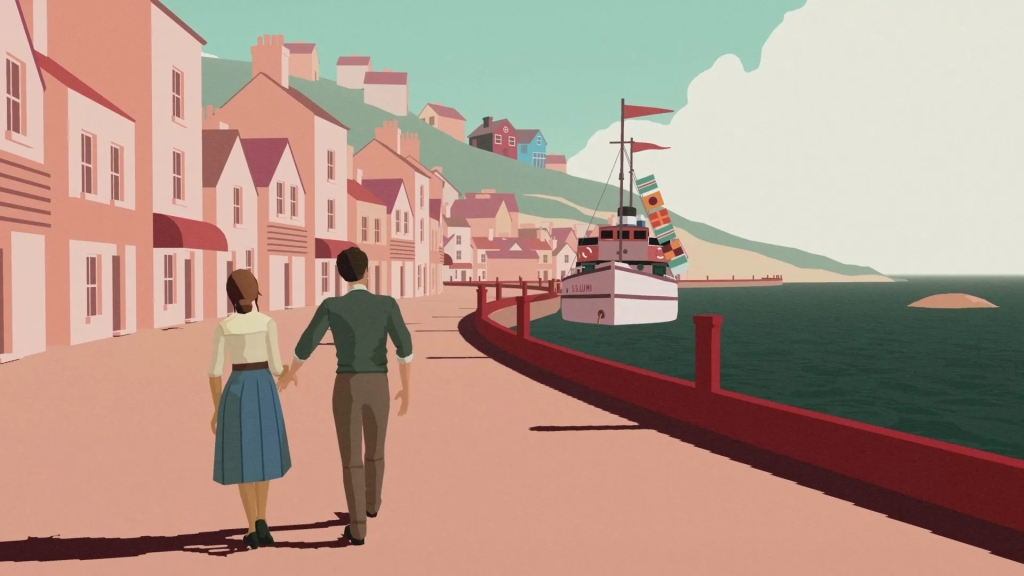
The pair first meet on a train from Scotland down to Cambridge. It’s a perfect romantic introduction; Peter offering to help Clara put her suitcase on the top rack, her offering to share the carriage as everywhere else would be full.

South of the Circle‘s art design is evocative of screen prints from the 1960s, full of clean lines and stark contrasts. (Source: mezha.media)

The main point of interaction in the game is dialogue choices, but instead of seeing a preview of words, you see a shape that gives a general emotion.

A red circle indicates panic, confusion, or concern. A green circle indicates caring and honesty. The black square is for being strong an assertive, a pink circle is negative and shy, and finally a sunshine image is for enthusiasm and interest.

Not all emotions are accessible with each interaction, only three at one time. It’s a great concept for a replaying a past love story, of people thinking back on moments and regretting acting in a certain way, whether shyness or being too forthright, and it’s great to get a general sense of how Peter could have reacted differently.

It’s also interesting that in certain conversations, one of the prompts comes up before the other. For example, when Peter helps Clara with her suitcase, two options come up in response, one being strong and assertive (the “be-a-man” approach) or honesty and openness. For a few seconds, the strong and assertive is the only prompt on screen.

It gives Peter a little bit of depth; so many characters with dialogue choices can change on a player’s whim in a certain situation, leaving their backstory a little vague and blank as to why they are acting in a certain way, but here it gives a small detail as to Peter’s background.

Source: playstationcountry.com

The two keep crossing paths once they arrive in Cambridge. Peter drives Clara to work when she misses catching her bus in the pouring rain, and she sits in on his lecture and asks question about his work. Again, it’s a perfect romantic setting, of two people in their element, thrown together by fate, both seeing sparks fly as they talk.

Chance meetings turn into coffee dates, into a night at a funfair, into seaside holidays, and finally into secret Scottish highland hideaways (with Clara remarking, “I don’t know what my father would say about me bringing an unmarried man up there.”)

It’s a gradual and believable slide into comfort and romance, yet it’s fleeting. It’s tableaus and snapshots, of little inside jokes (the game remembers what choices you’ve made and the characters reference them), the sort of thing someone remembering a relationship would envision.

Happy memories of times gone by. (Source: news.xbox.com)

Alongside the development of Peter and Clara’s relationship, we get further flashbacks into Peter’s life, such as his childhood and him with his fellow researchers.

His childhood doesn’t seem to be filled with fun, with an over-protective mother and a quick-to-anger father. A lot of the prompts in these sections are delayed; we see the prompt appear but it doesn’t become clickable for sometimes five to ten seconds, as if Peter is finding the courage to speak back to his parents. His responses are usually the panicked or negative choices.

With his friends, Peter is still a little shy and reserved, but given a few seconds the “man-up” choice is presented. A lot of the talk with his friends would be regarded as “locker-room talk”, with  the two researchers always hunting for new “conquests” and seeing Clara as, quote, “inspiration” for Peter.

Peter’s childhood and social life is also explored in the game, giving glimpses into other areas of his life. (Source: mezha.media)

And to be fair, they are right with Clara being a muse for Peter. For three years he has been writing a research paper and has been stuck for a long period. But when Clara comes into his life, she reads his work and helps him complete it.

From there, their relationship takes a turn for the worse, as society starts to turn its eye onto the couple.

First, it’s the time period. The game is set in 1964, the height of Soviet paranoia, anti-nuclear marches, and Russian spy rings working inside academia.

Second, the location. It’s only been fifteen years since women were first admitted to Cambridge University, and some of the old guard still believe they are, “not built for academic work”.

It’s both the sexism of the time and guilt by association that causes the breakdown of Peter and Clara, the British “stiff-upper-lip” being the finishing blow, of words left unsaid, and memories now tarnished with emotion.

While half the game is set in the English countryside and sunlit offices and streets, the other half is of Peter and his ill-fated research trip to the Antarctic.

Maps, radios, and scientific equipment are all used to great effect in mini-puzzle sequences. (Source: mezha.media)

The game takes a little while before explaining the contrasting locations. It drops little hints and off-hand mentions of geography and weather patterns at the start, only really coming to the forefront once Clara and Peter have settled into their relationship.

The scenery is bleak and other-worldly, yet it works perfectly with the developing romance back in England. It says that even in chaotic and unsettling moments there is always some pin of normalcy, of hope and clearer skies at a later date.

The story in Antartica is as desolate as the landscape around it, with an increasing sense of foreboding and mystery. I won’t spoil it here for the story takes some jaw-dropping twists and turns as Peter stumbles through the tundra.

The snow and cold starts to affect Peter, blurring the line between memory and locations, with conversations, atmosphere, and even set design switching from Cambridge to Antartica.

It’s interesting visually if a little jarring the first time; editing cuts like this haven’t really been done before (lest people think their game is lagging for the quick cuts).

It keeps Clara in the forefront of the mind, this warm presence that may be lost to Peter, but he is fighting to find her.

There is no camera movement in SotC, but there is always something on the horizon to guide you forward. (Source: polygamer.com)

The story is very structured with only little spaces for Telltale-style branching, which can lead players to feel frustrated any the lack of choice, but that is the central point of the story, that memory can be influenced by emotion, but can’t change what happened.

Peter is in the Antarctic no matter what; that is the present and everything else is in the past. Events and choices start to contradict, yet Peter is always seen as the sympathetic one and Clara starts to over-react.

While Peter is the protagonist, we as players have to come to the realisation that he isn’t presenting us with the whole truth. It reaches an apex as Peter sets off for the Antarctic, with the player’s feeble attempts to change what happened, but for Peter mentally torturing himself by the final moments.

It’s a devastating ending to come to, that all choices lead to the same conclusion for our protagonist, and it’s only how he chooses to remember himself (and how we as players guided him) that gives him comfort.

It’s a hearty mix of mature themes and aching loneliness and despite the short run time (an average of three hours), I highly recommend it as a great interactive story.

Banner Photo Source: nintendo.de