
Despite coming out over fourteen years ago, Mirror’s Edge is still fondly remembered for both its amazing art direction and its superb gameplay.
While the concept of free running had been bubbling up under the surface of popular culture (highlighted in 2006’s Casino Royale, and reaching the gaming sphere in 2007 with Assassin’s Creed), no game had before (and in my opinion, since) made first-person free running a resounding success.
Fondness and fidelity kept it spinning in disc trays and hard drives, with lead character Faith Connors becoming instantly iconic, despite the story being quite sparse.
Eight years after the original, a sequel/reboot, Mirror’s Edge: Catalyst, was released. Keeping Faith and the “City of Glass”, it expanded upon the world and backstories of the characters, while maintaining focus on free running across the rooftops of a near-future city.
It’s one of these new characters I wanted to focus in on, one that got very little in terms of story and screen time, yet has left a lasting impression on me, all due to their interaction with Faith.
While never explicitly said in the games, many fans of the games have questioned Faith’s sexuality. Some claim she is gay, some say asexual, and others say she’s straight, all with their various evidence for their opinion.
While I could be swayed in any which way, there is this one character, one interaction of less than a minute and a half, that pushes me toward one direction. I like this scene, for all its coded phrases and hints, and that’s why I wanted to analyse it.
So, let me introduce you to Beatrix Bloch.
Exit Strategy – Faith, Beatrix Bloch, and Queer Coding
Beatrix Bloch’s entrance to the story is quite abrupt.
Catalyst has various side missions for the players to complete, mostly given by characters Faith has already interacted with, like free running mentor Birdman or whiz-kid hacker Plastic.
This is also how Beatrix Bloch enters the story, but not connected to any other character or mission; she calls out to Faith directly.
This is interesting for two reasons. First, Faith is quite a solitary character. She has rivalries and a few friends, but no one really close. Even Plastic, who Faith puts her…well, faith in several times during the game, they aren’t the best of friends.
Second, Faith is part of the underground resistance, whereas Beatrix is part of the hiCaste; the ruling elite of the city, putting these two characters at opposite ends of both the social and economical spectrum.
So for this woman to be able to call up Faith especially and exposing herself to an illegal underground network and banishment from the elite, she must be quite the character.
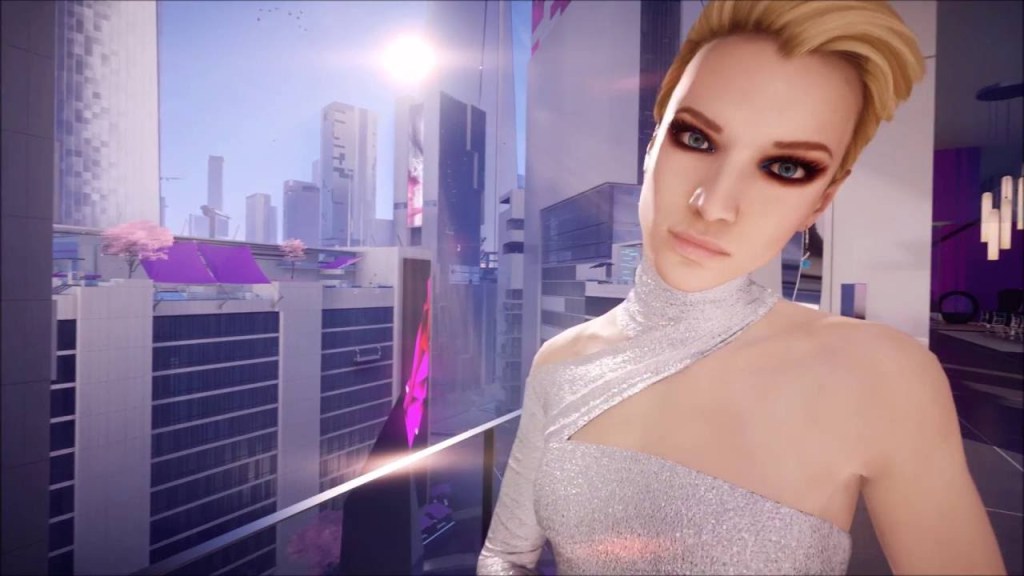
Upon reaching Beatrix’s apartment in the more affluent part of the city, a pop-up appears, giving players a little more backstory into Beatrix and Faith’s friendship. The transcript reads as follows;
“You met BEATRIX BLOCH briefly shortly before your capture two years ago and the two of you had a short, but honest conversation. She might be HICASTE, but there is something you can relate into in her. Now she needs your help with something, thought whatever a woman like her might need help with is beyond you.”
This prior meeting takes place in the associated comic book, where the two women met in a nightclub, and Beatrix told Faith how she was envious of the runners’ freedom, and wishing she didn’t have to follow the rules dictated by her caste, even who she wanted to marry. She even says she would trade places with Faith in an instant.
However, even though there is a lot to unpack there, I’m deciding to focus on the game, so we can discard the comic story from the discussion.
Even without the prior knowledge of the comic interaction, the mission’s briefing asks several questions.
How did these two characters, of completely different social standings, come together? What does Faith relate to in her, something that she sees reflected? How are they on first name terms after one meeting two years ago?
It speaks to something hidden; this is a society based around surveillance and security, yet these two made a connection that transcends that perceived threat, something that bonds them together on a more emotional level, something that Beatrix would risk to contact Faith, and Faith would risk capture to answer.

The mission starts with Faith calling out to Beatrix. Beatrix is standing on her balcony, looking out over the city. It could be a peaceful moment, a place of tranquility, watching the hustle and bustle from on high.
Faith’s first comment; “I honestly never expected to see you again.”
It’s a small line and one that can be imbued with so much meaning. It’s to the point, no false niceties or societal “how-do-you-do’s”, but straight towards the sentimental quality we all have within us.
It’s something that only people with an intense connection could make, not something you say to someone you met for less than five minutes in a night club…not matter how honest the conversation was.
Faith’s delivery also has subtleties to give meaning. Throughout the rest of the game Faith speaks with a strong tone. Even in moments of great anger or sadness, she delivers she lines with stoicism and usually a commanding presence.
Here with Beatrix, Faith’s line delivery is notably softer, with even a slight quaver at the beginning of the sentence, as if daring herself to continue.
Beatrix’s responds with a reminder of when the two spoke last time, even asking what happened to Faith after their meeting (Faith went to prison for two years). Again, asking someone who you barely know about why they haven’t kept in contact is deeply personal and can be imbued with all sorts of meaning.

After a few more pleasantries between the two, Faith asks what made Beatrix reach out to her.
Beatrix drops a big bombshell, she’s recently gotten married, although within the same sentence defines it as a “corporate union”. Faith asks if she had any say with the marriage, Beatrix dismisses it as a “board decision”.
Despite being an heiress to a major logistical firm, Beatrix is still having to be ‘sold off’ to a man, one who is in an even higher social circle than her. She is not allowed to strike out on her own, but instead reduced to a gilded cage.
And the ones making that decision; old-money elders who are in charge of the City of Glass, i.e. those who don’t want any change to the status quo, like say, someone have a non-normative (aka, non-heterosexual) relationship and denying the creation of heirs to the corporations (since the hiCaste would not use surrogates, wanting to keep bloodlines ‘pure’).

Faith is outraged at the notion of marriage solely as a corporate decision, but Beatrix seems resigned to the fact, saying it’s now her “reality” and that she is, “…OK with it, duty and all…”
The mention of “duty” is an interesting one, not something one who is her own heiress would say, reinforcing the fact that it is other forces that are bringing this marriage together.
But “duty” doesn’t correlate with societal demands, it recalls more familial pressure. I can almost picture the scene, of Beatrix’s family explaining that she needs to carry on the Bloch legacy.
While it’s not mentioned in the game, it can be inferred that women, like everything else in the City of Glass, are treated like property, and by the fact Beatrix and her husband are part of the hiCaste system, that only pure offspring between the two would be heirs to their respective empire.
So Beatrix resigns herself to be married to a man, one who has the exact same level of apathy toward the marriage as she, reduced to providing the next generation of hiCaste people.
As the conversation between Faith and Beatrix continues, Beatrix reveals her new husband is violent, liking to “…argue with his fists.” Faith offers to break his wrists. Beatrix says it’s tempting, a slight smile on her face, but declines.

Beatrix cannot simply annul the marriage though, she needs something stronger to present the board of directors, and she thinks she has a lead.
Beatrix knows her husband is sleeping with another woman, and so needs recordings of the two secretly meeting. This is where Faith comes in.
Beatrix presents a few listening devices and Faith immediately pockets them, saying she’ll help Beatrix. Again, a single five minute conversation, between a runner and a hiCaste, and Faith is willing to jump in without any hesitation…
As a final note before Faith heads out, Beatrix lightly touches Faith’s arm while thanking her. Throughout the game Faith talks with several characters, and only a few does she let touch her.
She visibly steps back when she reunites with Runner leader Noah (the two later hug). Later when Noah dies, Faith doesn’t hold Noah’s corpse or be close to him, only touching his arm and chest to try and wake him up.
In other scenes, Faith only lightly taps Birdman on the shoulder when he gives her his first dash, and she completely blanks Icarus when he offers his hand later in the game.
So it means something when Faith allows someone to touch her, and means an extra note that it is soft, not a steady handshake of a corporate board member, or a shoulder bump of a runner, it’s more intimate than that.
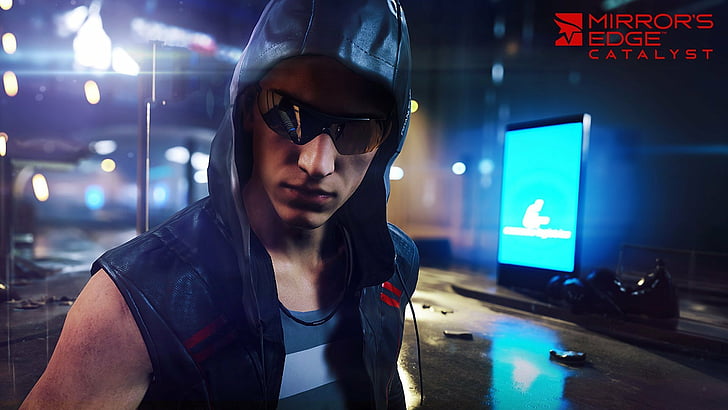
After Faith leaves the level proceeds, with Beatrix giving directions to the places for the listening devices and Plastic hijacking the call to inform Faith of the increased security presence. Once Faith has placed all the bugs she hopes Beatrix gets what she needs and Beatrix responds with thanks.
And that’s it. No final note in a later level, no other radio transmission letting us know whether Beatrix was successful and what she plans to do after getting her divorce.
Conclusion
I find it both odd and amusing that this conversation and this character have stuck with me for so long.
I’ve been trying to understand why and I think it comes down to the light touch of it all. In the end, Faith (and Beatrix) don’t need to be identified as gay by the creators and it doesn’t really matter if they are. This entire dissection is purely speculation.
But in that speculation is a kernel of…something. LGBT characters and themes have reached wide prominence in the AAA sphere, and speculation of characters’ sexuality runs through nearly every genre, from Leon Kennedy in Resident Evil 4, to Rhys Strongfork in Borderlands 3, and Lara Croft in the most recent Tomb Raider reboot trilogy.
I feel Mirror’s Edge: Catalyst plays it delicately; it can be inferred and isn’t queer baiting with “almosts” and “what-ifs”, but if someone wanted to pick up on the threads, it can be seen.
In comparison to a character sexuality being directly stated in-game or other media (which has its place and I wholeheartedly support), here the light touch allows the right amount of colour and shade into Faith and Beatrix’s lives.
It makes space for other games to make off-hand comments about same-sex partners and coded references to non-heteronormative relationships (in itself a step towards normalisation) while not overshadowing the game or the mission with a heavy-handed “this character is gay” statement.
So while I can totally understand fans of Mirror’s Edge to go either way on this subject, I will hold up the coding and subtle references between Faith and Beatrix to be a strong standard for threading LGBT themes into characters and games and I would be interested in seeing more.
Banner Photo Source: wallpapercrafter.com





 TOM CLEMENT | GAME PRODUCER | NARRATIVE DESIGNER